14 Jul 2018

14 Jul 18 - A Local Hairstreak

For the last few years I've planned to look for a local speciality: White-letter Hairstreak. Numbers of this easily overlooked Butterfly crashed in the 1970s & early 1980s when Dutch Elm disease swept through the UK & wiped out most of the UK's Elm trees within a decade. I've been aware of a local site for a few years, but I have never managed to find a combination of suitable weather & my availability at weekends within the flying period. My friend who discovered this site has generally only seen them flying high around the Elms & has only seen one low down nectaring, so this has been another factor in the priority to have a look. Having been unable to get out for the last few days to the site, this morning was another hot, still day & so I suggested to mate, Peter Moore that we gave it a look. Peter picked me up late morning & a few minutes later we were leaving the parked car. There was a bit of a hike along footpaths before getting to the actual site. Once there we spread out to check a large patch of Thistles where they had been seen before. No joy in the patch of Thistles I started checking, but a whistle from Peter suggested a more positive outcome where he was. I swiftly walked over, but I didn't really need to hurry as it was still nectaring when we left about an hour later. Given there are well known sites in Dorset, this site will remain as a vague Swanage site, although Peter & I will forward details of the sighting to the county recorder. Having had problems with collectors at Map Butterflies site, then I won't be broadcasting specific, but not well known, sites of other locally rare Butterflies.
White-letter Hairstreak: Initial views
White-letter Hairstreak: Good mystery photo
White-letter Hairstreak
White-letter Hairstreak: It spent a fair bit of time upside down to frustrate the photographers. It worked as I went looking for another, but failed to find one
White-letter Hairstreak
White-letter Hairstreak: I'm assuming with this body shape that this is a female
There was a good selection of other Butterflies present. In total I saw thirteen species there. A Holly Blue in my garden was a fourteenth species for the day.
Small Copper
Brown Argus
Peacock
Painted Lady: It was good to see such a pristine individual
Silver-washed Fritillary
One of the problems I though of as I was walking to the site was how to identify an Elm tree. Given their relatively scarcity then it was a tree I wasn't familiar with. Fortunately, Peter knew. He said they had a distinctive asynchronous leaf shape.
The distinctive asynchronous Elm Leaf shape
Not bad for an hour of looking for local Butterflies.

13 Jul 2018

13 Jul 18 - The Next Generation

One of the other great things about Middlebere is the resident mammals are aware that they are relatively safe around the hides & farm and consequently, they are happy to pose for photos.
Sika Deer: This youngster followed mum up to the barbed wire fence, which mum easily jumped, but was too high for the nipper
Sika Deer were introduced from Japan to Brownsea at the end of the 19th Century. They are well suited to Poole Harbour as they are competent swimmers & crossing from Brownsea to the mainland wasn't a problem. They quickly spread out into Poole Harbour & the surrounding forests. They are quite at home in the Purbeck grasslands, woodlands, marshes & heathland. Over the last two decades of living in Dorset, I've seen them continue to spread out from Poole Harbour. A few years ago, I heard a radio program focusing on Sika Deer in the Purbeck area. That said the population was around 4000. To keep the population at this number, about a 1000 a year were being culled. While I really enjoy seeing them in the area, I can't help thinking that this culling program should be increased to significantly reduce the Sika Deer population in the area.
Sika Deer: After sizing the fence up, the nipper decided to just walk around it close to the water's edge
Culling the Sika Deer numbers would help to re-establish the undergrowth that Sika Deer are incredibly good at removing. Perhaps this would allow some of our migrant Warblers like Willow Warblers & Chiffchaffs to improve their numbers in the Purbeck area. Talking to ex-local Steve Morrison, there used to be around a 100 pairs of breeding Willow Warblers at Studland in the 1970s. These day's there are probably only 10-20 pairs. The decline of Willow Warblers in the South of the UK will be down to a number of factors, however, loss of ground cover for nesting in the Purbeck area will be one of those factors. Apparently, Sika Deer have been good at opening up paths within the marshes which have benefited the local Water Rail population. I wouldn't support a complete elimination, but removing half or more of the Sika Deer population, along with a study of the impacts & benefits would be good.
Sika Deer
Another local resident at Middlebere are the Foxes. There are one or two that I sometimes see close to the main hide & which are happy to pose for photos. However, I've not managed to photograph any of the really young cubs in the past. So was happy when this Fox cub decided to rectify that situation.
Fox cub: Initially, it wasn't sure about me
Fox cub: But it quickly realised I wasn't a threat
Fox cub: Like all nippers, it quickly got impatience to explore further & was off soon after this photo

12 Jul 2018

12 Jul 18 - Ospreys Doing What They Do Best

To escape the tedium of the World Cup blocking out the TV channels, I made a number of evening visits to the Middlebere local patch. The combination of a rising evening tide, the long warm evenings, the start of the Wader migration & hopefully people staying indoors to watch the footie meant I couldn't resist a few recent visits to Middlebere. They have been good visits with generally one or two Spoonbills present, a Great White Egret (that I found on 24 Jun 18) flying over to roost every visit & a few Waders.
The Great White Egret: It gives distant views as it flies over high on the way to its roost in the failing light (11 Jul 18)
As I arrived this evening, I was disappointed that there were few Waders left on the last patch of exposed mud. I looked up & the culprit was immediately obvious.
This circling Osprey was flying over the top of the creek: It eventually spooked all the Waders
Osprey: It was a tatty looking individual
Generally, the adult Ospreys on view from Middlebere in the Autumn & sometimes the Spring are quickly able to grab a fish & head off to enjoy it. On one occasion a few Autumns ago, I saw a perched Osprey drop a fish, fly down channel & within about ten minutes return with another fish. I guess one of the local Foxes might have had Fish that evening. However, this Osprey was having a much harder time. In twenty minutes, it dived four times, hit the water on three of these occasions & failed each time. Finally, it landed on the Osprey post for a long rest. It disappeared down channel close to dusk & looked like it was still hunting. This is the first time, I've seen Ospreys feeding so close to the Middlebere hide. Enjoy the photos.
Osprey: The first dive
Osprey
Osprey
Osprey
Osprey: Close crop of the last photo confirming this individual is unringed. Currently, there is a second Osprey with a red ring in the area
The second dive.
Osprey
Osprey
Osprey
Osprey
Osprey
Osprey
Osprey
Osprey
Osprey
Osprey
Osprey
Osprey
Osprey
Osprey
Osprey
Osprey
Osprey
Osprey
Osprey
Osprey
For those of you wondering about the score that evening: it was Osprey 1 Footie 0. A total victory for Osprey. The Osprey showed more typically the following evening: it sat around on its pole & in two hours it managed to turn around once so it was no longer facing the hide. Just like most of the footie fans that week: couch potato.

11 Jul 2018

11 Jul 18 - Ageing The Middlebere Spoonbills

Question which to watch? World Cup England verses Croatia or Middlebere. Answer: Middlebere. There was a selection of recently arrived Waders and a few breeding Shelduck showing off their surviving chicks. But the stars of the show were the two Spoonbills.
Spoonbill: A fairly typical early evening view of some sleeping Spoonbills (just how I remember my first ever Spoonbills at Minsmere in the late 70s)
Spoonbill: 1st Summer. The right hand individual which I think is the Spoonbill I saw & photographed here on 24 Jun 18. This individual has no crest
Spoonbill: 2nd Summer. The left hand individual which has a short crest. This is a newly arrived individual
Spoonbill: They finally woke up & started a bit of grooming
Spoonbill: 2nd Summer. A stretch of the wings followed
Spoonbill
Spoonbill: 1st Summer. The left hand original individual looks like a 1st Summer
Spoonbill: 2nd Summer. The newly in (crested) individual looks like a 2nd Summer. This is the individual showing a short crest & less extensive yellow on the spoon
Spoonbill: 1st Summer. The original individual has a more extensive yellow patch on the spoon
Spoonbill: 2nd Summer. The new individual. It is being photobombed by a few Black-tailed Godwits
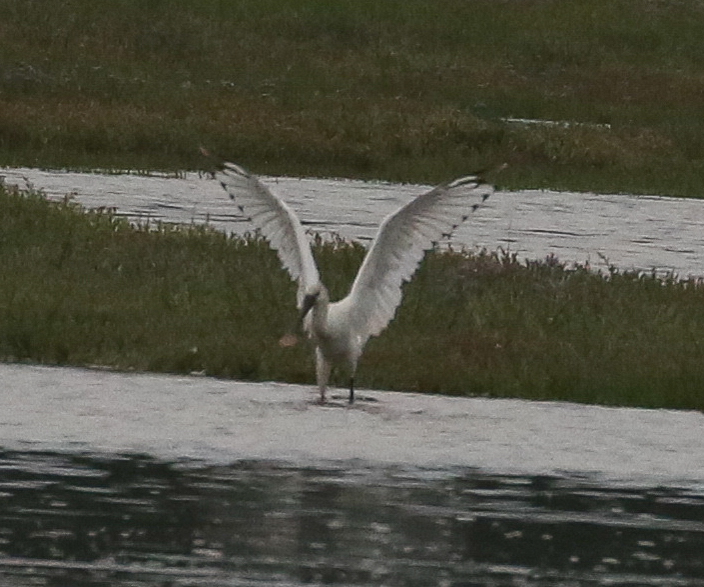
Spoonbill: (12 Jul 18)
Spoonbill: 1st Summer. A final wave from the original Spoonbill (12 Jul 18)
Spoonbill: 1st Summer. Only the original Spoonbill was present on 13 Jul 18. There was a Spoonbill at Lytchett Bay so presumably that's the 2nd Summer individual
Spoonbill: Tradition demands a final sunset picture (occasionally)