
I wonder how many Birders living in the Western Palearctic don't have a soft spot for the Wheatear group. Living in Dorset, we only really see Wheatears as migrants with the very occasional bird hanging onto into the Summer suggesting they might occasionally breed. But I like seeing them as it means that when I see them, there will also be other migrants on the move. Also all the Wheatear species are great characters. The only regular species we get in the UK is the Wheatear (I don't do the trendy name of Northern Wheatear), with another 5 species having appeared once or more as vagrants. They are White-crowned Black Wheatear, Pied Wheatear, Black-eared Wheatear, Desert Wheatear & Isabelline Wheatear. Fortunately, I've managed to see them all over the years, including the only record of White-crowned Black Wheatear: which I suspect will remain high up on the wanted list of many twitchers who weren't twitching in the early 80s for many years to come.
I have been lucky this year to see a number of different Palearctic Wheatear species in Gujarat & Rajasthan parts of India, Morocco & the Western Sahara, Israel & Croatia. They have all appeared on this blog in various posts (or are new Croatian photos), but I thought I would bring them all together in one post, as I'm sure I won't be the only person who thinks the Wheatear group are great. So sit back & enjoy. The backgrounds are all bright & sunny, which goes with the current UK weather. Ironic as when I started writing this post it was bright & sunny and as I come back to put the finishing touches to it, I can hear the rumble of thunder.


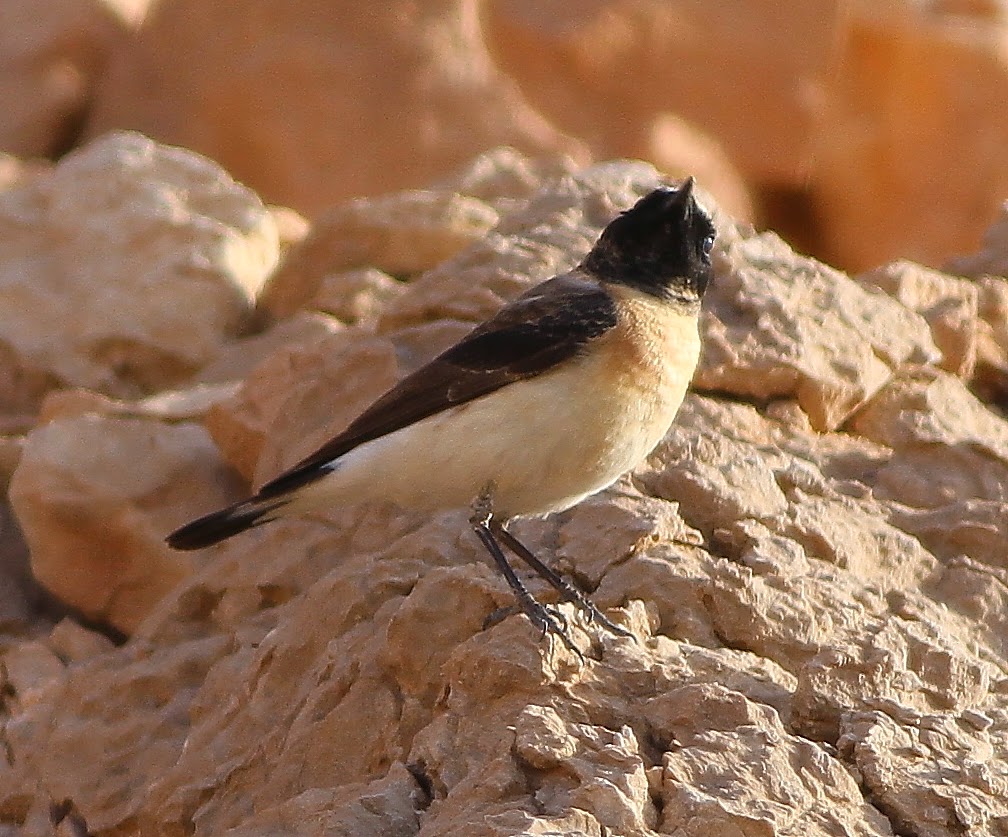


I have been lucky this year to see a number of different Palearctic Wheatear species in Gujarat & Rajasthan parts of India, Morocco & the Western Sahara, Israel & Croatia. They have all appeared on this blog in various posts (or are new Croatian photos), but I thought I would bring them all together in one post, as I'm sure I won't be the only person who thinks the Wheatear group are great. So sit back & enjoy. The backgrounds are all bright & sunny, which goes with the current UK weather. Ironic as when I started writing this post it was bright & sunny and as I come back to put the finishing touches to it, I can hear the rumble of thunder.
White-crowned Black Wheatear: Adult. Eilat Mountains, Israel (10 April 14). This photo had the approval of the local Israel army checkpoint guys
White-crowned Black Wheatear: 1st Winter bird. Aoussard Road, Western Sahara (8 Feb 14). The black crown with a single white crown feather indicated this was an immature bird. The tail pattern was checked & found that the black was primarily on the black central tail feathers & did not have the strong T shape (that the Black Wheatears have)
Black Wheatear: Dakhla Bay, Western Sahara (11 Feb 14). The brown plumage & broad T shaped tail pattern, confirmed the identification
Wheatear: Aoussard Road, Western Sahara (12 Feb 14). A nice bright male showing off its tail pattern

Wheatear: Ne'ot Smadar, Israel (12 April 14). Female
Wheatear: California Farm, Swanage, Dorset (2 May 14). Guess I had better sneak in a shot from the UK
Eastern Pied Wheatear: Desert Coursers, Gujarat, India (15 Jan 14). Also known as Variable Wheatear as there are 3 distinct colour forms across its range. This is the picata form
Eastern Pied Wheatear: Desert Coursers, Gujarat, India (16 Jan 14). This is the picata form
 Eastern Pied Wheatear: CEDO, Gujarat, India (20 Jan 14). Male of the picata form transforming into adult plumage
Eastern Pied Wheatear: Tal Chappar, Rajasthan, India (25 Jan 14). This is the opistholeuca form & would normally winter in Northern Pakistan, rather than Gujarat
Red-rumped Wheatear: Male. Tan-Tan, Morocco (6 Feb 14). This is the moesta subspecies which occurs from Western Sahara to Egypt
Red-rumped Wheatear: Female. Tan-Tan, Morocco (6 Feb 14)
Black-eared Wheatear: Beit Yatir, Israel (8 April 14). Male. Eastern melanoleuca subspecies
Black-eared Wheatear: Male. Amran Pillars, Israel (10 April 14). Eastern melanoleuca subspecies
 Black-eared Wheatear: Male. Velji Do, Croatia (5 May 14). Eastern melanoleuca subspecies
 Black-eared Wheatear: Female. Velji Do, Croatia (5 May 14). Eastern melanoleuca subspecies
Persian Red-tailed Wheatear: CEDO, Gujarat, India (20 Jan 14). This is the Red-tailed chrysopygia subspecies. Note, the pale grey upperparts & slim, weak build for a Wheatear. This bird was wintering on a small Kopje (a small stony hill on the sandy plain)
Persian Red-tailed Wheatear: CEDO, Gujarat, India (20 Jan 14). It occurs from Transcaucasia to Afghanistan & winters in Pakistan & NW India. This is the Eastern of the two species (the Western xanthoprymna species being the one that occurs in Turkey and is now split as the monotypic Kurdish Wheatear
Desert Wheatear: Desert Coursers, Gujarat, India (16 Jan 14). This is the atrogularis subspecies (which is combined with the nominate deserti by some authors)
Desert Wheatear: CEDO, Gujarat, India (20 Jan 14). This is the atrogularis subspecies
Desert Wheatear: Aoussard Road, Western Sahara (8 Feb 14). This is the homochroa subspecies which occurs from Western Sahara to Egypt
Isabelline Wheatear: Tal Chappar, Rajasthan, India (24 Jan 14). Note, the upright stance & heavy bill
Isabelline Wheatear: Tal Chappar, Rajasthan, India (25 Jan 14). Note the black tail, uniform pale upperparts, black alula, and heavy bill & head
Unfortunately, there are a few gaps here. I did see a Hooded Wheatear, but right next to the Israeli-Egyptian border & an Isreali road checkpoint. The army guys on the checkpoint weren't worried about us being there, but were insistent no cameras were used along the border. They did check my camera earlier that day, but fortunately, they were happy with the White-crowned Black Wheatear (above) & didn't look further. As for the other gaps, hopefully I will get to fill some of those in the next few years & maybe give me the opportunity to republish this post.


