Showing posts with label Pale Flycatcher. Show all posts

1 Jul 2023

1 Jul 23 - Angola - A Bonus Endemic

It was another early start, but at least it was only a twenty minute drive back to a spot on the Tundavala Escarpment that we had scouted the previous afternoon. As we entered the rocky area at the top of the road, we flushed a couple of Freckled Nightjars from the road. Fortunately, they landed again & they provided me with a bonus pre-dawn Tick. This area had long parts of the escarpment that was heading away from us on the left and the right. The key endemic we were looking for was Swierstra's Francolin. They call in the first few hours of light & we were expecting that they would call from a prominent position to allow their call to carry from the escarpment edge.
The Tundavala Escarpment: There are some stunning views from the edge of the escarpment
After about thirty minutes of searching, a Swierstra's Francolin started calling from part of the escarpment that was heading away to our left. It sounded like it was about a half mile from us, but there was a lot of the cliff and at varying elevations to scan and it wasn't possible to figure out exactly where it was calling from. Swierstra's Francolins are the most difficult of the Angolan endemics to see. Most trips only hear them or if they are really lucky, they get a brief flight after flushing one: so I wasn't optimistic. Still there were worse places to sit in Angola & scan for a Tick, whilst supping on an early morning coffee, especially as it was warmer than we were expecting.
Another view from the Tundavala Escarpment
We spent a couple of hours scanning up and down and from near to far along the escarpment cliffs. Finally, after a couple of hours of looking, Niall shouted that he could see a Swierstra's Francolin. We were spread out & looking from various viewpoints. There was a quick scramble to get to where Niall was sitting, but quickly we had all enjoyed prolonged scope views. Niall was happy as it was one of the few Ticks for him: as he hadn't connected on previous trips. It was a calling from a prominent position that was maybe six hundred metres away and lower down the escarpment than our position. The photos aren't brilliant, but given most Birders fail to see Swierstra's Francolin, it was an achievement to get them.
Swierstra's Francolin: This is a West Angolan endemic
I hadn't taken my scope on this trip and I was using the camera to photograph distant objects of interest to zoom into to check they weren't a calling Swierstra's Francolin. When I sorted my photos in the UK, I found a photo I had taken of the rock it was calling from, well before it was found. But it wasn't on there at the time. It appears that some of the time it was calling from rocks that weren't in our view, before finally moving to a rock we could see.
The Swierstra's Francolin was calling from a prominent rock on this escarpment
After twenty minutes of watching it, I saw it walk off its rock & disappear back into the vegetation. This was the sign we could go back to the 4WD & have our field breakfast.
Buffy Pipit: This is the neumanni subspecies which breeds on the Angolan plateau and disperses to Namibia & Botswana
After breakfast, we drove down a couple of miles to an area of forest with barbeque grills set up.
Pied Crow: This monotypic species occurs in Sub-Saharan Africa, Madagascar, Aldabra & the Comoro Islands
Part of the forest with the barbeque grills: Initially, the attendants didn't want us to enter. But it was a language problem and we didn't appreciate there was an entrance fee. Once the one US dollar fee per person was paid, we were OK to enter
The barbeque area: This was a mixture of tables, surrounded by areas of flowering plants, dry bush areas, as well as, some bigger fruiting trees around a small stream
Black-collared Barbet: This is the bocagei subspecies which occurs from South Angola to North Namibia, North Botswana, South Zambia & West Zimbabwe
Cape Crombec: This is the flecki subspecies which occurs from South Angola to East Namibia, East Botswana, South West Zambia & West Zimbabwe
Variable Sunbird: This is the falkensteini subspecies which occurs from Gabon to North Angola, the East of the Democratic Republic of the Congo, Kenya, Tanzania, Zambia & Zimbabwe
Variable Sunbird: This was the commonest Sunbird we saw at Tundavala
Variable Sunbird: The same individual
We saw plenty of Variable Sunbirds at Tundavala. But the species we were looking for was an adult Oustalet's Sunbird. Finally, we found one in the barbeque park. We had seen a number of out of plumage immature Sunbirds and seeing the adult Oustalet's Sunbird confirmed my suspicions that the immatures were all Variable Sunbirds.
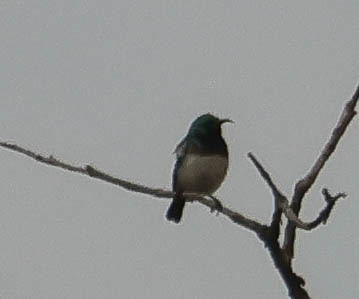
Oustalet's Sunbird: This is the nominate oustaleti subspecies which occurs in Central & South Angola. A second subspecies occurs from North East Zambia to Malawi & extreme South West Tanzania
Angolan Agama sp.: This appears to be an Agama & is perhaps an immature male Namib Rock Agama which have a brick red head and blue body
Angolan Agama sp.: Another photo of the same individual
Congo Rope Squirrel: They were easily seen in the barbeque area
We had spent a couple of hours of the morning unsuccessfully looking for the last Angolan endemic, Angola Slaty-flycatcher. We decided to try another Birding site below the escarpment in the afternoon & to leave Angola Slaty-flycatcher for a final look on the last day.

30 Jun 2023

30 Jun 23 - Angola - It's Time For A Chat

It was another day with a long two hundred & fifty mile drive from Huambo to Lubango. We left at dawn and stopped after a couple of hours for an en-route breakfast break. It was a largely uneventful six hours drive that wasn't helped by a long stretch of dirt tracks around many miles of tarmac road that was closed off: presumably for resurfacing although it looked like no work was taking place on the road. The only highlight of the drive was a pair of Lanner Falcons.
Lanner Falcon: This is the nominate biarmicus subspecies which occurs from Angola & the South of the Democratic Republic of the Congo to Kenya & South Africa
Finally, we arrived at the decent looking Casper Resort in the middle of Lubango. Despite the decent appearance there were the usual problems with the slow arrival of meals and also a barely functioning wifi, which was a surprise given it looked an upmarket hotel. After a slow late lunch snack, we left the hotel for the stunning escarpment area at Tundavala. This was easily the best looking location we visited in Angola with some cracking rock formations and the vertical escarpment edge, overlooking a much lower plain. There was a fair bit of light woodland a couple of miles before the escarpment edge. We tried a couple of brief stops before continuing on to the top.
Pale Flycatcher: This was a fairly common species in the woodland. This is the murinus subspecies which occurs from Gabon, Republic of the Congo, & Angola to the South East of South Sudan, West & South Kenya, and South to North East Namibia, North Botswana, West & South Zambia & Zimbabwe
The top of the escarpment included areas of large stone boulders. This was surrounded by larger areas of grassland which is undoubtedly, burnt regularly as that is a national past-time.
Some of the boulders were very attractive
Another large boulder
The area was largely open grassland behind the boulder fields and the escarpment
Some areas around the boulders had wild flowers growing, which shows how good the habitat could be if the locals stopped their burning obsession
The road ends by one of the more impressive areas of the escarpment with stunning views over the plains below.
The view from the escarpment over the plain below
The escarpment edge had parties of Bradfield's Swifts and Rock Martins which appeared & as quickly dispersed again
These young girls were chasing each of the tourist groups wanting money for posing for photos
The top endemic that we were looking for this afternoon was the gorgeous Angola Cave-chat. We were glad to quickly see the first of several Angola Cave-chats.
Angola Cave-chat: This monotypic endemic occurs in the rocky caves & gorges of West Angola
Pied Crow: This monotypic species occurs in Sub-Saharan Africa, Madagascar, Aldabra & the Comoro Islands
Pied Crow: Pied Crows were an erratic, but regular, species that we saw while driving, but this was the first time we had seen them at a Birding site
Wailing Cisticola: This is the namba subspecies which occurs in the highlands of West Angola
Wailing Cisticola
Violet-eared Waxbill: This monotypic species occurs from Angola to Namibia, Zambia, South Zimbabwe, Botswana & Northern South Africa
Yellow-spotted Rock Hyrax: Yellow-spotted Rock Hyraxes seem to enjoy a lazy life: with some stunning views from their territories and probably a safe life providing they can keep out of sight of large Raptors
Namib Rock Agama: Thanks to my mate Steve Morrison for helping to identify a number of the Lizard species from my published photos
We carried on Birding until dusk & it was nice to only have a twenty minute drive back to the Casper Resort.

28 Jun 2023

28 Jun 23 - Angola - If We Go Down To The Woods Today

We had another pre-dawn departure from the hotel and well over an hour of driving to get to some remnant Miombo forest around Londuimbali. A quick roadside stop as we got close to the forest patch, produced a couple of Salvadori's Eremomelas.
Salvadori's Eremomela: This is a monotypic species which occurs from the East of the Democratic Republic of the Congo to South East Gabon, the central plateau of Angola & West Zambia
The forest was an interesting area with remnant forest on one side of the road, but largely degraded cleared fields on the other side. We were initially distracted as we got out of the 4WD as Niall could hear a Miombo Scrubrobin singing from some remnant vegetation in the cleared fields. We didn't manage to find it, but did find the only Boehm's Flycatcher we saw. Had we realised that it was to be the only one, then we should have tried to get a bit closer: hindsight is a great thing.
Boehm's Flycatcher: This is a monotypic species which occurs from Angola to the Democratic Republic of the Congo, Zambia, South West Tanzania & North Mozambique
The area was cleared to the left, but with reasonable patches of low dry forest on the right
The forest had all gone on the left hand side of the road
There were quite a few Birds in this forest, but most species moved through fast
The bush has managed to recover around the remains of this old building
We found a small forest path into reasonable looking Miombo forest and explored for about the best part of a mile into the forest. We eventually gave up and headed back to the road when we encountered a number of cleared fallow fields in the forest. There must have been a village further on and we were starting to reach the edge of their fields.
Swallow-tailed Bee-eater: This is the hirundineus subspecies which occurs from Angola & Namibia to Zimbabwe & Northern South Africa
Anchieta's Barbet: This is the rex subspecies which occurs in West central Angola
Anchieta's Barbet: Two other subspecies occur in other parts of Angola, Southern Democratic Republic of the Congo & Zambia
African Golden Oriole: This is the notatus subspecies which occurs from Angola to Tanzania, Mozambique & North East South Africa
Black-necked Eremomela: This is the atricollis subspecies which occurs in Brachystegia woodlands of Angola to South East Democratic Republic of the Congo & Zambia
Black-necked Eremomela: They clearly have an interesting display
Pale Flycatcher: This is the murinus subspecies which occurs from Gabon, Republic of the Congo, & Angola to the South East of South Sudan, West & South Kenya, and South to North East Namibia, North Botswana, West & South Zambia & Zimbabwe
Woodland Pipit: This is the schoutedeni subspecies which occurs from South East Gabon & South Republic of the Congo to the South of the Democratic Republic of the Congo & South Angola. I was pleased to see this Woodland Pipit as it was a species we missed in my 1990 trip to Southern Africa
The Woodland Pipit had taken up territory around this fallow field
It's a sad reality for many Angolans that they have long walks to their fields: We saw many African ladies carrying loads on their head, but this lady won the best load when she walked past us with a spade and other objects balanced on her head
By late morning, we were back at the dirt main road and decided to have another look for the Miombo Scrubrobin that we had heard singing when we arrived. After a bit of searching, we finally located it singing in a dense area of bushes. It remained on the same perch, but a perch that was always partially obscured by vegetation.
Miombo Scrubrobin: This is a monotypic species which occurs from Angola to the Democratic Republic of the Congo, Burundi, Zambia, South West Tanzania & North Mozambique
Richard posing at the early lunch break: Niall had a large fridge in the boot of the 4WD, along with large flasks of hot water, coffee presses and a reasonable selection of spreads that could go on local bread. There were no teddy bears invited to our picnics
One of the distant large rocky hills
The plan for the rest of the day was to try a nearby area of wet fields. I will cover this in the next Blog Post.