Showing posts with label Asian Desert Warbler. Show all posts

22 Apr 2014

22 April 14 - Photospot2: Desert Warblers

One of my first long distant twitches in the UK was for a Desert Warbler at Meols. I remember it was a great bird to see. I decided to blow part of my university grant on an overnight train there from Southampton, but hitching back South to save some money for what my student grant was meant to be used for. In those days, it was just a single species. However, about 10 years or so ago, the 2 subspecies were split into separate species: Asian Desert Warbler & African Desert Warbler. The former is still a very rare bird with only a dozen accepted records up to 2012 in the UK. This is a regular migrant as many leave their harsh, high altitude, desert habitats to winter in India & NE Africa and it's not too surprising that they occasionally end up in Western Europe as vagrants. The latter is at best a local migrant (perhaps moving in response to rain or the lack of it) in the North West African deserts & has never occurred in the UK. I've been luck to see & photograph both species this year. Therefore, it's an ideal opportunity to recycle some photos into another post, as well as posting some additional unseen photographs. But it is also an opportunity to look in more detail at two closely related species.
Asian Desert Warbler: CEDO, Gujarat (20 Jan 14)
Asian Desert Warbler: Desert Coursers, Gujarat (17 Jan 14)
Asian Desert Warbler: CEDO, Gujarat (20 Jan 14)
Most of the birds in the deserts in NW India are Winter visitors, but they were feeding in small parties & were moving around with a Desert Wheatear in each case. This is much the same behaviour as my local Dartford Warblers following their Stonechat friends on the local heathlands. I'm not sure what the Desert Wheatears & Stonechats get out of the relationship, but the Warblers get a good lookout which frequently perches up high. 
Desert Wheatear: CEDO, Gujarat (20 Jan 14). This was the lookout companion for the Asian Desert Wheatears
Asian Desert Warbler: Desert Coursers, Gujarat (17 Jan 14). They were feeding in small parties & were quite mobile in this arid habitat
Asian Desert Warbler: CEDO, Gujarat (20 Jan 14). There were feeding on the ground for a lot of the time & frequently flitted, close to the ground, between bushes
The African Desert Warblers were a lovely pale golden brown colouration, whereas the Asian Desert Warblers were a colder grey brown. African Desert Warblers have plain tertials & central tail feathers, in comparison to the dark centres to the tertials & central tail feathers on the Asian Desert Warblers. Of the two, the African Desert Warblers were easily the better looking bird, but both are great species to see. Their feeding habits were very similar, both feeding on or close to the ground & moving quietly between clumps of vegetation. I didn't hear calls from either species whilst I was watching them.
African Desert Warbler: Aoussard Road, Western Sahara (8 Feb 14)
African Desert Warbler: Aoussard Road, Western Sahara (8 Feb 14). Like the Asian Desert Warblers, they are very well camouflaged to march their habitat
I was surprised to find that the more resident African Desert Warblers were feeding unobtrusively & didn't appear to have any Desert Wheatears around them. Perhaps there are more subtle habitat differences which separated these two species (where I saw them), as both appear to be resident in the Western Sahara.

20 Jan 2014

20 Jan 14 - An Enigmatic Family Year Tick

Having seen the main species (Sykes's Lark & White-naped Tit) quicker than expected, then a new plan for day 2 at CEDO was up for grabs. The options were either to head to the coast for Crab Plovers & other coastal species, look for Great Indian Bustard (very hard with low chance of success) or Grey Hypocolius. After some discussion, the revised plan was to look first thing for Grey Hypocolius, followed by some general birding around the lake area. This is a monotypic family which I've only seen in Bahrain in the mid 90s. They winter in low numbers from the Middle East to Gujarat & it was a species I was keen to have another look for, especially as it's still a family that many well travelled birders haven't seen. They are often seen near a local village & Jugal had arranged for a local villager to guide us to the spot. The bad thing was we had to meet him at first light, hence the alarm rang far too early before dawn.
Grey Hypocolius: Female. They are attracted here by these small berries
Barred Buttonquail: A pair appeared as we were leaving the Grey Hypocolius site & proceeded to spin in the dirt which is a characteristic of Buttonquails (apparently they spin on one leg, whilst scrapping away the dirt with the other leg) & they leave plate sized depressions in the ground
Barred Buttonquail: The female has a black throat, whereas the male is the browner, less contrasty, bird of the two
Black Redstart: Male phoenicuroides race
Black Redstart: Female
We left & heading back to the lake area for the rest of the morning. One of the stops was to look for Asian Desert Warblers. These were quickly found, but the family party of about 4 birds were moving around quite a bit. This wasn't helped by them moving between bushes on the ground on some occasions. However, just like the Dartford Warblers on my local Dorset heaths which follow the Stonechats around, these Asian Desert Warblers were following a Desert Wheatear. I assume the Warblers use the Stonechats/Wheatears as lookouts as they are usually up higher on the tops of the low bushes than the Warblers are.
Asian Desert Warbler: They often feed close to the ground
Asian Desert Warbler
Desert Wheatear: The lookout
Short-toed Eagle
Marsh Harrier: I hadn't expected to find one roosting in the daytime in the middle of the plain
Montagu's Harrier: Female. The central bar on the secondaries is darker than the trailing edge, the pale band between these 2 dark lines is fairly broad (narrower on Pallid) & the trailing edge is uniform along the length of the secondaries (broadened towards the base on Pallid). Also it's barred on the axilliaries & underwing coverts (mottled in Pallid)
Montagu's Harrier: Female. The dark bar on the middle of the secondaries is also visible on the upper surface. Photos of a female Pallid Harrier can be found in the post (The Best Of The Rest)
Montagu's Harrier: Female. Pallid would have a more obvious white collar & darker ear coverts
Rock Eagle Owl: Not going to pass up the chance for more Owl Photos
Rufous-tailed Desert Lark
Short-toed Lark: Thi is the greyer longipennis subspecies
Short-toed Lark: There is only a small amount of streaking on the breast
Eastern Pied Wheatear: Male transitioning into adult plumage
Indian Mongoose: Hunting in the Persian Red-tailed Wheatear 'kopje'
The final stop before lunch was the village with the wet pools. Again there were some very close Waders, but a few more passerines this time.
Marsh Sandpiper
Pied Wagtail
Yellow Wagtail: Think this is race thunbergi, but it's less clear cut than the birds seen in the Desert Coursers area
Clamorous Reed Warbler: Also know as Indian Reed Warbler

17 Jan 2014

17 Jan 14 - Wild Asses In The Salt

The plan for the day was a trip well out into the dried up lake & to be out for most of the day. It was to be a long day & sun glasses were going to be essential to reduce eye strain from the harsh light & dust. It was also a day for harsh lighting & the photos have suffered in some cases.
Life for some of the local kids is pretty basic: But they are all very friendly. Perhaps because Desert Coursers puts money into the local schools
A local villager demonstrating how easy it is to balance things on her head
We stopped by a small well pumping water for the cattle & where there was a small pool by its side. This produced a Grey-necked Bunting & a small party of Bimacs.
This was the only fresh water we saw all day after leaving the village areas
As we carried out into the lake, it got more & more arid until there was nothing, save a few white painted stones to act as track markers.
Mirage: It certainly was arid out in the dried up lake bed
Eventually, we reached a small area of vegetation on a small hill a few metres above the rest of the land. This was like a small island & had a selection of typical bush species & several unphotogenic Sykes's Nightjars.
View from the small hill over a 1/4 mile wide area of dried salt
I generally like to think that my birdwatching hobby has little adverse impact on the wildlife, so was upset when we saw 4 Wild Asses that had walked across this bare lake bed for a mile or two & then across the final 1/4 mile of dried salt. They were almost at our hill, when they stopped as they detected us parked up. After a few minutes of looking & waiting, they turned around & walked back from where they had come. I'm sure they would have coped with the walk much better than I would have done, but I still felt sorry for them.
Wild Asses: Crossing the salt pan
Wild Asses: They stopped about 100 metres out when the sensed our presence
Wild Asses: Unfortunately, they then turned & walked back from where they had come
This is the pick of the birds & other mammals for the day.
Peregrine: This looks like the winter visiting calidus subspecies. Amazing to see this is a totally dried up lake bed with no vegetation for about a mile in any direction. But if a bird came by, it wouldn't be getting away
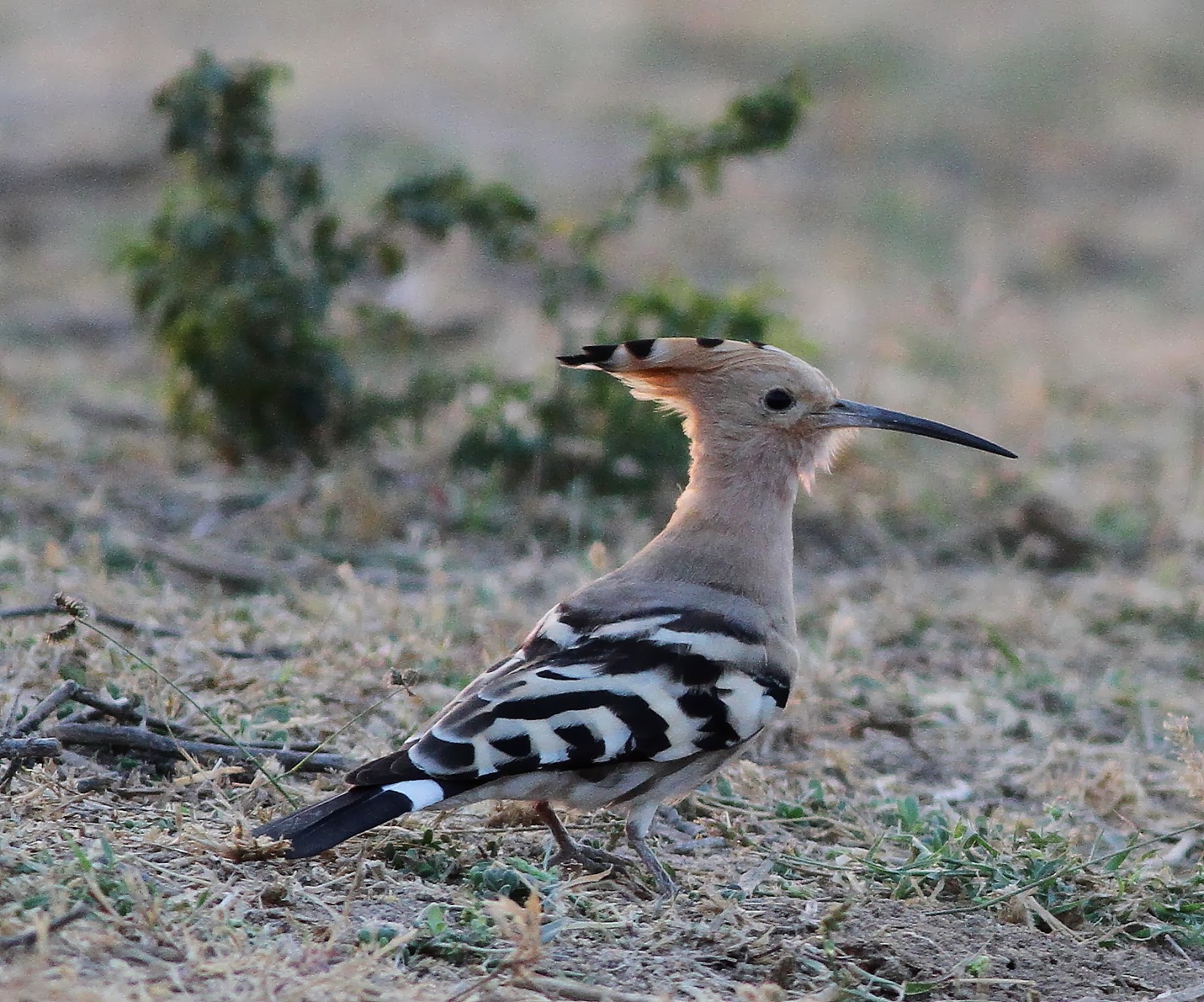
Hoopoe
Bimaculated Lark: The bulky shape, stout bill, dark streaks on the crown & mantle, pale scapulars, dark eyeline behind the eye, brown cheeks & dark chest patch all help to confirm the identification
Asian Desert Warbler
Eastern Pied Wheatear: Female
Desert Wheatear: Male
Daurian Shrike
Baya Weaver 
Grey-necked Bunting: Male
Nilgai: Distant views of this large, ungainly mammal in the heat haze
Indian Fox: Quite a striking mammal & a Subcontinent endemic (thanks to Richard Webb for the identification)
Life on the lake bed is pretty basic
Even more basic for this family