There was a change of pace for my second day of Birding in the Ushuaia area. The first day had seen a two hour drive North to Rio Grande, followed by a fair bit more dirt track driving looking for Austral Canestero & Magellanic Plover. It was good to have got the long driving day behind me & have a day pottering around the nearby Tierra del Fuego National Park. I teamed up for the day with Steve Preddy, who was one of my cabin mates on the forthcoming Antarctica trip. It was the first time I met Steve, but we had chatted on the phone after he got in touch in the UK.
Great Grebe: This is the navasi subspecies which occurs in Southern Chile & Argentina
The National Park doesn't open until 09:00 and there was time for a lazy start to the day, before I picked Steve up about 08:15 from his B&B accommodation. We quickly sorted the payment to the Park and were heading off to one of the eBird hotspots, Sendero Cerro Guanaco, to look for Patagonian Tyrant. Despite spending the morning looking, we failed to find any. They can be a tricky species to see and it's a species I have missed before in the Ushuaia area, as well as, in Chile. But there were a few other species to keep us occupied.
Great Grebe: This looks like another Grebe species with strong pair bonds
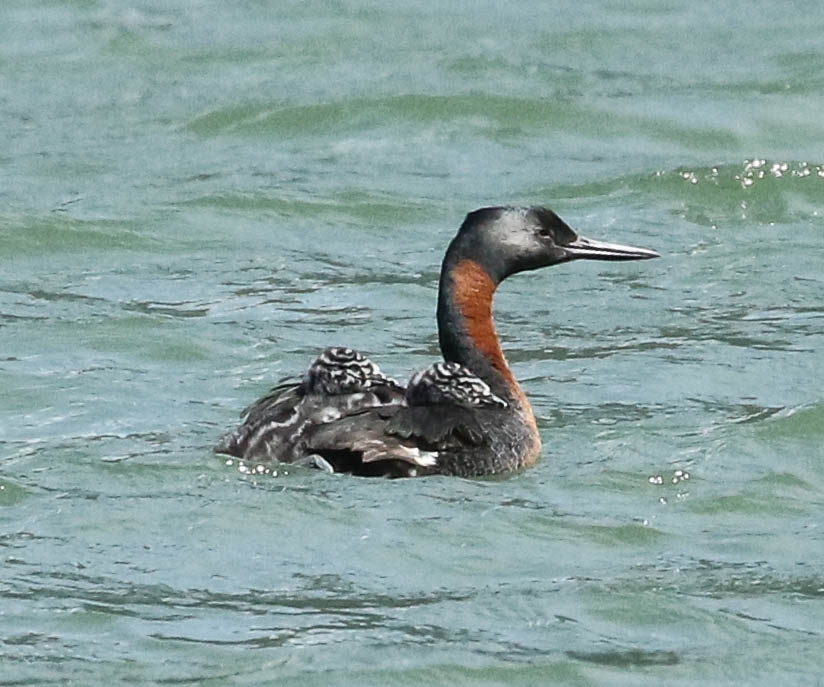
Great Grebe: There are two young chicks on this adult's back
Great Grebe: The chicks are good at hiding under the parent's wing
Night Heron: Immature. This is the obscurus subspecies which occurs from North Chile & North-central Argentina to Tierra del Fuego
There was a walking trail from the car park through the woods alongside the large Lago Roca lake, which spans Argentina & Chile. There was a reasonable number of Birds along the trail, but there wasn't a large variation of species.
There was some reasonable-looking forest along the trail
Thorn-tailed Rayadito: This is the nominate spinicauda subspecies which occurs from central Chile & adjacent West Argentina to Tierra del Fuego
Thorn-tailed Rayadito: They are a gorgeous species
Thorn-tailed Rayadito: With few species in Tierra del Fuego they fill the niches that Tits would do in the UK
White-crested Elaenia: This is the chilensis subspecies which occurs from the Andes of Bolivia to Tierra del Fuego. The Southern population is migratory & they migrate North to Brazil
White-crested Elaenia: The chilensis subspecies is a monotypic split in waiting when I move to IOC taxonomy
White-crested Elaenia: Like a number of other Elainias, they have a pale crown stripe which can be tricky to see at times
Austral Thrush: Adult. This is the magellanicus subspecies which occurs from Southern Chile & Argentina to Tierra del Fuego
Austral Thrush: Immature. The immature Austral Thrushes have spotted breasts
Patagonian Sierra-finch: This is the patagonicus subspecies which occurs from central Chile & Argentina to Tierra del Fuego
Patagonian Sierra-finch: Typically, the individuals by the car park were more approachable
Patagonian Sierra-finch: The russet mantle separates this species from Grey-hooded Sierra-finch which also occurs in the Tierra del Fuego area
Patagonian Sierra-finch: Immature
After giving up on the Patagonian Tyrant hunt, there was time for a quick look around other parts of the National Park.
There were some good lakeside marshes
The mountains were never far away
Spectacled Duck: This monotypic species occurs in forested regions of Southern Chile & Argentina
We spent mid-afternoon having a look for some Ashy-headed Geese which were still a Tick for Steve, but had no luck. Eventually, we had to leave as I needed to return the car by 17:00.
The End of the World Train: This trainline is the closest line to either of the poles. It was originally built in 1909 as a train line from Ushuaia to a penal colony. It remained in use until the penal colony was closed in 1947. It reopened as a historic tourist train line in 1994
Magellanic Woodpecker: This superb artwork made a dull sided building look a lot more interesting. Fortunately, I had seen a couple of Magellanic Woodpeckers on my first trip to Argentina
I had an evening in the bedsit to pay some bills & tidying up emails, as I knew I would have no wifi connectivity once I got on the Plancius. The ship does have a limited wifi, but it is expensive & I also knew I would rather be on deck than using the expensive wifi.