Showing posts with label Oriental Scops Owl. Show all posts

29 Mar 2014

29 March 14 - Indian Owl Fest

I've just completed writing the last post for the Indian trip which visited Calcutta, the Andamans, the Western Ghats, Gujarat & Rajasthan. Out of the 420 species of birds seen, I managed to photograph 342 species (over 81% of species seen). However, to spin these photos out a bit further, I've decided to pull together some posts on particular themes. So here is the first of them on the Owls seen on the trip. On the trip I managed to see 11 or 12 species of Owl depending on taxonomy & all species seen were photographed. On the Andamans, I saw Orintal (Walden's) Scops Owl which Clements currently lumps as a subspecies of Oriental Scops Owl, but Rasmussen splits. I can't tick it at the moment as I also saw Oriental Scops Owl in the Western Ghats & I keep to a Clements taxonomy for simplicity.
I can't tick this Owl at Periyar
India is a great country for seeing Owls & seeing them well. In most countries, Owls are something you look for at night & we did see several species after dark. However, due to the large game animals & the number of sites I visited which are Tiger reserves, then looking for Owls after dark is often not possible (the Andamans being the main exception on my trip). But the result is the local Indian guides have become good at finding Owls in daytime roosts, where with care, you can get some good photos & more importantly not disturb the Owls. I'll leave you to enjoy the Owls.
Andaman Scops Owl: Jirgatna, Andamans (23 Dec 13)
Indian Scops Owl: Nominate subspecies bakkamoena, Thattekad, Western Ghats (5 Jan 14)
Indian Scops Owl: Subspecies gangeticus, Bharatpur, Rajasthan (28 Jan 14)
Bruce's Scops Owl: Desert Coursers, Gujarat (14 Jan 14)
Oriental Scops Owl: Parambikulam, Western Ghats (2 Jan 14)
Oriental Scops Owl: Parambikulam, Western Ghats (2 Jan 14) 
Oriental (Walden's) Scops Owl: Chiriya Tapu, Andamans (24 Dec 13)
Rock Eagle Owl: Jungle Hut, Western Ghats (29 Dec 13) 
Rock Eagle Owl: CEDO, Gujarat (19 Jan 14)
Dusky Horned Owl: Bharatpur, Rajasthan (28 Jan 14)
Brown Fish Owl: Parambikulam, Western Ghats (2 Jan 14)
Jungle Owlet: Parambikulam, Western Ghats (1 Jan 14)
Jungle Owlet: Parambikulam, Western Ghats (2 Jan 14)
Spotted Owlet: Subspecies brama, Jungle Hut, Western Ghats (29 Dec 13)
Spotted Owlet: Subspecies indica, Desert Coursers, Gujarat Ghats (14 Jan 14)
Andaman Boobook: Chiriya Tapu, Andamans (22 Dec 13)
Hume's Boobook: Chiriya Tapu, Andamans (22 Dec 13)

2 Jan 2014

2 Jan 14 - I Heart Spotting Woodpeckers

After another curry for lunch (I don't know how non curry lovers survive in India), it was time to explore another part of the Tiger Reserve. We had asked about driving in the Reserve, but amazingly this is limited to joining a bus for all camp visitors to a bamboo rafting & tribal dancing trip (with zero chance of being able to stop for birds). Despite, this being a Tiger Reserve, they have no set up for jeep drives with the local forest guide/naturalists which is significant downside to the tented camp. We drove back to Top Slip as we had see jeep drives advertised from Top Slip, but with equal lack of enterprise, they only run in the morning & they couldn't organise one in the afternoon (as it wasn't the morning). Perhaps it was down to a consideration for the wildlife, but I suspect lack of initiative as it was another government run reserve, was the more likely explanation. So we returned to the camp & explored another area on foot with our local guide.

Despite seeing a good selection of birds on the walks on the first afternoon & mornings, we had been disappointed to not bump into any bird flocks. Fortunately, this changed on this afternoon's walk, when we explored a side road near to the camp.
The side road was chained off so the only access was on foot
Fairly soon as we walked down the track, we encountered a large slow moving bird flock. This produced one of the best birds of the Western Ghats section of the Indian trip: Heart-spotted Woodpecker. There were several reasons for the high rating. Primarily, it is because it is an small, odd shaped, but very cute, Woodpecker. Secondly, this was a bird I might have seen in Thailand back in 92 when a potential Heart-spotted Woodpecker was seen in flight, but never relocated, despite appearing to have landed nearby. But, Black-and-buff Woodpecker was also present at that site & the identification was never clinched. Finally, this was bird no 6200 for my World List.
Heart-spotted Woodpecker: No 6200 using Clements taxonomy. This would be a much higher number if I adopted an IOC taxonomy, but I'm not going to follow the trend to switch to the IOC taxonomy, just to claim to have seen a bigger number of birds (I wonder how many of the recent vocal IOC converts would have adopted the IOC list, if their list got smaller?)
Heart-spotted Woodpecker: Great crest on this chunky little Woodpecker which is only 16cm long
Heart-spotted Woodpecker: A very short tail, even for a Woodpecker which generally are short-tailed
There were plenty of other birds in this large flock. Eventually, we carried on down the road a bit further, until the forest guide heard a couple of Asian Elephants feeding in the forest. He carried on along the road on his own, before calling us forward. They weren't too close & were feeding among the bushes & trees, so no worthwhile photos. Not wanting to have them between us & the camp, we had to turn around & slowly return to the camp.
Oriental Honey Buzzard: This individual flew over. Note, the small weak head 
Oriental Honey Buzzard: A second individual was then seen sitting in a tree
Malabar Trogon: Male
Malabar Trogon: Female. Unfortunately, both birds kept well away from the road
Brown-capped Pygmy Woodpecker: Good to see this little Woodpecker again
White-bellied Black Woodpecker: Another great Woodpecker which is 48cm long 
White-bellied Black Woodpecker: Another view showing the white belly
Black-rumped Flameback Woodpecker: The black throat, unsplit moushachial & white barring on the exposed black primary edges are the key features to separate this golden backed Woodpecker from the other contenders
Black-rumped Flameback Woodpecker: A better view of the black throat
Orange Minivet: I prefer the 'yellow' female Minivets to the 'red' males
Common Iora
Bronzed Drongo: This is a small glossy Drongo with a short forked tail 
Greater Racket-tailed Drongo: This is the largest bodied Indian Drongo, but it has a short tail than smaller bodied Lesser Racket-tailed Drongo (the rackets are just sticking out below the branch in this photo)
Malabar Woodshrike
Chital Deer
Indian Giant Squirrel
At dusk, we went out looking around the camp for nightbirds. The first highlight was seeing a Great Eared Nightjar hawking close to our accommodation, but the light was too poor for a photo. We heard this calling at dawn the following morning & I was surprised, we hadn't heard it calling this morning. As it got darker, an Oriental Scops Owl started calling strongly close to the tent & unlike the previous evening (when it was calling unseen & high in a tree), this time it was calling from a more open, lower perch. We had good views of the bird over about 20 minutes or so. Long enough to go & get our neighbours from the next tent & show them the bird. I even managed to get a short burst of video (whilst hand holding the camera against a tree trunk). This was calling very differently to the Walden's (Oriental) Scops Owl on the Andamans.
Oriental Scops Owl
Oriental Scops Owl: A back view

24 Dec 2013

24 Dec 13 - I Thought Punk Died Out At The End Of The 70s

Another early start to get to Chiriya Tapu soon after dawn. The forest birding was as good as the previous morning, but with a handful more cars on the road. When a tuk-tuk appeared & stopped, we expected the usual Indian gorping & greeting of "What is your good name" or "From what country are you coming" etc ad nauseum, but it was Dave Willis who was on an extended trip to the Andamans, along with another Indian birder from SW India. After paying their driver off, we had another couple of pairs of eyes on the road that morning.
Andaman Woodpecker: The star of the morning's birding. I thought the Punk look had ended in the 70s!
Andaman Bulbul: Couldn't resist for photos of this great looking Bulbul
White-headed Starling: I'm sure they want to be Woodpeckers as they were frequently clambering around the trees looking for food
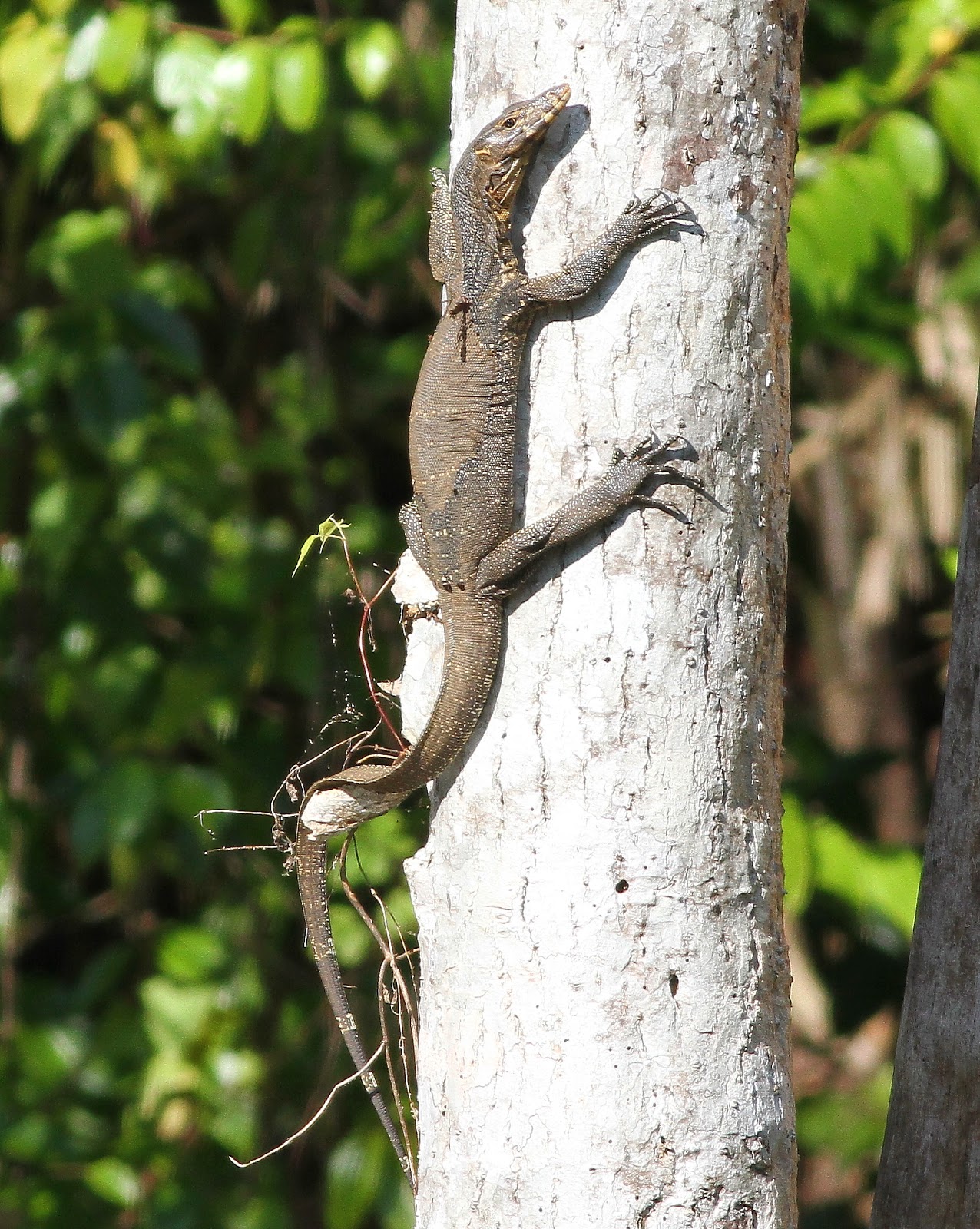
Monitor Lizard sp.: This was about 2 ft long
Just in case you're wondering why some of the photos are cropped: The trees round here get big
Me: With essential forest birding kit of bins, camera & coffee cup
We finally pushed onto the coastal edge, but didn't linger long before finding another woodland patch to look for Andaman Crake. The best thing about looking for Andaman Crakes is your focusing on the ground & not 30 or 40 metres up in the tree tops. Unfortunately, we didn't get to see any Crakes.
Collared Kingfisher: One of the few birds on the coastal edge
Forest Wagtail: A shy skulking forest species
Andaman Shama: Always happy to see Shama's. They are very elegant & good songsters & they keep fairly low down
As we were leaving Chiriya Tapu to head back to Port Blair for some food, we bumped into a Violet Cuckoo. This is a miniature Asian Cuckoo that I've not seen for over a decade. It is a difficult bird to see in India, given its limited resident range of the Andamans & Nicobars, as well as being a scarce summer visitor to parts of NE India.
Violet Cuckoo
After a break for lunch, we were back at Chiriya Tapu for the late afternoon. The highlight was our first Andaman Cuckoo Dove.
Andaman Cuckoo Dove: I'm always surprised about how small headed Cuckoo Doves are
Obviously we looked for Owls again given it's dark soon after 17:30.
Oriental (Walden's) Scops Owl