Showing posts with label Little Egret. Show all posts

21 May 2025

21 May 25 - The Brownsea Fisherman

At the end of my volunteering day on the DWT Brownsea reserve, I was waiting on the quay for the volunteer's boat to drop us back to Poole. There was a Little Egret close to the quay feeding at the water's edge. I saw it catch & quickly swallow a small Fish. I couldn't resist taking some photos and within two or three minutes, it had caught and swallowed another three Fish.
Little Egret: This was the second small Fish I saw it catch and quickly swallow
Little Egret: A much larger Fish
Little Egret: It took a bit more effort to move the Fish around in its bill
Little Egret: Going, going, almost gone
Little Egret: That's another Fish caught
Little Egret: It was now only a few metres from the quay
Little Egret: Brownsea was the first place in the UK where Little Egrets bred as they expanded into the UK. That was only 1996 and now they have expanded their range to just about all parts of the UK
The Little Egrets can be very showy around the Brownsea quay when they are around.

9 Oct 2024

9 Oct 24 - Little & Large

I was doing my usual volunteering on the Dorset Wildlife Trust Brownsea reserve, as it was a Wednesday. I wasn't on the rota for anything immediately after the morning briefing, so I took the opportunity to head to the Tern hide to scan the lagoon and do a Wader & Wildfowl count. One of the first species I saw was a Great White Egret at the edge of the lagoon. At the time, I thought this was a Brownsea Tick for me, but it turns out I've had one sighting before in Autumn 14. Given they are scarce visitors to the lagoon, I grabbed a few photos, before getting on the DWT radio to let the DWT wardens know.
Great White Egret with a Little Egret for comparison: Little & large. The identification wasn't really very hard in the circumstances
Great White Egret with a Little Egret for comparison: A Greenshank is now trying to get in on the act
The Great White Egret was feeding at the edge of the lagoon for about forty-five minutes before it flew off.
Great White Egret: This is only my second Great White Egret on the Brownsea lagoon, despite it being a regular species in Poole Harbour these days

14 Aug 2024

14 Aug 24 - A Brownsea Little Egret

One of the nice things about visiting Brownsea, is sometimes it is possible to get close photos of Brownsea's Birds. Generally, this is when they are in close to one of the hides. So, it was good to see this Little Egret feeding on the shoreline next to the main jetty.
Little Egret: When I first started Birding, Little Egrets were a national rarity. Around the start of the 1990s, they started occurring more often and the first pair bred in the UK in 1996. Poole Harbour is home to nationally significant numbers of Little Egrets and this is one of the species that gives Poole Harbour a Special Protection Area designation

9 Nov 2022

9 Nov 22 - Indonesia - Banda Sea Cruise Day 14 - A Very Early Start On Pantar Island

We had missed one of our main target species on the previous day on Alor: Alor Boobook. Fortunately, Alor Boobook also occurs on our next location: the neighbouring island of Pantar. To maximise our chances of success, Wilbur decided we would leave the Lady Denok at 03:00 to give us a good crack at seeing this recently split Boobook. We had the joy of wading ashore through the shallow water over the mudflats in the dark.
It was a dark night when we left the Lady Denok at 03:00
It was a mile or so walk to get to the site Wilbur had for the Alor Boobook. Initially, we didn't hear any Alor Boobooks calling, but finally we heard one. After a bit of time, we finally got some good views of it.
Alor Boobook: Alor Boobook has been recently split from the Southern Boobook complex
Alor Boobook: Another photo taken using just the light from Wilbur's torch, which shows how good cameras have become to photography in low light situations
As we returned to the road, we heard & then saw a Wallace's Elegant Pitta in the mangrove edge.
Wallace's Elegant Pitta: Elegant Pitta has now been split into three species: Banda Sea Pitta, Temminck's Elegant Pitta (which IOC call Elegant Pitta) & Wallace's Elegant Pitta (which IOC call Ornate Pitta). Wallace's Elegant Pitta is a monotypic species. This individual sang from the mangroves in the early morning light
We had another hour to check some of the neighbouring forest & scrub edge before Wilbur decided we should head back to the Lady Denok. Heading back wasn't a bad decision as we needed to head out to sea as we had a long crossing to our next destination: Kalaotoa Island.
Indonesian Brown Honeyeater: This is the monotypic species that occurs from Bali to Flores & Timor
Zitting Cisticola: This is the fuscicapilla subspecies which occurs in East Java & the Lesser Sundas. It is a very widespread species which occurs in Europe, Africa South East Asia to Australia
Zebra Finch: This is the guttata subspecies of Zebra Finch according to Clements which occurs in the Lesser Sundas from Lombok to Timor, with another subspecies in Australia. IOC have split them as Sunda Zebra Finch & Australian Zebra Finch. This will be another armchair tick when I switch to IOC taxonomy
Indonesian Butterfly sp.
We had hoped to leave from this jetty & avoid another wade off the mudflat, but there was no water in the creek
Indonesian Crab sp.
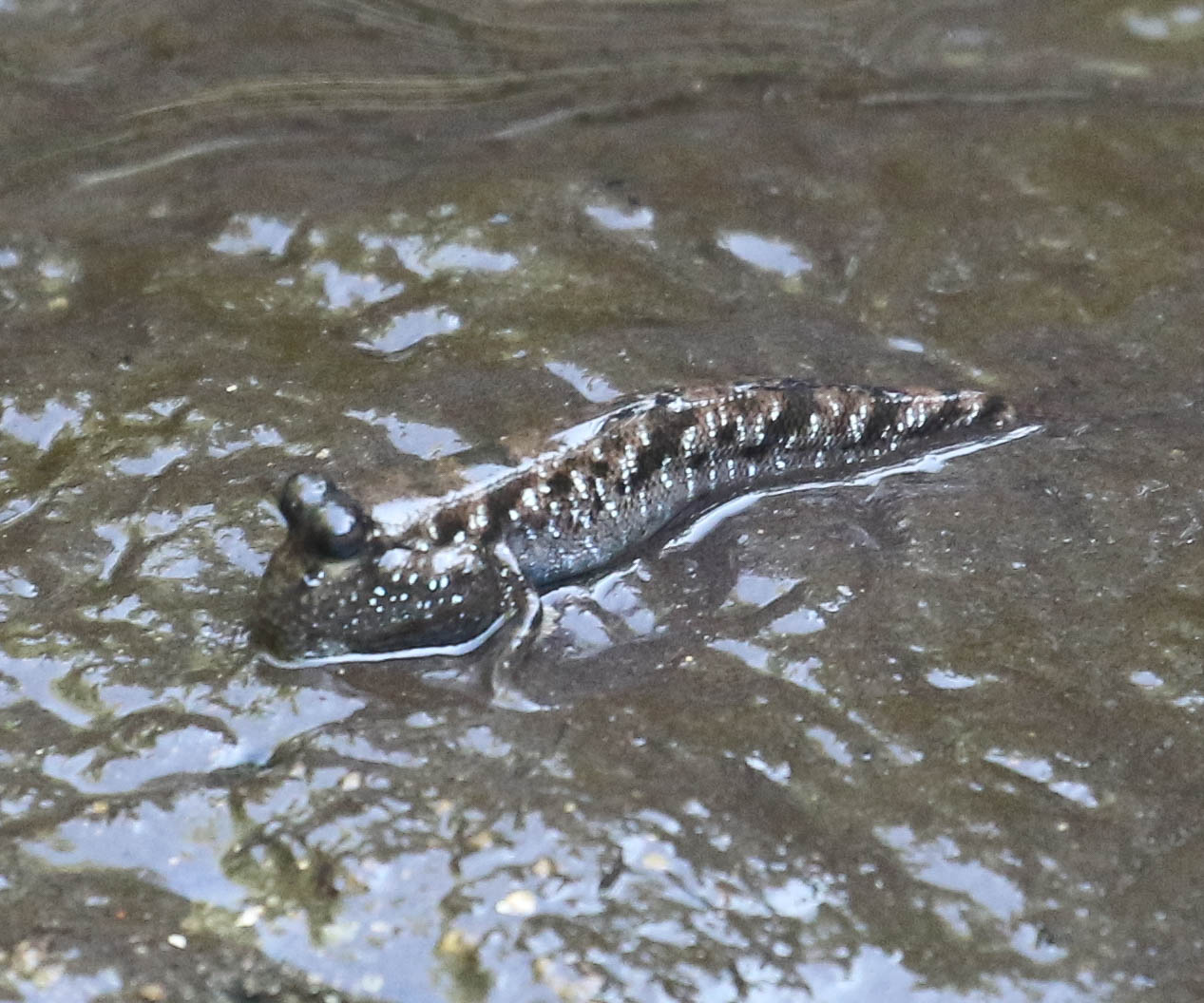
Indonesian Mudskipper sp.
Returning past the mangrove edge
As we headed back to the Lady Denok, we saw a few Herons & Waders feeding on the mudflats.
Little Egret: This is the nigripes subspecies which occurs from Indonesia & the Philippines to New Guinea, North & Eastern Australia
Little Green Heron: This is the steini subspecies which occurs in the Lesser Sundas. This is a widespread species which is also known as Striated Heron & occurs from Africa to Asia, New Guinea & Australia, as well as, Central & South America
Whimbrel
Common Sandpiper
Back into open water
The Lady Denok
We had over one day at sea until we reached Kalaotoa Island. The avian highlight of the crossing was my first Swinhoe's Storm-petrel, along with a single Tahiti Petrel, a couple of Streaked Shearwaters, a few Wedge-tailed Shearwaters & at least fifty Red-necked Phalaropes. But a close Sperm Whale was the star highlight for the crossing.
Sperm Whale: A shot showing the blow hole and the low dorsal fin
Sperm Whale: Sperm Whales have a unique off-centred blow hole on the left side of the head, which is diagnostic if seen well
A local boat
We ended a long day with a reasonable sunset

13 Jun 2022

13 Jun 22 - The Isle Of Purbeck Pelagic

Back in June 22, I was lucky to be invited by my friend Mark Singleton, who is one of the local National Trust team, to join one of the annual breeding Seabird surveys that are carried out by Footprint Ecology for the National Trust. The survey covers the Purbeck coast from Durlston to St Aldhelms and along the cliffs to Old Harry. We left Swanage on one of the small fishing boats and sailed past Durlston as far as St Aldhelms, before returning along the same coastline. The only problem with the trip, we were warned we would be out from 09:00 to early afternoon, which turned into mid-afternoon & there wasn't a toilet on the boat. Therefore, it was a case of skipping breakfast and limiting myself to a single cup of tea for breakfast.
Durlston Castle: Durlston Castle is a Victorian folly & restaurant that was built in the four years before its completion in 1891 by George Burt. Burt made his fortune running the family firm, Mowlem, who mined and shipped Purbeck stone to London. The Castle was the centrepiece of his Durlston Park. It is now owned and run by Dorset County Council as the centre for Durlston and the start of the Jurassic Coast World Heritage Coastline
The Tilly Whim Quarry at Durlston: This old quarry area is now closed off as the underground quarry works are in a dangerous state
My Durlston Seawatching location: This is where the lighthouse gully reaches the sea and it provides the lowest point for seawatching at Durlston. There is a similar low point at St Aldhelms: but it is a mile & a half walk from the car park to the start of the steep track to the base of the cliffs which includes a short climb up & down one part of the path
Approaching the Durlston Lighthouse & one of the Mile Markers
Looking West from Durlston
Durlston Climbers: There is a part of the Durlston Country Park where climbing is allowed which is well away from the Seabird ledges
Durlston Climbers
Durlston Climbers
As we passed the Durlston cliffs, we started to see the first of the Seabirds. Durlston has the highest densities of Seabirds on the Purbeck coastline. The vast majority of the Auks are Guillemots, with a small percentage of Razorbills. There are some breeding Fulmars, Shags, Herring Gulls and a few pairs of Kittiwakes. The Purbeck speciality is easily the handful of pairs of Puffins in the Dancing ledge area.
Fulmars
Guillemots: There are good numbers of Guillemots on the Durlston undercliffs
Debbie & Durwyn surveying one of the Guillemot ledges: The counts are supplemented with photos of all the cliffs, so that the field counts can be confirmed from examination of photos. These photos will provide additional information for comparing results from one year to another
More Guillemots on the undercliff at Bird Cove which is West of Dancing Ledge
Guillemots
Guillemots
Guillemots
Guillemot
Bridled Guillemot: The bird of the day was this Bridled Guillemot. This is a colour morph which increases going North in the Guillemot range. They are scarce in Dorset, but commoner in the Shetland Islands. It is the first I've definitely seen in Dorset
Razorbills & Guillemots: This photo is good at showing the black Razorbills from the browner Guillemots
Razorbills & Guillemots
Blacker's Hole: This is one of the sea caves at Blacker’s Hole & it is home to the last small colony of Purbeck Kittiwakes: we saw six occupied nests
One of the Kittiwake nests
Kittiwake: This first Summer Kittiwake was hanging around the colony
Herring Gull: This Herring Gull looks like it is still incubating
Herring Gull: This Herring Gull nest has two healthy-looking chicks
Peregrine: This is one of the Durlston Peregrines
Little Egret: One or two of the Poole Harbour Little Egrets feed along the Purbeck coastline
Dancing Ledge: This is another ex-quarrying area which is now part of the National Trust coastline to the South of Langton Matravers
Dancing Ledge: As we passed Dancing Ledge, this group of school kids were preparing for a coastal activity of some sort. Good to see they were all wearing safety gear & wetsuits
The Dancing Ledge area and the Portland West Cliffs are the only known parts of the Dorset coastline where Puffins still attempt to breed. There are no more than a few pairs in the Dancing Ledge area. I don't think anybody has been able to confirm successful breeding for a number of years. However, I doubt there are many people actually looking along this part of the Dorset coastline when they would fledge. Therefore, are the pairs failing, perhaps as the nest sites could be accessible to a land predator or are they sometimes successful & Birders aren't looking for Pufflings.
Puffin: The Dancing Ledge area is the only known part of the Purbeck coastline where Puffins still attempt to breed
Puffin: It's great having this gorgeous species so close to home
Swift nest hole: There is a small Swift colony on the Purbeck coast near to Dancing Ledge. This is one of a few cliff-nesting Swift colonies in the UK. A Swift had just flown into the nest hole
Sika Deer: This was the surprise of the day. It's hard to see how this Sika Deer reached this platform
Sika Deer: It looks quite content when this photo was taken. They are a semi-aquatic species of Deer, so it is possible it could jump in the water & swim along the coast to a beach where it could get out of & back onto the downs
Finally, we reached the Winspit to St Aldhelms section. There is another reasonable sized Guillemot & Razorbill colony on this section, along with a few Fulmar nests. As we reached the St Aldhelms tide race, the sea got a bit more bouncy, but we were soon past the last of the breeding Seabirds and turning around.
The East Quarry at Winspit
Winspit
The West Quarry at Winspit
Approaching St Aldhelms: It was time to turn around and enjoy the trip back to Swanage, as the survey was over
Peveril Point: This is the last point of the Jurassic Coast, before the turning into Swanage Bay. Mark is relaxing & chatting with Durwyn & the team
Sea Kayakers: These two Sea Kayakers were enjoying the seas off Peveril Point
We weren't done yet as we crossed Swanage Bay to cover the chalk cliffs of Ballard Down as far as the breeding Gull colony on Old Harry. But I will cover that in the next Blog Post.