Showing posts with label Flying Fish. Show all posts

31 Jan 2024

31 Jan 24 - ORCA Saga Caribbean Calypso Day 14 - Barbados: Another Unusual Taxi Destination

The previous Blog Post had covered our arrival into Bridgetown, Barbados and the successful trip to see my first Masked Duck. with the first part of the plan completed, it was time to move on to get some better views of some Barbados Bullfinches. One of the good areas on eBird was around the Bridgetown Hilton Hotel. This was about three miles from the port, so it was easy to drop in there on the way back to the port. It was a surprisingly slow drive back to the Hilton Hotel as we got caught in a lot of slow traffic.
This cannon marks the entrance to the Pavilion Court apartment complex: This is part of the old British military hospital compound which was in use from 1789 to 1905 and it has retained a lot of its distinctive colonial look
When we arrived, I saw there was a military cemetery outside of the Hilton complex with some big trees. This looked a better option to visit, rather than to try getting into the Hilton's grounds.
A sign by the military cemetery: Obviously, that excludes the British who first colonised the island in 1625
A memorial to Barbadian merchant seamen who lost their lives in World War II: This was one in a number of interesting memorials in the cemetery. I do enjoy walking around this old cemeteries and looking at the history in the cemetery, whilst looking for Birds
Prime Minister and ex-World War II navigator, Errol Walton Barrow is buried here
There were some decent-sized trees in the military cemetery
I saw the first of several Barbados Bullfinches within a few minutes of entering the cemetery. This was good as I only had about a half hour of time charter left, excluding the time needed to get back to the port.
Zenaida Dove: This is the aurita subspecies which occurs on the Lesser Antilles. Two other subspecies occur on the Bahamas, the Greater Antilles, the Virgin Islands & Mexico
Zenaida Dove: The most prominent species in the cemetery were these Zenaida Doves
It was good to be able to spend a few minutes getting my eye in on these common and pretty Zenaida Doves, which I had been in too much of a rush to look at properly on Grenada & earlier in the day. But I had limited time left on my taxi charter and I carried on further into the cemetery to look for some Barbados Bullfinches. I saw one on the cemetery wall, but it dropped over the far side. Then this one popped up on a gravestone: job done.
Barbados Bullfinch: Both sexes of this endemic species looks very similar to the female Lesser Antillean Bullfinches. I saw several on the drive from Bayfield to the Hilton area as they are a tame & conspicuous species of gardens, scrubland & open woodlands
Brown Anole: This Lizard is native to Cuba & the Bahamas. However, it has been widely introduced elsewhere and it is now found in a number of Southern States of the US, as well as, other Caribbean islands, Mexico & Taiwan
I was back on the ship for a late snack lunch around mid-afternoon. After that I went back ashore with Jan to have a wander around the port area, where she was hoping to find some shops. As we walked along the approach road we failed to find any shops. But we did find a fish processing area, where one of the Fish being cleaned up were one of the local Flying Fish species. There were a few Cattle Egrets getting some easy food there.
The tree-lined approach road to the port
Cattle Egret: This is the ibis subspecies which occurs in Southern Europe East to Iran, Africa, Madagascar, the Seychelles, Aldabra, the Comoros Islands & Mauritius. In the 20th Century this subspecies also colonised North & South America and was introduced to Hawaii
Flying Fish sp.
If only wild Flying Fish had a barcode: Charlotte's newest addition to her menagerie
We gave up on the search for shops & walked back to the ship, On the way back, I spotted a Lizard which turned out to be another Brown Anole & some Hermit Crabs. While we were watching it, some other tourists from another ship spotted a gorgeous-looking, but poisonous, Frangipani Hawk Moth caterpillar.
Brown Anole: I found another Brown Anole on the trees around the port
/Hermit Crab sp.
Brown Anole: Finally, it showed itself
Frangipani Hawk Moth caterpillar: The Frangipani Hawk Moth is native to the tropical & subtropical Americas from the Southern & South West US
Having failed to find any interesting shops outside of the port, Jan & I returned to the ship.
Just double-checking which island we were on
It was all very civilised with music being played which we had celebratory mid-afternoon tea & cakes in the lounge: I was happy having seen both the potential Ticks on Barbados
A map of our route and the islands still to visit

28 Jan 2024

28 Jan 24 - ORCA Saga Caribbean Calypso Day 11 - The Mythical Green Flash

Our fifth day at sea after leaving Tenerife started with another promising day of early morning sunshine. Sadly, another day where I failed to see any Cetaceans. However, the Mirrorwing Flying Fish and Small Clearwings were still being regularly seen throughout the day.
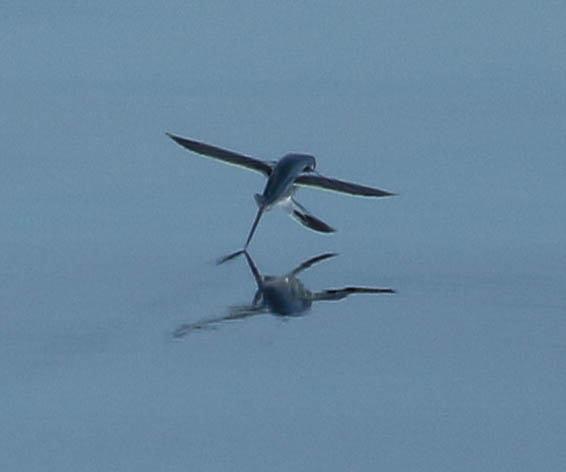
Mirrorwing Flying Fish
We were also regularly encountering Sargassum Weed. There were many large patches of Sargassum Weed that had broken off from the main Sargassum Weed belt in the Sargasso Sea. This Sargassum Weed moves in a clockwise rotation around the centre of the Sargasso Sea. The Sargasso Sea is approximately two thousand by seven hundred miles in size and occurred to the North of our route. Sargassum Weed is an brown macroalgae. It forms vast rafts in the Sargasso Sea and it provides an important breeding ground for many Fish and other marine species.
Sargassum Weed: We were frequently encountering large patches of Sargassum Weed
A close up of a small piece of Sargassum Weed
Occasionally, when I've seen large numbers of Flying Fish, I see a Smurf or two. Smurfs are the name given to the youngest of Flying Fish. Typically, they are only a couple of inches in length and when you see them leap out of the water, they only manage about a few feet before they drop back into the water. To the naked eye, they appear to be round. Due to their limited flying range, they are just about impossible to photograph. They have dropped back into the water, before I even get the chance to lift the camera. However, I was lucky enough to be trying to photograph an adult Flying Fish, when I saw a Smurf appear.
Smurf sp.: Sadly, it is out of focus, but it is possible to see it is a mini Flying Fish
It had been a long day with no Cetaceans. Jan decided to pack up the surveying just before sunset, to allow Terry to start working on the daily slide. There was only a few minutes before the sunset, so I decided to stay up on deck as I cannot resist an atmospheric sunset. On this occasion, the sun dropped behind the cloud on the horizon.
It was a good-looking sunset: Then it got a lot better
But suddenly, the sun reappeared through a gap in the cloud on the horizon. I was intrigued as I hadn't seen that before. I carried on watching the sun with the bins right on last light, when magically the yellow-orange sunlight changed to lime green. This was the mythical Green Flash that I had looked for on many occasions, but I hadn't seen. It lasted about fifteen seconds. I was worried I wouldn't have the time to raise the camera in time to get a photo, so, I just enjoyed it. I had always wondered why it was green. I was expecting that it should be a violet-blue colour, if it was down to light being refracted into different colours by the earth's surface. When I googled the Green Flash phenomenon that evening, I saw this was confirmed. However, these violet-blue frequencies tend to be quickly absorbed by the Earth's atmosphere and the frequencies that aren't absorbed produce the lime-green colouration. Perhaps the low cloud helped to reflect the lime-green colouration or maybe it is provides a darker background which makes the green colouration stand out better.

It had been a good day. I had photographed my first nigh on impossible to photograph Smurf and seen this mythical phenomenon.

26 Jan 2024

26 Jan 24 - ORCA Saga Caribbean Calypso Day 9 - In Range Of Flying Fish

After two quiet days at sea after leaving Tenerife in the Canaries with lots of poor visibility, the conditions improved as we finally left the Saharan Sand behind. On the third day we were enjoying warm sunny weather in the middle of the Atlantic.
We were on deck before sunrise, which allowed me to photograph the sunrise
With two days of not seeing any Cetaceans, I had a short view of a probably Minke Whale. But it dived quickly, didn't resurface and I hadn't been able to eliminate the possibility of it being a Beaked Whale. Sadly, that is the reality of some sightings. But it is important to be accurate on recording sightings, rather than trying to get a name to a sighting on the briefest of views.
It was good to have a reasonable number of passengers on deck throughout every day with us
Although the Cetaceans were few & far between, fortunately, we finally started to see good numbers of Flying Fish.
Mirrorwing Flying Fish: They can be identified by their glassy and veined wings. Some have a broad transverse clear bar from base of the wing to its middle and a broad light grey band on rear half of the wing. The pelvic fins are enlarged and clear. They can get up to about a foot in length
Seeing Flying Fish is always a treat and it is endlessly enjoyable. Firstly, they are good to convince you that when you aren't seeing anything at sea, it is because there isn't anything appearing. So when you see Flying Fish, then you know you aren't just staring sleepily at the sea.
Mirrorwing Flying Fish: They range across most the tropical Atlantic from as far North as the Caribbean and Cape Verde to as far South as Brazil and St Helena within their core range, but they occur less frequently North and South of this core range
Secondly, they are great to show the passengers and tell them about their interesting ability to jump out of the water and glide to escape a predator: they assume the ship is a giant predator.
Mirrorwing Flying Fish: This was the commonest species of Flying Fish that I saw with over one hundred individuals seen daily as we headed for the Caribbean
Finally, they are a photographic delight and with practice, it is possible to get some nice photos. Having photos is great, as it is then possible to show the passengers their exquisite fins which is often difficult to see in the field. When I was not on survey, I was generally standing in a good position and looking for Flying Fish, whilst chatting to passengers. This allowed me to get a few nice photos. I also skipped one lunch to try some photography from closer to sea level. Unfortunately, this coincided with a period of few Flying Fish.
Mirrorwing Flying Fish: This is one of about seventy-two species of Flying Fish
Mirrorwing Flying Fish: Their identification is difficult as I've yet to find a field guide covering their identification. There is the useful Fishbase website which covers the species, along with some identification information and range maps. However, it is focused on identification of caught specimens and it doesn't have photos of them in flight
Mirrorwing Flying Fish: Another problem with their identification is that the colour of the wings of Flying Fish rapidly fades once they are dead and this will make it harder to correlate the species in flight with caught specimens
Mirrorwing Flying Fish: This photo shows that the forewing is clearer than the rear of the wing
Mirrorwing Flying Fish: This Flying Fish is about to drop back into the water
Mirrorwing Flying Fish: A final splash and it was gone
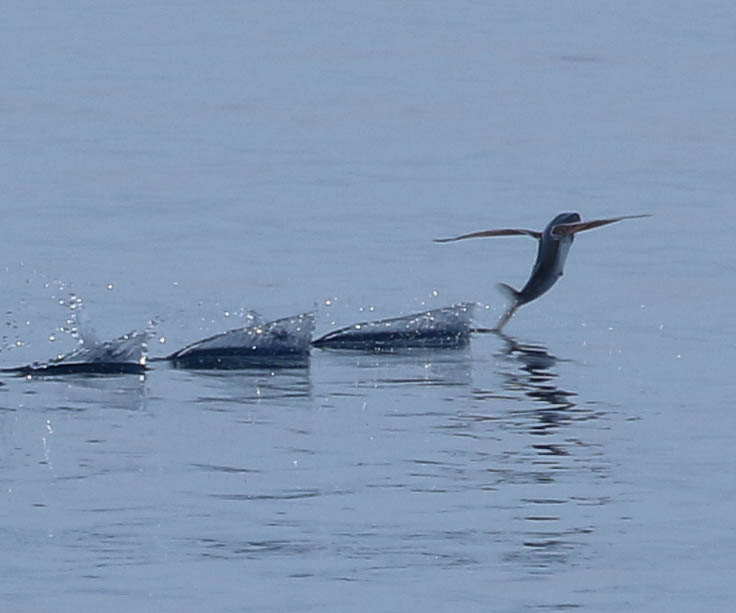
Mirrorwing Flying Fish: When the finish their glide, they often drop their lower tail into the water & flick it side to side. This gives them enough speed to lift off the water surface again and often in a different direction. They also produce excellent wavy ripples if the water is calm. The best Flying Fish can repeat this two or three times and get close to forty or fifty metres from where they jumped out of the water
It wasn't always wall to wall sunshine during the day: There was some threatening weather ahead during the afternoon. Fortunately, we missed this rain squall
The rain showers did produce this good rainbow
Our fourth day at sea was similar to the third day, with a good sunrise.
It was an atmospheric sunrise: (27 Jan 24)
We also saw a number of Small Clearwing sp. They were typically around six inches long, with a dark bluish upper body with pale undersides & clear wings with obvious veins. The Fishbase website confirms the specific identification of the Small Clearwing sp is tricky. There are two species, Exocoetus volitans and Exocoetus obtusirostris, which both occur and have similar ranges along the route of the Saga Caribbean Calypso. Exocoetus volitans can be distinguished from Exocoetus obtusirostris by having a less blunt snout and by the origin of the anal fin being at a location behind the origin of the dorsal fin. This feature isn't possible to clearly see in my photos.
Small Clearwing sp: This was the second commonest species of Flying Fish that with around thirty or so individuals seen daily as we headed for the Caribbean (27 Jan 24)
We saw Mirrorwing Flying Fish on a daily basis as we continued our journey to the Lesser Antilles.
Mirrorwing Flying Fish: (27 Jan 24)
We finished the day on deck with an equally atmospheric sunset: (27 Jan 24)

31 Oct 2022

31 Oct 22 - Indonesia - Banda Sea Cruise Day 5 - Flying Fish On The Crossing From The Tanimbar Islands To The Babar Islands

This is the fourth & final Blog Post detailing the Flying Fish we saw on the crossing from the Tanimbar Islands to Babar Island. The previous three Blog Posts covered the Seabirds, an Olive Ridley Turtle & Cetaceans that we saw.

Regular readers who read the Atlantic Odyssey Blog Posts will know that I also really enjoyed seeing & photographing the Flying Fish we saw in the warmer Atlantic waters. I was looking forward to the Banda Sea Cruise as I was expecting to see good numbers of Flying Fish at regular intervals: I was not disappointed. At this point, I have not been able to identify any of the Flying Fish that we saw, so I am using my own nicknames for the different species.

The commonest species of Flying Fish were the Small Clearwing Flying Fish. They were a gregarious small species of Flying Fish that clearly feed in large shoals as suddenly we could see a hundred or more erupt out of the water on either side of the boat. I noted about twelve hundred on this first crossing. They were the smallest Flying Fish maybe about six inches long, with a plain clear wing with a white trailing edge and no small fins on the body close to the tail. All these features were very similar to the Small Clearwing (Exocoetus sp.) that we saw in the tropical Atlantic on the Atlantic Odyssey and West African Pelagic. However, there are two common species in the tropical Atlantic, Exocoetus volitans and Exocoetus obtusirostris, and both of these Exocoetus species occur within the Banda Sea. Exocoetus volitans can be distinguished from Exocoetus obtusirostris by having a less blunt snout and by the origin of the anal fin being at a location behind the origin of the dorsal fin. That isn't possible to see in any of my photos.
Small Clearwing (Exocoetus sp.): These small Clearwing Flying Fish were sometimes encountered in large shoals. It was great to suddenly seen a hundred or so take to the air
Small Clearwing (Exocoetus sp.): Note the small size, clear wing with a white trailing edge and lack of small fins on the body close to the tail
Small Clearwing (Exocoetus sp.): Another individual demonstrating some of the nice reflections the flat calm seas provided
Small Clearwing (Exocoetus sp.): They launch themselves out of the water, glide for many twenty or thirty metres, then reach the water. Often these smaller Small Clearwings would re-enter the water, alternatively, they would kick again to travel a greater distance
Small Clearwing (Exocoetus sp.): They could produce some lovely images
Small Clearwing (Exocoetus sp.): Back into the air for another twenty metres, which would give them a good distance & probably safety from an underwater predator that could have spooked them
The second species of Flying Fish were these Indonesian Large Flying Fish. They would erupt out of the water on their own or in small groups involves only a few individuals. They were noticeably larger than the Indonesian Clearwing Flying Fish and closer to twelve six inches long, with a plain darker wing with a white trailing edge and small fins on the body close to the tail. All these features were very similar to one of the larger Flying Fish, Four-winged Flying Fish (Hirundichthys affinis), that we saw in the tropical Atlantic from the Atlantic Odyssey. I photographed ten on this first crossing.
Indonesian Large Flying Fish: Note, the plain darker wing with a white trailing edge, two tone body and small fins on the body close to the tail
Indonesian Large Flying Fish: Another individual
Indonesian Large Flying Fish: Another individual showing off the two tone body
Indonesian Large Flying Fish: Just showing off for the photographer
Indonesian Large Flying Fish: Another individual showing off
As I was sorting the photos out, I realised I had photographed more than one large species of large Flying Fish. This is the second species that I saw. I didn't notice this species when we were on the Lady Denok so they must have been a similar size to the Indonesian Large Flying Fish. It's difficult to confirm how many we saw, but I photographed three individuals. They were superficially similar to the Indonesian Large Flying Fish, but they had dark wing tips & dark spots near the trailing edge of the wing. Like The Indonesian Large Flying Fish they had small fins on the body close to the tail. I've nicknamed them Indonesian Spot-winged Flying Fish.
Indonesian Spot-winged Flying Fish: Note, the dark wing tips & dark spots near the trailing edge of the wing
Indonesian Spot-winged Flying Fish: Note, the small fins on the body close to the tail
Indonesian Spot-winged Flying Fish: Another individual
I've saved the best looking of the Flying Fish, to the end. I've nicknamed this as Indonesian Yellow-winged Flying Fish for obvious reasons. The photos confirmed I saw at least five of these lovely large Flying Fish which an obvious broad yellow forewing and plain dark grey rear wing and small dark and pale-edged fins close to the tail.
Indonesian Yellow-winged Flying Fish: This is a lovely Flying Fish with this obvious broad yellow forewing and plain dark grey rear wing and small dark and pale-edged fins close to the tail
Indonesian Yellow-winged Flying Fish: Another individual
Indonesian Yellow-winged Flying Fish: Another individual showing off for the camera
Finally, we are approaching the Babar Islands group
It will be back to land birding in the next Blog Post as we spent the late afternoon with some bonus Birding on the Eastern end of Babar.