Showing posts with label Speckled Teal. Show all posts

29 Nov 2025

29 Nov 25 - Argentina 25 - Some Noisy Locals In Ushuaia's National Park

When I was planning my time in the two days around Ushuaia, there was only one potential Tick for me: Patagonian Tyrant. I checked with one of the local Bird guides, but I was told it was unlikely that I would see any in the Ushuaia area when I was there, as they are best seen in March. Therefore, I didn't expect to see any new Birds. I had decided to hire a car for my first day in Ushuaia and to head off to the National Park for some general Birding.
National Park sign: Signs like this on nature reserves in the UK would be good with no drones, picking vegetation for fires, fishing, dogs or kayaking
My first stop was Lago Roca where there is a forest trail along the edge of the large lake.
Lago Roca: There was still a strong Force 5-6 wind blowing at dawn as I looked out of the flat window. So, it was surprising that by ten in the morning that the wind had almost totally dropped.
Lago Roca: By lunchtime, the wind had dropped completely in the National Park
My first stop was Lago Roca where there is a forest trail along the edge of the large lake. Some familiar faces popped up very quickly as I started walking: Thorn-tailed Rayadito, White-crested Elaenia, Patagonian Sierra-finch and Rufous-collared Sparrow. I knew I had some good photos from my 2023 visit of these species, so I didn't spend long photographing them, despite them being some of the commonest species along the trail.
Thorn-tailed Rayadito: This is the spinicauda subspecies which occurs in central & Southern Chile and Southern Argentina. The remaining subspecies occur on isolated islands of Chile
White-crested Elaenia: This is the chilensis subspecies which breeds from Bolivia to Tierra del Fuego. It is sometimes considered a species, but the latest AviList details it as the Southern-most subspecies of White-crested Elaenia
Patagonian Sierra-finch: This monotypic species occurs commonly from central Chile & Southern Argentina to Tierra del Fuego
Rufous-collared Sparrow: This is one of the most widespread Passerines in Latin America and consequently, I suspect many visiting Birders think they are boring. While they are common, they are also a good-looking New World Sparrow, that would be considered differently if they were a scarce species. They are also one of the first species whose song it is important to learn, otherwise, you will be chasing a lot of songsters only to eventually find they are another Rufous-collared Sparrow
Rufous-collared Sparrow: This is the subspecies which breeds from Southern Chile & Southern Argentina to Cape Horn and winters as far North as Bolivia
This Southern House Wren popped up to see what was going on.
Southern House Wren: This Southern House Wren started singing
Southern House Wren: But it quickly went back to looking for food
Southern House Wren: AviList splits the House Wren complex into Northern House Wren, Southern House Wren and five Caribbean island splits. This is the chilensis subspecies of which occurs from Southern Chile & Southern Argentina to Tierra del Fuego
It was good when this Andean Condor flew over Lago Roca.
Andean Condor: This monotypic species occurs throughout the South American Andes, as far North as Colombia
Further along the trail, there was a very approachable family party of Austral Thrushes.
Austral Thrush: Juv. This is the magellanicus subspecies which occurs South of central Chile & central Argentina. There is a second subspecies on the Falkland Islands
Austral Thrush: Juv. The spotting in the wings indicates it is a juvenile
Austral Thrush: Juv
Austral Thrush: Juv
Austral Thrush: Juv
Austral Thrush: Juv
As I continued along the trail, I heard some very loud cackling from further along the trail: I hurried on. Despite not being familiar with Argentinian Bird calls, I knew this could only be one species. I've only seen Magellanic Woodpeckers once in Los Glaciares National Park on my first trip to Argentina in 1998. I rounded a corner in the path and there was a pair checking out the trees.
Magellanic Woodpecker: Pair. This monotypic species occurs in the Nothofagus forests of South Chile & South West Argentina
Magellanic Woodpecker: Male. They are one of my favourite Woodpeckers
Magellanic Woodpecker: Male
Magellanic Woodpecker: Female
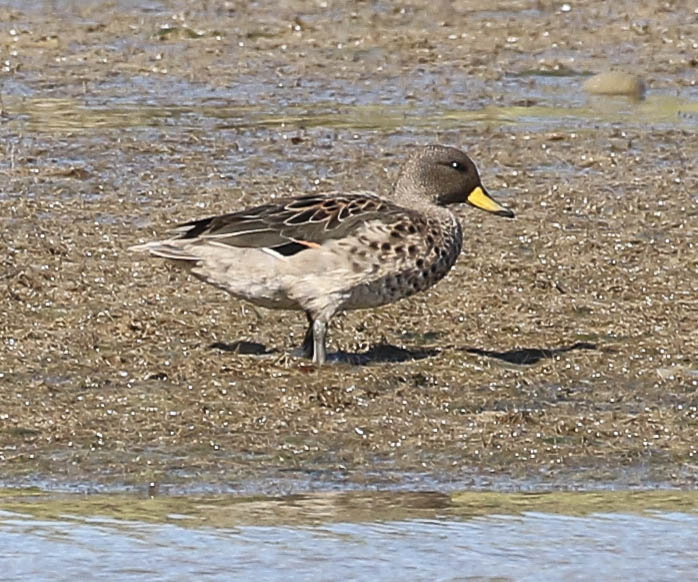
As I walked back to the car, there was a lone Speckled Teal on the lake and a couple of Black-chinned Siskins feeding on the trail.
Speckled Teal: This is the nominate flavirostris subspecies which occurs from North Argentina to Tierra del Fuego, South Georgia & the Falkland Islands
Black-chinned Siskin: This monotypic subspecies occurs from Central Chile & Southern Argentina to Tierra del Fuego & the Falkland Islands
These White Dog Orchids were common Flowers on the forest floor.
White Dog Orchid
White Dog Orchid
Many of the trees had this good-looking Cyttaria darwinii Fungi on them. There were also quite a few trees which google has identified as False Mistletoe in them.
Cyttaria darwinii: This was a common Fungi on the trees along the trail
Cyttaria darwinii
False Mistletoe
It was now getting close to lunchtime and I had a good morning of Ushuaian Birding. I wanted to explore a bit more of the National Park, which I will cover in the next Blog Post.

9 Jan 2023

9 Jan 23 - Argentina - Inland Wetland Pools

After an early look around the small coastal town of Mar Chiquita, I headed off to check out the large cattle estancias, inland from the Mar Chiquita area. It was turning into an increasingly hot day into the low thirties and the air conditioning was much appreciated, as the track was throwing up a lot of dust. I had a number of eBird locations where Red-winged Tinamous has been seen, but it was clearly going to be a hit & miss species and it appeared that some of these sightings had occurred when a Birder had been allowed to drive onto an estancia. In the last Blog Post, I had included the photos of a number of the dry country species seen on the estancias. In this Blog Post, I will focus on the species on the wet pools.
This was one of the better marshy areas
Pied-billed Grebe: This is the antarcticus subspecies which occurs throughout South America
White-tufted Grebe: This is the chilensis subspecies which occurs from South Peru & South Brazil to Tierra del Fuego & the Cape Horn Archipelago
Snowy Egret: This is the nominate thula subspecies which occurs from the United States & West Indies to central Argentina
Snowy Egret: I wonder how often UK Birders check Little Egrets for the bright yellow lores that are found on Snowy Egrets: we could do with another UK Snowy Egret
White-faced Ibis: This monotypic species occurs from the Great Basin of the Western United States to South West Brazil & central Argentina
White-faced Ibis
Roseate Spoonbill: This monotypic species occurs from the Southern United States & West Indies to Brazil & North Argentina
Roseate Spoonbill: This must be the best-looking Spoonbill
Maguari Stork: This monotypic species occurs on the tropical plains & marshes to the East of the Andes
Ringed Teal: This monotypic species occurs from South Brazil to Bolivia, Paraguay, Uruguay & North East Argentina. This was a bonus Tick as somehow we had missed it during our five week Argentinian trip in Nov/Dec 1998
Silver Teal: This is the nominate versicolor subspecies which occurs from South Bolivia, Paraguay & South Brazil to Tierra del Fuego
Silver Teal: They really are a gorgeous Duck
Cinnamon Teal: This is the nominate cyanoptera subspecies which occurs from South Peru & South Brazil to Tierra del Fuego & the Falkland Islands
Red Shoveler: This monotypic species occurs from South Peru & South Brazil to Tierra del Fuego & the Falkland Islands
Speckled Teal: This is the oxyptera subspecies which occurs from the Andes of central Peru to North Chile & Argentina
Bahama Pintail: This species is AKA White-cheeked Pintail. This is the rubrirostris subspecies which occurs from the Pacific coast of Ecuador South to central Chile and Eastern South America from Eastern Bolivia, central & Eastern Brazil & Uruguay South to North Argentina
White-winged Coot: This monotypic species occurs from extreme South East Brazil to East Bolivia & South to Tierra del Fuego
There were still a good number of other species seen on this drive inland of Mar Chiquita and I will cover them in the final Blog Post for the day.

16 Mar 2018

16 Mar 18 - Chile: Halfway to Everest (Lauca National Park): Part 2 Parinacota

The previous Post had covered many of the Landbirds at Lauca National Park. This Post covers the Waterbirds. There were a number of scattered large pools & lakes near the small settlement of Parinacota. Many were distance & realistically I could only scan from the road. I could see good numbers of Andean Geese & other Waterfowl on these lakes or the wet bogs near them. There were many youngsters & I didn't fancy walking out as it was likely to disturb them. I spent a lot of time slowly scanning the whole area hoping I would see a Diameded Sandpiper-plover, but couldn't find any. I reckoned I could spend a long time walking about around the lakes trying to find a DSP. In the end, I hoped retracing my route to the first bog before returning to Parinacota again might be a more successful use of my limited time. It probably was, but it didn't produce a DSP. But there were a few new Waterbirds & Waders to photograph.
Silvery Grebe
Speckled Teal
Giant Coot: Juvenile
American Golden Plover
Andean Lapwing
Grey-breasted Seedsnipe: Male
Grey-breasted Seedsnipe: Male. It is a pity about the wire fence
Least Sandpiper
There were also a couple of Mammals around Parinacota: Vicunas & the bizarre Southern Viscacha.
Vicuna
Southern Viscacha: Although, this looks like a large Hare, it is actually a large Rodent. The body is around 16 inches long & the heaviest Southern Viscachas have been 3 Kg
Southern Viscacha: They like these rocky moist slopes at elevations over 2500 metres & occur from Southern Peru to Western Bolivia, Northern & Central Chile & Western Argentina
Southern Viscacha: This looks to be a perfect life for a Southern Viscacha
Southern Viscacha
By mid-afternoon, I had been up & down the road in Lauca National Park twice & spent a lot of time scanning all the bogs. I had failed to find any Diademed Sandpiper-plovers. It had been a good day in the park. It had clouded over & become a lot colder. So, I decided to head back to Putre & spend an hour or two checking one of the other dry valleys. However, by the time I reached Putre, cold steady rain had set in & I ditched the Birding plan. After a visit to the cafe for a very late lunch, I left for the coast as I was booked into a hotel in Arica that evening. My original plan for the North had been for two nights at Putre. Having seen the hotel, I wasn't worried I had revised the plan back in Jan to only spent a single night there. After I had booked all the flights & sorted the hotels, I heard I could get a morning's pelagic out of Arica & it was planned for the following morning: hence my early departure for the coast. I had cut my time at Putre & Lauca for the pelagic. I reached Arica just after dark, found my hotel & checked in. Then I headed out again to look for the departure point for the Pelagic. We were leaving just as it got light & I needed to ensure I knew where I was going in the morning. Departure point sorted, it was time to get an early night as it was going to be an early start in the morning.