Showing posts with label Tahiti Petrel. Show all posts

31 Oct 2022

31 Oct 22 - Indonesia - Banda Sea Cruise Day 5 - Seabirds On The Crossing From The Tanimbar Islands To The Babar Islands

In the previous Blog Post, I wrote about how we successfully saw a roosting Tanimbar Scrubfowl on Nustabun Island, a small island off the coast of the main island of Yamdena, after Wilbur & Raja returned to look for one after dusk. This had the big advantage that we could start sailing for Babar, our next island, sometime after midnight. This was a better option than getting up & landing on Nustabun Island at dawn for a second search.

It is a journey of around 110 miles and the Lady Denok was probably averaging nine mph (eight knots). The plan was that we would arrive early afternoon, which would give us a bonus opportunity to land on East Babar for a few hours of birding. Had we left the following morning, then we wouldn't have arrived at Babar until after dark, when there wouldn't have been any time for Birding.

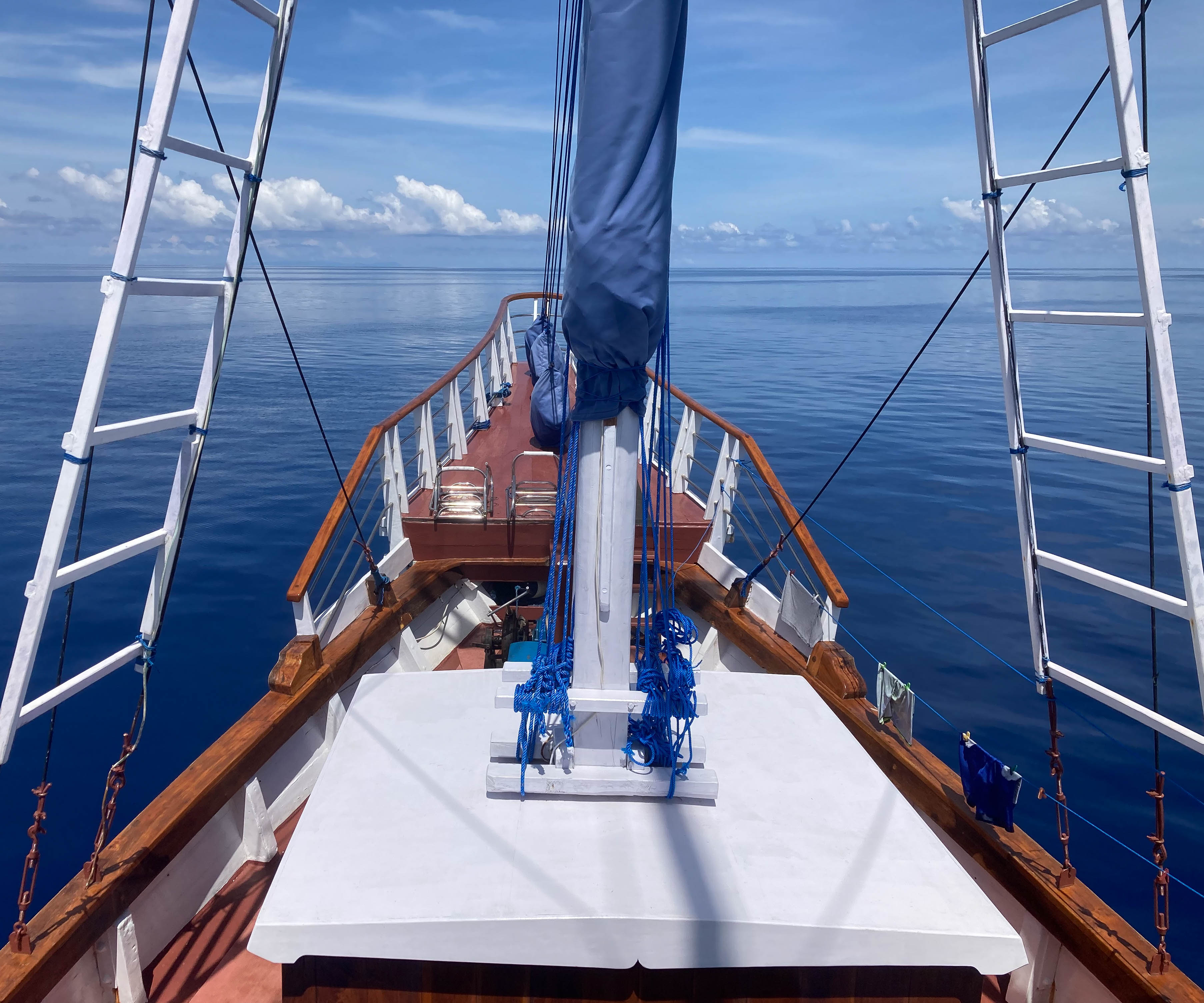
One of the pleasures of travelling on the Lady Denok was we were sailing through very calm seas throughout the cruise.
The Lady Denok: Note the glass-like sea
The Lady Denok: Looking back from the bows. We either seawatching from the upper deck or when the sun was too strong, the covered deck below it
Local fishing boat: I was regularly surprised at seeing these small fishing boats many miles out to sea from the nearest islands
Another local fishing boat
The seas were never busy with Birds or Cetaceans, but several times an hour we would see one or more Seabirds and the occasional party of Cetaceans. The commonest Wildlife encounter were Flying Fish will over 1250 seen. Frustratingly, most of the Seabirds were sitting on the water or on floating objects & then tended to flush at a fair distance. The result was few Seabirds came close to allow decent photographs.
Tahiti Petrel: Tahiti Petrels were one of the commonest Seabirds we saw with at least twenty-five individuals seen during the day
Tahiti Petrel: there are two subspecies of Tahiti Petrel with the trouessarti subspecies breeding around New Caledonia & the nominate rostrata subspecies breeding on Fiji, American Samoa, the Society, Marquesas & Gambier Islands. It is not clear whether one or both subspecies occur in Indonesian waters and it is only in the last decade or two that their occurrence in Indonesian waters has been recognised, e.g. there is no mention of the species in the BOU Annotated Checklist to the Birds of Wallacea published in 1986
Tahiti Petrel
Tahiti Petrel: Another individual
Tahiti Petrel: A third individual
Bulwer's Petrel: The first of two Bulwer's Petrels we saw on this crossing. Bulwer's Petrels became a familiar sight on the crossings as we headed East
Bulwer's Petrel: Another photo of the first individual. Note, the long thin & angled wings
Bulwer's Petrel: The second of two Bulwer's Petrels we saw on this crossing
Bulwer's Petrel: Bulwer's Petrel have a wide breeding range from the Azores, Madeiran, Canary & Cape Verde Islands in the Atlantic, to Round Island in the Indian Ocean and islands off South China, Bonin Island, Hawaiian Islands, Kiribati and the Marquesas Islands in the Pacific Ocean
Bulwer's Petrel: Outside of the breeding season, they wander widely in warmer waters of the Atlantic, Indian & Pacific Oceans
Bulwer's Petrel
Matsudaira's Storm-petrel: I assumed this was another Bulwer's Petrel when I first saw this individual sitting on the water. But after it flew, some of the Australian based Birders called it as a Matsudaira's Storm-petrel. I carried on photographing it, hoping to be able to figure it out from the photos
Matsudaira's Storm-petrel: It is clearly a very worn individual, but it's possible to see the remnants of the white primary covert bar which is a feature of Matsudaira's Storm-petrel & which helps to separate it from Bulwer's Petrel (which doesn't have a white primary covert bar)
Matsudaira's Storm-petrel: The tail should be forked, but like the secondaries, it is very heavy moult
Matsudaira's Storm-petrel: They breed on the Volcano Islands to the South of Bonin Island. Outside the breeding season, they disperse as to the Indian Ocean, Indonesia & as far South in the Pacific as New Guinea
Matsudaira's Storm-petrel: Another photo showing the remnants of the white primary covert bar
Matsudaira's Storm-petrel: Note the very steep forehead which is far steeper than would be seen on a Bulwer's Petrel. Additionally, the wings are shorter & the primaries are broader than on a Bulwer's Petrel
Wilson's Storm-petrel: Wilson's Storm-petrels were another of the common Seabirds seen with at least eighteen seen on this crossing. Frustratingly, they would all fly up off the water at long range
Wilson's Storm-petrel: They are one of the commonest of all Seabirds with a wide breeding range across the Southern Oceans. The nominate oceanicus subspecies breeds on Crozet, Heard & Kerguelen Islands in the Southern Indian Ocean and Macquarie Island. The exasperatus subspecies breeds on the South Shetland, South Georgia and South Sandwich Islands, as well as, in Antarctica. Finally, the chilensis subspecies breeds in Southern Chilean fjords, Cape Horn and perhaps the Falkland Islands
Wilson's Storm-petrel
Great Frigatebird: Note, the lack of white axillaries which would be seen on a Lesser Frigatebird
Brown Booby: Adult
Brown Booby: Adult
Five Brown Boobies and a lone Red-footed Booby
Red-footed Boobies: Adults
Red-footed Booby: Immature
Bridled Tern: Note, the long thin while eyebrow & extensive black crown which is a key feature to separate a lone Bridled Tern from a Sooty Tern. Bridled Terns are also smaller, but size is difficult to judge on lone birds
Bridled Tern: Note, the extent of the white in the underwing on the primaries. Another key feature to separate a lone Bridled Tern from a Sooty Tern
Sooty Tern: A comparison photo showing the darker primaries on the underwing & the broader white eyebrow on a Sooty Tern. Ascension Island (23 Apr 18)
Crested Tern: This was the commonest Tern species that we saw on the Lady Denok during the cruise
Crested Tern: Crested Terns are a widespread species occurring along the coast from Namibia to the Red Sea, through the Indian Ocean to the Indian Subcontinent to South East Asia, China, Philippines, Indonesia, New Guinea, Australia & islands in the Western Pacific
Little Tern: This is the sinensis subspecies which occurs from South East Russia to Japan, South East Asia, Philippines, Indonesia and New Guinea
Little Tern
I will cover the Cetaceans and Flying Fish in the next Blog Post.

15 Nov 2014

15 Nov 14 - Unable To Land Again On Morane

We had spent the previous night offshore of the uninhabited French Polynesian Morane Island, after our excellent day ashore with the Tuamotu Sandpipers & other Seabirds. It had been a wetter exit from Morane in the late afternoon of the previous day. We had been used to wet landings & departures from the coral edge, with water up to our knees at least & sometimes closer to our waists. Fortunately, this wasn't living coral reef so we weren't damaging it. The wave action had turned the old coral into a solid rock beach, albeit one with a lot of sharp edges. When you are standing in the water waiting for the boat to find the right wave to come in on, then it was just luck that determined how wet you got. There was always a couple of the crew with us to ensure we got in & out of the boat & they were likely to be wetter than us, given they were on the coral edge for much longer than any of the passengers. With reef shoes & shorts it wasn't too bad & we dried out quickly in the warm weather or had a shower if back on the Braveheart. All the camera gear had been placed in dry bags that the crew moved separately, so the cameras were protected. The plan for the day was we would have a second landing on Morane. However, the swell had got up overnight & the Kiwi crew who were really confident of being able to get in under challenging circumstances, decided that it was too difficult for us to land. It was a pity, but we had enjoyed an excellent day ashore the previous day & seen all we had expected to see. With the landing off the plan, we were given the chance for a snorkel close to the island. Around half the passengers & some of the crew took the opportunity to get in the water just offshore from the reef. Unlike the Tenararo snorkel, there weren't any Green Turtles on this occasion, but I did see another Black-tipped Reef Shark. Black-tipped Reef Sharks are shorter than me & generally placid in open waters on reef edges, so it was good to see another one.
Back in seawatching mode: There were some homemade seats on the side & back of the top deck
Seating on the front deck was more ad-hoc: Kim, Allan, Tim & Martin (left to right)
After the snorkelling was over, the boat was recovered while we were getting showers, changing into dry clothes & reapplying sun tan lotion. The plan for the rest of the was head off to a sea mount about 20 nautical miles from Morane & try some chumming. Despite several hours of chumming, it was fairly quiet. However, I did see my first Black-winged Petrel & my second Polynesian Storm-petrel. Unfortunately, I stepped back to try & photograph the Polynesian Storm-petrel & found there was a gap in the home-made deck which my foot went through. I gashed my knee, but fortunately, it was only a bad graze. We had made our last landing of the trip & therefore, there would be no chance of it getting infected in a wet landing. There is a higher chance of infections in tropical waters, compared to the UK seas. The worst thing in the long term, was the lack of photos of the Polynesian Storm-petrel.
Steve Holloway, Richard Lowe & Geoff Jones on the back deck: My legs slipped through the narrow gap by the railing
There were around ten of the bulky Murphy's Petrels around Morane Island & the sea mount, as well as singles of Black-winged Petrel, Tahiti Petrel & Polynesian Storm-petrel.
Murphy's Petrel: They are a bulky Pterodroma Petrel with a steep forehead & pale throat
Murphy's Petrel
Murphy's Petrel: This individual has spotted a fish scrap from the chum
Black-winged Petrel: It looks like a fairly typical Pterodroma from above
Black-winged Petrel: Showing the distinctive underwing pattern. It is a pity it isn't in focus, but it's the only one I saw
Tahiti Petrel: This long-winged Petrel with its distinctive two-tone underbody pattern was easy to identify, but they never seemed to perform for the cameras
Tahiti Petrel
Before dusk, we checked out if the seas had moderated around Morane, but they hadn't. We spent the night off Morane, but the seas were as bad in the morning, so the crew decided it was time to start heading back towards the island of Mangareva. The motion from the seas were pretty bad for most of the day & I spent most of the day in my bunk. When I got on deck all I saw were a few Sooty Terns & White Terns.

8 Nov 2014

8 Nov 14 - Topping Up on Petrels

Once the rain stopped, we went back out seawatching from the upper deck around the seamount about 20 nautical miles off Henderson Island. So it was back to the upper deck, which provided a number of places to watch from depending on the wind direction & weather conditions.
Looking forward from the centre of the starboard side
There was a route over the box to the left of the funnel which led to the helicopter deck: It currently held a large storage box with a couple of benches behind
Martin, Kim & Steve relax on the helicopter deck benches: In better weather on 9 Nov
The main highlight of the day was the Polynesian Storm-petrel which appeared in the last Post. But the other highlight were the Petrodroma Petrels seen during the day. Murphy's Petrels and Henderson Petrels were the commonest two species, with the occasional Herald Petrel and Juan Fernandez Petrel. The latter wasn't a species we had expected to see, but we saw one or two on most of the days that we were at sea. Frustratingly, the Juan Fernandez Petrels only ever seemed to be fly by Petrels & could not be attracted into the chum. Additionally, three Pseudobulweria Tahiti Petrels put in an appearance.
Tahiti Petrel: This is a medium-sized Pseudobulweria Petrel with long, narrow wings, a long body and long tapering tail. The bill is particularly thick. It breeds on New Caledonia, Fiji, American Samoa & French Polynesia
Tahiti Petrel: The black head & breast strongly contrast with the white belly & undertail
Murphy's Petrel: This is a medium-sized, heavy-bodied Pterodroma Petrel with relatively short, narrow wings
Murphy's Petrel
Herald Petrel: The key features of this Pterodroma Petrel are the long, narrow wings, pointed tail & relatively slim bill. Plumage wise the key features are the white belly, white lores & throat, smudgy grey breast band, dark undertail, dark underwing with pale band on the primaries which extends to the secondaries & another pale band on the leading edge of the underwing
Herald Petrel: They breeds from Raine Island (in the Coral Sea) to Tonga, French Polynesia & Easter Island
Henderson Petrel: This is a dark, medium-sized, slim Pterodroma Petrel with slim, long & narrow wings, relatively long, pointed tail (which it tends to keep closed in flight)
Henderson Petrel: Apparently, they are not separable at sea from dark phase Herald Petrels, but it should be fairly safe to assume all the dark phase individuals we saw were Henderson Petrels, given how this close we were to the only known breeding site of Henderson Island
Around mid afternoon we headed back to Henderson Island and as we got within sight of the island, we had three Kermadec Petrels heading past towards Henderson Island. Unfortunately, none were close.
Kermadec Petrel: Dark morph. This is a medium-sized Petrodroma Petrel with long, broad wings, short, squarish tail & short, stubby bill. Overall, it is a dark Pterodroma with an obvious whitish flash on the underwing coverts. There is a less obvious white band in the underwing secondaries & on the leading edge of the underwing: neither of which can be seen in this heavily cropped photo. This is the neglecta subspecies which breeds from New Zealand to French Polynesia & Easter Island. Another subspecies breeds on a number of islands off Chile