It was to be a day of driving as we still had 500 miles before we reached the town of Dakhla. The first stop was about 30 minutes South of Tan-Tan, where the road
crosses a river close to the coast. We could see a flock of about 20 Ducks further down the
estuary & after getting closer found they were all Common Scoters,
which I hadn't expected. However, when I saw how rough the sea was
offshore, it wasn't that surprised.
Estuary to the South of Tan-Tan: It's just possible to see how rough the sea was beyond the dunes
Common Scoter: 3 males & a female (top right)
Overall, it was a dull drive South through arid desert areas. The road followed the coast fairly closely to allow some views of the Atlantic. However, given the cliffs are all sandy, it was not too close to the edge. Quite frequently, we saw small fishing huts & tents where locals were scratching a living from the sea. Most of the photos make it look like a great place to get a sun tan. What none of the photos convey, is there is a strong & cold coastal wind making a fleece & coat necessary.
Coastal cliffs: About 60 miles out from here is Fuerteventura, the nearest of the Canaries to the mainland
As we officially crossed into the Western Sahara, we ended up passing through 2 police checkpoints. We were waved through the Northern one, but the second one on the Western Sahara side stopped us. Fortunately, we were prepared for this & the many of subsequent checkpoints with pre-completed forms, answering lots of pointless questions along with scanned copy of our passports. These are essential for any visiting birders, as otherwise you will be likely to be asked each of these questions in turn, so they can be filled into a book. This reduced the questions to a quick exchange of where we were going, which was usually a silly question on a single road going South, with little in the way of towns. Being able to speak a few words of French helped at some of the checkpoints. Note, there is a convention of a stop line about 20 yards before the actual checkpoint stop line. You are expected to stop there & wait to be called forward. On one occasion at 04:30 in the morning & with nobody ahead of us, Richard failed to stop & wait to be called forward (as he missed the line in the dark). We were threatened with a £70 fine for not stopping at the first stop line & waiting. For several minutes, it looked like we were going to be having to pay the fine. But it looks like the police are fairly careful to not fine tourists. On the first day, I was stopped by a police checkpoint which had a view of a large area of hillside. Apparently, it was because I had overtaken a slow lorry where there was a white central line, despite it being completely safe to overtake & no other traffic around. Again the £70 fine was threatened, but we were let off.
Checkpoints are pretty common in the Western Sahara
Dolphin statue: Unfortunately, the closest we came to seeing any cetaceans. Some trips are lucky to bump into Atlantic Humped-backed Dolphins at Dakhla
There were very few towns between Tan-Tan & Dakhla. The exception was the huge, by local standards, city of Laayoune. This apparently has a population of 200,000, about 40% of the total Western Sahara population. There was a massive house building program throughout the city and the cost to Morocco must be enormous. It's hard to see where the people were going to be coming from to populate all the new buildings.
Laayoune: Entrance gate to the city
Laayoune: A typical street view
Laayoune: The large central display ground
After carrying on South for another couple of hours, we reached the small town of Cape Bojador. Not that you would realise it's small size, when you see its entrance gates.
Cape Bojador: Entrance gates are very important in Morocco & Western Sahara
Cape Bojador: The town is on a prominent bend in the coastline & has this impressive lighthouse
Stone-curlew
Stone-curlew: It was depressing at the amount of rubbish in the desert. While this was only a few hundred yards from a small cafe, rubbish was often plentiful miles from habitation, due to the locals habit of throwing everything out & the persistent winds
Camels: We saw a few parties of Camels during the drive
Finally, we arrived at the start of the Dakhla peninsula. This sticking out 25 miles South into the
Atlantic forming an inner bay. As a result, the peninsula seems to be a
very wind swept, but the bay provides shelter for good numbers of
Waders, Gulls & Terns, with Seabirds seen on both sides of the
peninsula. Dakhla is also the only town in the Southern part of the
Western Sahara. 30 miles away, there is start of the 140 mile long road to
Aoussard (also known as Awsard), which is one of the few roads heading
inland in Southern half of Western Sahara. About half way along the peninsula, there is a wide sandy bay which looked good for birding. Unfortunately, in the strong cold coastal winds we experienced throughout our stay, the bay was heavily disturbed by kite surfers.
Kite surfers in Dakhla Bay: Unfortunately disturbing the Waders
Closer to Dakhla, there were a number of camper vans on the sand cliffs overlooking the bay. There seem to be a lot of Europeans who come down to the Western Sahara for the winter (along with their satellite dishes to pick up better TV than the local Moroccan's service). Also perched up on the cliffs was a small flock of Gulls & Terns, containing Audouin's & Lesser Black-backed Gulls, Royal, Caspian & Sandwich Terns.
The mixed Tern & Gull flock with a Caspian Tern behind the Lesser Black-backs: The far side of the bay, about 6 miles away, can be seen in the distance
Audouin's Gull: Adult with Royal & Sandwich Terns
Lesser Black-backed Gull: Adults with a 1st Winter
Royal Tern: With a 1st Winter Audouin's Gull
Royal Terns: With the commoner Sandwich Terns
We arrived at the pre-booked Hotel Palais Touareg close to dusk. This was to be our base for the next 5 nights.
This was a moderate quality hotel on the bay's edge. Like the
neighbouring hotels, it didn't serve any food, apart from croissants
& decent coffee in the cafe. We found the staff were very helpful in the hotel & one spoke a reasonable amount of English.
There was an OK restaurant on the water's edge closer to the town
centre.


 Turnstone
 Turnstone
 Audouin's Gull: Colour ringed adult. The left leg is white over pale green & the right leg has a metal ring with 61 (perhaps 615) on it
 Audouin's Gull: Close up of the ring
 Audouin's Gull: Colour ringed 2nd Winter.
The left leg has a wide white ring with BN7C on it & the right leg has a metal
ring
Audouin's Gull: Colour ringed 2nd Winter.
The left leg has a wide white ring with BN7C on it & the right leg has a metal
ring  Audouin's Gull: Close up of the ring
 Audouin's Gull: 1st Winter
 Caspian Tern
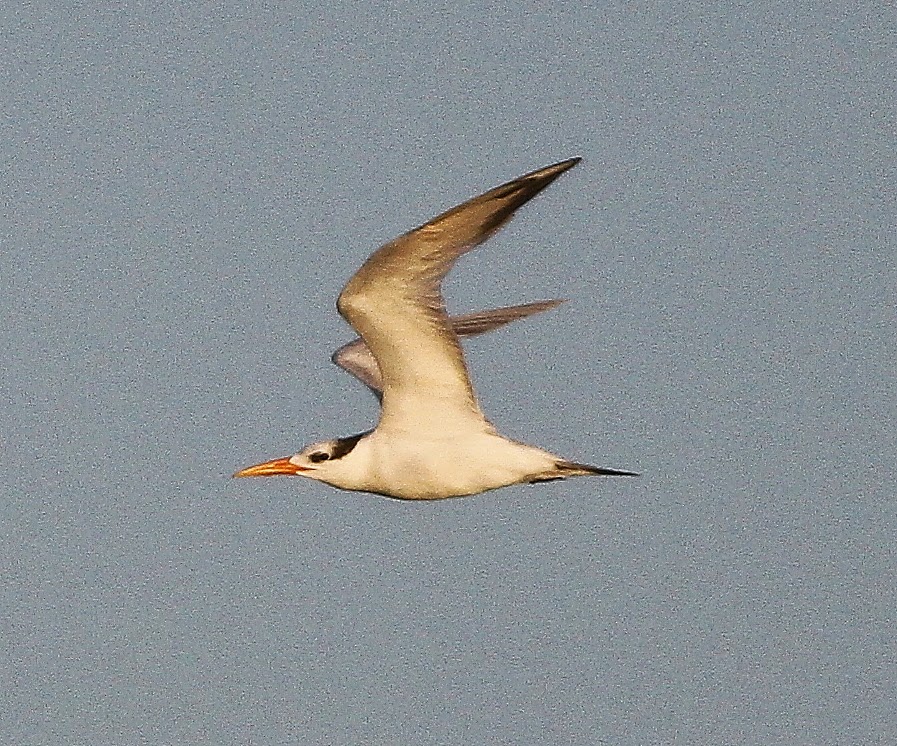 Royal Tern: This is the albididorsalis subspecies of African Royal Tern. I think that the ones that have turned up in the UK before are the American maximus subspecies
 Royal Tern
 Sandwich Tern
 Sandwich Tern
  Hoopoe Lark
 Hoopoe Lark
  Black Wheatear: The brown colouration and T shaped tail pattern with the tail broad band confirm this is a Black Wheatear, rather than an immature White-crowned Black Wheatear


