Showing posts with label Common Darter. Show all posts

20 Jun 2025

20 Jun 25 - Highland Darters

After a couple of excellent ORCA surveys out to the Western Isles, I headed back to the Beinn Eighe area. The forecast was looking good for warm and sunny weather for the next couple of days and I wanted to prioritise looking for the Scottish Dragonflies I hadn't seen. In reality, that plan would have been blown out of the window, as I was well positioned if the pod of six Sperm Whales off Burghead the previous afternoon and evening were still in the area. But fortunately for them, they had moved back out into the North Sea. The first site I tried was a clearing mentioned in Watching British Dragonflies by Dudley, Dudley and Mackay near the Beinn Eighe picnic area. I saw a couple of sightings each of flyby Hawkers and Emeralds, which was an improvement on my previous visit before the ORCA surveys, when neither species were flying in the dull weather. But the views were too quick to get any photos or be sure what species I was seeing.
The clearing mentioned by Dudley et al: I'm sure that I would have sorted out the flyby Hawkers and Emeralds at this site, if I had waited until it started to cool down
The only large Dragonfly I saw well in the area was a Golden-ringed Dragonfly. Typically, it was happy to land and pose for photos.
Golden-ringed Dragonfly: They seem happy to pose low down for photos, even when it's hot
After an hour or so, I headed back to the car and onto the Beinn Eighe Visitor's Centre. My timing was good as I bumped into one of several people I met in the Beinn Eighe area who was looking for Scottish Dragonflies. But this was the first person who had actually seen Azure Hawker and Northern Emerald. There was a good area for both species by taking the path behind the Visitor's Centre and then bearing left whenever the path forked. After a few hundred metres the path runs parallel to the road and goes over a small wooden bridge. This guy had seen both species about one hundred metres after the bridge. They were generally flying high, but had come down to ground level as it cooled down on the previous afternoon. It sounded like it could be a long wait. As I approached the recommended area, I saw a couple of Highland Darters resting on waist-high bushes.
Highland Darter: It's a good thing I stopped for some photos, as I couldn't relocate them when I looked later in the afternoon
This was an unexpected bonus as they were generally expected to start flying around the start of July. But they must have emerged early in the recent good Scottish weather. I have two Dragonfly books from the early 2000s, both of which treat Highland Darter as a separate species from Common Darter. However, there are comments that the taxonomy wasn't finalised and it might be a Highland subspecies of Common Darter. It looks like it is now treated as a subspecies of Common Darter based upon the British Dragonfly Society and National Biodiversity Atlas websites.
Highland Darter: This is now the nigrescens subspecies of Common Darter. They are very similar to Common Darter, but with more extensive black bands at the base of the abdomen
A Dorset Common Darter: Rempstone Forest (3 Aug 14)
Another Dorset Common Darter: A young Male at Arne (11 Jul 14)
Soon after I joined John, a Manchester-based Birder and Dragonfly watcher to look for the Azure Hawkers and Northern Emeralds. While we were looking, this Small Pearl-bordered Fritillary dropped into the grass briefly, before flying off, never to be seen again.
Small Pearl-bordered Fritillary: The large number of white segments on the hind underwing separates this species from Pearl-bordered Fritillary
Small Pearl-bordered Fritillary
I will cover the search for Azure Hawker in the next Blog Post.

28 Jul 2024

28 Jul 24 - Silverlake Dragons

I covered the group of Male Scarlet Daters at Silverlake in the last Blog Post. This Blog Post covers some of the other Dragonflies at this superb Dragonfly site. The common large species were Emperor Dragonflies. There was also at least one Lesser Emperor which flew past me in the early afternoon, but it carried on flying. I heard that one had landing in the trees at the other end of the lake which allowed the opportunity for photos, but I didn't hear that news until well after the event.
Emperor Dragonfly: Male. There were a few whizzing around the lake, but this one landed for long enough for a photo
Other Dragonflies & Damselflies I saw included Common Darters, Black-tailed Skimmers, Keeled Skimmers, Beautiful Demoiselle and Small Red-eyed Damselflies. There were also plenty of Blue Damselflies, but none of them were seen close enough to identify them: they would have been Azure Damselflies or Common Blue Damselflies.
Common Darter: Male
There were plenty of Water Striders around the water's edge: they are one of the two large UK Pond Skaters species.
Water Strider: The other large Pond Skater species is River Strider, but this species prefers moving water
Water Strider: Mating whilst feeding on a dead Damselfly
Around the water's edge, there were good numbers of Backswimmers or Great Water Boatmen as they used to be called. This is a generic name for four species in the Notonecta family.
Backswimmer sp.: This appears to be one of Notonecta family of Backswimmers. There are four UK species, but without catching it & seeing the upperside of the body, it isn't possible to identify down to a species. The brown legs could indicate it is Common Backswimmer (Notonecta glauca)
This might be a large Caddis Fly sp.: It was still struggling, but it was unlikely to reach somewhere where it could pull itself out of the water. Therefore, it is likely to end up as food for something else, perhaps the Water Striders

3 Aug 2014

3 Aug 14 - Beautiful, Black, Blue & Emerald

With no joy in the first 2 bogs tried, I carried on into Rempstone Forest to check out the final local historical site for Scarce Blue-tailed Damselfly. En route, there were a few commoner Dragonflies, Butterflies & a Wasp Spider. For those of you that don't like Spiders, well don't go to the bottom of the post. But best to continue as this is one of the best looking UK Spiders. But first there was a great Helice Clouded Yellow. Clouded Yellows are a great migrant Butterfly that appear in varying numbers in Dorset. A smaller variable percentage come in the pale Helice form. This only affects females (like the Valesina Silver-washed Fritillaries), but I've yet to understand why only females have this aberration.
Clouded Yellow: Helice female. A percentage of the females have a pale form know as a Helice, where the butterfly is much paler than the normal dark yellow colouration. They are even whiter on the upperwing
Clouded Yellow: This is the typical form taken at Fontmell Down as part of the same recent invasion (30 July 14)
 
Common Blue
Common Blue
There were also a few Black Darters, Common Darters, Beautiful Demoiselles & a good selection of Emerald Damselflies. But unfortunately, the Scarce Blue-tailed Damselfly site was as dry as a bone. So no chance of any there.
Black Darter: Male
Common Darter: Female
Common Darter: Female closeup of the face. The black line above the frons (nose) does not turn down by the side of the eyes & this is diagnostic of Common Darters: it turns down in all the other species
Common Darter: Female. the 2 yellow bands on the side of the thorax also confirms it is a Common Darter
Beautiful Demoiselle: Male
Emerald Damselfly: Male. The pale blue covering the first 2 segments in Emerald Damselfly & the pterostigma are long & relatively thin separate this from a Scarce Emerald Damselfly (which has the pale blue over the first & half of segment 2. Scarce Emerald also has a broader, shorter pterostigma
Emerald Damselfly: Female.
Emerald Damselfly: Female. Emerald Damselfly has a narrow white stripe on the side of the thorax and an isolated green spot just above the middle leg. Scarce Emerald does not have the green spot and the white stripe on the side of the thorax
Emerald Damselfly: Immature female
Emerald Damselfly: Immature female. Just about possible to see the green spot & the orange side stripe on the thorax
Finally, the Wasp Spider. I remember seeing my first Wasp Spiders at Radipole in the early 80s. In those days, they were apparently reasonable well established on the Kent to Dorset coastline, having only been found for the first time in the UK in 1922 in Rye, Sussex. I don't know how they got there in the first place from the continent. They have expanded their range considerably since & are now well established from Cornwall to Suffolk, with scattered localities elsewhere as far as Birmingham.
Wasp Spider: Female. This is a female, the males are much smaller than this large Spider

27 Jul 2014

27 July 14 - Nearly A Hat Trick

It is now that time of year when Dorset people who are interested in Butterflies start talking in excited, almost reverent, tones about Alner's Gorse. This is a Butterfly Conservation reserve in North Dorset which is home to 3 of the 4 species of Hairstreak Butterfly that occur in Dorset. I wouldn't be surprised to hear that the Spring flying Green Hairstreak occurs as well. Even better, if you time it right you might see all 3 of the Autumn Hairstreaks on the same day. These 3 Hairstreaks are small, easily overlooked, species which often spend a fair bit of time in the treetops of the respective favourite trees, but will come down to nectar or sit on lower vegetation. At this point, they should be easy to see & photograph, but as they can sit still for relatively long periods of time, they are easily overlooked until they fly back up high again. Still it would be boring if all Butterflies were as easy to see as Gatekeepers. A couple of visits this time last year resulted in me adding all 3 species to my Dorset Butterfly list. However, I only managed to photograph 2 of the 3 species. So I was keen to go back again this year to try for Brown Hairstreak photos, as well as hopefully see the other 2 species again.
Alner's Gorse: Great looking habitat for Hairstreaks
Alner's Gorse is a good sized reserve and somewhere it would be possible to spend most of a day exploring. However, I had plans for the rest of the day, so had decided to try & limit my time there on this visit. I had heard that people had recently seen a Brown Hairstreak around the small car park, so I wasn't in a hurry to head off to explore the reserve. After spending about 10 or 15 minutes chatting with a couple in the car park, I suddenly spotted a female Brown Hairstreak only a couple of metres off the ground. She had probably been happily sitting there for longer than I had been looking. There was a quick dash back to the cars for cameras, before the chance for enough photography to impress a paparazzi photographer (except for the lack of a flashgun). But we had a real celebrity who knew how to pose for the cameras, rather than the self inflated pretend celebs the paparazzi seem to focus on.
Brown Hairstreak: Female. Females are a lot brighter than the males & have a larger orange patch on the upper forewing (not that I've ever seen the upperwings). I like the black & white banding on the feet and the bright yellow tips to the antenna (details I never notice in the field, but are very apparent on the photos)
Purple Hairstreak: Female. Looks like this one has been around for a while
Purple Hairstreak: Female. The purple is restricted to the base of the upper forewing, it would cover nearly all the upper forewing in a male
Purple Hairstreak: Alner's Grove (13 July 13). On its favourite Oak tree. Note, while the underside of the hind wing has a letter W where the white almost lines up with the white on the upperwing
Unfortunately, no sign of any White-letter Hairstreaks while I was there, but I a couple of tatty individuals had been seen before I arrived. So here is the White-letter Hairstreak from last year (taken with my little Lumix camera).
White-letter Hairstreak: Alner's Grove (4 Aug 13). Note, the underside is superficially similar to Purple Hairstreaks, but the letter W has the left side of the W sharply angled back towards the head
There are plenty of other Butterfly species present at Alner's Grove. I've seen 21 species without making too much effort over 3 visits at this time of year in 2013 & 2014 and there are a number of other fairly common species which occur at the site that I've not seen. Generally my visits have been focused around seeing Hairstreaks & I've not spent as much time as I should have exploring the wider reserve. Two of the other good species here are White Admirals & Silver-washed Fritillaries.
Peacock
Comma
Ringlet
Gatekeeper
Speckled Wood
Having seen & photographed a Brown Hairstreak & had some bonus photos of Purple Hairstreak, I was keen to push on to the second part of my plan for the day: to look for a new Dragonfly on the Somerset Levels. You will have to wait for the next post to find out which species this was & how I got on.
Common Darter: The new Dragonfly is more exciting than this species

21 Jul 2014

21 July 14 - Caught Out By A Conman (Darter) Or The Pitfalls Of Darter Identification

If you're going to write a blog or publish stuff in another format, then there is always the risk that you will misidentify something. I've seen this on other blogs, where people have made errors & it's interesting looking at the different reactions. Some put their hands up & admit to the error, others probably change things very quietly hoping nobody spots they have made a mistake & on a few occasions, I've seen people carry on with the error regardless of the facts. Another reaction I've seen from a well known figure & prolific tweeter has been to suddenly go quiet for a few hours after being told he has made a mistake. I'm looking forward to his next mistake to see if this was pure coincidence or another interesting approach. My approach is to put my hand up to the error & try to learn from the mistake, so I don't make it again. 

Over the weekend, I was finally looking at some old photos from a couple of years ago & labelling them. I found this Darter photo from Dorset's newest birding site, Longham Lakes. This has been well watched over the last four years since the gravel extraction phase at this site ended. I didn't look at this photo really closely, but labelled it as a Red-veined Darter.
Darter: Longham Lakes (18 Aug 12)
This went out as an email on the local email group as I don't remember any records of Red-veined Darters for this site. It prompted a swift & private response from my sharp eyed mate, Steve Morrison, asking whether I had attached the right photo as this was a Common Darter. A quick look in this case, revealed he was right, as I couldn't even see any red veins on it. I had been going on the red pterostigma (the red cell at the end of each wing) & hadn't really checked the photo more carefully. Oh dear. Should have looked at the photo and the books a bit more closely. At this point, I forwarded a photo of the Red-veined Darter taken at Arne recently to ensure that I hadn't screwed that one up as well. That one had red veins, but having re-read the Dragonfly guide, the pterostigma should be yellow-brown with a dark line above & below and alarm bells starting ringing about this one. But on balance, I still thought this would be OK. 
Darter: Arne (11 July 14)
The email back from Steve confirmed that this too was a Common Darter. I quickly contacted Brett Spencer as Brett probably knows more about Dragonflies than anybody else I know who now lives in Dorset. Steve lives in France these days so I don't have to try comparing their knowledge (phew hopefully that will avoid a legal action!!!). A quick response from Brett confirmed the Arne Darter was a young male Common Darter. So that's now two misidentifications & the Arne Darter was already published on the blog. I only had time last night to quickly add a brief update to that post, but have now changed it. But rather than adopt the approach of constantly rewriting history like the Ministry of Truth in George Orwell's classic book 1984, I thought I would try to get the features sorted properly this time. I've often tried to make the blog a bit more interesting than a diary of what I saw when I went out. So I've tried to add a bit more to the blog, e.g. subspecies & ranges or the features which make this species what it is. My worry now was have I mislead anybody else due to my errors.
Common Darter: Arne (11 July 14). Common Darters have 2 obvious yellow stripes on the sides of the thorax
 Common Darter: Arne (11 July 14) They also have yellow stripes on the black legs (would be all black in Ruddy Darters). The facial pattern has the black above the frons [nose area] extending as a line, but not going down the sides of the frons (which it would do in Red-veined Darters). The eyes are reddish-brown with yellow or green below & get redder with age, but never getting as deep red as on a Ruddy Darter
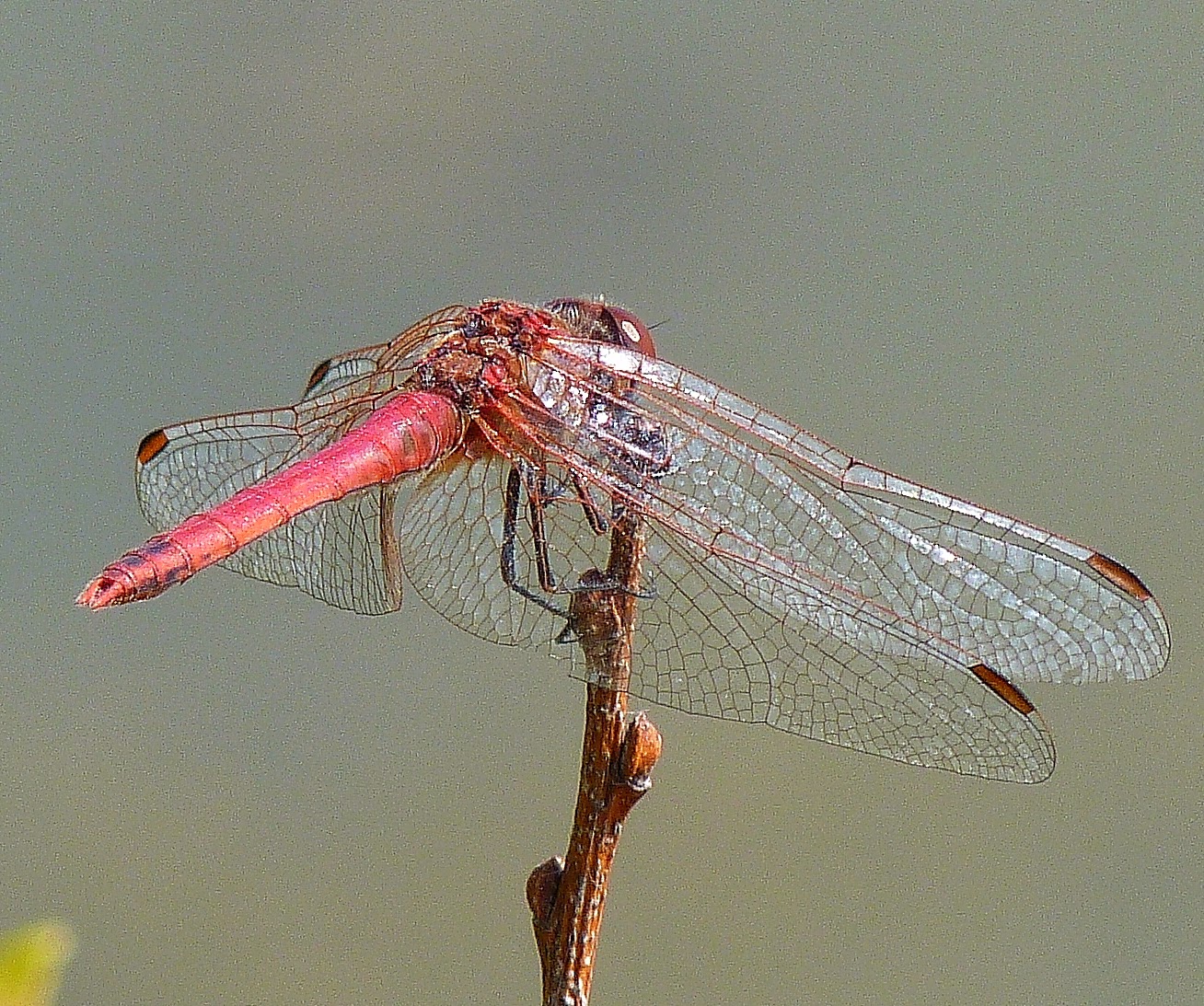
Common Darter: Arne (11 July 14). Males have an orangey-red abdomen. Clearly, from my photos the pterostigma colour can vary from greyish in the first individual to red with a touch of yellow in this individual. Note, the lack of yellow bases to the hind wings
Here are the comments from Steve on the above individual: The Arne photo gives the impression of something good based on the colouration of the veins, but not enough to be Red-veined and they really are red or orange-red in Red-veined. Common Darters have the most parallel sides of the Sympetrums. There is variation in Common Darters, as with many Dragonflies and some do show coloured veins. The Arne one being closer to the extreme than most. The pterostigma on Common invariably appear reddish and usually dark, but sometimes pale, but invariably reddish. Brett added that a Red-veined Darter would only ever have this extent of red on the pterostigma on an old male.

I did send Steve my final photo of a Red-veined Darter from West Bexington last year. I was confident about this one as the local birders, Mike Morse & Alan Barratt, took Peter Moore & myself to this site & others including Brett had also seen them earlier in their flying period. But there was always the possibility I had photographed a wrong individual, but this time I thought I was right. This got a thumbs up from Steve, so it can stay on my Life & Dorset list.
Red-veined Darter: Note, the brick-red abdomen, yellow-brown pterostigma with dark borders & yellow basal patches to the hind wings (although Common Darters can show this, but not as extensively). The red veins are mainly on the basal part of the leading edge of each wing. Unfortunately, I've not got a picture of the facial pattern to see the black ending down the sides of the frons. Other features to look for are the brown thorax lacking pale stripes, the eyes of males are reddish-brown above and blue below (but all are hidden on the photo by the wings) & the black legs have a yellow stripe on them
Steve has added the following comments against this individual. The veins in this individual are actually relatively indistinct for a Red-veined Darter and close to the Arne Common Darter, but they are always more extensive than Common Darters. Also note the more subtly pinched-in look at the Red-veined Darter abdomen (not applicable in females). Also the pair of red tips on the ante-alar ridge [part of the edge of the thorax in front of the front wing bases], just in front of the red tegulae [the bit where the wing joins the thorax] are more diagnostic of Red-veined Darter, than Common Darter. On a Common Darter, this area usually looks pale contrasting with the red tegulae, as seen on the Arne Common Darter. Wow got a couple of new bits of anatomy into the post, which I had to look up on the internet. I've added my layman's explanation in square brackets.

Overall, it has been a good learning experience for me. Many thanks to Steve & Brett for their comments on the Arne individual. Also thanks to Steve for having a proof read of this post to make sure it was OK before publishing it. Can't wait to get back out now to have another closer at Common Darters and hope that some more Red-veined Darters appear in Dorset this year, to get a better view & photos of them.

11 Jul 2014

11 July 14 - Dragonfly Bonanza At Arne

The sharp eyed of you might have spotted this post has changed title. Originally, it referred to a Red-veined Darter in the title, but it can no longer do so, given the Darter photographed was a Common Darter. Rather than into the reasons why here, I have just corrected this post. But I will be publishing another post in the near future on the pitfalls of Red-veined Darter and Common Darter separation.

My mate, Brian Field, was up from Cornwall for the day to look for the Swallowtails. However, before heading out to look for the Swallowtails, I had planned a day of birding & wildlife photography to showcase some of my local patches. Before we even left the house, there was the first chance for some photography when I had a look at my large pond.
Southern Hawker: Just emerging from its larva case & still pumping its wings up. They are erratically seen around the garden. But it looks like they are fairly common in the pond, as there were 3 empty cases on the Iris and there are a number of similar sized larva in the pond
The first stop was an early visit to Middlebere to catch the rising tide. A few returning Waders including the first 2 Green Sandpipers, a Greenshank, 5 Dunlin & 124 Black-tailed Godwits, but no sign of the Spoonbills today. We moved swiftly on to Arne to look for Dragonflies. As we walked out to the Dragonfly ponds near the Shipstal hide, we heard the first returning Whimbrel for the Autumn. A couple were later seen from the hide. But the main reason for the visit was to look for Dragonflies & here we were not disappointed. Walking out to the Dragonfly ponds was our first Arne Dragonfly: another Southern Hawker.
Southern Hawker: Separating the Hawkers isn't easy until they perch up. This is a Southern as the pale blue on final 2 segments of the abdomen form a solid across the segment. Common Hawker & Migrant Hawker (the other 2 most likely contendors in Dorset), both have the same double semi-circular markings as on the rest of the abdomen segments
This was the interesting Darter which I mistood to be a Red-veined Darter. It is just a well marked young male Common Darter.
Common Darter: Young Male Still not fully mature as the abdomen can get a brighter red
Common Darter
There was a good selection of other Dragonfly species around the ponds. In total, we saw 12 species at Arne: Southern Hawker, Brown Hawker, Emperor Dragonfly, Keeled Skimmer, Four-spotted Chaser, Common Darter, Emerald Damselfly, Red-eyed Damselfly, Large Red Damselfly, Small Red Damselfly, Blue-tailed Damselfly & Azure Damselfly. That's pretty good, given there are only 29 regular Dragonflies & Damselflies in Dorset (excluding a few vagrant species). The Red-eyed Damselflies were a highlight for me as I didn't realise they occurred here. Unfortunately, I failed to get any photos of them. Given the number of species present, I was trying to focus on photographing species that haven't yet appeared on this blog.
Four-spotted Chaser
Common Darter: Note, the dark pterostigma & the diagnostic 2 yellow bands on the thorax. Another not fully mature Dragonfly: the abdomen will get a more uniform red colouration in time
Emerald Damselfly: There are three other uncommon Emerald damselflies that have fairly recently established themselves in Kent & East Anglia, but currently this is the only species in Dorset. This is still not fully mature, but it is possible to see that there is pale blue on the first & second segments of the abdomen (in time the green centre of the second segment will turn blue). The similar looking Scarce Emerald has pale blue only on the first & the top half of the second segment
Small Red Damselfly: Male. This is a smaller & weaker species than the Large Red Damselfly. The all red abdomen indicates it's a Male Small Red Damselfly & the red legs also confirm the identification (Large Red Damselflies have black legs)