Showing posts with label Razorbill. Show all posts

30 Jun 2022

30 Jun 22 - #30DaysWild Day 30 - Clearly Not In Dorset

For the last fifteen years, I thought I had seen a Turkestan Shrike in the UK at Buckton, after seeing the UK's second record of Asian Brown Flycatcher at Flamborough in 2007. At that time, it was a subspecies of Isabelline Shrike. With 'another' Turkestan Shrike being pinned down at Bempton, I thought I had better double check the status of this record on Tuesday evening. I knew the Buckton individual was being touted as a Turkestan Shrike when I saw it & I knew it was accepted by BBRC, therefore, I had thought I was OK.

When I read the BBRC report for 2007, I saw report said "Collectively, these [features] all point to a seemingly clear example of what is assumed to be a young L. i. phoenicuroides ('Turkestan Shrike'). Its rather greyish cast and lack of obvious rufous above pointed towards it belonging with greyer birds included within 'karelini': a poorly understood and highly variable form closely allied to phoenicuroides, but possibly just a distinctive colour morph of that taxon". On the face of it, then it had seemed OK as a Turkestan Shrike.

A bit more checking showed it wasn't listed on the RBA database of previous records as a Turkestan Shrike. Time for some more reading about karelini. Fifteen years on & the position of karelini doesn't seem to be a lot clearer as to whether it is a colour form of the species, with other suggestions that it might be a stable hybrid population with Red-backed Shrike. Had I checked this earlier in the week, then I could have seen it on Tuesday. I couldn't go on the Wednesday as that is my volunteering day on the DWT Brownsea reserve. I spent that day worrying that the Turkestan Shrike would do a bunk on Wednesday night, especially as I had just had to strike the Buckton record off my list.

Fortunately, news came through on Thurs AM that the Turkestan Shrike was still showing at Bempton, albeit at long range. I was on the road North to Bempton before 08:30. This is a journey I think the car can do on auto pilot, given I visited Bempton Cliffs four times last year as I was keen to see the Black-browed Albatross in England (a list I keep for a bit of fun). But the reality is Bempton Cliffs is the prime English Seabird spectacle, especially as no boat is needed a boat to access the site. This makes it a really enjoyable place for anybody who likes Seabirds.

The Turkestan Shrike had proved to be elusive at times on the previous day, but that was as it was spending a fair bit of time on the adjacent Wandale Farm. A group of Birders had been able to arrange access to the farm for £10 per person where it was showing well at times. I arrived just around 15:00 and the latest update suggested the farm was the best option. The farmer's son was collecting the money and he confirmed it was still in the bushes close to the farm buildings. There were around a dozen Birders watching it.
Turkestan Shrike
After a while it flew, it reappeared around the other side of the bushes in the farm yard. It provided even better views than the initial views & it was about 20 metres away from us. I don't think I've ever been that close to any Shrike in the UK or abroad. It was quite unconcerned about us & the others were well behaved & just enjoying the views.
Turkestan Shrike
Turkestan Shrike
Turkestan Shrike
Turkestan Shrike: Well worth the £10 entrance fee, given some of the Birders on the previous day had complained about distant views at 150 metres
Not all the locals were impressed by the new visitor. There were at least ten Tree Sparrows, as well as, a House Sparrow in the same area & they were far from impressed with the Turkestan Shrike turning up.
Tree Sparrow: Although I see Dorset Tree Sparrows every two or three years in October, they have all been Vis Mig individuals & if they perch up it is for no more than one minute, before departing again. Most have only been in flight views
Tree Sparrow
After a couple of hours or so, the Turkestan Shrike flew across the field into the next hedgerow. The farmer's son was happy for us to walk along the normally private field edges to the Bempton Cliffs. Eight minutes late I was there, about a half mile South East of the Staple Newk viewpoint. Right in front of me were some very showy Razorbills. It would have been rude to not take some photos.
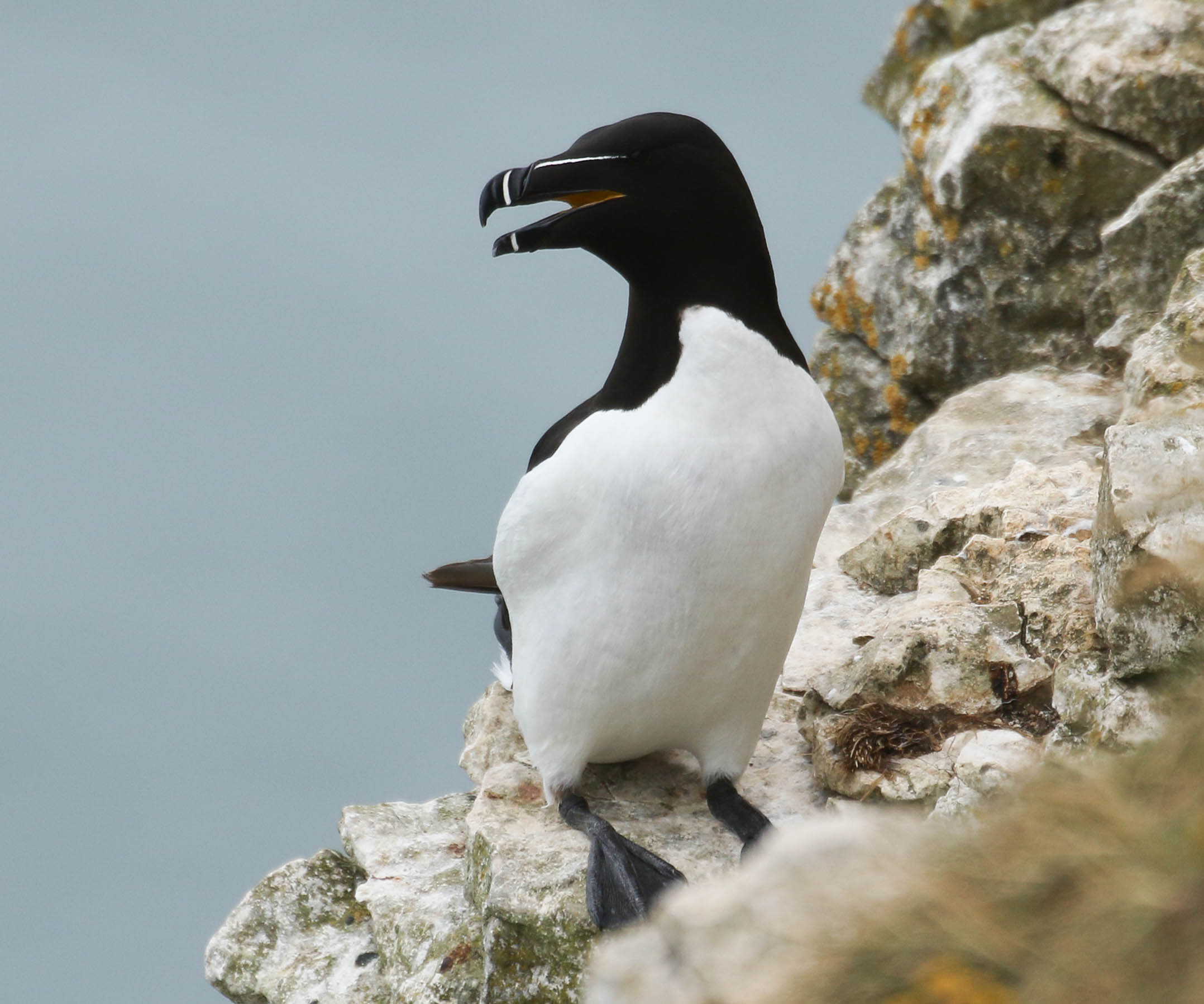
Razorbill: You don't get views of Razorbills this close on the Purbeck coastline
I walked a couple of hundred metres towards Staple Newk to see if the people there could see the Black-browed Albatross, as that had been seen sitting on sea earlier in the afternoon. I stopped to talk to a Birder & his wife, who said, that the Black-browed Albatross was sitting on the cliff.
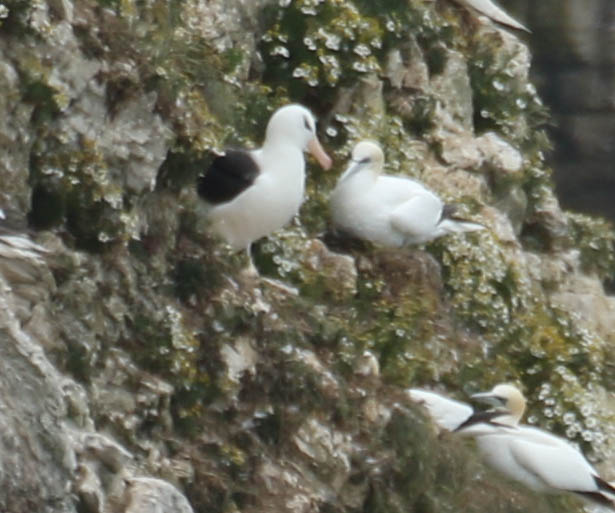
Black-browed Albatross: All very easy compared to the times I kept missing it in 2021
The people at Staple Newk couldn't see the Black-browed Albatross. I passed an update onto RBA & waited for a few people to appear, so that others knew where to look. The temperature was cooling down, so I decided to wander back for another view of the Turkestan Shrike. When I got back to the farm, it was in the hedgerow one field away. I clearly wasn't going to get better views & decided that it was time to start the six hour journey back in the daylight.

13 Jun 2022

13 Jun 22 - The Isle Of Purbeck Pelagic

Back in June 22, I was lucky to be invited by my friend Mark Singleton, who is one of the local National Trust team, to join one of the annual breeding Seabird surveys that are carried out by Footprint Ecology for the National Trust. The survey covers the Purbeck coast from Durlston to St Aldhelms and along the cliffs to Old Harry. We left Swanage on one of the small fishing boats and sailed past Durlston as far as St Aldhelms, before returning along the same coastline. The only problem with the trip, we were warned we would be out from 09:00 to early afternoon, which turned into mid-afternoon & there wasn't a toilet on the boat. Therefore, it was a case of skipping breakfast and limiting myself to a single cup of tea for breakfast.
Durlston Castle: Durlston Castle is a Victorian folly & restaurant that was built in the four years before its completion in 1891 by George Burt. Burt made his fortune running the family firm, Mowlem, who mined and shipped Purbeck stone to London. The Castle was the centrepiece of his Durlston Park. It is now owned and run by Dorset County Council as the centre for Durlston and the start of the Jurassic Coast World Heritage Coastline
The Tilly Whim Quarry at Durlston: This old quarry area is now closed off as the underground quarry works are in a dangerous state
My Durlston Seawatching location: This is where the lighthouse gully reaches the sea and it provides the lowest point for seawatching at Durlston. There is a similar low point at St Aldhelms: but it is a mile & a half walk from the car park to the start of the steep track to the base of the cliffs which includes a short climb up & down one part of the path
Approaching the Durlston Lighthouse & one of the Mile Markers
Looking West from Durlston
Durlston Climbers: There is a part of the Durlston Country Park where climbing is allowed which is well away from the Seabird ledges
Durlston Climbers
Durlston Climbers
As we passed the Durlston cliffs, we started to see the first of the Seabirds. Durlston has the highest densities of Seabirds on the Purbeck coastline. The vast majority of the Auks are Guillemots, with a small percentage of Razorbills. There are some breeding Fulmars, Shags, Herring Gulls and a few pairs of Kittiwakes. The Purbeck speciality is easily the handful of pairs of Puffins in the Dancing ledge area.
Fulmars
Guillemots: There are good numbers of Guillemots on the Durlston undercliffs
Debbie & Durwyn surveying one of the Guillemot ledges: The counts are supplemented with photos of all the cliffs, so that the field counts can be confirmed from examination of photos. These photos will provide additional information for comparing results from one year to another
More Guillemots on the undercliff at Bird Cove which is West of Dancing Ledge
Guillemots
Guillemots
Guillemots
Guillemot
Bridled Guillemot: The bird of the day was this Bridled Guillemot. This is a colour morph which increases going North in the Guillemot range. They are scarce in Dorset, but commoner in the Shetland Islands. It is the first I've definitely seen in Dorset
Razorbills & Guillemots: This photo is good at showing the black Razorbills from the browner Guillemots
Razorbills & Guillemots
Blacker's Hole: This is one of the sea caves at Blacker’s Hole & it is home to the last small colony of Purbeck Kittiwakes: we saw six occupied nests
One of the Kittiwake nests
Kittiwake: This first Summer Kittiwake was hanging around the colony
Herring Gull: This Herring Gull looks like it is still incubating
Herring Gull: This Herring Gull nest has two healthy-looking chicks
Peregrine: This is one of the Durlston Peregrines
Little Egret: One or two of the Poole Harbour Little Egrets feed along the Purbeck coastline
Dancing Ledge: This is another ex-quarrying area which is now part of the National Trust coastline to the South of Langton Matravers
Dancing Ledge: As we passed Dancing Ledge, this group of school kids were preparing for a coastal activity of some sort. Good to see they were all wearing safety gear & wetsuits
The Dancing Ledge area and the Portland West Cliffs are the only known parts of the Dorset coastline where Puffins still attempt to breed. There are no more than a few pairs in the Dancing Ledge area. I don't think anybody has been able to confirm successful breeding for a number of years. However, I doubt there are many people actually looking along this part of the Dorset coastline when they would fledge. Therefore, are the pairs failing, perhaps as the nest sites could be accessible to a land predator or are they sometimes successful & Birders aren't looking for Pufflings.
Puffin: The Dancing Ledge area is the only known part of the Purbeck coastline where Puffins still attempt to breed
Puffin: It's great having this gorgeous species so close to home
Swift nest hole: There is a small Swift colony on the Purbeck coast near to Dancing Ledge. This is one of a few cliff-nesting Swift colonies in the UK. A Swift had just flown into the nest hole
Sika Deer: This was the surprise of the day. It's hard to see how this Sika Deer reached this platform
Sika Deer: It looks quite content when this photo was taken. They are a semi-aquatic species of Deer, so it is possible it could jump in the water & swim along the coast to a beach where it could get out of & back onto the downs
Finally, we reached the Winspit to St Aldhelms section. There is another reasonable sized Guillemot & Razorbill colony on this section, along with a few Fulmar nests. As we reached the St Aldhelms tide race, the sea got a bit more bouncy, but we were soon past the last of the breeding Seabirds and turning around.
The East Quarry at Winspit
Winspit
The West Quarry at Winspit
Approaching St Aldhelms: It was time to turn around and enjoy the trip back to Swanage, as the survey was over
Peveril Point: This is the last point of the Jurassic Coast, before the turning into Swanage Bay. Mark is relaxing & chatting with Durwyn & the team
Sea Kayakers: These two Sea Kayakers were enjoying the seas off Peveril Point
We weren't done yet as we crossed Swanage Bay to cover the chalk cliffs of Ballard Down as far as the breeding Gull colony on Old Harry. But I will cover that in the next Blog Post.

4 Jul 2021

4 Jul 21 - The First Trek To Bempton Cliffs

I first visited Bempton Cliffs in my early teens during a family holiday in the mid-late 1970s, when we were staying with my Dad's relatives in Leeds. It resulted in six Ticks that day: Fulmar, Gannet, Guillemot, Razorbill, Puffin & Kittiwake. I remember it was a great afternoon with my first views of proper Seabirds. It would have included Tree Sparrow as well, if it wasn't for a pair that popped up one summer & attempted to breed in a nest box in our suburban garden on the Kent-London border. Surprisingly, I never returned in the following decades.

On 2 & 3 July 20, a Black-browed Albatross appeared in the Gannet colony at Bempton Cliffs for a few hours. In Jun 81, I had seen Albert, the original Black-browed Albatross, that spent its most summers from 1975 to 1995 in the Hermaness Gannet colony. As a result, I wasn't going to race up to Bempton Cliffs on a mid-week trip, in the hope of seeing another one in the UK. It returned the following year to the Gannet colony at Bempton Cliffs on 28 Jun 21 and it was seen on & off until it flew out to see on the evening of 30 June 21. With no sightings over the next three days, it looked like it had moved on. Then news broke early on Sunday 4 July, that it was back in the Gannet colony. I had nothing planned for the day, so I decided to use it as an excuse to make a long-overdue return visit to Bempton Cliffs. I arrived about 16:30 to hear that the Black-browed Albatross had left the cliff it had been on all day, flown around a bit, before flying out to sea & being lost to view. It didn't seem likely that it would return, which proved to be the case. But there was the best part of six hours of light before it would be dark and there were plenty of Seabirds to see & photograph.

Although I was primarily looking for the Black-browed Albatross, it was hard not to take photographs of the breeding Gannets, Auks and Kittiwakes that are perched closed to the viewpoints or constantly flying past. Bempton Cliffs are the UK's best mainland Seabird colony and the numbers of Seabirds that are breeding along the cliffs are stunning. Additionally, the viewing platforms provide excellent views of small parts of this massive Seabird colony: which stretches for several miles. If you haven't been, then plan a visit and make sure you have plenty of food & drink as you won't want to leave. It's also well worth having plenty of warm clothes as it can be noticeably colder on that coast, compared to a few miles inland.
Gannet: The cliffs are vertical & about 400 ft high, so they are 50% higher than my St Aldhelms patch. But being vertical, it will be more difficult for Rats to access the nests
Gannet: There is a constant stream of Gannets moving in all directions around the cliffs. Not surprising with over 13,000 pairs along the breeding cliffs that stretch from Bempton Cliffs to Flamborough Head
Gannet: Most of the breeding pairs are on the steeper parts of the cliffs, but some individuals are happy to sit at the top of the cliffs and within easy view of the viewpoints
Gannet: This photo is hardly cropped
Gannet: Like a number of Seabirds, Gannets maintain close pair bonds. I guess it's necessary if one parent is going to be a sea for a day or so feeding, before returning to feed the young
Gannet: I assume these are two males who are involved in this fight
Gannet: One is starting to get the upper hand (or should that be bill?)
Gannet: Finally, the loser left the winner to occupy this small bit of cliff
There were areas near the top of the cliff where near adult Gannets were congregating: The adult Gannets nest below
Gannet: A close up of the some of the near adult Gannets: presumably, this allows them to start the courtship process
Gannet: It was also an area where it was possible to do some preening
Gannet: It looks like the preening worked, as another Gannet arrived & they started to display to each other
Gannet: It was also an area where it was possible to have a rest & let the food digest
Bempton Cliffs are also known for their breeding Auks, with around 57,000 pairs of Guillemots, 19,000 pairs of Razorbills and around 1,400 pairs of Puffins.
Guillemot: Like most of the Seabirds along the Bempton Cliffs coastline, Guillemot numbers have increased in recent years
Razorbill
Razorbill: Razorbills are the Auk that nests closest to some of the viewing platforms
Razorbill: I like the juxtaposition with the flowers
Razorbill: The next generation
Puffin & Razorbills: It looks like this Puffin has found a craft breeding hole in the cliff
Puffin
Puffin
Puffin: Sometimes it's tiring been the star of the show
Kittiwake: There are around 45,000 pairs of Kittiwakes
Kittiwake
Kittiwake: Looks like they are having a good breeding season, based upon a totally unscientific set of photos
Barn Owl: This Barn Owl started flying over the fields, well before it was dark. However, it wasn't that close
There are good numbers of Tree Sparrows around the RSPB shop & cafe, as well as, along the clifftop path.
Tree Sparrow: Juv. Always a treat for a Dorset Birder to see on the deck, rather than as a Vis-Mig species every few years
Tree Sparrow: Juv
Tree Sparrow: Juv
I stayed until last light in the slim hope that the Black-browed Albatross would reappear on the cliffs: but it didn't. It had been a good trip to Bempton Cliffs, even if I didn't see the Black-browed Albatross. It was a long drive home & it was wasn't that far off dawn by the time I arrived home. Fortunately, I was still working at home in the post C19 world & so I could "lie in" to a few minutes before I was due to start work.