Showing posts with label Three-striped Palm Squirrel. Show all posts

27 Jan 2014

27 Jan 14 - Bharatpur Big Foot

Two or three years ago, local birder Shaun Robson introduced Dorset birders to the concept of Big Foot Birding as it became known locally. The rules are simple: to see or hear as many species of birds in one day starting & finishing at your house & only walking. So no use of cars, bikes, buses or boats. As I was walking around Bharatpur, I was remembering the Big Foot idea & decided that as I was seeing a good selection of wetland & woodland birds that I would avoid the temptation of the rickshaw drivers & see how well I did with a Bharatpur Big Foot. So far the morning's walk from the entrance gate to the small temple & drinks stall had been good with a good selection of typical dry country bush species & lots of waterbirds. I had also had a look from both of the nearby tower hides. However, the main target for the day, Brooks's Warbler, was now in walking range. This likes to feed in the trees along the main track from the temple & drinks stall towards Python Point, which is the track on the map that runs alongside the Ghana canal. So now I had the chance to focus on adding more bush & tree species for the Big Foot list. 
Purple Heron
Purple Heron: Coming in to land
Oriental White Ibis: This is also known as Black-headed Ibis. There are also Spoonbill, Lesser Whistling-duck & a Garganey in the photo
Spoonbill
Lesser Whistling-duck: They are so graceful when they landing 
Lesser Whistling-duck
Knob-billed Duck: With a couple of Painted Storks. This is also known as Comb Duck
Tawny Eagle: Similar to Steppe Eagle, but this dark phase Tawny Eagle has darker wing coverts than the flight feathers, lacks the dark trailing edge to the wing, has a small pale flash on the inner primaries, has vaguely barred flight feathers & a dark tail band. The narrower wings & long tail rule out a Spotted Eagle
Bonelli's Eagle: Juvenile. This is identified by the bulking secondaries, dark primary tips, lack of a dark trailing edge to the wing & tail, narrow black band along the secondary coverts, paler inner primaries, compared to the darker (but not too dark) secondaries & buffy brown throat & upper breast
Rock Dove
Ring-necked Parakeet
Plain Prinia
Hume's Yellow-browed Warbler: This is the nominate humei subspecies
Hume's Yellow-browed Warbler
Oriental Magpie Robin
Bank Myna
Brahminy Myna
Three-striped Palm Squirrel: On the Northern edge of its range
Having walked the path once without any success with the Brooks's Warbler, I turned around to return to the temple area. I was almost as far back as the tower hide, when I heard its distinctive monosyllabic call. Fortunately, I quickly located the bird & managed to confirm the identification & get some photos of this subtle Winter visiting Phyllos. The main features are it is a small Phyllos Warbler with pale olive colouration, a pale yellowish-olive crown stripe, a yellowish supercilium, yellow at the base of the lower mandible, 2 pale wingbars & a yellowish rump. This was another case of the usefulness of the OBC images web site for getting my eye on in advance of seeing the bird.
Brooks's Warbler: One of the things I noticed is the yellowish features seem to almost merge into the overall olive colouration, compared to a Yellow-browed Warbler or Hume's Yellow-browed Warbler, where there are generally clear-cut edges. The second wingbar is faint on this individual, but you can see the supercilium, hints of the crown stripe, the wingbars & the bill colouration. Additionally, the overall colouration with the paler olive underaparts
Brooks's Warbler: Showing the crown stripe
Brooks's Warbler: I can just make out the side of the crown stripe on this photo
Brooks's Warbler: The second wingbar is very faint
Brooks's Warbler: Showing the pale yellow base to the lower mandible  
After a celebratory sprite at the drinks stall, there was time for a slow walk back to the entrance. Lots of tempting offers of rickshaw rides, but I had to say I preferred to walk as trying to explain the Big Foot rules would have been too difficult. I lingered on the main track in the park till dark hoping a Nightjar would fly over or an Owl would start calling. But I was also hoping something interesting would cross the track in the fading light. In 91, a local told us where to stand & we saw an Indian Porcupine crossing the main track at dusk. But I had no joy on any of these species, although I did have another couple of Jackals on the track. Finally, I got back to the hotel after dark & I totted up the species list. I hadn't set out till about 09:00 as I wanted a decent breakfast as I knew I wouldn't get any food in the park & didn't have anything to eat other than a small bar of chocolate. I walked in excess of 10 miles at Bharatpur & saw or heard 98 species of birds & 8 species of mammals. The highlight of the day was seeing my first Brooks's Warbler. With a bit more time to sort out some staked out species like Owls & roosting Nightjars & with a full day of birding, it would be easily possible to break the 100 species barrier. Especially, as the following day, I was to be shown stakeouts for 2 Owl species & a Siberian Rubythroat, that I walked right past, but more of that in the next post. Still it was a great days birding & it was a good total considering I had nothing staked out in advance.

5 Jan 2014

5 Jan 14 - The Final Afternoon at Thattekad

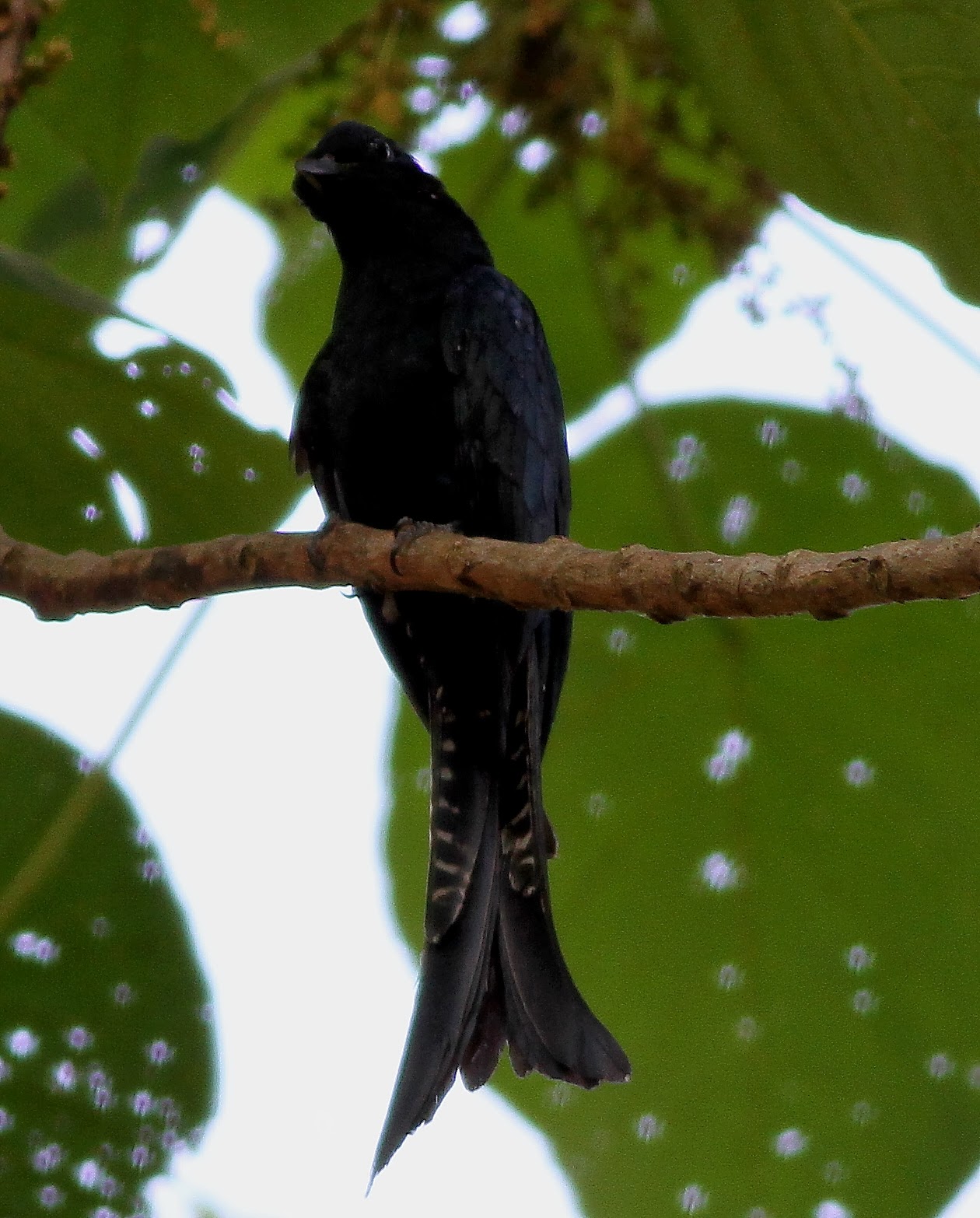
The final afternoon of the trip with Brian & Vinod, but the good news from my viewpoint is I've still got 24 days left in India. So if your not already bored by Indian photos on this blog, then I've still got plenty of opportunity to change that. We had a last couple of hours to look around Thattekad for some final birds, before Brian was due to head off for the final 3 hour journey to Cochin. Fortunately, we found a decent bird flock in the last 30 minutes to finish off the trip. Even better this had a Fork-tailed Drongo Cuckoo in it. The Drongo Cuckoos look very similar on first appearances to a Drongo & it's was no surprise to find that they use Drongos as hosts to bring up their offspring.
Fork-tailed Drongo Cuckoo: Another recent split from Asian Drongo Cuckoo which has a square tail. The barring on the undertail coverts confirms this is a Drongo Cuckoo & not a Drongo
Cattle Egret: Providing a personal bug removal service to this cow
Black Baza: This small Baza must be one of the best Asian raptors
Common Koel: This is a commonly heard, but less frequently seen, Cuckoo
Black-hooded Oriole: Male
Malabar Woodshrike
Three-striped Palm Squirrel: This is the common striped Palm Squirrel of Peninsula India, but is replaced at higher elevations of the Western Ghats by Western Ghats Striped Squirrel
Nilgiri Palm Squirrel: This Palm Squirrel appears unstriped & has a strong rufous band in the tail so I am assuming its this species as Three-striped should have a grey tail (but would welcome comments)
Green Forest Lizard: This Lizard was about 9 inches long
Georgie & the car
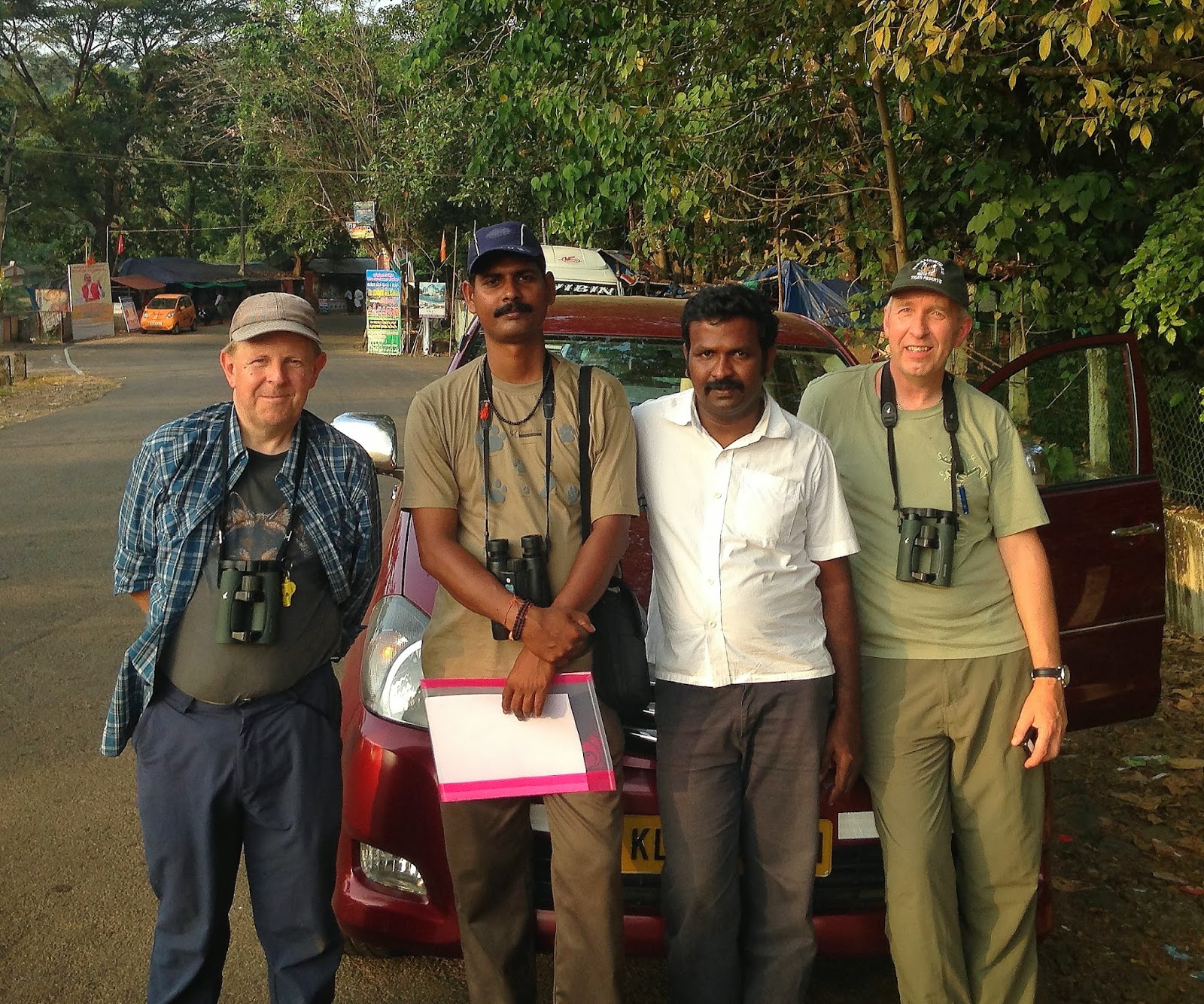
End of trip photo
I couldn't stay at Thattekad & ask for some additional time looking for Owls from Vinod as he was booked to guide the people already staying in his homestay. So after saying goodbye to everybody, I headed back in a taxi, to the cooler temperatures of Munnar for a few days. The next few days were spent starting to plan for the rest of my time in India & doing some blog updates.
Vinod: A good bird guide for the Western Ghats
If anybody is considering a Western Ghats trip, then I can definitely recommend Vinod as a guide. He is a thoroughly likable guy, who knows a lot of good sites for the birds & mammals in the Western Ghats. This is especially true around Munnar & Thattekad where his local knowledge helped us see most of the remaining birds we needed in the last 2.5 days & he works hard in the field to find you the birds. Like a lot of the local guides, he struggled a bit with his Phyllos Warblers identification. But I quite liked that as it mean that I had to do the work to find the better Warblers amongst the Greenish & Tickell's Warblers & I didn't want to have all the birds just identified by somebody else for me. He also has a homestay at Thattekad with 2 rooms & a wife who cooks good Indian food. Unfortunately, for me both rooms were occupied while we were there & the tourists were expecting Vinod to take them out for a general wildlife experience. Vinod's contact details are (Vinod Narayanan, vinodnatu1@gmail.com, +91 9746248274 or +91 8943894087).