Showing posts with label Grey Kingbird. Show all posts

5 Feb 2024

5 Feb 24 - ORCA Saga Caribbean Calypso Day 19 - A Day On Nevis

Our seventh and penultimate landing on the Saga Caribbean Calypso cruise was Nevis, the smaller island of St Kitts and Nevis. The two islands are just over one hundred square miles in size. The population is around forty-eight thousand, with around one quarter living on the smaller island of Nevis. As usual, we were on deck at dawn for the final approach into Charlestown, the main town on Nevis. A Red-billed Tropicbird and a probable Loggerhead Turtle were the highlights of this final approach.
Approaching Nevis
Sunrise over Nevis
Being a small island, we couldn't dock the ship. Therefore, like our visit to Bequia, the Spirit of Discovery anchored in the bay and we were transported ashore on the ship's lifeboat tenders. The priority for going ashore was, those passengers who were on all day tours first, followed by the remaining passengers and finally the entertainers, including the ORCA team, and the crew. Knowing there would be a reasonable delay before we were allowed to disembark, Jan suggested that we had a Wildlife Hour on the top deck where we invited the passengers to join us to see what we could see. We didn't see any Cetaceans, but enjoyed some Magnificent Frigatebirds, Royal Terns and Brown Pelicans, as well as, some passenger engagement with passengers we hadn't met before.
The ship were really good at publicising the events we organised: However, they could have done better by getting the news to a few Dolphins
Magnificent Frigatebird: A Magnificent Frigatebird put on a good display for the passengers who joined us
Royal Tern: There were a few Royal Terns to keep my camera busy
Royal Tern
Royal Tern
Royal Tern
Royal Tern
Brown Pelican: Plus, a posing Brown Pelican while we looked for Cetaceans
Once our top deck session was over, it was time for me to head ashore.
Waiting for the tender to leave
I'm ashore on Nevis
Nevis is dominated by the extinct volcano, Nevis Peak, which is just under one thousand metres high
Turnstone: There were a dozen Turnstones roosting near to the quayside. This is the subspecies which occurs in North East Alaska & Arctic Canada and which Winters in South East US, the Caribbean, Central & South America
There was only one potential Tick on Nevis for me: the difficult and shy Bridled Quail-dove. There are eBird records from the few trails around the lower slopes of Nevis Peak. There didn't seem to be any particular trail that was any better than the other, so I opted for the Heritage Trail to the Montravers Estate. This is an old sugar cane estate, which dates to the mid-18th Century. It has been abandoned for decades and has reverted to dry secondary forest. It was about a mile walk through the town to the start of the Heritage Trail. There were a few Birds to photograph along the way.
The island museum
The owner of this car had converted it into a green car
Cattle Egret: This is the nominate ibis subspecies which occurs throughout Europe, Africa and Madagascar and which colonised the New World in the 20th Century
Scaly-naped Pigeon: I had seen Scaly-naped Pigeons on most of the landings. But many were from taxis. So, this was my first chance to get some photos
Scaly-naped Pigeon: This monotypic species occurs in the Great Antilles, Lesser Antilles & Dutch Antilles
Finally, I reached the Heritage Trail. Initially, it passed through dry secondary forest along what must have been the old cart track to the plantation.
The lower dry forest
This one hundred and sixty-five year old Baobab tree marks the entrance to the Montravers estate
Grey Kingbird: This is the vorax subspecies which occurs in the Lesser Antilles: some Winter on Trinidad & the Guianas
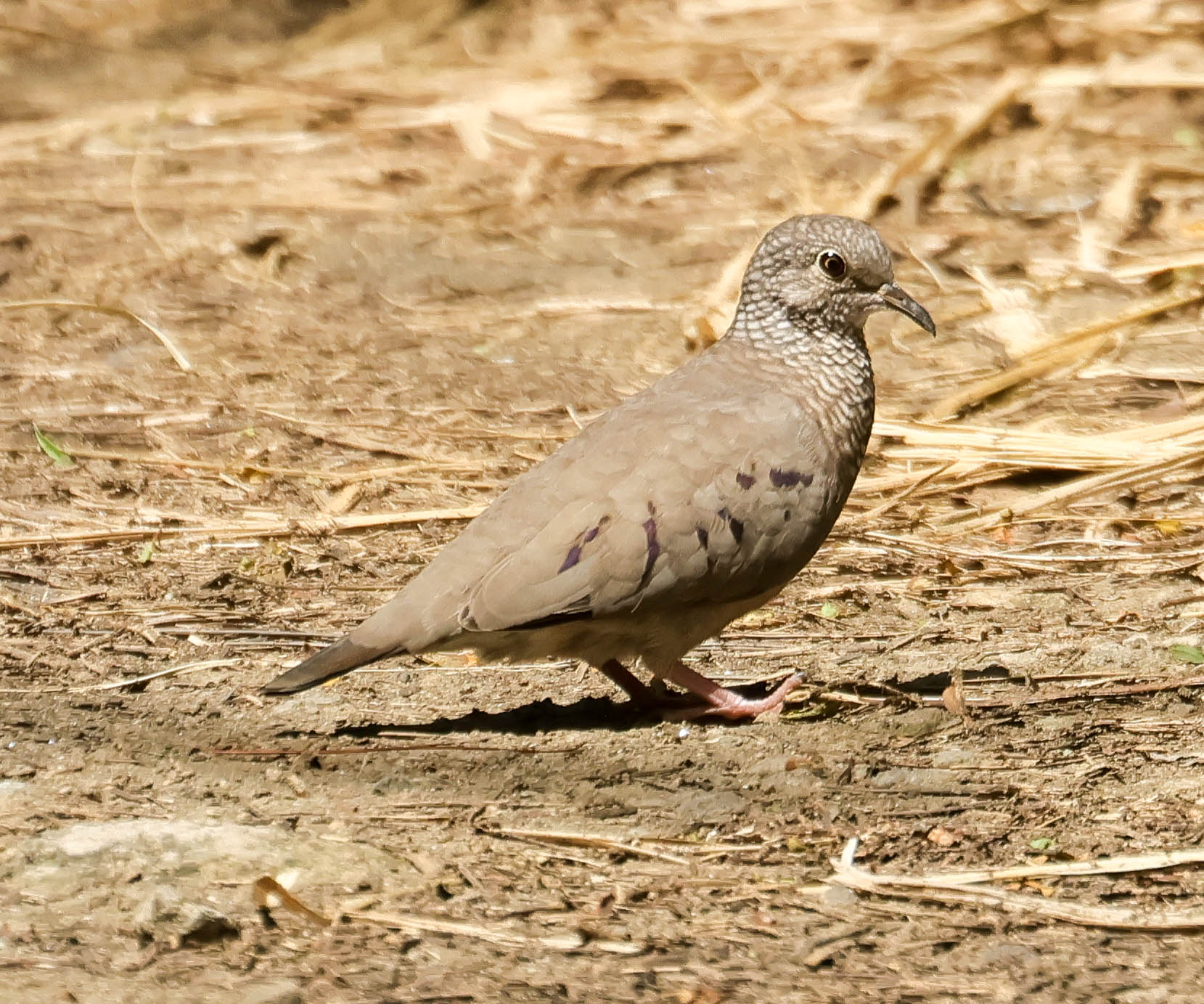
Common Ground-dove: This is the nigrirostris subspecies which occurs in the Northern Lesser Antilles
Black-faced Grassquit: This is the omissa subspecies which occurs on Puerto Rico, the Lesser Antilles, North Colombia & North Venezuela
After nearly a mile's walk, I reached the ruined estate buildings. The buildings are behind locked gates and so I didn't have the opportunity to have a look around them.
The higher forest had become a bit damper
This higher, damper forest was probably a better area to find a Bridled Quail-dove. But it was around lunchtime and that isn't a good time of day to look for shy Doves. I carried on up the trail past the house. But unfortunately, the public trail ran out after another hundred metres into private land. I found some short side trails to explore, but they were pretty quiet. It was time to wander back to the town.
One of side trails looked interesting: It would have been good if I could have been up there before breakfast time. But that's not possible when on this type of cruise
Great White Egret: This is the egretta subspecies which occurs from South Canada to Tierra del Fuego. I was surprised to find it feeding on a forest track. But small island species often have to adapt to feeding wherever they can get food, as they do not have the choice of habitats that their mainland cousins have
Band-winged Dragonlet: Female. This Dragonfly is found from North America to the Caribbean, Central America & South America
Band-winged Dragonlet: Male. The sexes are very different. I photographed this individual on St Lucia (2 Feb 24)
I'm almost back at the quay area again
The island's defences need modernising
As I was queueing for tender I saw this great T-shirt that one of the passengers was wearing: Our island hopping was Grenada, Barbados, Martinique, St Lucia, Bequia, Dominica, Nevis & Antiqua
I got back to the ship in time for a late afternoon snack, as I had missed lunch. Then it was time to head to the top deck and rejoin Jan, Charlotte and Terry to get a final hour of surveying in as we left Nevis. Unfortunately, it didn't produce any Dolphins.

30 Jan 2024

30 Jan 24 - ORCA Saga Caribbean Calypso Day 13 - Grenada: Our First Caribbean Run Ashore To Mount Hartman

We were on deck as normal for dawn, so we could maximise our surveying time as we approached the island of Grenada: even if that only gave us an hour or two of survey time. It was then a dash for a late breakfast, as the ship was preparing to moor & the ship cleared customs. We were asked to give a few minutes for the Saga passengers to start going ashore before we disembarked, which allowed us the time to not have to hurry the food. This survey proved to be a good start to the Caribbean section when the only Audubon's Shearwater flew past. Unfortunately, I failed to get any photos as I carried on watching it with the bins. Some of the other local Birds were more photogenic.
Magnificent Frigatebird: This monotypic species occurs in the tropical West Atlantic & East Pacific Oceans
Brown Booby: This is the nominate leucogaster subspecies which occurs on islands in the Gulf of Mexico, the Caribbean & the tropical Atlantic
Brown Booby
Jan (left) & Charlotte: Jan is the official surveyor as she has the ORCA bins. Charlotte, like the rest of us, was generally watching, when not talking to the passengers
The ship ran up the national flag as we approached Grenada: This is good etiquette, but it doesn't appear to be a compulsory action
All too soon we saw the Pilots boat appear: Usually this is the sign that we were too close inshore to be worth continuing to survey. But we carried on enjoying the view & pointing out Birds to the passengers
Our first view of St George's the capital of Grenada: Grenada is about 135 square miles in size, with a population of about one hundred and seventeen thousand at the time of our visit
The town doesn't extend far around the bay
Fort George dominates the high ground above the port: The fort was originally built by the French between 1706 & 1710, following their colonisation in 1649. The island remained under French control until its capture by the British in 1762, during the Seven Years' War. It was ceded to Great Britain in the following year by the Treaty of Paris. At this point, the fort was renamed Fort George
There was ongoing maintenance work on the fort
The port and town behind it
It's good to see the town hasn't been ruined by high buildings
Charlotte, Terry & Jan: Ashore & wearing civies: we always wore the ORCA clothing on ship, except for the evening meal
The port customs building which had a large shop behind it: We were greeted by a small Calypso band playing on their drums outside the building
Charlotte in soft toy heaven: Trying to decide how many she can adopt without Terry saying that's too many
Grenada: Preparations were already advanced for the celebration on 7 Feb of fifty years of independence from the UK
Once we were ashore & had dragged Charlotte away from the soft toy shop, we changed some money into local currency. My plan was to hire a taxi to visit Mount Hartman on the arid side of the island. Terry planned to take the others to the Grand Etang: a high elevation lake surrounded by lush forest, which he had visited on a previous trip. My key target species were the two Grenada endemics, Grenada Dove and Grenada Flycatcher, albeit the latter species also occurs on St Vincent & the Grenadines. Both species occur in the dry forest at Mount Hartman. I quickly arranged a taxi charter for a few hours to take me to the site, with an option to continue to Grand Etang National Park, if time allowed. The driver said he knew the area. But it became clear that he didn't, when we ended up in a building site. This area was once part of the National Park until the forest was destroyed to allow somebody to make a lot of money out of a new hotel complex.
The independence day flags hadn't reached the smaller villages yet
Fortunately, I had some directions to the park, but I hadn't been able to establish the site of the park HQ, where others had looked in the past. So, I ended up taking the driver along a dirt road to the edge of the park. The habitat looked good enough to try walking further through the dry scrubby forest, so I decided to give this track a punt.
There were good numbers of these cacti under the trees
Very quickly I started to bump into a few dry country Birds, but they were mainly the widespread common species. But I did see my first Grenada Flycatcher within the first ten to fifteen minutes: one Grenada endemic down & one to go.
Common Ground-dove: This is the antillarum subspecies which occurs in the Southern Lesser Antilles from St Lucia & Barbados to Grenada. It is a widespread species that occurs from South East of the United States, through the Caribbean and Central America and as far South as Colombia, Venezuela & North East Brazil
Antillean Crested Hummingbird: This is the emigrans subspecies which is restricted to Grenada and the Grenadines. Other subspecies occur in E Puerto Rico, the Virgin Islands & elsewhere in the Lesser Antilles
Grey Kingbird: This is the vorax subspecies which occurs in the Lesser Antilles. Some winter from Trinidad to the Guianas. The green colouration is caused by a leaf in the foreground
Grenada Flycatcher: This monotypic Lesser Antillean endemic also occurs on St Vincent & the Grenadines
Cocoa Thrush: This is the personus subspecies which is restricted to Grenada. Other subspecies occur in St Vincent, as well as, from Colombia, Venezuela & Trinidad to Bolivia & Brazil
Tropical Mockingbird: This is the antillarum subspecies that occurs in Martinique, St Lucia, St Vincent, the Grenadines & Grenada. Other subspecies occur from Mexico to Colombia, Trinidad & Tobago, Venezuela to Brazil
Lesser Antillean Grasshopper sp.
After about a mile, the track reached the coast. There was a bridge over an inlet which took me outside of the National Park. More crucially the habitat had changed from the arid forest to Mangroves, which was the wrong habitat for the Grenada Doves. The highlight in this area was a small group of Black-faced Grassquits: time to head back to the arid forest.
Black-faced Grassquit: Female or Immature. This is the omissa subspecies which occurs from Puerto Rico, the Lesser Antilles, Tobago, to North Venezuela & North Colombia
The bridge by the inlet
There were good numbers of yachts in the bay
On the way back along the track, I heard a calling Grenada Dove and headed off the path in search of it. I saw one and heard another two. Having seen the two Grenada endemics, I reckoned I had enough time to have the best part of an hour at the Grand Etang National Park. I walked quickly backed to the taxi & we left for the Grand Etang. Fortunately, the driver knew how to get to this well-visited National Park. I will cover the rest of the day in the next Blog Post.