
After a late arrival at the Otun-Quinbaya Reserve, we were up pre-dawn as the plan was to look for some Owls. However, it had thrown it down for quite a bit of the night & was still raining too heavily to make it worth looking for Owls when we got up. We still heading out before dawn so we could get wet from first light. I had bought a camera cover, but as the rain was steady, I decided that this wasn't going to be the first time to check out whether the cover was as waterproof as it was reported to be. As a result, the camera stayed in the room for the morning. In the circumstances, it was probably the best result. As it got light, we started Birding along one of the forest tracks. Fairly quickly we saw the first of a number of the endemic Cauca Guans, along with a couple of Sickle-winged Guans. Also, my first White-naped Brush-finches & a couple of Chestnut-breasted Wrens. But our main target was the exquisite Hooded Antpitta. This near endemic Antpitta is smaller than a Robin with a pale orange head, pale brown upperparts, off-white underparts & a uniquely bright yellow bill. It has been a target species for many Birders on previous trips, but few had succeeded. However, Janos had a recording of its call & was aware of a rough area of the reserve where Birdquest had seen it for the first time during the previous year's tour. But, after a couple of hours in the rain, it wasn't looking hopeful as we walked up & down about a half mile of the one of the main tracks. As happened on a number of occasions, most of the group were keeping close to Janos. Brian & I often lagged behind as we were taking photos & we were confident in our abilities to find our own Birds. On this occasion, with no camera, I was birding with Rob, the other Brit Birder, while Brian was a bit further behind us. Suddenly, I heard Brian quietly call, I've got it. Knowing Brian well, I knew that without any species being called, it had to be a Hooded Antpitta. I turned to call to Janos, before started to quietly run to where Brian was. But, in the excitement the legs didn't get it right & I ended up going flying. I started running as I was rising & went flying a second time, before finally getting the coordination right on the third attempt. Brian was over thirty metres away, so my falling wasn't going to disturb the Hooded Antpitta. Rob beat me by a few yards to where Brian was crouching. I arrived a few seconds later & immediately Brian got me onto the gorgeous Hooded Antpitta, sitting low in the vegetation, & occasionally calling, less that ten metres away. Brian later said he heard the call & was looking for it, when it flew closer & perched up. Unfortunately, my camera was in the room. But I reckon it would have had a significant knock as I hit the ground & so maybe it's a good thing I didn't have the camera with me. I never got around to asking Brian for a copy of his photos & now sadly, it's too late. But he was really pleased to have found the Bird of the trip & with his photos. Anybody wanting to see what a Hooded Antpitta looks like & why it was voted Bird of the trip, can try this link. This website even has a copy of its thin call. After we had all had some great views of this mythical species, we walked back to where the minibus was parked by a couple of buildings in the forest. Here we had a late breakfast & enjoyed a bit of shelter from the rain. By late morning, we were heading back to the park accommodation for lunch. Finally, it had stopped raining & there was the opportunity for some photography around the accommodation. Like many forest reserves I've visited over the years, the park accommodation had a good selection of species around it, with a few individuals having become a bit easier to see than those within the main reserve. This site was no exception & with the sun finally out, I could finally give the camera some exercise.
 US Birder Rich photographing some Hummingbirds by the park restaurant & visitor centre
I was glad to see there were some more Cauca Guans near the accommodation & they were more approachable than the ones we had seen earlier.
US Birder Rich photographing some Hummingbirds by the park restaurant & visitor centre
I was glad to see there were some more Cauca Guans near the accommodation & they were more approachable than the ones we had seen earlier.
 Cauca Guan: Sadly, this endemic species is now a local species in the Cauca valley of Central Colombia
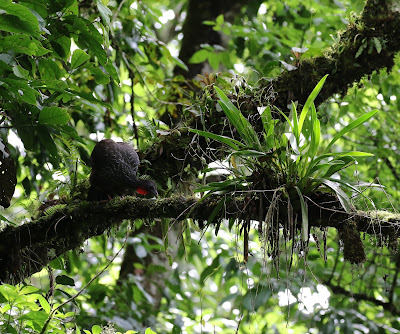 Cauca Guan: A wider shot to show this stunning forest
 Cauca Guan
 Cauca Guan: The range, red dewlap (throat) and lower elevation than Andean Guan, all help with the identification
 Lesser Green Violet-ear: Also known as Lesser Violet-ear
There was a lot of noise near the entrance to accommodation, as three Red Howlers appeared & started calling, before finally settled down.
Lesser Green Violet-ear: Also known as Lesser Violet-ear
There was a lot of noise near the entrance to accommodation, as three Red Howlers appeared & started calling, before finally settled down.
 Red Howler
 Red Howler
 Red Howler
It was time for lunch.
Red Howler
It was time for lunch.


