19 Jun 2025

19 Jun 25 - Starting The Day With An Otter

My primary purpose for the Scottish trip was to lead two ORCA surveys on CalMac ferries to the Western Isles. I had only been on these routes as a passenger and I was looking forward to the opportunity to survey on them. The office team put me in touch with one of the Scottish Team Leaders, Bill Anderson, to have a chat about both routes. I followed that up with further conversations when I met up with Jan Storie, my first Saga ORCA Team Leader. Both sets of advice were really helpful, given I hadn't surveyed on these routes before.

The first survey route was a morning return trip from Uig, on North Skye, across to Lochmaddy, on North Uist. This was followed by an afternoon return crossing from Uig to Tarbert, on Harris. The survey was a success with a Minke Whale, a distant unidentified Whale blow, thirty Short-beaked Common Dolphins and two unidentified Dolphins. The survey team was made up of two surveyors on their first survey, with Cristina only on her second survey. It was a really successful survey, with all of the team quickly picked up the survey and bridge protocols and everybody quickly gelled as a team. Given it was a busy survey, I needed to focus on mentoring the team and so the camera didn't leave its bag.
The North Uist and Harris team: Cristina McAvoy, myself, Lily Goodwin and Uzume Michels
The day wasn't over for Uzume and myself when we disembarked, as our second survey was leaving from Mallaig the following morning. It was a one hundred and sixty mile drive between the ports, via Fort William. It is possible to knock one hundred miles off that route by taking the short ferry crossing from Armadale, on Skye, to Mallaig. Unfortunately, that ferry doesn't run in the evenings. I finally dropped Uzume in her hostel in Mallaig about eleven that evening. I was reluctant to pay for a second night in a hostel and after a bit of searching I found a quiet-looking layby next to a coastal bay at Loch nan Uamh, for a good night's sleep in the Focus Hotel. I awoke the following morning about six to find flat calm conditions in the bay. There was a Grey Seal that was hauled out on some rocks in the bay. While I was having breakfast and brewing a hot drink, I saw an Otter swimming close to the layby. I quickly dashed for the camera and managed to get a few photos, before it swam out of view.
This early morning Otter was a nice start to the morning
It was a good layby with Grey Seal, Otter and a couple each of Common Sandpipers and Arctic Terns
Once I had finished breakfast, it was a thirteen mile trip back into Mallaig. I managed to find a nearby on road parking spot close to the CalMac terminal and I walked down to meet the rest of the ORCA survey team. This was a more experienced team with Neil Ross, who was starting his Team Leader training, Jane Forsyth, an experienced surveyor and Uzume excited to be on her second survey in two days. It was another great survey team which again gelled well together.
The Memorial to those lives lost at sea stands next to the terminal building: It looked a bit out of place in its surroundings. Perhaps, this working area is realistic, given that most of those lives lost will be working sailors and fishermen
The crossing from Mallaig to Lochboisdale on South Uist is a longer crossing, which allows about two and a half hours of surveying each way. It proved to be even busier than the first survey, with sixteen Minke Whales, fifty-eight Short-beaked Common Dolphins, an unidentified Dolphin, nine Harbour Porpoises and a Grey Seal. Again, the camera didn't have the chance to leave its bag.
The ORCA survey team: Myself, Neil Ross, Uzume Michels and Jane Forsyth
It had been a great couple of surveys, with the bonus Otter in-between. I will be volunteering to survey on these routes in future years. I would like to thank the CalMac for allowing the ORCA survey teams onto the bridges. It was time to head back to the Central Highlands, as the weather forecast for the next two days looked good for catching up with the Scottish Dragonflies. It was getting on for midnight, when I pulled the car back into the Beinn Eighe layby, that I had slept in three nights earlier.

17 Jun 2025

17 Jun 25 - Exploring The Bridge Of Grudie

I had a look around the Bridge of Grudie area on the previous early evening. This site is a few miles South West of Beinn Eighe and next to Loch Maree, in the Central Highlands. Having driven past the Bridge of Grudie, I found this interesting-looking bog to the South West, which I decided to explore. However, I couldn't find any Dragonflies due to the overcast conditions. On a positive, the rain I had driven through since Glasgow had finally stopped.
One of the boggy pools I checked the previous evening (16 Jun 25)
Another view of the previous boggy pool (16 Jun 25)
Great Sundews (16 Jun 25)
This dead Dragonfly, which had fallen foul of the Great Sundew cluster, was the only Dragonfly I saw on the first evening.
This dead Dragonfly found out the hard way about Great Sundews (16 Jun 25)
It started off very overcast on the following morning in the Beinn Eighe area, but the forecast was for improving weather later in the morning.
The day started with uninspiring cloudy conditions over the adjacent Loch Maree
The low cloud wasn't helping
This was as sunny as it became: Looking over the river above the Bridge of Grudie
Another view of the Bridge of Grudie
I was hoping some sunshine would encourage a few Dragonflies to start flying at the Bridge of Grudie. This is a site for Azure Hawkers and Northern Emeralds. Neither species appear to be common here, compared to the nearby Beinn Eighe area. There were less trees to check and the area around the river was worth a look. If either species are flying around the trees, they should be easy to spot. Perhaps it was just too overcast. Initially, all I could find were the Large Heaths covered in the last Blog Post. After a fair bit of searching I bumped into this White-faced Darter and a Four-spotted Chaser. They were quite approachable due to the overcast conditions.
White-faced Darter: Female. The black abdomen with the obvious pale yellow markings and the black at the base of the wing confirm the identification, without having to see the white face
Four-spotted Chaser: This species has a large UK range as they are commonly found on my Dorset Heaths
Bog Asphodel: This was a common species in the boggy areas at the Bridge of Grudie
I had a quick look at the Beinn Eighe picnic centre car park, as well as, the visitor centre.
Views across Loch Maree from the Beinn Eighe picnic centre
I like this giant stone Pine Cone near the Beinn Eighe visitor's centre
I had to leave the Beinn Eighe area by lunchtime, as I had arranged to meet up with Jan Storie on Skye. Jan was the ORCA Team Leader on the Saga Caribbean Calypso cruise at the start of 2024. It was a good opportunity to get some more details from Jan about the two ORCA surveys that I had coming up, as I both were new routes for me. Jan knew both routes well, but she was heading South for her next Saga ORCA cruise on the following morning, so she wasn't available for either survey.
Jan and myself
Late afternoon saw me heading to the Portree Scottish YHA for the evening and to meet up with one of the ORCA surveyors, Uzume Michels.

17 Jun 25 - Scottish Large Heaths

There was an appeal for an ORCA Team Leader to lead some surveys to the Western Isles in mid-June. I offered to covered a couple of them, using the surveys as a plan to tour up the West Coast of Scotland along the West Coast 500, look for a UK Orca and try to see the remaining British breeding Dragonflies: Azure Hawker, Northern Emerald, Highland Darter (which now is treated as a subspecies of Common Darter) and Northern Damselfly. All of these plans were weather and sightings dependent. I left Dorset on the afternoon of 15 Jun. The following morning I woke up to sunshine and largely blue skies in the lakes. However, it was solid cloud as I crossed the Scottish border and raining, by the time I reached Glasgow. Not good weather for Dragonflies. I had a number of potential sites to try and checking the forecast, I headed for the Beinn Eighe area of the Central Highlands: where the rain was predicted to be lighter. But the time I arrived, the weather had improved to full cloud cover and it had stopped raining. I had another good night's sleep in the Focus Hotel in the Beinn Eighe area and awoke to dry, cloudy conditions, with the forecast suggesting the sun light break through later in the morning. There wasn't a rush to get going quickly, given the target species were Dragonflies, so there was time for a leisurely chat with some fellow travellers in a campervan over breakfast. The first stop was the nearby Bridge of Grudie where I spent a couple of hours looking for Dragonflies with limited success. But I did bump into a few Large Heaths, which I've only still a couple of times before at English sites: Crowle Moors (2012) and Foulshaw Moss (2018).
Large Heath: Bridge of Grudie. This is the scotica subspecies
When I compared them to the photos, I've taken at the English sites, I saw they were paler with less obvious eye markings on the underwing. This is because they are the scotica subspecies, which occurs in the Scottish Highlands. Without planning to photograph the two English subspecies, I've actually managed to do that.
Large Heath: Crowle Moors. This is the polydama subspecies (1 Jul 12)
Large Heath: Foulshaw Moss. This is the davus subspecies (5 Jun 18)

11 Jun 2025

11 Jun 25 - Nice & Rosy

It was a good day to be volunteering on the DWT Brownsea reserve. Finally, it was a warm and sunny day, with a dry South Easterly wind. Albeit that wind produced a bit of mist in the morning, but not enough mist to cause a real problem to watch the lagoon. It was good to see the Sandwich Tern and Common Tern chicks were doing well, albeit I didn't take any photos. As I was scanning the lagoon, I saw a white Tern flying off the lagoon, that was too small to be a Sandwich Tern. It was always back on until I lost it. It looked interesting and I thought I had probably just had to let a Roseate Tern go. But there was every chance it would return after fishing.
Roseate Tern with a Common Tern: Not a great photo, but the Boomerang Island is one hundred and sixty metres from the Avocet hide
I was in the new Lookout hide and visitor centre at lunchtime, when I had a couple of free minutes between visitors to have a scan of the Boomerang Island. This is generally the island where visiting, non-breeding Terns settle down among the resting local Terns. The small, whiter Tern had returned and it was looking good for a Roseate Tern. Whiter in colouration with an all-black bill. It was breast on, but finally it turned and I could see the whiter primaries and tail. That was good enough to confirm the identification.
Roseate Tern with a Common Tern: This individual didn't have particularly long tail feathers
This individual didn't have the normal long tail feathers. So, it was probably the same individual that Graham Armstrong had found on 7 Jun, but which hadn't been seen since. Not too surprising as Roseate Terns are generally one-day individuals. It was unusual that it was still around and presumably had just been overlooked in the intervening days.
Common Tern: This individual was resting just in from of the Avocet hide: It's a pity that the Roseate Terns just check out the Common Tern colonies, instead of just sitting on the Boomerang Island

11 Jun 25 - A Game Of Chase

I arrived at the DWT Villa with two of the other regular volunteers, Colin and David. We were delayed in entering the Villa by a few minutes, when David spotted a couple of Red Squirrels having a game of chase in the treetops.
Red Squirrel
Red Squirrel
Red Squirrel
Red Squirrel: Having won the game of chase, it was time to check out the broken end of this branch

4 Jun 2025

4 Jun 25 - Some Showy Med Gulls

One of the nice things about the DWT Brownsea hides, is Birds sometimes drop in close to the hides, especially around the muddy area in front of the Avocet hide. Today, it was a Second Summer Mediterranean Gull. Adults and First Summers aren't uncommon visitors to Brownsea, but Second Summers aren't as regular on the lagoon. I think it's the first individual I've seen of this age right in front of the hide.
Mediterranean Gull: Second Summer
Mediterranean Gull: Adult. They are more regularly seen close to the Avocet Hide (28 May 25)

2 Jun 2025

2 Jun 25 - Croissant Time In Roscoff With ORCA

It was nice weather for my third ORCA survey on the Roscoff - Plymouth route and the third ORCA survey that I've led, since I was signed off as an ORCA Team Leader at the end of 2024. I met the rest of the team, Julie, Sara and Mark, the previous evening in Plymouth at the Brittany Ferry terminal. We had a quick boarding and a good overnight crossing on the Armorique. It's a slow overnight crossing to ensure that the ferry arrives in Roscoff at the reasonable local time of 08:00. The ferry didn't depart from Roscoff until 15:00 and so there was plenty of time to have some food and a walk around the attractive old town.
There are some nice architectural features on the local houses: The curves roofs look really good
It's a gentle thirty minute walk to the cafes by the old harbour from the ferry terminal.
Looking across the old harbour towards the lighthouse
The Cafe Ty Pierre: My favourite cafe which does a nice French breakfast with an obligatory croissant
The cafe ceiling
The cafe is located on the quayside, just below the Mk, on this upside down ceiling photo
Gannet: We saw a few during the survey on the way back to Plymouth
After breakfast, we had plenty of time to have a stroll around the town.
The start of the old main street beyond the cafes: This is the chocolate shop
The chocolates look great, but they aren't cheap
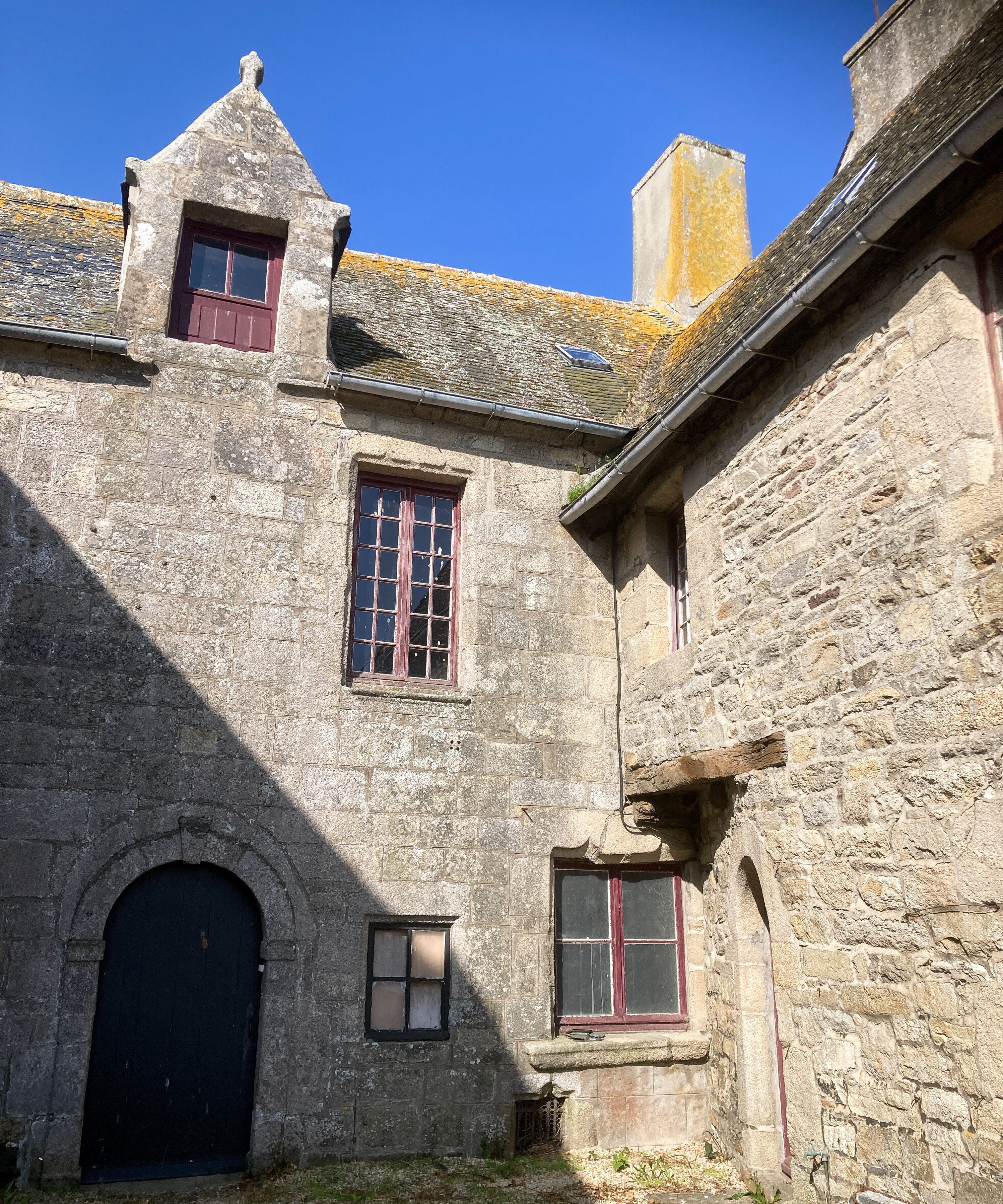
This old neighbouring building looks like it needs a fair bit of TLC
The elaborate spire of the Notre-Dame de Croaz-Batz Church
It looks like Roscoff suffers the same problem with holiday homes as many UK coastal towns
The bay which separates the Perharidy peninsula from Roscoff
The inner part of the same bay
It was time to head back to the cafes area for an early lunch.
The ORCA team waiting after some lunch: Julie Bunt, Sara Amos, Mark Delf and myself
This looks a more decorative, than defensive, lookout
The old harbour lighthouse
The 17th Century Chapelle Sainte-Barbe built to protect local sailors
The Fort de Bloscon: It was built in 1694 to protect the channel between Roscoff and the island of Ile-de-Batz from English invasions. It was decommissioned at the end of the 19th Century, before being reactivated during WWII. It is now privately owned with no public access
We were back onboard early afternoon and we allowed up onto the bridge soon after we departed the port. It was a busy crossing with twelve groups of Dolphins, with the totalling forty-five Short-beaked Common Dolphins and a further two unidentified Dolphins. There are no photos as I didn't take the proper camera, as I wanted to focus on the surveying and mentoring of the team.
Short-beaked Common Dolphin: I took this photo on the return journey of my last Roscoff survey (7 Oct 24)