19 Aug 2014

19 Aug 14 - Shieldbugs - An Interesting Overlooked Group

I can remember seeing my first Hawthorn Shieldbug whilst at university. For many years, this was an interesting looking group of insects, but one which I was struggling to identify given the lack of a field guide I did find an ancient book in the university library to work out the Hawthorn Shieldbug. Then a few years ago, I found a great website and more importantly the guys behind the website had produced a field guide. It is the Photographic Guide to the Shieldbugs and Squashbugs of the British Isles by Martin Evans & Roger Edmondson. A superb & not expensive book which is well worth buying. The only problem was I had still only seen one species. Still armed with a camera, I have managed to get a few photos of Shieldbugs over the last few years & have managed to identify a few more species.
Birch Shieldbug: A medium sized Shieldbug with dark red-brown and black over most of the wing cases. Adult. Swanage (18 May 12)
Green Shieldbug: Adult. The all green colouration & slightly enlarged pronotum (body behind the head), dark wing tips and reddish tips to the last two stages of the antennae identifies this species. Swanage (8 Aug 14)
Green Shieldbug: Final instar: the final immature larval stage before the winged adult appears. Swanage (8 Aug 14)
Forest Bug: Final Instar. Spean Bridge (16 June 11)
Dock Bug: Adult. A large, mottled brown Bug with a broad abdomen. Godlingston Heath (1 June 14)
Boat Bug Enoplops scapha: Wingless larva. St Aldhelms (6 July 14)
Tortoise Beetle Cassida vibex: Looks like a Shieldbug Instar, but is one of about 18 species of Cassida Beetles. Thanks to Sean Foote for identifying it. Swanage (8 Aug 14)
I'm sure that going out with somebody who knew more about this interesting group of insects, would quickly increase the number of species I've seen. But it's been fun just finding them by chance and plenty more to look out for. This is an insect group that it is fairly easy for a beginner to get into as many appear to be fairly widespread and there are only 43 species in the group.

16 Aug 2014

16 Aug 14 - Curse Of The Birdfair

This is the Birdfair weekend at Rutland & another year when there has been a good rarity in Dorset. For 2 years on the trot, the Dorset guys at the Birdfair, had to put up with the knowledge of Aquatic Warblers being caught at Lytchett Bay in 2011 & 2012. However, these were on a private ringing site with no public access & therefore, perhaps less gripping than today. Today, the goodie trapped was a Bonelli's Warbler at Portland Bill which is a good county tick. I decided to wait to see if it was seen after it was released & once the news came through it had been seen again, I ran out of excuses to wait any longer. I arrived to find it was very elusive & hadn't been seen for over 2 hours. Tried the book shop, but didn't get very far before I saw a movement of people into the front garden. It has been relocated, but was elusive. Not joy. I drifted to the road side of the trees, but far too windy. Heading back into the Obs garden, I could see Martin watching it, but it had dropped by the time I reached him. Eventually, I decided to try the front corner again & wait as it was about the most sheltered & warm set of trees. After a short warm up act from a couple of Willow Warblers, my mate James Lowther picked it up in a Sycamore: nice one James. I was quickly onto it & trying to give directions, while also grabbing as many photos as possible. The poor quality of the photos, just proves us blokes can't multitask.
Bonelli's Warbler: Note, the short, but relatively strong supercilium, dark eye, plainer pale lower face & silvery-white underparts
Bonelli's Warbler: Unlike the Willow Warblers, it stayed in one place for a minute or so & slowly looked around for food
Bonelli's Warbler: Frustrating, the best shot & the bird wasn't in a good posture. Note, the silvery-white underparts & pale bill
Bonelli's Warbler: Note, the colouration of the upperparts
Bonelli's Warbler: The trendy peeps try to precede the name with Western, to separate it from Eastern Bonelli's Warbler. It's even more daft as some authors have renamed Eastern Bonelli's Warbler as Balkans Warbler: thus my shortened name works anyway
Bonelli's Warbler: Final view before it moved out of my view. Kept hoping it would reappear, but sadly not

13 Aug 2014

13 Aug 14 - Two New Dorset Shieldsbugs

One of the great advantages of getting into new Insect groups without any help, other than a field guide, is the fun when you see something new. If I need help with Butterflies or Dragonflies sites, then I have mates I can ask about the gaps. Alternatively, there are some good websites available with information about what is flying at the moment. As a result, I've been able to plan dates in advance, of particular sites or habitats to try for the next interesting Butterfly or Dragonfly & then just wait for suitable weather. But with some of the less watched Insect groups I've been trying to get into, I don't know anybody else who has looked at them. Therefore, I take the fun approach of keeping an eye out & photographing everything I don't recognise. This more laid-back approach with these groups, means I haven't worked out what habitat I should be looking in or at what time of year is the best to look. Therefore, with help I could probably head out & see a number of species quickly. Instead, I probably walk pass some common species in ignorance, but occasionally, I have a good day & get a bonus new species. In this case, it was 2 new Shieldbugs on the same day.
Sloe Bug: The purplish brown forewings, yellowish pronotum (shoulder plate behind the head) & scutellum (triangular shaped back plate) and the yellow connexivum (outer ring) with the yellow and black markings identify this species. They are found in a mixture of scrubs & tall vegetation on the edge of woods
Gorse Shieldbug: The strong rufous edges to the pronotum & the base of the forewings, identifies this as a Gorse Shieldbug. This is a freshly emerged adult. After hibernating over the Winter, they will re-emerge as adults ready to breed, but with the red faded to green. This is a fairly common species in the UK in heaths, parks and gardens, where the food plants occur (Gorse, Broom, Dyer's Green-weed, Laburnums & Clovers)

12 Aug 2014

12 Aug 14 - Jersey Tiger

This blog has largely focused on UK Birds, Butterflies & Dragonflies in recent months. So for a change a day flying Moth: Jersey Tiger. This is not an uncommon species to those who run Moth traps along the Dorset coast & I was surprised to not caught one when I brought my Moth trap out of retirement 3 years ago for the Summer. Despite their frequency locally, I have only run into a couple before & so was pleased when I saw one whilst out walking locally.
Jersey Tiger: It was really happy to nectar on this Marjoram
It is local to Devon, Dorset, the Isle of Wight & part of the Kent coast. The excellent, Dorset Moth Group website, states it is a coastal species found from Abbotsbury to Portland & Weymouth and also around the Swanage area. There are a few scattered records elsewhere in Dorset. The first Dorset record was 1964, but it is only in the last 15 years or so, that it has become more regular in coastal Dorset. It is a large day flying Moth, which will also come to MV Moth traps.
Jersey Tiger: A great moth to see
Its most likely confusion Moth is the similar sized Garden Tiger which is a common & widespread Moth across all of lowland UK.
Garden Tiger: Swanage (7 July 10). Note, the upper wing is brown with wavy white lines, rather than black with straight lines. Also there wing shape is far more rounded
Garden Tiger: Swanage (7 July 10)

11 Aug 2014

11 Aug 14 - Homage To Gilbert White - The Migrant Hawker Tree

In his classic book 'The Natural History of Selborne', Gilbert White explained the disappearance of the Swallows in the Winter, by explaining that they spent the Winter hibernating at the bottom of ponds. 225 years on, it is all a bit far fetching as an explanation. But he was a pioneering amateur naturalist and it fitted the facts as he saw them. They regularly were seen touching the water (actually drinking in flight) & they disappeared in the Winter. As a homage to Gilbert White, this blog can shake the scientific world & explain where Migrant Hawkers come from. Up to now the popular theory is they are migrants to the UK & some breed. This 'breeding' can now be confirmed as I have confirmed photos of their breeding in the UK. As I watched them, the sun melted their connection to their mother Migrant Hawker Tree & they flew off for their first time. It is surprising this behaviour doesn't appear to have been documented before, but I cannot find evidence when I looked on the font of all wisdom & knowledge: the Internet.
Migrant Hawkers Tree: With 2 males & 1 female fully grown Migrant Hawkers. Looks like it will be a good year next year, given the number of 'eggs'
Migrant Hawker: Male. Note, the prominent yellow triangle on segment 2 of the abdomen. Also, there is only a pair of short pale marks on the top of the thorax. Note, the final segments have 2 spots on each segment, whereas the Southern Hawker has a broad blue band
Migrant Hawker: Female. They have the same markings as the male, but are yellow or brown, instead of blue

8 Aug 2014

8 Aug 14 - Evil Looking Brute

Seen this evil looking Robberfly recently on a few occasions. It is the Hornet Robberfly, Asilus crabroniformis. They are really big & obvious once I got my eye in, due to their pale brown colouration & large size (About an inch long). Quite often I saw them basking on dried horse dung on Downland. The larva live around these dung pats for a couple of years, before hatching out in June. The adults will be on the wing till around the end of Oct. Their prey includes Grasshoppers, Beetles (especially Dung Beetles), Bees, Wasps & other Robberflies. They sit around a lot as they hunt from low perches or the ground. Other delightful facts is they can take 10 - 30 minutes to suck out the contents of their latest prey item. But don't worry they aren't known to attack humans.
Hornet Robberfly
They are fairly widespread over the Southern counties of England, especially South of Bristol to the Home counties. After that records seem to become more scattered heading into Wales, the Midlands & East Anglia, with just the one site in North Yorkshire.
Hornet Robberfly
The great advantage of carrying a camera around nearly all the time I am out, is it allows me to quickly grab a photo of something like this & then try & figure it out later. 

8 Aug 14 - Putting Names To The Map Collection

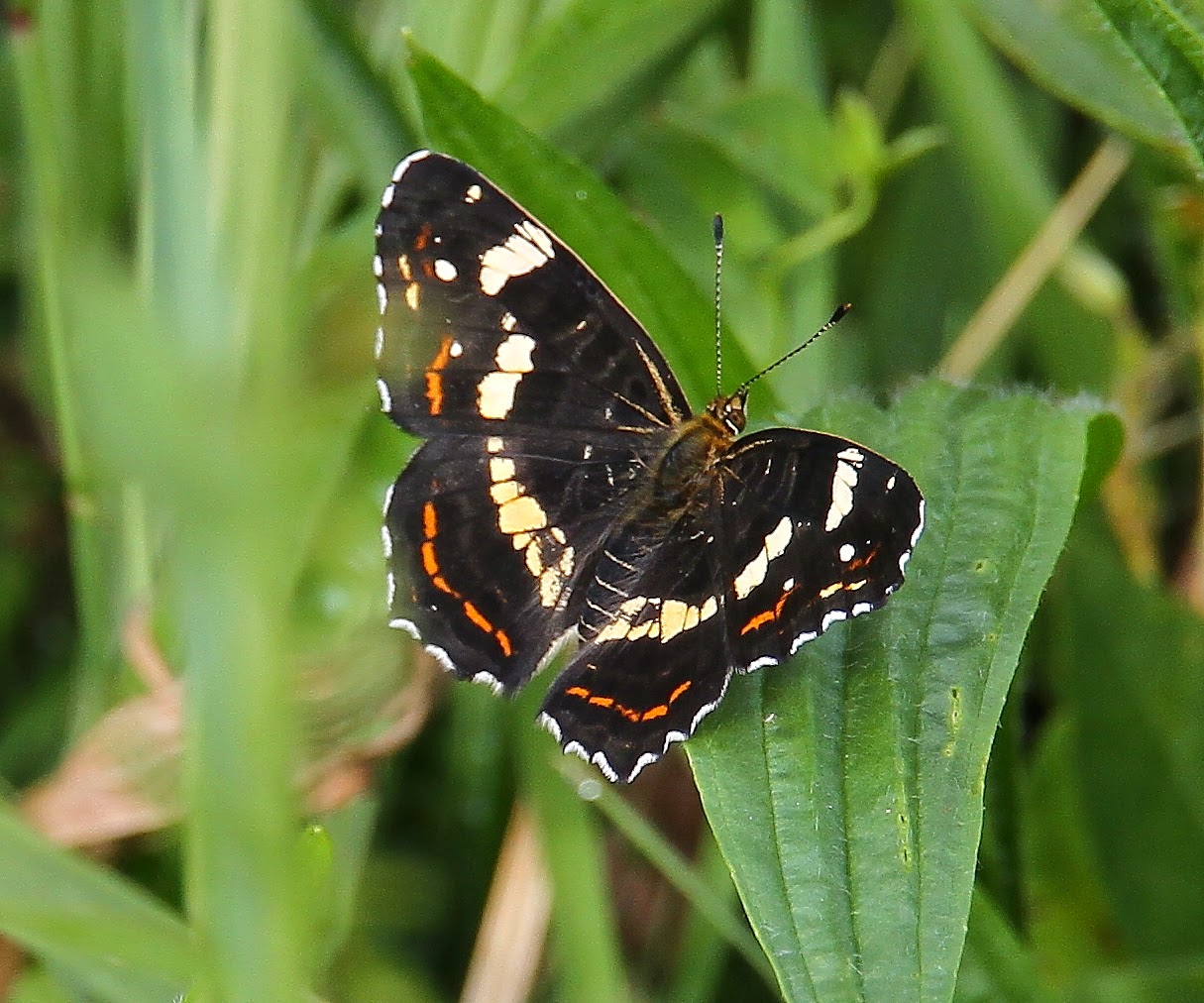
This morning, I had a call from Brian Arnold, to say they are watching the Map & it's being quite obliging in front of the camera. I get there & it is still there when I arrived about 15 minutes later. I was about to take some photos, when I see there are clearly two broken orange bands on the rear edges of the wings. This makes it a female and so we have a second individual. After getting some shots, I quickly bring out my mobile as they are photos from yesterday's blog on it and show Brian & Derek that the previous day's Map was a male (with only a single broken orange band). I had the advantage of getting better upper wing shots yesterday & having more time to look at those photos. So now we are looking at two Maps here. That rules out the chance of both arriving together, given their extreme potential vagrancy to the UK.  But that still didn't help with the vagrancy verses release theory, except it now means that the vagrancy would have had to have been a previous generation into a Spring generation which is less migratory.
Map: Individual B Female. The double orange band indicates it is a female
Map: Individual A Male. This is the male from the previous day. The single orange band indicates it is a male
Map: Individual A Male. Another photo of the same individual from today. Individual A has 2 strong, 1 weak & then 2 strong orange bars on the hindwing counting from the body
The female flew, but happy settled on a low white Umbellifer flower & started to nectar. Next thing is we see a second individual flying. We leave the female settled on the ground & nectaring & go off in chase of that individual which clearly is going to be yesterday's male (or so we thought). But we put up 2 more which start flying as well & but couldn't get any photos (as too flighty). But I was happy I had just seen 3. Several minutes later, we go back to look for the female & she is still there happily nectaring where we left her. So that has to be 4 individuals. Excitement is kicking in now at what we have just seen. I've never taken drugs, but reckon I should be talking about a new drug called MAP, with a near instant hit for all serious fans of Butterflies. Time to put a few updates & calls out as I knew several friends who were waiting on news.
Map: Individual B Female. She was still sitting on the Umbellifer & happy to show off her underwings
I spent the rest of the day at the site, getting photos as Maps were found. As the sun disappeared or they felt uneasy, they seemed to retreat to the surrounding bushes & trees. As the sun reappeared, then we were seeing them. The female seemed to be more of a natural model & easier to photograph. The males were more flighty & easier to disturb. As the day progressed, I started to look at differences in wing patterns, focusing on the fine detail of the orange band & the dark markings in the white band & seeing more males as I was getting more photos. Then I picked out a second female. So a multiple number of individuals present & as I write this I don't have a clear idea of how many I saw, but think it is 9 (with 7 males & 2 females). Hopefully, I will be able to prove this at the end of the post, but I'm sure that will be added to over coming days & when I see other photos. But for anybody who read my Swallowtail Mugshot post, you can figure where the rest of this post will be going. Time to get into the analysis & to prove the individuals. My Butterfly & Birding mate, Nick Urch, went into teacher mode (Nick you are on holiday) & suggested they should all have names Albert, Bettie, Colin etc, but I will settle for simple letters.
Map: Individual C female. Single band so looks like a male. But abdomen shape confirms it's a female. Considered most likely to be a female. But not Individual A as the hindwing has 5 strong orange bars (Individual A has 2 strong, 1 weak & then 2 strong orange bars counting from the body). Also the black marks in each of the white bands nears to the body are a different shape
Map: Individual C female. A better angle confirming the body shape as a female. Many thanks to Nick Urch for allowing me to publish this image. Copyright remains with Nick
Map: Individual D Male. Single band so a male. But the hindwings (counting out from the body) has 1 strong, 2 missing & 2 final orange bars. Also the black mark in the white band nears to the body are pretty small marks 
Map: Individual E Male. Single band so a male. Looks like A as the hindwings (counting out from the body) are 2 strong, 1 missing & 2 strong orange bars on the left hindwing. On the right hindwing, orange bars 4 & 5 are different shapes in Individual A. Also the orange on the right forewing stops after 2 marks. Individual A is more worn, but has orange continuing onto the right forewing 
Map: Individual F Male. Single band so a male. No problems picking out this one given the extreme wear. All the others have been pretty fresh, although Individual A has some wear to the upperside
Individual F is interesting as it looks like it has been flying for a week or more, so hatched earlier? Does this help with the release/locally bred considerations.
Map: Individual G Male. Single band so a male. Looks superficially like A & E as the hindwings (counting out from the body) are 2 strong, 1 missing & 2 strong orange bars on the left hindwing. On the right hindwing, orange bars 4 & 5 are different shapes in Individuals A & E. Also the 2 white patches in the band on the right forewing stops are a very distinctive shape.
Map: Individual H Female. Two bands so a female. Right this is easier to pick out as I only have to worry about Individual B as they others so far are males. Individual B has a broader outer orange band, whereas Individual H has the broader inner orange band 
Map: Individual I Female. Single band so looks like a male, but abdomen shape actually indicates it's a female. Looks superficially like C as the hindwings (counting out from the body) are 5 strong. But distinctive small white spot next to 2 white squares on right forewing (no white spot on Individual C)
Map: Individual J Male. Single band so a male. Looks superficially like A, E & G as the hindwings (counting out from the body) are 2 strong, 1 missing & 2 strong orange bars on the left hindwing). But the shape of these orange marks eliminate each of these individuals. Note, the 3 parallel white lines on each forewing along with an extra offset white line on the right forewing
So we are no further forward in being able to say where these have come from a vagrant from a less migratory Spring brood or a release. I suppose there is always the option C of a local breeder having an escape which started everything off. Guess we will never know. Just hoping the next thing I find will be a nice obvious bird with no doubts to its credentials.