27 Jul 2014

27 July 14 - Nearly A Hat Trick

It is now that time of year when Dorset people who are interested in Butterflies start talking in excited, almost reverent, tones about Alner's Gorse. This is a Butterfly Conservation reserve in North Dorset which is home to 3 of the 4 species of Hairstreak Butterfly that occur in Dorset. I wouldn't be surprised to hear that the Spring flying Green Hairstreak occurs as well. Even better, if you time it right you might see all 3 of the Autumn Hairstreaks on the same day. These 3 Hairstreaks are small, easily overlooked, species which often spend a fair bit of time in the treetops of the respective favourite trees, but will come down to nectar or sit on lower vegetation. At this point, they should be easy to see & photograph, but as they can sit still for relatively long periods of time, they are easily overlooked until they fly back up high again. Still it would be boring if all Butterflies were as easy to see as Gatekeepers. A couple of visits this time last year resulted in me adding all 3 species to my Dorset Butterfly list. However, I only managed to photograph 2 of the 3 species. So I was keen to go back again this year to try for Brown Hairstreak photos, as well as hopefully see the other 2 species again.
Alner's Gorse: Great looking habitat for Hairstreaks
Alner's Gorse is a good sized reserve and somewhere it would be possible to spend most of a day exploring. However, I had plans for the rest of the day, so had decided to try & limit my time there on this visit. I had heard that people had recently seen a Brown Hairstreak around the small car park, so I wasn't in a hurry to head off to explore the reserve. After spending about 10 or 15 minutes chatting with a couple in the car park, I suddenly spotted a female Brown Hairstreak only a couple of metres off the ground. She had probably been happily sitting there for longer than I had been looking. There was a quick dash back to the cars for cameras, before the chance for enough photography to impress a paparazzi photographer (except for the lack of a flashgun). But we had a real celebrity who knew how to pose for the cameras, rather than the self inflated pretend celebs the paparazzi seem to focus on.
Brown Hairstreak: Female. Females are a lot brighter than the males & have a larger orange patch on the upper forewing (not that I've ever seen the upperwings). I like the black & white banding on the feet and the bright yellow tips to the antenna (details I never notice in the field, but are very apparent on the photos)
Purple Hairstreak: Female. Looks like this one has been around for a while
Purple Hairstreak: Female. The purple is restricted to the base of the upper forewing, it would cover nearly all the upper forewing in a male
Purple Hairstreak: Alner's Grove (13 July 13). On its favourite Oak tree. Note, while the underside of the hind wing has a letter W where the white almost lines up with the white on the upperwing
Unfortunately, no sign of any White-letter Hairstreaks while I was there, but I a couple of tatty individuals had been seen before I arrived. So here is the White-letter Hairstreak from last year (taken with my little Lumix camera).
White-letter Hairstreak: Alner's Grove (4 Aug 13). Note, the underside is superficially similar to Purple Hairstreaks, but the letter W has the left side of the W sharply angled back towards the head
There are plenty of other Butterfly species present at Alner's Grove. I've seen 21 species without making too much effort over 3 visits at this time of year in 2013 & 2014 and there are a number of other fairly common species which occur at the site that I've not seen. Generally my visits have been focused around seeing Hairstreaks & I've not spent as much time as I should have exploring the wider reserve. Two of the other good species here are White Admirals & Silver-washed Fritillaries.
Peacock
Comma
Ringlet
Gatekeeper
Speckled Wood
Having seen & photographed a Brown Hairstreak & had some bonus photos of Purple Hairstreak, I was keen to push on to the second part of my plan for the day: to look for a new Dragonfly on the Somerset Levels. You will have to wait for the next post to find out which species this was & how I got on.
Common Darter: The new Dragonfly is more exciting than this species

25 Jul 2014

25 July 14 - Photospot6 - Palearctic Wheatears

I wonder how many Birders living in the Western Palearctic don't have a soft spot for the Wheatear group. Living in Dorset, we only really see Wheatears as migrants with the very occasional bird hanging onto into the Summer suggesting they might occasionally breed. But I like seeing them as it means that when I see them, there will also be other migrants on the move. Also all the Wheatear species are great characters. The only regular species we get in the UK is the Wheatear (I don't do the trendy name of Northern Wheatear), with another 5 species having appeared once or more as vagrants. They are White-crowned Black Wheatear, Pied Wheatear, Black-eared Wheatear, Desert Wheatear & Isabelline Wheatear. Fortunately, I've managed to see them all over the years, including the only record of White-crowned Black Wheatear: which I suspect will remain high up on the wanted list of many twitchers who weren't twitching in the early 80s for many years to come.

I have been lucky this year to see a number of different Palearctic Wheatear species in Gujarat & Rajasthan parts of India, Morocco & the Western Sahara, Israel & Croatia. They have all appeared on this blog in various posts (or are new Croatian photos), but I thought I would bring them all together in one post, as I'm sure I won't be the only person who thinks the Wheatear group are great. So sit back & enjoy. The backgrounds are all bright & sunny, which goes with the current UK weather. Ironic as when I started writing this post it was bright & sunny and as I come back to put the finishing touches to it, I can hear the rumble of thunder.
White-crowned Black Wheatear: Adult. Eilat Mountains, Israel (10 April 14). This photo had the approval of the local Israel army checkpoint guys
White-crowned Black Wheatear: 1st Winter bird. Aoussard Road, Western Sahara (8 Feb 14). The black crown with a single white crown feather indicated this was an immature bird. The tail pattern was checked & found that the black was primarily on the black central tail feathers & did not have the strong T shape (that the Black Wheatears have)
Black Wheatear: Dakhla Bay, Western Sahara (11 Feb 14). The brown plumage & broad T shaped tail pattern, confirmed the identification
Wheatear: Aoussard Road, Western Sahara (12 Feb 14). A nice bright male showing off its tail pattern
Wheatear: Ne'ot Smadar, Israel (12 April 14). Female
Wheatear: California Farm, Swanage, Dorset (2 May 14). Guess I had better sneak in a shot from the UK
Eastern Pied Wheatear: Desert Coursers, Gujarat, India (15 Jan 14). Also known as Variable Wheatear as there are 3 distinct colour forms across its range. This is the picata form
Eastern Pied Wheatear: Desert Coursers, Gujarat, India (16 Jan 14). This is the picata form 
Eastern Pied Wheatear: CEDO, Gujarat, India (20 Jan 14). Male of the picata form transforming into adult plumage
Eastern Pied Wheatear: Tal Chappar, Rajasthan, India (25 Jan 14). This is the opistholeuca form & would normally winter in Northern Pakistan, rather than Gujarat
Red-rumped Wheatear: Male. Tan-Tan, Morocco (6 Feb 14). This is the moesta subspecies which occurs from Western Sahara to Egypt
Red-rumped Wheatear: Female. Tan-Tan, Morocco (6 Feb 14)
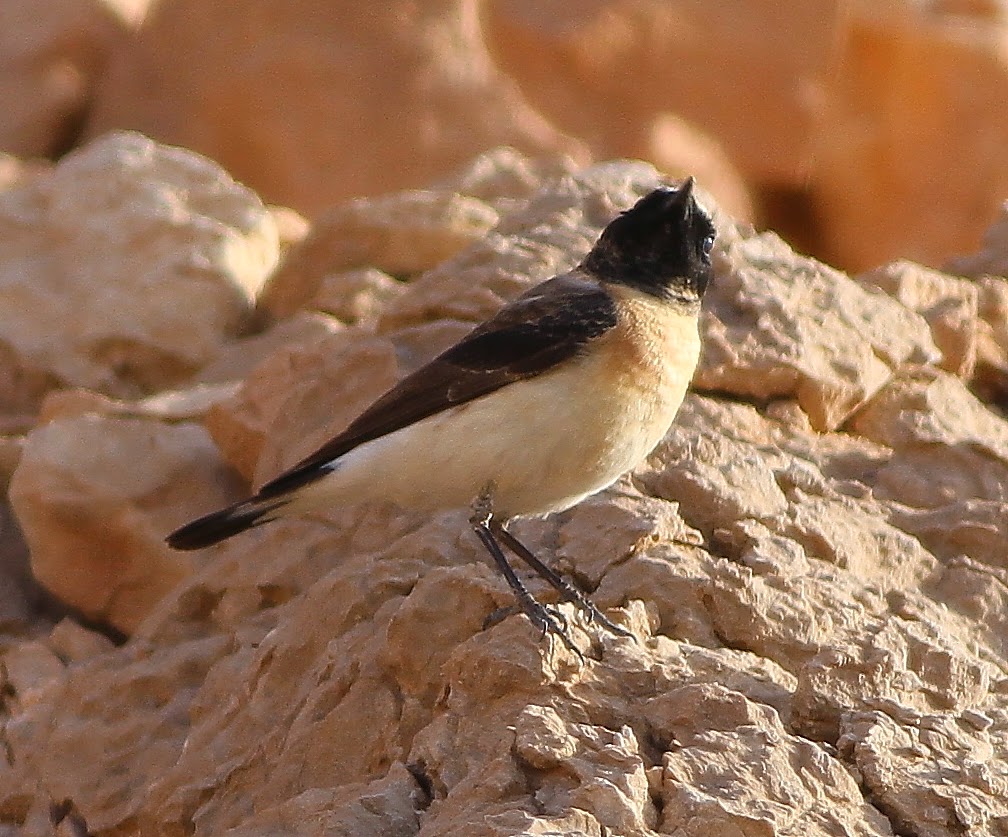
Black-eared Wheatear: Beit Yatir, Israel (8 April 14). Male. Eastern melanoleuca subspecies
Black-eared Wheatear: Male. Amran Pillars, Israel (10 April 14). Eastern melanoleuca subspecies
Black-eared Wheatear: Male. Velji Do, Croatia (5 May 14). Eastern melanoleuca subspecies
Black-eared Wheatear: Female. Velji Do, Croatia (5 May 14). Eastern melanoleuca subspecies
Persian Red-tailed Wheatear: CEDO, Gujarat, India (20 Jan 14). This is the Red-tailed chrysopygia subspecies. Note, the pale grey upperparts & slim, weak build for a Wheatear. This bird was wintering on a small Kopje (a small stony hill on the sandy plain)
Persian Red-tailed Wheatear: CEDO, Gujarat, India (20 Jan 14). It occurs from Transcaucasia to Afghanistan & winters in Pakistan & NW India. This is the Eastern of the two species (the Western xanthoprymna species being the one that occurs in Turkey and is now split as the monotypic Kurdish Wheatear
Desert Wheatear: Desert Coursers, Gujarat, India (16 Jan 14). This is the atrogularis subspecies (which is combined with the nominate deserti by some authors)
Desert Wheatear: CEDO, Gujarat, India (20 Jan 14). This is the atrogularis subspecies
Desert Wheatear: Aoussard Road, Western Sahara (8 Feb 14). This is the homochroa subspecies which occurs from Western Sahara to Egypt
Isabelline Wheatear: Tal Chappar, Rajasthan, India (24 Jan 14). Note, the upright stance & heavy bill
Isabelline Wheatear: Tal Chappar, Rajasthan, India (25 Jan 14). Note the black tail, uniform pale upperparts, black alula, and heavy bill & head
Unfortunately, there are a few gaps here. I did see a Hooded Wheatear, but right next to the Israeli-Egyptian border & an Isreali road checkpoint. The army guys on the checkpoint weren't worried about us being there, but were insistent no cameras were used along the border. They did check my camera earlier that day, but fortunately, they were happy with the White-crowned Black Wheatear (above) & didn't look further. As for the other gaps, hopefully I will get to fill some of those in the next few years & maybe give me the opportunity to republish this post.

23 Jul 2014

23 July 14 - The Magic Of The Wonderous Willow

Don't worry this isn't a homage to cricket. But shock, horror, it's a post about Birds on a Birding blog. June & July can get very quiet for birding in Dorset, hence the reason I diversify into insects, especially Butterflies & Dragonflies. Still quite an id challenge on a few species, a good learning experience and a good excuse to keep me getting out & busy with the camera. I have been out Birding as well, but just not seen that much of interest recently. That was until local patch stalwart, Ian Ballam, found a Spotted Crake sitting in a Willow tree over the weekend. Fantastic Poole Harbour record to actually see one in the harbour, as the one (or possibly two) heard in the Spring were only heard calling after dark in the Wareham area and it/they quickly moved on. I can't remember when the last Spotted Crake was actually seen in Poole Harbour, but probably around 10 years ago, although there have been a couple other Spring birds calling after dark in that period for a few days, before moving on.

Anyway, the Spotted Crake was looked for over the next day & a half with no further sightings, apart from a sighting about 2 hours after the initial sighting. Then a surprisingly early text yesterday morning to say it had reappeared & again it was sitting in the what I now think should be called the 'Wonderous Willow'. The Irish Birders have the 'Magic Bush' on Tory Island where birds just appear & perhaps this is the start of something new locally. I managed to get the OK to visit this morning & was pleased to hear it had been seen as I was parking the car. But I then had to negotiate the maze of paths, secret planks across ditches (covered by muddy water), retraced my steps after taking the wrong path, before finally getting to the right site. By this time, not surprisingly the Spotted Crake had dropped out of the Wonderous Willow. But a bit later it popped out again briefly. Then it reappeared for a final few minutes & allowed some photos as it moved around in the tree. The previous day, it was seen with 2 Water Rails in the same Willow, along the Reed & Sedge Warblers that seen to be constantly bouncing around in the branches.
Spotted Crake: Wow. I heard the bird in the Spring, which was a Poole Harbour tick, but personally, I only considered that as a 1/2 tick as not seen, so great to add this fully to my Poole Harbour list
Spotted Crake: There have also been birds seen recently in Somerset & Gloucestershire in the last few days, so presumably they all arrived on the same winds
Spotted Crake: The whitish chin & brownish bill indicate it is a juvenile
Had I been asked a week ago, where to look for a Spotted Crake, then my answer would have been simple: to look at the edge of a reedbed, where there was a bit of exposed mud and in late evening on a end of August date. Sitting in Willow tree in July would not have entered my head. But what I think is happening here is the Spotted Crake and the Water Rails are feeding in the adjacent reed edge & probably quite a bit at night and are now coming into the Wonderous Willow as it is safe. It sits above a ditch, so no chance of predators taking them (except for possibly an opportunistic Sparrowhawk). Also, perhaps they are enjoying the early morning sun after a night of feeding. I guess this is probably a typical behaviour, but one I've not heard of before for either species, as it probably normally occurs in trees out of sight in the reed bed.
Spotted Crake
Unfortunately, this is a private site with no opportunity to open it up to public access.
Spotted Crake: Heading back to the reeds
While I was waiting to see if the Spotted Crake would show again, this Kingfisher appeared. This is another recent arrival as there are no local breeding sites.
Kingfisher: Male. Perching in the Wonderous Willow
Kingfisher: Male as it has an all black bill, females would have an orangey lower mandible

21 Jul 2014

21 July 14 - Caught Out By A Conman (Darter) Or The Pitfalls Of Darter Identification

If you're going to write a blog or publish stuff in another format, then there is always the risk that you will misidentify something. I've seen this on other blogs, where people have made errors & it's interesting looking at the different reactions. Some put their hands up & admit to the error, others probably change things very quietly hoping nobody spots they have made a mistake & on a few occasions, I've seen people carry on with the error regardless of the facts. Another reaction I've seen from a well known figure & prolific tweeter has been to suddenly go quiet for a few hours after being told he has made a mistake. I'm looking forward to his next mistake to see if this was pure coincidence or another interesting approach. My approach is to put my hand up to the error & try to learn from the mistake, so I don't make it again. 

Over the weekend, I was finally looking at some old photos from a couple of years ago & labelling them. I found this Darter photo from Dorset's newest birding site, Longham Lakes. This has been well watched over the last four years since the gravel extraction phase at this site ended. I didn't look at this photo really closely, but labelled it as a Red-veined Darter.
Darter: Longham Lakes (18 Aug 12)
This went out as an email on the local email group as I don't remember any records of Red-veined Darters for this site. It prompted a swift & private response from my sharp eyed mate, Steve Morrison, asking whether I had attached the right photo as this was a Common Darter. A quick look in this case, revealed he was right, as I couldn't even see any red veins on it. I had been going on the red pterostigma (the red cell at the end of each wing) & hadn't really checked the photo more carefully. Oh dear. Should have looked at the photo and the books a bit more closely. At this point, I forwarded a photo of the Red-veined Darter taken at Arne recently to ensure that I hadn't screwed that one up as well. That one had red veins, but having re-read the Dragonfly guide, the pterostigma should be yellow-brown with a dark line above & below and alarm bells starting ringing about this one. But on balance, I still thought this would be OK. 
Darter: Arne (11 July 14)
The email back from Steve confirmed that this too was a Common Darter. I quickly contacted Brett Spencer as Brett probably knows more about Dragonflies than anybody else I know who now lives in Dorset. Steve lives in France these days so I don't have to try comparing their knowledge (phew hopefully that will avoid a legal action!!!). A quick response from Brett confirmed the Arne Darter was a young male Common Darter. So that's now two misidentifications & the Arne Darter was already published on the blog. I only had time last night to quickly add a brief update to that post, but have now changed it. But rather than adopt the approach of constantly rewriting history like the Ministry of Truth in George Orwell's classic book 1984, I thought I would try to get the features sorted properly this time. I've often tried to make the blog a bit more interesting than a diary of what I saw when I went out. So I've tried to add a bit more to the blog, e.g. subspecies & ranges or the features which make this species what it is. My worry now was have I mislead anybody else due to my errors.
Common Darter: Arne (11 July 14). Common Darters have 2 obvious yellow stripes on the sides of the thorax
 Common Darter: Arne (11 July 14) They also have yellow stripes on the black legs (would be all black in Ruddy Darters). The facial pattern has the black above the frons [nose area] extending as a line, but not going down the sides of the frons (which it would do in Red-veined Darters). The eyes are reddish-brown with yellow or green below & get redder with age, but never getting as deep red as on a Ruddy Darter
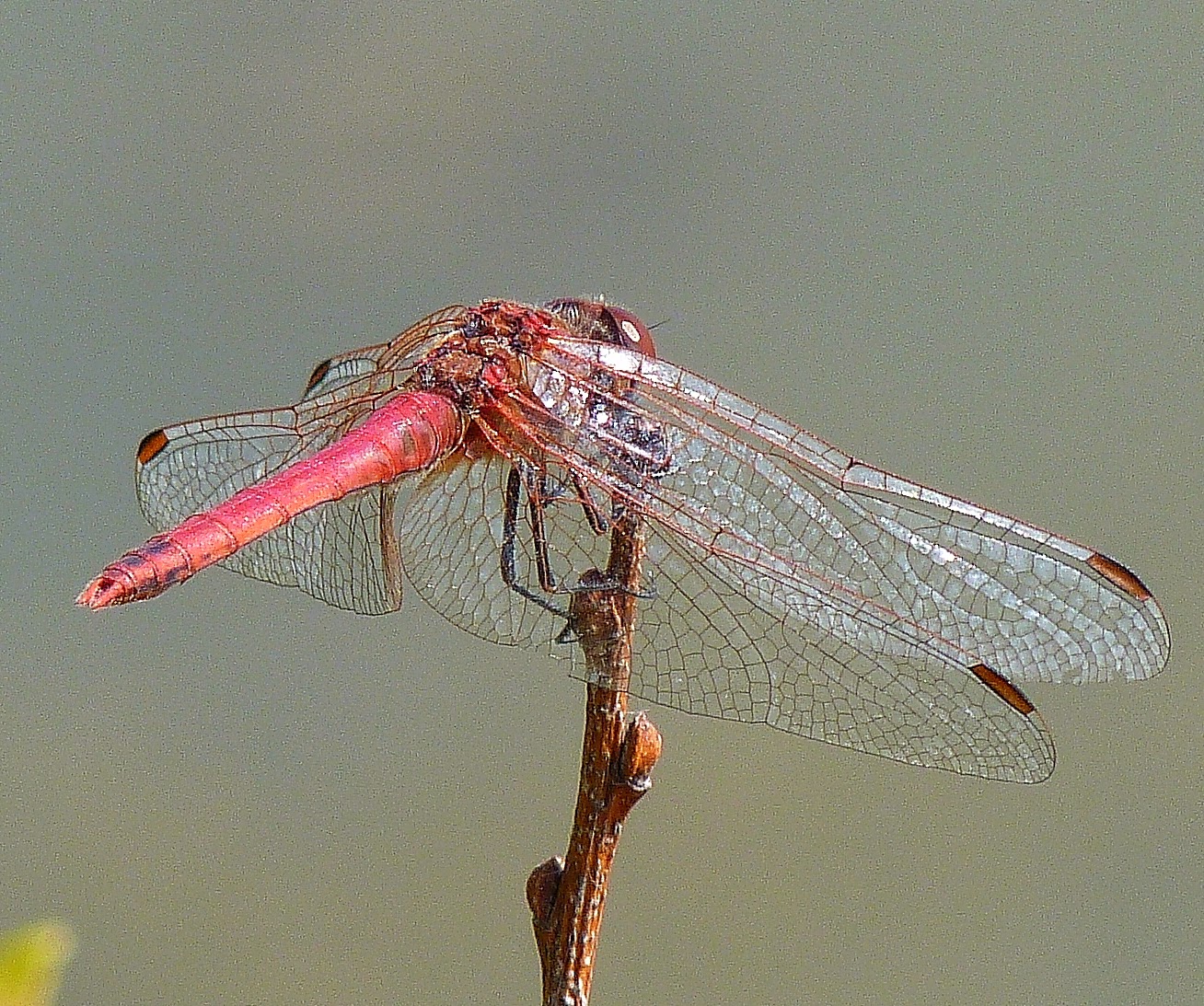
Common Darter: Arne (11 July 14). Males have an orangey-red abdomen. Clearly, from my photos the pterostigma colour can vary from greyish in the first individual to red with a touch of yellow in this individual. Note, the lack of yellow bases to the hind wings
Here are the comments from Steve on the above individual: The Arne photo gives the impression of something good based on the colouration of the veins, but not enough to be Red-veined and they really are red or orange-red in Red-veined. Common Darters have the most parallel sides of the Sympetrums. There is variation in Common Darters, as with many Dragonflies and some do show coloured veins. The Arne one being closer to the extreme than most. The pterostigma on Common invariably appear reddish and usually dark, but sometimes pale, but invariably reddish. Brett added that a Red-veined Darter would only ever have this extent of red on the pterostigma on an old male.

I did send Steve my final photo of a Red-veined Darter from West Bexington last year. I was confident about this one as the local birders, Mike Morse & Alan Barratt, took Peter Moore & myself to this site & others including Brett had also seen them earlier in their flying period. But there was always the possibility I had photographed a wrong individual, but this time I thought I was right. This got a thumbs up from Steve, so it can stay on my Life & Dorset list.
Red-veined Darter: Note, the brick-red abdomen, yellow-brown pterostigma with dark borders & yellow basal patches to the hind wings (although Common Darters can show this, but not as extensively). The red veins are mainly on the basal part of the leading edge of each wing. Unfortunately, I've not got a picture of the facial pattern to see the black ending down the sides of the frons. Other features to look for are the brown thorax lacking pale stripes, the eyes of males are reddish-brown above and blue below (but all are hidden on the photo by the wings) & the black legs have a yellow stripe on them
Steve has added the following comments against this individual. The veins in this individual are actually relatively indistinct for a Red-veined Darter and close to the Arne Common Darter, but they are always more extensive than Common Darters. Also note the more subtly pinched-in look at the Red-veined Darter abdomen (not applicable in females). Also the pair of red tips on the ante-alar ridge [part of the edge of the thorax in front of the front wing bases], just in front of the red tegulae [the bit where the wing joins the thorax] are more diagnostic of Red-veined Darter, than Common Darter. On a Common Darter, this area usually looks pale contrasting with the red tegulae, as seen on the Arne Common Darter. Wow got a couple of new bits of anatomy into the post, which I had to look up on the internet. I've added my layman's explanation in square brackets.

Overall, it has been a good learning experience for me. Many thanks to Steve & Brett for their comments on the Arne individual. Also thanks to Steve for having a proof read of this post to make sure it was OK before publishing it. Can't wait to get back out now to have another closer at Common Darters and hope that some more Red-veined Darters appear in Dorset this year, to get a better view & photos of them.

20 Jul 2014

20 July 14 - A Few Coastal Butterflies

Popped out for a few hours this afternoon to look for Essex Skippers at St Aldhelms. I don't know they are here, but assumed they would be. But in the end, I struggled to find many Skippers with only a handful of Small Skippers & Lulworth Skippers seen, as it was cooling down by the time I started to look for the Skippers. Still a good selection of other common Butterflies seen, along with several Oak Eggars. Also the chance to submit my first count for the Big Butterfly Count. It takes 15 minutes to do & a couple of minutes to upload your sightings & you can even do it on a smart phone, if (unlike me) you chose an area with mobile coverage. So give it a go. They are only interested in the 21 commonest Butterflies & day flying Moths & full details are on the Big Butterfly Count site.
Peacock: A stunning upperwing pattern
Peacock: The underwing doesn't give any indication of how great they are when they open their wings
 
Painted Lady
Oak Eggar: Male. These were flying around very fast & erratically, like a demented Painted Lady on speed. I assumed they would turn out to be one of the Eggar species, but it took quite some time to finally see one land. Note, they are not dependent on Oak trees, but they get their name from their acorn-shaped cocoons. Perhaps they should have been called Acorn Eggar
The walk out from the Renscombe car park goes past a number of arable fields. One field still has a couple of male Corn Buntings which have been just hanging on at this site, although the numbers have declined from when I first started to watch the area over 25 years ago. Yellowhammers are another species which are still hanging on here, but in better numbers locally than the Corn Buntings. Either species brighten up the walk out to the headland.
Yellowhammer
Finally, it's getting to the time of years when the Bush Crickets & Grasshoppers start getting a lot commoner. Again a group I've been trying to get into for a number of years. The Bush Crickets aren't too hard to work out, but I find the Grasshoppers to be a trickier as some species come in a variety of colours.
Field Grasshopper: Nymph. Adults are generally brown, grey or green, but some nymphs come in this distinctive pink colour
Field Grasshopper: Nymph. The v shaped white marking on the pronotum (thorax area) is sharply angled and the pronotum forward of kink is shorter than the area at the rear
Field Grasshopper:This is what adults more typically look like (Langton Matravers, 27 June 10)