22 May 2023

22 May 23 - Spring Spotted Flycatchers

Spring Spotted Flycatchers are normally scarce at St Aldhelms with typically only one or two seen on a good day. So, it was surprising to hear Phil Saunders had a big fall of at least twenty-three on Sunday 21 May 23. I was out the following morning & saw at least eleven Spotted Flycatchers between the Renscombe Farm car park & Trev's Quarry: this included eight flying North. Steve Morrison had seen another ten at the Head itself at the same time I was seeing my Spotted Flycatchers, so overall there were similar numbers to Phil's day. On both days, there were a number of individuals flying strongly North & rapidly leaving the Head, so it was clear that the fall was continuing for a second day with a good turnover of individuals.
Spotted Flycatcher: One of the eleven Spotted Flycatchers by Trev's Quarry
There was also a Marsh Harrier over in the late morning. I picked it up in the field North of Trev's Quarry at 11:08. It was still hunting over the fields near the car park as I got back to the car, but it quickly rose in height presumably to get a good view of the surrounding area. It dropped back to ground height & disappeared off North West at 11:33.
Marsh Harrier: Marsh Harriers are a scarce species with only one or two records a year at St Aldhelms
There was a third fall of Spotted Flycatchers on the 23rd with another thirteen individuals between the Renscombe Farm car park & Trev's Quarry, including another four flying North. During this period, the winds were North Easterly which were helping to provide a headwind & encouraging the fall.
Spotted Flycatcher: One of the thirteen Spotted Flycatchers at the top of Pier Bottom (23 Sep 23)
On the 23rd, a full-sized replica of a 16th or 17th Century Spanish Galleon, the El Galeon Andalucia, was seen heading East past St Aldhelms. Despite being a replica, it clearly has an engine as well, as it was motoring East without any sails up in a North Easterly wind.
El Galeon Andalucia: This is full-sized replica with a modern engine as well (23 May 23)

17 May 2023

17 May 23 - A Cheeky Water Vole

When I started this Blog in Oct 13, it was to create a place for me to put my photos and use them to showcase the excellent birds & other wildlife in the UK, as well as, abroad. I didn't have any idea how the Blog would be received, but I hoped that if I found it useful & interesting, then others would also do so. Today's Blog Post is number 800, I've recently pasted the 550,000 hits on the Blog and it's been viewed from 168 countries. All of which are far higher than the modest plans I had when I started the Blog. Anyway, enough flag-waving for the Blog and onto the subject of today's Post.
Water Vole: Initially, it was nervous & fed close to the denser vegetation
I volunteer on the Dorset Wildlife Trust Brownsea reserve every Wednesday during the months when the island is open. The volunteering is a mixture of public engagement and pointing out the wildlife, especially the Birds and Red Squirrels on the reserve. It also gives me the opportunity to have a look on the lagoon at various points in the day.
Water Vole
On this afternoon, one of the DWT wardens, Jonny, had been filming a live virtual meeting in the Avocet hide with some of the other volunteers. When it finished, I headed back into the hide for a final check of the lagoon before I left the island. Within a few minutes, Jonny came back into the hide to announce that a young Water Vole had been seen feeding by the main track. The other volunteers & I quickly left the hide & found the Water Vole was a couple of feet off the track at the edge of some long grass by some Brambles. Not typical Water Vole habitat. On a few occasions, it disappeared back into the vegetation as additional people joined the group, but when we stayed still, its confidence increased & it popped out again to grab another blade of grass to eat.
Water Vole: It popped out grabbed a blade of grass to eat, albeit it quickly finished the snack
Water Voles are not uncommon on Brownsea, but they are generally very shy & they quickly disappear out of view or underwater. I've only seen them once before on a visit in Sep 2010, when I popped over to see some old friends who were visiting from Southampton.
Water Vole: Finally the photo I was looking for
It was time to head back to the villa, drop off the radio & head off to catch the ferry off Brownsea.

16 May 2023

16 May 23 - A Spring Red-veined Darter

The weather looked promising for some late Spring migrants at my St Aldhelms patch, but in the end there was little around. A single Spotted Flycatcher at the top of Pier Bottom and small numbers of all three common Hirundines arriving were the highlights as I left Trev's Quarry & headed towards the head.

Out of the corner of my eye, I saw was a flash of a red Dragonfly, but that was all I saw before it disappeared off the main track. It was too brief to even decide whether it was a Dragonfly or Damselfly. The only red species flying at the moment is likely to be a Large Red Damselfly, but that is a species I've not seen at St Aldhelms. It was too brief a view to do anything with it, other than to feel frustrated by the poor sighting. I carried on a bit further, before deciding I might as well knock the Birding on the head. Fortunately, the Dragonfly had returned to the main track & I saw it fly again, but it quickly drop back onto the track. It was clearly a Darter. As I raised the camera, my mind was considering the options: it was a couple of months before either the first Common Darters or Ruddy Darters would be on the wing. Common Darters occur at St Aldhelms, whereas it would also be the wrong habitat for a Ruddy Darter. That left a migrant Red-veined Darter as the most likely candidate. I needed to get some photos.
Red-veined Darter: This my first Red-veined Darter that I've seen within 10 miles of the house: a list I'm particularly keen on as it highlights my local wildlife sightings
Red-veined Darter: A close up of the head & wings
After grabbing a few photos, it was time to check them to confirm the ID features. One of the bonuses of carrying a camera is it is often easier to zoom in to check the ID features on the photos, than it is to get close enough to see these features in the field. I could see the dark bordered pale pterostigma near the wing tips and the black marks on the abdomen. I could just about make out the facial pattern showing the blue-grey lower face & the white edges to the frons, as well as, the red veins. All these features confirms it was a Red-veined Darter: a nice migrant for St Aldhelms. I tried to get a couple of feet closer, but it saw the movement & disappeared back into the field & out of sight.
Red-veined Darter at Longham: Here is a better photo of a Red-veined Darter at Longham for comparison (30 Jun 19)

13 May 2023

13 May 23 - A Day Trip To St Mary's With ORCA

This was my second Cetacean for ORCA in May 23. The previous week had seen me surveying from Roscoff back to Plymouth. This survey was going to stay within the UK with a day trip to the Isles of Scilly on the Scillonian III. The weather looked mild & sunny with light winds and hopefully calm seas. This turned out to be the case. I drove down in the early hours of the morning & fortunately, I didn't stop until the Long Rock McDonalds on the edge of Penzance. After some food, I planned to head into Penzance. But the car wouldn't start as I had a flat battery. I contacted the team leader for the survey, Mary to let her know & asked if she could pick me up. I knew She was staying near to the Hayle & would be coming right past me. Fortunately, she picked up my phone call & arrived about fifteen minutes later. We were soon parked up in Penzance. Ian, the third member of the team arrived before we needed to join the queue to board the Scillonian III.
The view from the bridge wing
We were allowed onto the bridge, once we were clear of Penzance Harbour. The Scillonian III has a small bridge and there isn't room for us to survey from inside the bridge. However, there is plenty of room on the bridge wings with a walkway in front of the bridge. We had been warned to wear warm & waterproof clothing as we would be exposed to the weather on the crossing. Fortunately, it stayed dry, however, thanks to the wind chill it was far from warm, despite the sun.
Gwennap Head & Porthgwarra Valley
Despite our best efforts, we drew a blank on Cetaceans on the crossing to St Mary's. The Bird highlights were: three Storm-petrels, thirty-three Manx Shearwaters, a few Gannets, some Razorbills & Guillemots and four Puffins. There were a couple of Seals around the Eastern Islands, but they were too far away to do anything other than record them as Seal sp., even though we suspected that Grey Seal was the more likely species. I was focusing on watching for Cetaceans and I didn't have time to do much photography, other than when I was the recorder. We carried on surveying until just before we could see Hugh Town.
The walkway in front of the bridge
Survey over & Mary is enjoying the view of St Mary's
The top end of St Mary's
Telegraph at the top end of St Mary's
We docked just before 12:00 and had about three & a half hours for a shore run. This allowed us to be back on the quay an hour before the Scillonian III's schedule departure to ensure there were no last minute problems getting aboard. We all split up to do different things. My plan started with a walk to Porthcressa Beach in the hope of being able to scan over to St Agnes and Gugh. At high tide, the beach between the two islands is flooded, but at low tide it is possible to walk across to Gugh from St Agnes. There was a Laughing Gull that was hanging around a Lesser Black-backed Gull colony on Gugh.
Porthcressa Bay
I've seen a couple of Laughing Gulls in the UK and many more abroad, so I wasn't fussed enough to jump on an inter-island boat over to St Agnes to try to see it. Plan B was to see if I could see it from Porthcressa Beach. The answer was no: I hadn't bothered taking the telescope with me, but there was too much heat haze anyway. I spoke to a local Birder who did have a scope, but he said the Laughing Gull often dropped into the colony & disappeared out of sight & he hadn't seen it since he had started looking before I arrived.
Porthcressa Bay
Looking into Porthcressa Bay from Peninnis
I wasn't too fussed about hanging around & carried on, over Peninnis Head to look around the Old Town Church & Lower Moors, followed by walking around Porthloo Lane. These are some of my favourite parts of St Mary's. Not surprisingly, there weren't any migrants, but it was good to have a gentle walk around some of my old October haunts from the past.
Moorhen: Chick. Lower Moors, St Mary's
Song Thrush: They are always a favourite for visiting Birders as they are much tamer than elsewhere in the UK
Porthloo Beach
The Scillonian III: A sight that will be familiar to all the Birders who have visited St Mary's
Finally, I ended up back in a Hugh Town cafe to top up the caffeine levels before heading back with plenty of time to meet Mary & Ian on the quayside.
Hugh Town harbour
The inter-island boats return in time to connect with the Scillonian III's departure
We sailed on time and it was a better crossing.
Gugh: This photo was taken from the Scillonian III & Gugh was a fair bit closer that from Porthcressa Bay. But trying to pick out the Laughing Gull would still have been a challenge
My personal highlight on the return crossing, was finding a pod of three Risso's Dolphins heading straight for the Scillonian III, before passing down the port side. Frustratingly, I didn't manage to get any photos. When surveying, the initial priority is to note the vertical distance of the Cetacean from the horizon when it is first seen. We use binoculars which have a vertical graduated marking in the left eyepiece which allows that to be measured. Next you have to measure the angle from 12 o'clock (i.e. the direction the ferry is travelling) to the Cetacean.

These two measurements are useful as they allow the ORCA head office computer to calculate the distance from the ferry to the Cetacean. The maths also needs to know the height of the bridge above sea level (which is a known height for each ferry). The ships heading, speed, position, time, sea state, weather & visibility are also included in the calculations. Finally, the direction of travel and what the Cetacean is doing is also noted. All this information helps the ORCA head office computer to provide an estimate of the number of Cetaceans seen along each of the survey routes and ultimately the population numbers along each ferry route.
Risso's Dolphin: These Risso's Dolphins were photographed from the Plancius on the West African Pelagic between Cape Verde and the Canaries (3 May 18).
Once these measurements have been determined, the next thing is to identify the Cetacean involved. But I had already done that on the first sighting based upon their colouration, size & high dorsal fin. Finally, I could lift the camera to try & get a photo. But I hadn't seen them till they were fairly close, we were closing rapidly on each other and they weren't spending a lot of time on the surface. Think that's enough excuses for the lack of photos. They were only my second UK sighting, although I've also seen then on the Atlantic Odyssey, the West African Pelagic and Banda Sea Cruise.
Manx Shearwater: I saw thirty-three on the crossing to St Mary's and just under three hundred on the return journey
Half an hour later, Ian picked up a very close Minke Whale, but I was the recorder & had to head straight into the bridge to note the time, location, course & speed. Once I had noted them, it had already detected our presence & dived for good. C'est la vie. There were more Manx Shearwaters and a few each of Fulmars, Gannets, Razorbills and Guillemots. But no more Storm-petrels or Puffins. Eventually, we reached Mousehole, before starting the turn into Penzance Bay.
The Wolf Rock Lighthouse off the Cornish coast
Mousehole
St Michaels Mount in Penzance Bay
The second survey of the day was over and to get a relatively calm crossing on the Scillonian III is always a big bonus. It had been a lot of fun & I'm hoping I get selected for another Scillies survey.
Rock Pipit: This Rock Pipit greeted our return from the seawall of Penzance Harbour, while we were waiting to disembark
Fortunately, we managed to jump start the car when Mary dropped me back at it. It was then a straight-forward drive home in one go. I managed to bump start it on the Monday & got the car into the garage. They confirmed that the problem was an end-of-life battery and not anything more serious or expensive like a dying alternator. A new battery & I was back on the road again.

8 May 2023

8 May 23 - Roscoff To Plymouth With ORCA

Last Autumn I took part in my first Cetacean Survey for the charity ORCA on the Poole to Cherbourg route. This May I've was selected for the next two surveys: Roscoff to Plymouth & a day trip to Scillies. I arrived in Plymouth on 7 May with plenty of time for some food before leaving the car in the Brittany Ferry terminal car park. One of the good things is the surveys are well supported by the ferry company & we get free parking (where available), as well as, travel on the ferries.

I were due to meet the leader Kerry & the other two surveyors, Julia & Jonathan, at 20:30. Kerry & Julia were there, but unfortunately, Jonathan had phoned in to say he was ill. So a bonus for me as I would get a cabin to myself. Kerry was happy we had a big enough team to complete the survey, but it would just mean spending two in every three thirty minute slots surveying with the third slot as recorder. Typically, there would be a down time slot as well when we are meant to rest our eyes. But given the amount of seawatching I've already done at sea in Antarctica & the West Pacific Odyssey this year, then my eyes are not used to the luxury of thirty minutes rest when at sea & I would have been Birding anyway.

We boarded the Armorique about 21:30 & we departed just before 22:00. We had a quick chat to confirm the plan for the following morning. The ship was expected to arrive around 07:00 into Roscoff and there would be a wakeup call for the passengers at 06:30. I reckoned it would be light around 05:30, so I set my alarm for 05:15, happy that there was nobody in my cabin to disturb with the early start. After a quick breakfast, I was up on deck to find it was overcast & a steady drizzle. We were about an hour off the French coast so I was hopeful of some Seabirds. The first sighting was a Stock Dove that was flying around the ferry. I found a covered viewpoint at the stern & started Seawatching. There was a steady movement of Manx Shearwaters, but sadly none of the hoped for Skuas. Perhaps the depression that had caused the rain, had held them up further South & West.
Manx Shearwater: I saw 92 Manx Shearwaters in the last hour before reaching Roscoff, but none were close
Stock Dove: I wasn't expecting to see a Stock Dove on the ferry, but migrants are regularly attracted to lights on boats when they hit adverse weather
At 06:30, I headed down to meet up with Kerry & Julia as we approached Brittany. We were allowed to keep one cabin for the whole of the trip, so I moved my bag to the other cabin. That saved the hassle of having to take it into Roscoff. We had about five hours to explore Roscoff, before heading back to board the ferry about 12:30.
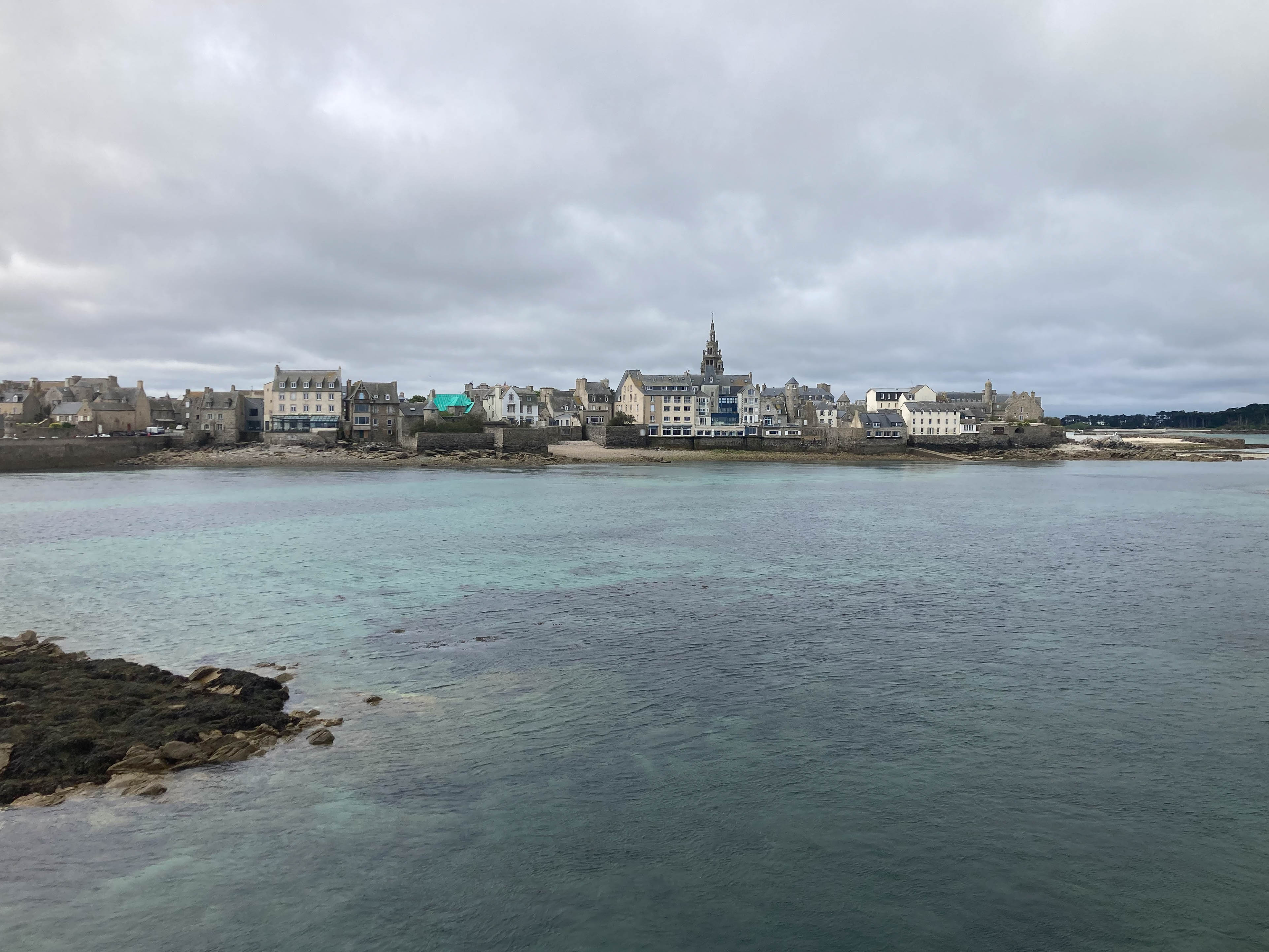
The town of Roscoff coming into view in the gloomy & wet morning
The centre of the town is about a mile from the ferry terminal & it was a pleasant excuse to have a look at this interesting French town. Fortunately, the rain had dried up, albeit it still wasn't particularly warm. Kerry knew a cafe that was likely to be open, so that was a good excuse for a croissant and a couple of coffees, while we waiting for the front to pass.
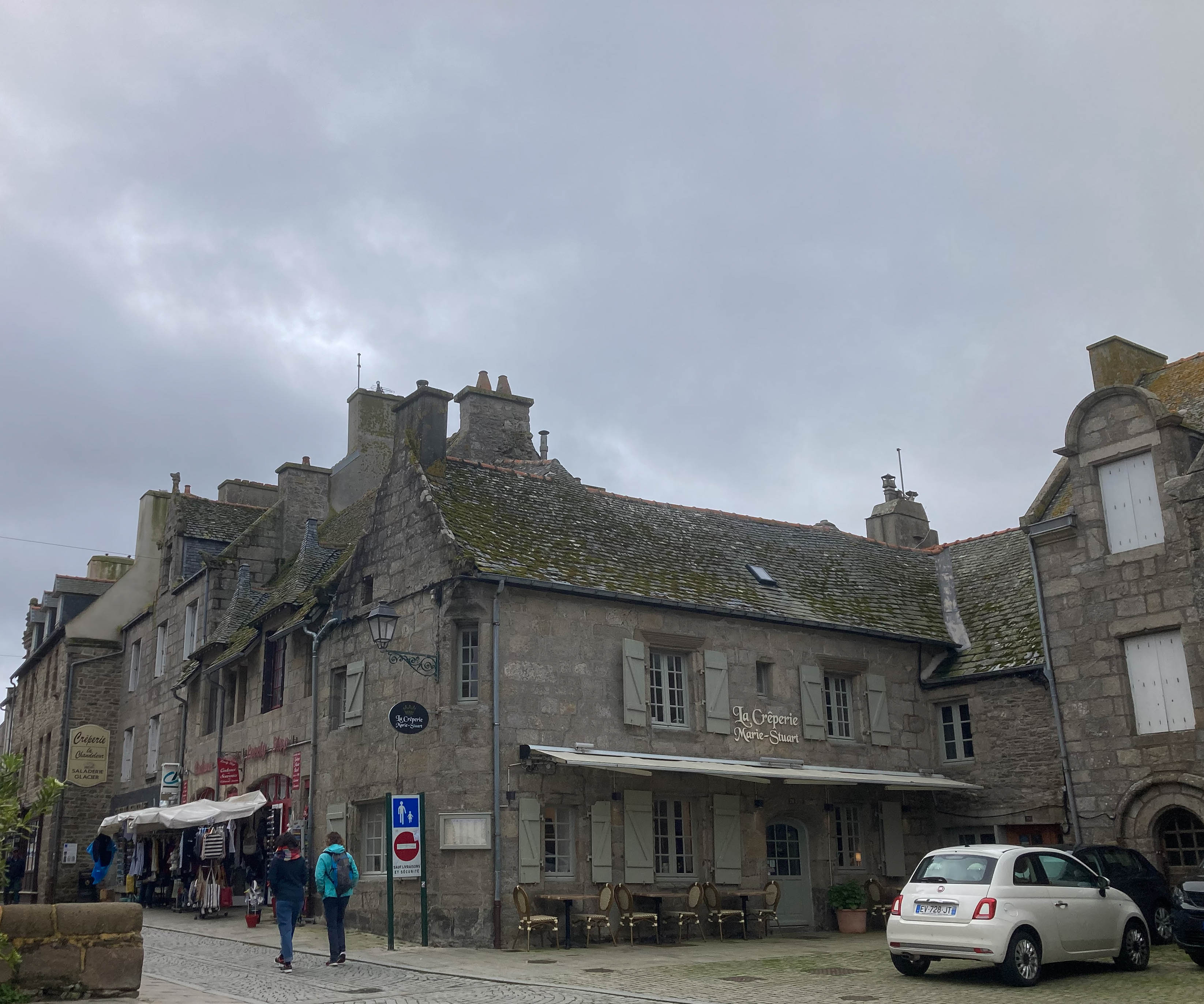
There are some great designs on these old houses, especially the curves in the roof over the window & the stonework around the windows
The small harbour
The cafe had this aerial photo of the town
The cafe ceiling: I would have loved a ceiling like this when I was a nipper
After a long lazy breakfast, we had time to have a wander around the town, before heading back to the ship. A brief Hummingbird Hawk Moth & some Speckled Woods were the wildlife highlights of the morning.
Some more cracking traditional designs
I can see some similarity to some of the old stone houses in the Isle of Purbeck, but also some very different styles
The French take their chocolate seriously
The old church in Roscoff: There was a march preparing to start as we passed to remember VE Day. It was 8 May and the day that the Second World War ended in Europe
The offshore islands looked like they might be interesting Spring migrant traps, but perhaps too close to the mainland
Some of the coastline from the long pier
There were a lot more foot passengers on the return crossing and that slowed down our boarding. But we still left on time. There was time for a final coffee, before we got ready for the survey. We don't have bridge access while the ferry is leaving the port, but we can head up as soon as the ferry is out the port.
A final view of Roscoff from the long pier
The crossing was disappointing with no Cetaceans or Seals seen on the French side of the channel. The steady movement of Manx Shearwaters was still continuing and there were a few Gannets, a couple of Fulmars & a single Guillemot. Even the Seabirds had pretty much dried up after the first ninety minutes. They picked up again when we were about an hour or so off the Devon coast, with smaller numbers of Manx Shearwaters & Gannets, but still no Skuas. About thirty minutes before we entered Plymouth Sound, I picked up a couple of Short-beaked Common Dolphins that tried to sneak in really close to the bows: they were only about twenty metres ahead of the ferry. Sadly, they were our only Cetaceans for the crossing, but I guess not every survey is going to see lots of Cetaceans.
Julia (front) & Kerry carrying out a final scan in Plymouth Sound: We had finished the survey when we entered Plymouth Sound, hence the reason they were both on the same bridge wing
We were back on dry land about 20:00. It had been a long day, but a lot of fun. Albeit the day wasn't over as I still had to drive back to Dorset.

3 May 2023

3 May 23 - An Apple A Day

An old saying I remember from my childhood was "An apple a day, keeps the doctor away". As I arrived on the Dorset Wildlife Trust reserve for my regular Wednesday volunteering, I was pleased to see a Red Squirrel running down the main track towards me. I stopped & I wondered how close it would get before it saw me. The reality is it was running to get to the apple core that a visitor had thoughtlessly thrown away, before I got there. Once it reached the apple core, it grabbed it & then sat in the tree enjoying its trophy.
Red Squirrel: I cannot resist another Red Squirrel photo from Brownsea

1 May 2023

1 May 23 - The Poole Harbour Forster's Tern

On 6 Apr 23, a Forster's Tern was seen at the Somerset end of Sutton Bingham reservoir. This must have been frustrating for Dorset Birders as the Southern tip of the reservoir lies within the Dorset border. Talking to locals who twitched it, it stayed within Somerset until it was seen flying South & disappearing just after 19:00. However, it appears that nobody saw it in Dorset waters, as the Dorset end of the reservoir is difficult to see from public areas. I'm sure most Dorset Birders expected it to pop up in Weymouth the next day, but it just vanished. I was one of the few Dorset Birders who wasn't worried about its disappearance despite it being a Dorset Tick, as I was on the West Pacific Odyssey & I was out of a wifi signal until I reached Japan on 17 Apr 23. At that point I heard about its one day appearance and the lack of further sightings.

Fast forward to 23 Apr 23, when news broke that it had been relocated at Lytchett Bay in Poole Harbour. There had been a delay in the news getting out while the identification was being checked. The Lytchett Birders reacted quickly, but it had already departed. It was relocated that evening in the Brownsea Tern roost when it was nearly dark.

The next morning I joined Nick Hopper at first light at South Haven to scan the Terns flying in & out of the Harbour mouth: in the hope it would fly past. Mark & Mo Constantine and Paul Morton were out on a private bird boat to look over the Brownsea seawall, in the hope it was still on the lagoon. They couldn't check the cameras as the Birds of Poole Harbour cameras had all gone down overnight. Like Nick & myself, they drew a blank. Then their boatman said he had seen an odd-looking Tern on one of the buoys off Hamworthy the previous morning on their Birds of Poole Harbour Bird boat, but he didn't think to mention it at the time. That was a long shot, but worth checking given Hamworthy is just outside of the Lytchett Bay area. They checked it out & surprisingly, the Forster's Tern was sitting on the buoy again. Nick had already decided to head towards Lytchett & Hamworthy when the rumour broke.

I was quickly following him, but taking the land route rather crossing the Harbour mouth on the ferry. This proved a good choice as I quickly received an update on the car's hands free to say it had relocated to Lytchett Bay. I guessed that the new Rock Lea viewpoint might be a good viewpoint and headed there. I arrived to see it in the Bay, however, it was feeding on the far side of the Bay. Good enough scope views to add it to the Dorset & Poole Harbour Lists as a second for Dorset & first for Poole Harbour. By the time I got to the far side of the Bay, it had moved again & was still distant. I had seen it & didn't bother to stick around in the hope of photos.

After that, it settled in a pattern where it spent most of the day feeding somewhere in the top end of Poole Harbour, appeared sometime in the early afternoon on Brownsea for a few minutes, disappeared again for the rest of the day, until the Birds of Poole Harbour cameras or the Brownsea team confirmed it was in the Tern roost.

I still wanted to see it on Brownsea as Brownsea lies within the historic Isle of Purbeck & these days, that List is more important to me than my Poole Harbour List: as it includes the area where I do virtually all of my Birding. I could have popped over to Brownsea on the 25th, but I decided to wait for another day, as the 26th was my regular volunteering day on the Dorset Wildlife Trust Brownsea reserve. I was prepared to stick it out to late, as the volunteers can stay beyond the public hours, however, I'm glad to say I picked it up on the Boomerang Island about 14:30. It only dropped in for about three minutes before it was spooked & it didn't return when I left for the 17:00 boat. I was pleased that I didn't have to stay in the hope it dropped in to the roost before I would have had to leave for the 19:00 boat. I still didn't have any photos, as I had been focusing on trying to get my colleague with the video scope onto it & showing it to the other visitors in the Avocet hide. Still it was now on my Isle of Purbeck List.

Fast forward to 1 May when I was volunteering as an extra spotter on the Birds of Poole Harbour Bird boat. We were told it was sitting on one of the islands as we headed to have a sneaky look over the Brownsea seawall at the end of the trip. That news was announced about ten minutes before we reached Brownsea. Fortunately, it was still there & I picked it on sitting on one of the islands near to the Tamarisks that are visible from the Tern Island. Within a minute or two all the passengers were enjoying good views as the island is closer to the seawall, than it is to the Tern hide. Just to add some icing to the cream, Paul Morton picked up a Little Tern on the lagoon. Little Terns are just about annual on Brownsea, but can be fleeting in the visits. Last year, I failed to see one for the Isle of Purbeck Year List, despite twitching twice onto Brownsea when Little Terns were seen.
Forster's Tern: From the Birds of Poole Harbour Bird boat
My next and last sighting of the Forster's Tern was back on Brownsea on my volunteering day on 3 May. It was briefly seen the following week, but I was in the villa having lunch between my volunteering duties & it had disappeared by the time I could get to the hide. The last sighting in Poole Harbour appears to be on 12 May 23 when it was photographed on the Brownsea lagoon & also seen feeding in Studland Bay off Pilots Point, Studland. I had looked for it inside the Harbour that morning, before a rapid departure to Portland Bill, when Dorset's first Moltoni's Warbler was found. Fortunately, I was there when it showed well for a couple of minutes on the only occasion it showed after it was released. I never saw the Forster's Tern at Studland, but will happily trade missing it that day by watching my first UK Moltoni's Warbler. There were a few subsequent reports of it being seen on Brownsea, but on several occasions before & after 12 May, this was down to some visiting birdwatchers misidentifying either the first Summer Common Tern or the first Summer Sandwich Tern that were both daily visitors to the lagoon.