4 Jul 2021

4 Jul 21 - The First Trek To Bempton Cliffs

I first visited Bempton Cliffs in my early teens during a family holiday in the mid-late 1970s, when we were staying with my Dad's relatives in Leeds. It resulted in six Ticks that day: Fulmar, Gannet, Guillemot, Razorbill, Puffin & Kittiwake. I remember it was a great afternoon with my first views of proper Seabirds. It would have included Tree Sparrow as well, if it wasn't for a pair that popped up one summer & attempted to breed in a nest box in our suburban garden on the Kent-London border. Surprisingly, I never returned in the following decades.

On 2 & 3 July 20, a Black-browed Albatross appeared in the Gannet colony at Bempton Cliffs for a few hours. In Jun 81, I had seen Albert, the original Black-browed Albatross, that spent its most summers from 1975 to 1995 in the Hermaness Gannet colony. As a result, I wasn't going to race up to Bempton Cliffs on a mid-week trip, in the hope of seeing another one in the UK. It returned the following year to the Gannet colony at Bempton Cliffs on 28 Jun 21 and it was seen on & off until it flew out to see on the evening of 30 June 21. With no sightings over the next three days, it looked like it had moved on. Then news broke early on Sunday 4 July, that it was back in the Gannet colony. I had nothing planned for the day, so I decided to use it as an excuse to make a long-overdue return visit to Bempton Cliffs. I arrived about 16:30 to hear that the Black-browed Albatross had left the cliff it had been on all day, flown around a bit, before flying out to sea & being lost to view. It didn't seem likely that it would return, which proved to be the case. But there was the best part of six hours of light before it would be dark and there were plenty of Seabirds to see & photograph.

Although I was primarily looking for the Black-browed Albatross, it was hard not to take photographs of the breeding Gannets, Auks and Kittiwakes that are perched closed to the viewpoints or constantly flying past. Bempton Cliffs are the UK's best mainland Seabird colony and the numbers of Seabirds that are breeding along the cliffs are stunning. Additionally, the viewing platforms provide excellent views of small parts of this massive Seabird colony: which stretches for several miles. If you haven't been, then plan a visit and make sure you have plenty of food & drink as you won't want to leave. It's also well worth having plenty of warm clothes as it can be noticeably colder on that coast, compared to a few miles inland.
Gannet: The cliffs are vertical & about 400 ft high, so they are 50% higher than my St Aldhelms patch. But being vertical, it will be more difficult for Rats to access the nests
Gannet: There is a constant stream of Gannets moving in all directions around the cliffs. Not surprising with over 13,000 pairs along the breeding cliffs that stretch from Bempton Cliffs to Flamborough Head
Gannet: Most of the breeding pairs are on the steeper parts of the cliffs, but some individuals are happy to sit at the top of the cliffs and within easy view of the viewpoints
Gannet: This photo is hardly cropped
Gannet: Like a number of Seabirds, Gannets maintain close pair bonds. I guess it's necessary if one parent is going to be a sea for a day or so feeding, before returning to feed the young
Gannet: I assume these are two males who are involved in this fight
Gannet: One is starting to get the upper hand (or should that be bill?)
Gannet: Finally, the loser left the winner to occupy this small bit of cliff
There were areas near the top of the cliff where near adult Gannets were congregating: The adult Gannets nest below
Gannet: A close up of the some of the near adult Gannets: presumably, this allows them to start the courtship process
Gannet: It was also an area where it was possible to do some preening
Gannet: It looks like the preening worked, as another Gannet arrived & they started to display to each other
Gannet: It was also an area where it was possible to have a rest & let the food digest
Bempton Cliffs are also known for their breeding Auks, with around 57,000 pairs of Guillemots, 19,000 pairs of Razorbills and around 1,400 pairs of Puffins.
Guillemot: Like most of the Seabirds along the Bempton Cliffs coastline, Guillemot numbers have increased in recent years
Razorbill
Razorbill: Razorbills are the Auk that nests closest to some of the viewing platforms
Razorbill: I like the juxtaposition with the flowers
Razorbill: The next generation
Puffin & Razorbills: It looks like this Puffin has found a craft breeding hole in the cliff
Puffin
Puffin
Puffin: Sometimes it's tiring been the star of the show
Kittiwake: There are around 45,000 pairs of Kittiwakes
Kittiwake
Kittiwake: Looks like they are having a good breeding season, based upon a totally unscientific set of photos
Barn Owl: This Barn Owl started flying over the fields, well before it was dark. However, it wasn't that close
There are good numbers of Tree Sparrows around the RSPB shop & cafe, as well as, along the clifftop path.
Tree Sparrow: Juv. Always a treat for a Dorset Birder to see on the deck, rather than as a Vis-Mig species every few years
Tree Sparrow: Juv
Tree Sparrow: Juv
I stayed until last light in the slim hope that the Black-browed Albatross would reappear on the cliffs: but it didn't. It had been a good trip to Bempton Cliffs, even if I didn't see the Black-browed Albatross. It was a long drive home & it was wasn't that far off dawn by the time I arrived home. Fortunately, I was still working at home in the post C19 world & so I could "lie in" to a few minutes before I was due to start work.

24 Jun 2021

24 Jun 21 - A Summer's Melody

Around late-evening on the 23rd, I heard about a probable Icterine Warbler that had been seen singing by the Harrier hide at Middlebere. It had been found by a local Birdwatcher whilst doing his normal dog-walk and had been present for about a week. This was exciting for a number of reasons as I've only seen one in Dorset on 31 Aug & 1 Sep 1981 at Portland Bill. Consequently, it would be a Ten Mile of the house Tick, which is the list I've been most keen on since I moved to Dorset back in 1996. Additionally, I was year-listing in the Historic Isle of Purbeck and this would be a good bonus year tick. I circulated the news & headed to bed, as it was going to be an early start the following morning.

I was up for about five the following morning & I arrived at Middlebere about 05:30. As I arrived I received a message from Paul Morton that it was still present & singing its heart out: but it was a Melodious Warbler. I was slightly disappointed as I had hoped to be the first there. While, it would be a nice Isle of Purbeck Year Tick and it would be my fifth local Melodious Warbler. I carried onto the Harrier hide & quickly located in the tops of some Pine trees just beyond the hide. After watching it and taking the first photographs, I started to get the news out that the probable Icterine Warbler was a Melodious Warbler & it was showing well.
Melodious Warbler: I never managed to get a photograph showing the wing formula well, but its still possible to see the short wings and the short primary extension
Paul Morton also managed to get some nice recordings of the Melodious Warbler which are on the Birds of Poole Harbour website for 24 Jun 21. It's not often we get the chance to hear one singing in Dorset.
Melodious Warbler
There is always the worry that something like a singing male Melodious Warbler in the breeding season might have a female with it, but this looked like a lone male who had overshot a Spanish territory. The news was released to the info services and over the next few days there were a number of visiting Birders who arrived to see it, until it was last seen on 28 Jun. Virtually, all were well behaved, apart from one unknown idiot: who was told off by one of the local Birders when he caught him playing a recording. His excuse, it wasn't showing. I wish it had been me who caught him, as this behaviour during the breeding season isn't acceptable in the UK. He would have ended up being photographed and the subject of a tweet highlighting his selfishness to the Melodious Warbler. Almost certainly this wouldn't have been an isolated incident.
Melodious Warbler: It spent nearly all its time singing from the top branches of the surrounding Pines. But on one occasion, it dropped down to this Bracken patch to sing
Trevor Warrick: Local Wareham Birder Trev has a reputation of being a late starter who is never seen early in field. Seeing Trev Birding at 07:45 was almost as rare a sighting as the Melodious Warbler

25 Apr 2021

25 Apr 21 - Nice, But Not Tickable

Whilst out today on one of the quieter back roads in the historic Isle of Purbeck, I came across three male Reeves's Pheasants. Their status in this part of Dorset is a bit of an oddity. Clearly released, but they are either still being released or seemly surviving OK. I was seeing them erratically & occasionally from 2008 to 2013 in this area, but it's an area I've largely neglected for several years. The other interesting comment I can make is, I've never seen any females. Have they been released as well, but are more likely to be mistaken as a Pheasant by the Pheasant-shooting brigade in this area & shot. Perhaps they are just more skulky. Either way it's a shame as they look cracking.
Reeves's Pheasant: Male. Turn the sound on

16 Apr 2021

16 Apr 21 - Harbour Porpoises Upstaging Wally

I didn't think that it would be possible to improve on seeing Wally the Walrus lazing around on the Tenby Lifeboat slipway. However, I was wrong as the local Harbour Porpoises decided to compete. I spent some time scanning the wide bay with the bins & scope in the hope of picking up some Dolphins. Surprisingly, I didn't see any, despite the perfect, calm seas. The best I could find was a handful of Guillemots.
The Harbour Porpoise came closer than this lone rock just off the fort
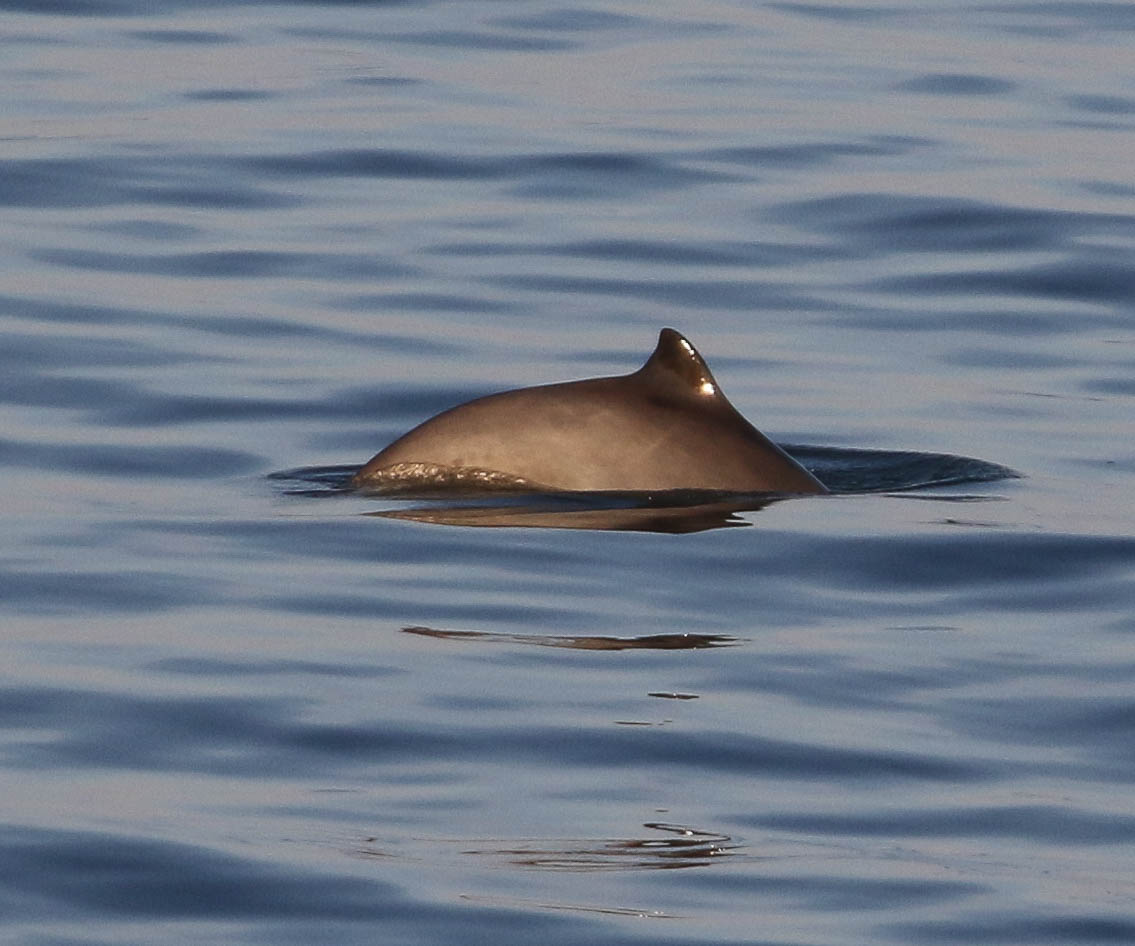
Then I picked up the first of three Harbour Porpoises. Initially, there was a distant pair, but then I picked up a third closer individual. This started to regularly appear as close as eighty metres from the shoreline. This is easily the best views I've ever seen of a Harbour Porpoise. Harbour Porpoises are shy and unlike their cousins the Dolphins, they proactively avoid boats. They surface and descend in an unobtrusive manner, which makes it hard to pick up their low profile on the water. On this occasion, looking down from the coastal path about thirty metres above the water level onto glass-like seas made for perfect conditions to see & photograph one.
Harbour Porpoise
Harbour Porpoise
Harbour Porpoise: A head shot from the last photo showing its small eye
Harbour Porpoise
Harbour Porpoise
Harbour Porpoise
Harbour Porpoise
Harbour Porpoise
Harbour Porpoise: Another surfacing almost completed
This is another surfacing sequence from the three quarters of an hour that this individual spent surfacing close to the shore.
Harbour Porpoise: It was so predictable that sometimes I managed to start taking photos just before it broke the surface to get the rare head photo
Harbour Porpoise
Harbour Porpoise
Harbour Porpoise
Harbour Porpoise
Harbour Porpoise
Harbour Porpoise
Harbour Porpoise
Harbour Porpoise: They drop below the surface without revealing the tail stock
While it was great to see Wally the Walrus, I did come away being more impressed by the performance from this Harbour Porpoise.

16 Apr 21 - There's Wally

On 14 Mar 21, an immature male Walrus was seen on Valentia Island, County Kerry, Ireland, but it wasn't present the next day. Six days later it reappeared near Pembroke in South Wales and for the next few days, it was pinned down around Saundersfoot. Then it moved a few miles & settled down on the lifeboat slipway at Tenby. As a local celebrity, he had been christened Wally by the media.

Although England had relaxed its recent Covid restrictions, there was a tighter restriction stopping entry into, and travel within, Wales that was still in place. As a result, I clearly wasn't going to head off to Wales. I had been taking a very cautious approach to Covid and had turned down a number of popular twitches in 2020 that other UK Birders had attended due to my caution over Covid. My only twitch in 2020 was for the Yelkouan Shearwaters at Portland Bill which had turned up outside of lockdown & where I took the social distancing seriously & stayed well away from the Birding throng.

I was interested in seeing my first Walrus, but I clearly wasn't going to break any lockdown rules. Finally, the Welsh lockdown was lifted on Monday 12 Apr. Given Wally had been there for a few weeks, there didn't seem any point in taking a day off work to go to see it. Secondly, I thought there would be more people going to look for it from England and that was another potential crowd that was worth avoiding. As luck would have it, I had to support some evening work that week & by the Friday lunchtime, I had completed my hours from the week. I could head off from my home office at lunchtime.
Rock Pipit: This Rock Pipit looked far greyer than my local breeding Rock Pipits do at St Aldhelms, but on paper it should still be the nominate petrosus subspecies: regional variation I guess
It was a slow journey through parts of South Wales as I hit the late afternoon rush hour, but I arrived on a warm, sunny & still evening at Tenby. The locals were clearly out enjoying the end of the lockdown with a number wandering around Tenby with pints in the hand, from the pubs that were serving onto the street, with other locals just meeting up with friends in the open air. Fortunately, there weren't that many locals looking for Wally that evening, as most locals had had plenty of other opportunities in the last few weeks to see him.
The Tenby Lifeboat Station with Wally at the bottom of the slipway
I quickly found the coastal path that overlooked the lifeboat station & there was Wally, resting at the bottom of the slipway: a successful twitch. I found a viewpoint away from the small group of locals who were watching Wally & settled down to enjoy the evening. I could have got a bit closer, but I was keen to avoid people. I had the benefit of a scope & my Canon camera with a 100 - 400mm lens, whereas, most of the locals weren't Birders & only had their eyes, small bridge cameras or mobiles.
There was a small twitch of locals, who were easy to avoid
Wally spent the evening resting on the slipway, but he rarely stayed still & was constantly fidgeting to find a more comfortable position, before moving again after a few minutes.
Wally the Walrus
Wally the Walrus
Wally the Walrus
Wally the Walrus
Wally the Walrus
Wally the Walrus
Wally the Walrus
Wally the Walrus warning this Herring Gull to follow the best practice social distancing rules
The old lifeboat station: This is now a private residence & its conversion was covered by a Grand Designs program
After I while, I started scanning the bay for Dolphins. I didn't find any, but I did find three Harbour Porpoises: which will be covered in my next Blog Post.
The Harbour Porpoise came closer than this lone rock just off the fort
I have long wanted to return to Tenby. I remember visiting it for a day when I was a kid on a family holiday, but I couldn't remember much about the town. It was only about fifteen years ago, that my mother mentioned she had lived for a few years in her early school days in one of the small houses right next to the harbour quayside.
Tenby Harbour: This view would have been very familiar to my mother
Maybe it was this local Polar Bear that attracted Wally to Tenby: A reminder that I still need to head off North to see some real Polar Bears

30 Dec 2020

30 Dec 20 - 2020 Last Knockings

A couple of days ago, I popped out to St Aldhelms with the telescope. There had been storm force winds 24 hours earlier, albeit as the winds had moved through overnight, it failed to produce much in the way of interesting Seabirds in Dorset. However, there was a large relatively tight feeding group of about 250 Razorbills, with at least 20 Guillemots and a handful of Gannets, Kittiwakes and Mediterranean Gulls offshore. So, clearly there were a lot of fish close inshore to attract them. There had been similar good numbers of the same species off Durlston and Portland recently. I had hoped to return yesterday, but it was a wet start to the morning, so I gave St Aldhelms a miss. However, as this morning was cold and dry with a F2 - F3 SW wind, I was keen to have another visit in the hope the good numbers Auks were still present. I was hoping that a Bonxie might be hanging around, given there have been one or two off Portland Bill recently.

I arrived a bit before 11, but there was no obvious feeding flock off the Head, just a few Gannets and quite a few distant parties of unidentifiable Auks flying past a long way out. I tried scanning with the telescope further out and easily a mile out and South West of the Head, I briefly picked up two fins. It took a couple of minutes before I saw them again, but this view was long enough to confirm they were Dolphins and not Harbour Porpoises. Any sightings of Cetaceans are a real bonus for me as firstly, all Cetaceans are a treat for me and secondly, this is only my third Cetacean sighting from St Aldhelms. I had seen at least fifteen Bottlenose Dolphins back in the late 90s heading East and a Harbour Porpoise feeding a long way out earlier this Autumn.

They were only occasionally surfacing, but they were heading North East and slowly approaching the waters off the Head. Steadily I was picking more individuals up in the pod. I could see the curved fin was long, but narrow based, and they looked to be a small, slim Dolphin. By this time I was up to twelve in the pod. Their size, structure and fin shape had me leaning towards Short-beaked Common Dolphins, rather than the bigger and heavier Bottlenose Dolphins that are the most likely species in Dorset waters off Durlston and Portland. Finally, I saw the first one side on and a good look at the body shape and the pale sides. Most of the time, they were only showing their upper bodies, but every now and then, one broke the surface and it was possible to see the long pale lower body and small beaks. The pod were getting steadily closer and were more compact and I could see there were at least eighteen individuals. By now, they were under a half mile offshore and I was getting a few more views as individuals broke the surface, showed off their pale sides and reconfirmed their smaller size and less bulky bodies.

I popped up to the coastguard viewpoint above where I was watching from, to let one of the volunteers know. He had been chatting to a couple of fishermen who mentioned that had seen them earlier in the morning. After another few minutes of watching them, I decided to have a look around the nearby Quarry Ledge. As I was leaving Quarry Ledge, a large mixed group of Seabirds had gathered about a quarter of a mile offshore, involving about thirty Gannets, a couple of hundred Kittiwakes, forty to fifty Mediterranean Gulls, lots of Herring Gulls and over a hundred Auks: about a half of which were Razorbills with the rest being unidentified, but probably mainly the same. I picked up a couple of the Short-beaked Common Dolphins at the same range and a few hundred metres West, heading for the feeding Seabird party. I had a final look about 12:30 from the coastguards watchpoint as the coastguard volunteer hadn't seen them, but couldn't relocate them. After about ten minutes of looking, I decided it was time to leave.

Not having expected to see much this morning, I hadn't bothered taking the camera with me. So, you will have to make do with one of my old photos.

I've yet to confirm how good a record this is for the Purbeck coastline. It is only my second sighting of Short-beaked Common Dolphin in Dorset: the previous one was a single individual Paul Morton found off Brownsea on 5 Feb 17 and sadly which was found washed up on the island's shoreline a couple of days later. I've checked with Steve Morrison who has spent many springs in the past religiously seawatching from St Aldhelms and more erratically watching in the autumn. It is a species he hadn't seen at St Aldhelms. I've just heard from Tom Brereton that there were forty to fifty Short-beaked Common Dolphins seen off Lyme Regis this evening: so clearly an arrival into Dorset waters.
Common Dolphin:  It would have been nice to have had them give views like this, but they were more interested in feeding rather than enjoying themselves. Northern Bay of Biscay (9 May 18)