24 Dec 2020

24 Dec 20 - Happy Christmas 2020

Well 2020 turned out very differently to how I thought it would this time last year, albeit with that back of my mind worry about what happened if C19 did the same as SARS as it was starting to get out of hand in Wuhan. As we all know, C19 has done a lot more damage to the world and people's lives that SARS did. When the stories of C19 started emerging I did worry about it getting bad, given I learnt the hard way about the impacts of SARS due to a trip to Tibet that year that had to be cancelled. However, in the early days, I didn't expect C19 to cause the chaos that it did.

I've spent the last year, staying very local, only going to shops as the food runs low & doing my best to avoid people. On the upside, I've been lucky to be able to work from home & having a good reason not to commute has been a positive. Fortunately, there are enough good local Birding spots that I've been able to get out Birding this Autumn, albeit I missed the Spring this year as I stayed at home throughout the lockdown and beyond. I had four foreign Birding trips that I had planned to do this year. A couple have been cancelled (with no likely prospect of them being replanned when I can go) & the other two rebooked in the future. I should have been at sea between the Falklands & South Georgia as I write this Post, but hopefully I will finally get there & Antarctica in the future. But it would be nice if the floor was moving around at the moment.
King Penguins: I should have been catching up with these friends this Christmas, South Georgia (3 Apr 2018)

I'll leave you with this song that I think sums up 2020 for me. It was written & sung by Laura, who is the youngest daughter of very good and old friends of mine from the late 80s. Laura & her music partner have formed Colour Formation & in the 2020 way, they haven't been able to meet up in person yet. But the video is superbly edited and even more special to me as her parents Nita & Steve are in the video, along with a cameo appearance from one of their chickens. Just as importantly the words sum up Christmas 2020 for many people. Please take the time to listen to the song & enjoy the video. The song can be downloaded from Amazon if you want.

I'll wish all the readers of this Blog a Happy Quiet Christmas & a Good and Safe New Year

22 Nov 2020

22 Nov 20 - This Autumn Keeps On Giving

I had been out at the St Aldhelms patch on the previous day and had ended up taking the scope & trying a seawatch. This was particularly difficult as it was gusting to F5 to F6 South West at the head. A bit over an hour of seawatching was all I could face & I wasn't able to find much more than two Kittiwakes heading West, about twenty five Gannets moving East & West and low number of Auks: some of which were possible to identify as Razorbills or Guillemets, with the rest being too far out to identify.

Sunday 22 Nov was a great contrast, with mild, still, overcast conditions. I took the telescope with me for another seawatch: this time from my normal viewpoint overlooking Billy Winspit's Garden. Billy Winspit was the owner of the cottage in Winspit closest to the sea until his death in 1966. Apparently, he also cleared the ledge below my seawatching position as a garden. It has long since become overgrown.
The Garden: The Garden is the closest ledge of vegetation, before the cliff drops down to the bushy bolder field at the base of the Head (6 Nov 20)
With the still conditions, the seawatching was considerably more pleasant. The highlights were a couple of Great Northern Divers East and a flock of sixteen Common Scoters West. There were less Gannets, but better numbers of Auks seen: with most about a mile out. Not a great return for over an hour of seawatching, but having been unable to visit in the Spring due to the lockdown, the GNDs and Common Scoter were patch year ticks. Eventually, I decided I had had enough and it was time to head home. I had a quick look in the nearby fields behind returning to the coastal footpath, immediately East of Quarry Ledge.
Quarry Ledge: one of my favourite parts of the St Aldhelms patch. It always looks like it should have something good & has yet to produce my first star species (1 Jul 14)
As I got back to the coastal footpath, I saw a small pale brown & white Passerine, about 25 metres away. With the naked eye, I assumed was going to be a Chiffchaff or Siberian Chiffchaff (although I hadn't seen any Chiffchaffs during the previous fortnight at St Aldhelms). Raising the bins, it was immediately clear it wasn't a Warbler & an RBF was the first thought. Before I had had chance to check the head on features that I could see, it flicked up a metre or two, before landing in the same bush. The white in the tail in flight was obvious and the identification was settled down to RBF (Red-breasted Flycatcher) or Taiga Flycatcher: wow.

It stayed in the same patch of bushes close to the footpath for the next 20 minutes or so, only moving away from the footpath when a couple of groups of walkers passed by. It was generally perched, but with occasional flycatching sorties. When still it was noted to pump its tail on occasions.
Red-breasted Flycatcher: The original cropped photo was very misty, but my mate Steve Morrison has managed to clean up the image, albeit it is still a horrible photo & the processing has resulted in a much more vivid colouration than it really was
Towards the end of the 20 minutes, it moved about 15 metres away from the footpath & inland. Soon after that I lost sight of it: I initially thought it had dropped to the far side of the bushes & out of my view. After about a half hour of waiting with no further sightings, I was fairly confident it hadn't moved inland, but it had left my immediate area. There is a line of bushes along field edges where Birds bush hop off the Head towards the main track & Trev Haysom's quarry. As I couldn't see it there, the most likely option was it had gone down into overgrown upper undercliff of the Garden. I walked back to my seawatching viewpoint overlooking the Garden & quickly picked it up flycatching from the back of the lone Sycamore on the ledge below me. I saw it fly catch several times, but it always landed out of view. After about five minutes, it disappeared & I suspect it dropped down into the bottom of the undercliff. Despite searching by Peter Moore, Phil Saunders (both of who arrived after it disappeared) & myself, we couldn't relocate it. We gave up about 15:15. I had rung a few local Birders who watch the site & Poole locals, but didn't spread the news too far initially given the combination of the current lockdown restrictions and my initial expectation that it was going to move through within a few minutes, as migrants don’t stop in this area. Perhaps the combination of a short light shower, kept it in the area for a bit longer than I expected.

While it was still showing close to where I had found it, I decided to try getting a photo with the IPhone & Leica 25-50 x 82 scope. Whilst being a cracking scope, it has always failed miserably at phone scoping, even when I used an adaptor with my old IPhone. So I'm amazed I managed to get anything at all with it. The colour balance is poor, but it does confirm that the upper tail coverts are slightly paler than the tail & the pale edging of the largest tertial. Both features which also rule out it being a Taiga Flycatcher, along with the milkier warm brown colouration of the upperparts, the pale buffy upper breast band & sides to the breast and the paler base to the dark tipped bill.

I believe this is only the second record for St Aldhelms, although there are seven records for Winspit/Worth Matravers. All previous records are detailed by Steve Morrison's All Time St. Aldhelms Head List on Bubo: which includes Winspit, but excludes Chapmans Pool.

20 Sept 2020

20 Sep 20 - A Long Awaited Dream

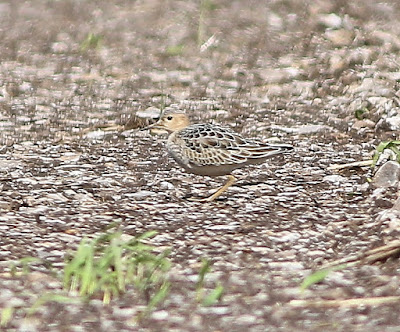
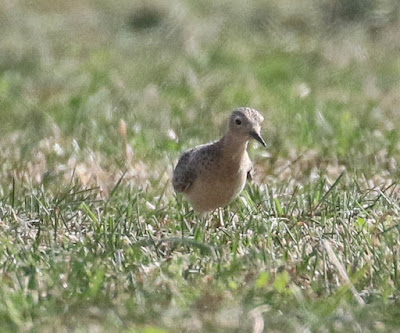
My favourite Wader on the UK List is Buff-breasted Sandpiper. However, it's a species I've not had a good track record with seeing. My first failure was Sep 80 when Pete Aley & I managed to get a lift from our edge of Kent/London homes down to Cornwall for a Semi-palmated Sandpiper. After seeing it, we carried on to Predannack airfield for a couple of Buff-breasted Sandpipers that had been showing well in previous days. However, there was no sign when we arrived. After a long wait, we picked up two small Waders flying high over the airfield. They looked hopeful, but a Merlin appeared from nowhere, caught one & the other disappeared. A few days later Pete heard the remains of a Buff-breasted Sandpiper had been found. Almost certainly that was what we had seen, but untickable views (UTVs). The following month, I was in the Cley area with my Southampton Birding mates. As we got out of the car & started walking behind the beach, we could see a lone Wader in front of us. Rather than stop & check it with the telescopes, we tried walking closer. As Dave Bishop identified it as a Buff-breasted Sandpiper, it took off West, was seen soon after flying over the East Bank as it left the area. My third set of UTVs. In 1981, things got even worse when we tried for one at the Perry's Oak Sewerage Farm, near Heathrow, but it had left before we arrived. I finally saw one at Pennington after a blow in Sep 1982. We arrived & were pleased to find a Pectoral Sandpiper, until we met the local Combridge brothers who had found my first Buff-breasted Sandpiper. After breaking the duck, I managed to see a couple more on Scillies a couple of weeks afterwards & then two more singles on Hayling Island & the Scillies, in the following year.

It was a long wait to my next Buff-breasted Sandpiper, as I didn't spend a long of time on the Scillies after the mid 80s & I wasn't interested in going a long way to see rarities I had seen before. In 1996, I moved to Dorset & started paying attention to my Dorset list. But circumstances meant I didn't connect with my first Buff-breasted Sandpiper at one of their traditional Dorset sites at White Nothe until Sep 15: in a ploughed field on a high stretch of the Jurassic coastline.
Buff-breasted Sandpiper: White Nothe (17 Sep 15)
In 2011, Nick Hopper found Poole Harbour's first Buff-breasted Sandpiper on Brownsea. It was late afternoon & I was off work for a week of Birding. But I had also put my back out & could hardly walk that afternoon. Normally, I could have made it to the hide within the time available, albeit I would probably have had to run & rely on Nick to be there with a scope. But I had no chance with my bad back. The back wasn't so bad the following morning, but I was too late as it had left overnight. A few years later, Poole Harbour's only other record again departed very rapidly from Lytchett Bay. Had I left when I heard, I should have connected, but getting ready for work & having breakfast cost me the Bird. Clearly, I was back to my standard track record of little success with this species, especially, as I would rather go Birding on my local patches, than twitch another, elsewhere in Dorset.
Redpoll: Not the best of photos, but this early morning individual dropped into the weedy field at the top of Pier Bottom valley with three mates was one of the best species seen on 20 Sep. A good view for St Aldhelms, where typically they flight straight over this area, calling as they disappear
Jumping forward to 20 Sep 20. I was out on the St Aldhelms patch again. Since the August Bank holiday, I have been trying to spend as much time as work & the weather will allow on the patch. I had been out on the previous day, where despite a noticeable NE wind, it had been a good day's Birding with some migrants around. My first Harbour Porpoises off the Head had been a significant bonus. But the NE wind seemed colder on the 20th and there were few migrants around. Around early afternoon, I decided to give up & head home for a very late breakfast. The quickest route was back along the coast path and to cut back up Pier Bottom valley, as it's a stiff walk up the hill to the Chapman's Valley path. Cutting up the valley, gives me the excuse of avoid the steep steps, whilst allowing me the opportunity to check the bushes in the valley.
Pier Bottom Valley: The bushes on the top of the left hand slope can sometimes hold migrants
Given the lack of migrants, I decided I might as well keep to the footpath as it would be quickest route to the car. There is an excellent field to the North of the valley, but I was dismayed to see the farmer had cut the plants in it during the previous week. For the last few years, it's had what looks to be a nitrogen fixing plant perhaps Lucerne in it, which had made it attractive to Autumnal Butterflies. With it cut, I expected I wouldn't be stopping as I walked along it, unless there were some Wheatears & Whinchats in it. When I was about half way along the field's length, I could see four Golden Plovers with a smaller pale Wader in with them. Although I couldn't see it well, I was already speculating that the most likely species was a Buff-breasted Sandpiper. Fortunately, there was nobody else on the footpath, so little chance of the Waders being disturbed before I got to them. I stopped early & grabbed some photos, as I didn't want a repeat of the Cley scenario. I quick look at the back of the camera confirmed the id. Superb: a long awaited dream to find a Buff-breasted Sandpiper & equally good, it was the first St Aldhelms record. I made a few photocalls & put the news out. I wanted to wait until a few others arrived to ensure it didn't move before the first people arrived. First on the scene was Phil Saunders. Phil would typically have also been at St Aldhelms that morning, but had switched to Durlston. The news from Phil wasn't good. Despite the cold wind, both the St Aldhelms & Worth Matravers car parks were full. He had finally found an on road parking place in Worth Matravers, but it would be nearly an hour's wait before he arrived. Peter Moore also was on his way from Portland and experienced similar parking problems. A few more Birders started arriving by mid-afternoon, but were more lucky to find places in the car parks.
Buff-breasted Sandpiper: With a couple of the Golden Plovers. At this point, they were the closest I was to see them. In hindsight, I spent too much time getting the news out compared to getting photographs
Buff-breasted Sandpiper
Buff-breasted Sandpiper: Showing how it gets its name
Golden Plover: This was a darker, less golden, individual than the others
I finally made it home & had my first food for the day about 15:30. It had been a much longer day than I had expected, but I'm not complaining.

14 Sept 2020

14 Sep 20 - The Changing Faces Of The St Aldhelms Patch

The pressure of work & windy weekends made weekend visits to St Aldhelms in August largely impossible this Autumn. It wasn't until the Bank Holiday weekend, that the pressure of work started reducing back towards normal hours & the weather improved. That provided a chance to get out onto the patch, with the added bonus that I could head out for pre-work visits to St Aldhelms (as far as Trev's Two-barred Greenish quarry). So, far in Sep, I've been able to get out on a bit over half of the weekday mornings, as well as, longer visits at the weekend. But this morning, I'm fogged in with 200 metres visibility in the house. This happened on the 3 Sep, but I went anyway just for the exercise: a couple of miles of exercise with less than 100 metres of visibility & nothing of note seen.

The start of the track at St Aldhelms: Normally, I should be able to see for 2 or 3 miles in every direction, whereas the tree in the middle of the track was 30 metres in front of me (3 Sep 20)
This is what the visibility should be like at this point
: Visibility of over two miles, albeit without the snow (2 Feb 19)
Trev's quarry: I never thought I would tire of looking in Trev's quarry, but maybe that changed on 3 Sep

Fortunately, the visibility on other visits has been much better. One of the great things about the St Aldhelms patch is it is a stunningly beautiful site to watch.

St Aldhelms: Looking down Pier Bottom Valley from near to Trev's quarry (30 Aug 20)

The coastal footpath: The Southern end of Pier Bottom descends down steep steps, before ascending again equally steeply on the other side

Pier Bottom Valley: Social distancing on the coastal footpath isn't easy, so I tend to roll under the barbed wire fence & walk through the field to the sets of bushes I'm interested to check out in the valley

The Front Quarry or Quarry Ledge to give its other name: This always looks like it should be an excellent migrant trap, but migrants rarely stick in it

Hopefully, the weather will be better tomorrow.

13 Sept 2020

13 Sep 20 - Ticky Tick, Clicky Click Click Click

Since the August Bank Holiday, I've visited the St Aldhelms patch for short pre-work visits most mornings, with longer visits at the weekends. There has generally been a steady selection of  expected migrants, but in small numbers with Wheatears, the occasional Whinchat or Redstart, as well as, the standard Warblers, Whitethroat, Blackcaps, Willow Warblers, Chiffchaffs & a few Lesser Whitethroats. All three of the regular Hirundines were on the move a couple of weeks ago, but is now largely Swallows. Overall, it's been hard work, although the Bank Holiday Monday was good with my first St A's Dartford Warbler and a Short-eared Owl that flew in off the sea just to the East of the front quarry. The Short-eared Owl was distant & as I was going to struggle to confirm it wasn't a Long-eared Owl at the range it was, I lifted the camera & hoped the photos would help. They did: as well as confirming it was my second patch Short-eared Owl, they also revealed it flew past a Hobby sitting on a fence post that I hadn't seen. Can I add that to the patch Year List?

Last weekend, Phil Saunders, AKA @BeardyBirder, was back on the patch. While Phil is great Birding company, it's quite depressing Birding with Phil as it highlights how many calls, I'm now missing with the tinnitus that has developed in recent years: especially Tree Pipits, more distant or higher species. The worst of which was a Lapland Bunting that Phil heard call (I didn't) & we watched disappear into the distance: I couldn't get anything on it in flight & I had to throw it away. A patch Tick missed.

This morning the alarm went off to get me up again & onto the patch. It had been a tough morning yesterday with a F4 SW wind, a bit too exposed in most areas at St Aldhelms & not a lot of note. The forecast was for a light F2-F3 SW wind. It had looked like the wind hadn't dropped as much as forecast when I got up, so I decided on another cuppa tea, before heading out. Yesterday, I had been on the patch about 06:30, today it was 08:10. I stopped as I always do on the road by the My Time centre near Renscombe Farm to scan the fields. I've seen a few Wheatear in these fields this Autumn, but little else of note. No Wheatears today, but seven Meadow Pipits flew out of the first field & landed on the fence, close to the car. I drove on to check the next field. The seven Meadow Pipits flushed, but landed on the fence again, but had encouraged another eight to join them. I checked them again & the first individual I looked at was a Lapland Bunting: Patch Tick. Fortunately, the camera was on the passenger seat & it was quickly lifted, powered it on, removed the lens cap & poked out of the car window. I'm afraid I'm a Birder & not a togger. Had I been the latter, I would have rushed out of my car, wearing an all in one camo suit & booted everything. But being a Birder, I stayed in the car & blasted away with the camera, hoping the previous day's settings were OK: they were. 
Lapland Bunting: A species I wanted to find locally for many years
It dropped off the fence & onto the grass verge, which allowed more photos. After enjoying a quick view with the bins, I texted a few locals, tweeted a photo out & looked up: no sign of the Lapland Bunting or any Meadow Pipits. They had probably decided to drop back into the field, but further back, as I couldn't see them near the fence. Time to leave it in peace & head onto the car park, as I was keen to get on with the walk to the coastguard's lookout. After about a half mile walk, there is a left hand track, by an open sided metal barn. This is often worth a look. Today it held no migrants, apart from a lone Whitethroat. Just as I was leaving, I heard a call I didn't recognise. I looked up to a chunky Passerine flying over, it looked about the size of a Yellowhammer, but shorter tailed & bulkier bodied, but not as chunky as a Corn Bunting. The flight was strong & level. It carried on SSW over the field for over a mile before I lost it over the coast path to the West of the coastguard's lookout. I couldn't see if it had come down or carried on. I can't be certain if it was the Lapland Bunting, but I've struggling to think what else it could have been. Later in the morning, I had a good look in that area, but with no joy. But the coastal walkers had already been walking past by the time I reached the area. Presumably it reached the coast & then coasted West or been disturbed by walkers.
Lapland Bunting: I may struggle to hear them, but the eyes still work as does the camera trigger finger

6 Sept 2020

6 Sep 20 - A Gorgeous Pec

I had enjoyed the previous week with daily visits to the St Aldhelms patch. Finally, as it was a nice Sunday evening, I popped down to Kimmeridge to see the Juv Pectoral Sandpiper that had been found the previous day. I'm glad I made the effort. It was happily feeding on the tideline and with care was reasonably approachable.
Pectoral Sandpiper: Juv
There was a Pectoral Sandpiper found on the RSPB Arne Moors on 10 Sep. Given the lack of public access to Arne Moors, then it could well be the same individual and have been there since it left Kimmeridge. It was present until 12 Sep, when it crossed the river onto the more accessible pools at Swineham. Two days later it was joined by a second individual until 23 Sep when one departed. The final sighting at Swineham was on 26 Sep.
Pectoral Sandpiper: Juv
One of the most obvious sights of Kimmeridge Bay is Clavell Tower. It was built around 1830 by the Rev John Richards Clavell as an observatory and folly. Clavell lived in the nearby Smedmore House, which still owns the estate today. It is 35 feet high and has four floors. The Tower is now owned by the Landmark Trust. By 2000, the Tower was in real danger of falling into the sea due to coastal erosion. Fortunately, it was saved by the Landmark Trust, who used specialist builders to dismantle it stone by stone, move the tower 25 metres further away from the cliffs and rebuild it again. The stones were all numbered, so that they could be replaced in their original position. The work started in Sep 06 and finished in Feb 08. The Tower is now let by the Landmark Trust as a holiday home to raise money for its ongoing maintenance. It is a reasonable price to stay there considering how unique it is.
Clavell Tower

8 Jul 2020

8 Jul 20 - Socially Distancing Seawatching

During the coronavirus lockdown, I stayed at home & only left the house for the weekly shop. After the lockdown was easied, I was still not travelling far. Work was keeping me busy during the week and weekends were largely revolved around the house and garden, with a few carefully chosen sites within the Isle of Purbeck, where there was little chance of bumping into people. Sadly, the Spring migration in Dorset was largely over before the lockdown was easied, which also meant I wasn't rushing to get out. The only potential British & Irish Tick was the putative Cayenne Tern in Ireland, but given that would mean breaking lockdown rules in Wales & Ireland, it was never a trip to consider. Clearly, that didn't deter a few self-centred idiots who then tried claiming after the event that they hadn't broken lockdown. Clearly, they had and should have quarantined themselves in Ireland for two weeks on arrival and also the UK on their return. But being self-centred enough to go, they clearly just don't care & just deserve the contempt of the Birding community in my opinion. Not only did these selfish twats break Irish self-quarantine rules, but they also failed to self isolate on their return. They should still have been in isolation, when at least three of the four individuals who were publicly named as having visited Ireland, turned up at Portland Bill.

From early July, there had been a good feeding party of Balearic Shearwaters feeding off Portland Bill. No surprise about that as July and early August is a good time to see Balearic Shearwaters in Dorset waters. However, the numbers had grown to about seventy which is much higher numbers than normal. On the late evening of the 7 Jul, the Portland Bill Obs website posted photos of a putative Yelkouan Shearwater which had been photographed with the Balearic Shearwaters. There have been a number of reported records in recent years, but only one accepted record of one photographed off Berry Head, Devon on 29 Jul 08. Given the Balearic Shearwater flock was sticking around, then there was a reasonable chance that the putative Yelkouan Shearwater would be relocated. But there wasn't anything I could do, due to a busy set of morning phone calls. Everything changed around mid morning, when I had three rapid calls to my landline from my Plymouth mate Pete Aley. We had already discussed options after the initial posting on the Obs website. I was on a works call with my boss so I couldn't answer any of the calls, but I could tell from the Pete's persistence, it must have been refound & confirmed. A quick check on the RBA website confirmed the fact. There was still nothing I could do until early afternoon, but after that I was free for the rest of the day. As the putative Yelkouan Shearwater was still showing, I asked my boss if I could head off for a few hours & I arrived just after 15:00. I quickly found most people were on the ledge by the Pulpit Rock. Everybody was very close & clearly ignoring the two metre rule. Two of the individuals, Steve Gantlett & Steve Webb, who were still supposed to be in quarantine after visiting Ireland were getting well into huddle. But given they broke Irish & UK quarantine rules, it's no surprise to see them in the huddle. Clearly, twitching in their eyes is as valid a reason to break social distancing rules as driving to Durham with coronavirus & then onto Barnard Castle on your wife's birthday.

I certainly wasn't going to join the crowd. I knew Pete was also following the two metre rule and found him away from the main group. I joined him at a safe distance. There were good numbers of Balearic Shearwaters off the Pulpit Rock, sitting on the sea & occasionally getting up to flying around. Pete had arrived about two hours before me, but hadn't had any sightings. It was time to set up by folding seat, scope & start scanning. After an hour, there had been a few shouts from the throng on the main Pulpit ledge, but we were too far away to have any idea if they were reliable sightings or not or to figure out where they might have been looking.

After about an hour, I picked up a smaller Shearwater sitting on the sea in front of a line of Balearic Shearwaters. It looked consistently smaller and slightly paler brown with a long, slim bill. That was all I could see for the several minutes as it bobbed up & down on the choppy water. I tried giving Pete directions, but unfortunately, he failed to get onto it. Then it flew, briefly circled when I could see a shorter tail, trailing legs & heavy wing moult before flying towards me. I quickly lost it in the scope, so switched to the camera & fired away in the right direction. As it wasn't particularly close, it wasn't too hard to point the camera in the right direction. Fortunately, it continued to fly towards me before banking & finally flying out of shot. The photos aren't great, but they do confirm that I had seen the putative Yelkouan Shearwater.
Putative Yelkouan Shearwater: This first uncropped photo provides an idea of how far it was: the effective magnification of my 100-400 lens & Canon 7D is about 13 times. It is the small Shearwater image in the foreground. The brown dots behind are the line of Balearic Shearwaters
Putative Yelkouan Shearwater: The first of a number of harsh crops with this one being from the previous photo. All the photos were taken in the same sequence & nearly all were consecutive frames. Each looks different to the last & if one photo is seen in isolation, then it's easy to think there might be more than one individual involved. Therefore, it's easy to see how some visitors have claimed that there was more than one individual present, ignoring the misidentifications of Balearic and Manx Shearwaters
Putative Yelkouan Shearwater: Note the clean underparts, short tail, collar patch & trailing legs. The trailing legs has been stated as a variable feature & but given it had just taken off, it might not have tucked them in yet
Putative Yelkouan Shearwater: Clearly signs of heavy moult on the outer secondaries & inner primaries
Putative Yelkouan Shearwater
Putative Yelkouan Shearwater: The wing moult is more apparent & looks very similar to much better photos on the Obs website on 7 Jul, 8 Jul and 9 Jul. But I'm still happy to have some photos of my own
Putative Yelkouan Shearwater: Again showing the wing moult
Soon after this sighting, I suggested to Pete we try & get a bit higher up & ended up climbing onto the rocks above the start of the Pulpit ledge. Pete had already been forced to move one when some unknown Birder had decided to stand close to him. When Pete moved, the guy asked why he had moved & seemed surprised when told why. Clearly, another twat who doesn't seem to have been aware of coronavirus & was also wanting to stand close to others to help him find the right bird. Self-isolating was a lot easier once we had found comfortable positions on the rocks. The next hour resulted in a lot of unsuccessful looking for me & I missed a sighting Pete got onto as it flew close past the Pulpit Rock. Around 17:00, the Balearic Shearwaters all seem to get out & fly about a kilometre or more off out to sea, with only a few finally returning. By 18:10, I started thinking I really needed to head home, given I had a lot of work I needed to do that evening & the Shearwater flock didn't look like it was going to return. I said goodbye to Pete & a few others, before walking a bit closer to the Obelisk to find an easier path up to the top of the slope, another ten metres above where I had been sitting. My mate, Pete Moore, saw me & gave me a shout. I hadn't seen him since the lockdown, so wandered back for a natter with him. He was standing with a few other Dorset locals & it was good to see they were being sensible with their social distancing. I had only been there two or three minutes, when Wyke Regis Birder, Dave Foot announced he had just located it sitting on the sea in a group of about twenty Balearic Shearwaters and a Manx Shearwater. We all got onto the putative Yelkouan Shearwater on the water & then enjoyed a flight view. It was closer than my earlier sighting and the added elevation helped to confirm we were looking at the right individual. As I lost it in the telescope, I picked up the camera and took a lot of shots in the area of the Shearwater flock. Three were good enough to confirm the identification, despite turning out worse than the photos above. It must had taken off again without us seeing it & headed towards the Obelisk. Suddenly, there was a charge past us, from people closer to the Pulpit Rock. We carried on looking from where we were, when two Birders appeared next to us, looked quickly & got very excited when they found it sitting in the Balearic Shearwater flock. They had seen & strung the lone Manx Shearwater in the flock and ignored our quiet comments about it being a Manx Shearwater. This was emphasised by their comments of how distinctive it was. Well the Manx Shearwaters did stand out from the Balearic Shearwaters off the Bill, but despite looking a bit browner due to wear than previous sightings, the Manx Shearwaters were still fairly distinctive (unless you were desperate to claim it & fairly clueless about what you were looking for). It sounds like they were the only people to misidentify the bird during its stay at the Bill. After another ten minutes when we had failed to relocate it & people at the Obelisk we looking in different directions, it was clear it had disappeared & that was a sign I should also leave.

I've only seen Yelkouan Shearwater once before, back in 1986 on a crossing from Turkey to Turkish Cyprus. Clearly, not a species I can consider to be familiar with. Reading up about identification of Yelkouan Shearwaters before heading to Portland & looking at the photos on the Obs website, helped me a lot on the features I should be looking for. Yelkouan Shearwater is an Eastern Mediterranean breeding species which is geographically separated from Balearic Shearwaters which breeds on the Balearic Islands of Mallorca & neighbouring islands. However, what also became clear is identification is clearly complicated by a population of Shearwaters that breed on the Balearic island of Menorca. The excellent Petrels Night and Day by the Sound Approach team, states the Menorcan Shearwater population look like Yelkouan Shearwaters, but DNA studies have indicated that may be a hybrid population. That book was published twelve years ago & it will be very interesting to read the thoughts of Bob Flood & Ashley Fisher in their new Shearwaters, book which should be arriving in the next few days. Whether it will be possible to identify the Portland individual definitively & whether it will be finally get accepted, are still questions for the future. However, it was a nice opportunity to get me to look at the Balearic Shearwaters & clearly it will be an interesting learning experience. Finally, after four months since the start of lockdown, my fuel gauge is showing half full. At this rate I might need to fill the fuel tank up by the end of August.