
There was a lot more to see at Prion Island beyond the South Georgia Pipits from the previous Post. The landing site is a small beach. With a number of Gentoo Penguins & Antarctic Fur Seal pups on the beach, we had to leave it quickly & get onto the boardwalk.


 Antarctic Fur Seal: The Tussock Grass looks comfortable
 Antarctic Fur Seal: Some occupied sites with prime real estate views


The landing beach: It was quite busy with Antarctic Fur Seals & Gentoo Penguins
However, there was time to grab a couple of quick photos & more time once we were on the boardwalk.
Gentoo Penguin: The welcome committee had sent a few representatives along to wave at us & greet us as we left the beach for the boardwalk

Gentoo Penguin

Gentoo Penguin

Gentoo Penguin: Gentoo Penguins make a proper nest

Gentoo Penguin: Most of the Gentoo Penguins were happy to watch from their nest sites on the hillside

Northern Giant Petrel: There were also a couple of the bouncers keeping any eye on the beach
As we found on Salisbury Plain, the Antarctic Fur Seal pups are inquisitive & keen to check us out. So as we got onto the boardwalk, I wasn't too surprised to see a couple of pups follow us up the boardwalk for some way. They were clearly use to using the boardwalk as an easy highway through the Tussock Grass. That was all very well, until a much larger female Antarctic Fur Seal decided to also use the boardwalk as a highway back down to the beach. At that point, there was nothing we could do, other than to carefully step off the boardwalk & stand just beyond biting range to let her pass.
Antarctic Fur Seal: These two pups followed us for about 50 metres

Antarctic Fur Seal: Pup

Antarctic Fur Seal: This pup would get quite close if you stayed still for too long

Antarctic Fur Seal: Another better behaved pup who stayed off the boardwalk


Leon Glass: Gets a few minutes off from duty on the beach to keep an eye on the boardwalk
 Wandering Albatross: Adult Snowy Wandering Albatross nest
 Wandering Albatross: Adult & chick Snowy Wandering Albatross. The adult was standing up as junior wanted to be photographed yawning
 Wandering Albatross: Adult & chick Snowy Wandering Albatross. Both now happy to pose for the cameras
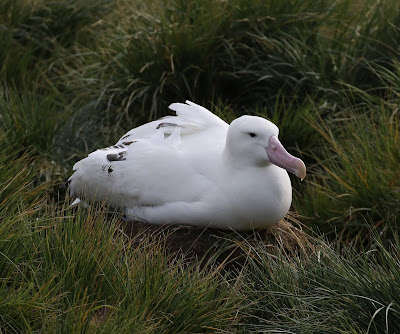 Wandering Albatross: Adult Snowy Wandering Albatross: Photos over the adult had settled down on the next again by the time I reached the other viewing platform
 Wandering Albatross: Subadult Snowy Wandering Albatross. This looked like it might want to leave
 Wandering Albatross: Subadult Snowy Wandering Albatross
 Wandering Albatross: Subadult Snowy Wandering Albatross. But after a stretch it settled down again

 It could get a bit congested on the boardwalk: Especially where at the point it was best to see the nesting Wandering Albatross
 It was a cracking view from the top of the boardwalk
At the top of the boardwalk there were a couple of larger viewing platforms overlooking a short grass clear area which had several Wandering Albatrosses & Northern Giant Petrels. The clearing was just about large enough for them to run along & get enough lift to be able to take off. From one of the viewing platforms, it was possible to see a nesting Wandering Albatross. Again the viewing boardwalk worked well to keep everybody at a safe distance from the nest. In my opinion, there were a handful of photographers (none of which I had any time for) on the ship who despite having much better photographic equipment than me, would have tried to get a lot closer if there wasn't a boardwalk. That would then have given a number of the other passengers the licence to also try getting to close & consequently risk disturbing the nest, especially with Northern Giant Petrels hanging around nearby.


Northern Giant Petrel: There was also this Northern Giant Petrel close to the Wandering Albatross. The bill tip colour is really subtle in this individual
 Northern Giant Petrel: Another older & uglier individual
 Southern Giant Petrel: White Nellie. Some really old Southern Giant Petrels can go really white which is a plumage that Northern Giant Petrels do not show. They are known as White Nellies. Unfortunately, this one wanted to remain well hidden in the Tussock Grass


As we were walking down the boardwalk, a shout went up to say there were a group of South Georgia Pintails flying over. Clements regards them as the endemic subspecies of the mainland Yellow-billed Pintails, but I'll stick with the name South Georgia Pintail (albeit as a subspecies) to separate them on the Blog from their mainland relatives. I had missed the brief flight views in the morning at Salisbury Plain, so it was good to see them flying over.

South Georgia Pintail: The endemic South Georgia Pintail subspecies which some other authorities split, so maybe I'll get to Tick it at some point in the future


All too soon it was time to head back to the beach for our zodiac tour of the coastline

The coastline was indented with lots of narrow channels with these large strands of Kelp

Having other zodiacs in the water did help locate interesting wildlife: However, it did feel like a safari at times

Arjen, the deputy Expedition Leader, driving his zodiac: Probably for South Georgia Pipits

Atmospheric photo of the kelp on the shoreline
 South Georgia Pintail: I was happy to see these close views of this party of South Georgia Pintail. It's not often you can get this close to a genuinely wild Duck
 South Georgia Pintail: Unlike the mainly relatives, these South Georgia Pintails have a reputation of scavenging dead Penguins if they get the chance, so perhaps the only meat-eating Duck? Although these ones look like butter wouldn't melt in their mouths
 South Georgia Shag: My first adults
 Antarctic Fur Seal
All to quickly it was time to return back to the Plancius, as the zodiacs couldn't pick the people up from Prion Island, until we had been dropped off. So ended another great day as there was little activity around the ship & by the time we were leaving the Bay of Islands, the light was starting to go.


Antarctic Fur Seal: About the only wildlife around the Plancius

Home


