
An early wake up call for many, but I was already up. We had arrived at the first of our planned landings in South Georgia
& had the first proper land to look at from the Plancius since leaving Ushuaia. The ship was making
its final approach to Salisbury Plain which had around 25,000 breeding
pairs of King Penguins.


 Antarctic Fur Seal: Pup. Ninety-five percent of all Antarctic Fur Seals breed on South Georgia. However, they also breed in smaller numbers on Bouvet Island, Heard & McDonald Islands, the Kerguelen Islands, the South Shetlands, the South Shetland & South Orkneys Islands. Additionally, they breed on Prince Edward Island, Crozet Island & Macquarie Island which lie North of the cold circumpolar current called the Antarctic Convergence
 Antarctic Fur Seal: Pup. This species was decimated in South Georgia by the whalers for their oil in the late 19th & early 20th century & it is thought there may only have been a few hundred left in South Georgia in the 1930s. Fortunately, this is long in the past & their numbers have recovered to an estimated 4.5 - 6.2 million worldwide
 Antarctic Fur Seal: Pup. It is thought that part of the reason for the quick recovery of the Antarctic Fur Seal was their main competitor for Krill, the Rorqual Whales, were also decimated by the whaling industry & the population of the large Whales has been a lot slower to recover
 Antarctic fur Seal: Most are cute & inquisitive, especially if you stay still
 Antarctic Fur Seal: Pup. This one looks a bit more sleepy
 Antarctic Fur Seal: Bull. There are still a few bulls left on the beach
 Antarctic Fur Seal: The majority of the colony was behind the beach
 There was a path marked across the Antarctic Fur Seal colony behind the beach: Which I decided not to take, to allow me to enjoy the King Penguins for longer


Sunrise at South Georgia: The old English expression "red sky in the morning, shepherd's warning" doesn't apply to South Georgia. It was just an indication of the start of an excellent "red letter day" which in Britain is a special treat day

Sunrise at South Georgia: The close up looks more like a sunset than a sunrise
At the daily pre-dinner briefing the previous day, we had been told the landings would be staged with the even cabins (known as the Albatrosses group) going first & the odd cabins (known as Petrels group) to follow. I was in an odd numbered cabin & therefore could have a slightly more leisurely breakfast. However, we would all have the morning ashore with zodiac rides back when we wanted, so the only difference would be the landing order. The landing order was alternated so that Petrels would be first at the next landing.
South Georgia

Salisbury Plain is in the North West of South Georgia: The long beach of Salisbury Plain is on the North coast where the vertical map line crosses the coastline
At first light, the ship made its final approaches to Salisbury Plain through the Bay of Islands. The initial views of South Georgia was stunning. This was the start of a routine we were to get used to when close to land. After an earlier morning call, there was an early breakfast during the final approach, with a couple of zodiacs put in the water to scout out the landing sites. Assuming the sea conditions were OK for us to get in the zodiacs, then up to 9 of the 11 zodiacs were launched. Seven of the Expedition staff & two of the Filipino crew were good zodiac handlers, but some of the Expedition staff took turns ashore to man the landing site. Generally, a few less zodiacs were used for landings, compared to occasions when we were only able to do zodiac cruises. Other members of the ship's crew & the Expedition Doc, Laura, assisted in coordinating the gangway, with the Doc usually one of the last to land with the fairly substantial medical kit.
Making the final approach to Salisbury Plain through the Bay of Islands

Some of the Islands were to our left

One of the many large South Georgia glaciers: As usual there was a stiff wind blowing (today it was a Westerly wind)
 Getting closer to Salisbury Plain
 Salisbury Plain: Anchored in the bay
It wasn't long after the first of the Albatrosses started getting into the zodiacs, before we were called to head to the zodiac loading deck. One of the advantages of travelling with a relatively small group of around 100 passengers on a well run expedition ship was we could all land fairly quickly.


The locals put out a good welcome committee as the final zodiac lands the last of the Expedition staff: Doc Laura (bobble hat) & Leon (from St Helena) with Hans driving the zodiac
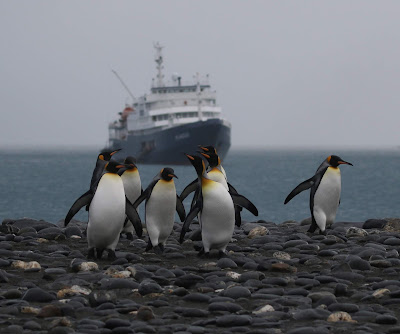 King Penguin: These guys showing they didn't need a zodiac
It was difficult to know what to photograph first when surrounding with some many curious & obliging subjects. But I started with the King Penguins, which must be one of the top ten Birds I've seen. They weren't a Tick, but being so approachable & tame, they are great subjects. The only drawback is they are also very inquisitive & sometimes want to get too close to check you out.

King Penguin: Part of the beach at Salisbury Plain

King Penguin: It was raining by the time I arrived on the beach & the light wasn't great at that point, but fortunately, it picked up later after the rain stopped. The zodiacs had to carefully navigate through the mass of swimming King Penguins

King Penguin: That's where these Giant Penguins came from

King Penguin: Part of the colony carries on up towards the top of the hillside

King Penguin: The right hand King Penguin walked by & ignored the noisy disagreement from the other two

King Penguin

King Penguin: Even when dirty they are stunning & at three foot high they are the second largest Penguin. There are fossil records of a Penguin species that was five foot six inches high: that would have been amazing to see

King Penguin: They are noisy & this one is about to start calling

King Penguin

King Penguin: The main colony was packed

King Penguin

King Penguin

King Penguin

King Penguin

King Penguin: They are hard to keep away from anything left unattended

King Penguin: I'm sure this must be edible

King Penguin: There were large numbers of King Penguins in the water, including this porpoising individual
 The beach was relatively quiet in places
 The Expedition team had marked out a path along the back of the beach to minimise the our disturbance to the wildlife
 This wet pool along the back of the beach stopped people walking off the beach
 The King Penguins waiting patiently for the next Southern Rail train to the sea from the edge of the colony


The end of the accessible beach for the passengers
 Hong Kong Birder John Holmes: Trying to impress the birds with his big lens
 Guess I should have a photo taken
 Bob Flood: Is he wondering how to convince Ashley to work on another Seabird book?
There was a selection of other Birds on the beach.


Wilson's Storm-petrel: One of the surprises was seeing a number of Wilson's Storm-petrels flying over the beach & just offshore during the morning. I guess they feel relatively safe from the attention of Brown Skuas & Kelp Gulls given the number of King Penguins chicks on the beach to provide food

Snowy Sheathbill: These unattractive Birds do a good job of scavenging & cleaning up the colony

Brown Skua: This is the Falklands subspecies & is another species that is a good scavenger around the colony

Brown Skua: The Falklands Brown Skua occurs from South Georgia to the Falklands & SE Argentina. Most winter off SE South America

Brown Skua: Unattended young or ill King Penguins don't have a chance with this bill
 South Georgia Pipit: Several had flown out to check out the Plancius despite being a few hundred metres offshore. Unfortunately, I missed this first sighting. However, I did see a couple on the beach. Clearance of Rats on South Georgia seems to have resulted in the population of South Georgia Pipits bouncing back on the mainland. Rat & Mice clearance on these isolated Seabird islands is so important
It is very hard to really take in a place like Salisbury Plain. The natural instinct for anybody with a camera is to keep photographing the King Penguins, other Birds, Antarctic Fur Seals & spectacular scenery. However, you do need to remember stop photographing & just look & enjoy the overall wildlife spectacle & scenery in front of you. Anyway, back to photography. One of the first sights on landing on Salisbury Plain, after the King Penguins, are the Antarctic Fur Seal pups. Presumably, the pups are now large enough at this time in the season for the mothers to leave them & go out to sea to look for food. There were a fair number of pups on the beach, all looking for their mothers to return. Some are just resting, but quite a few are inquisitive & slowly waddling around on the beach: all are cute & photogenic. They are more than happy to come & check you out if you stay still.


Waiting for the next zodiac back to the ship: Getting from the Plancius was straight-forward at first

King Penguins wondering why the Giant Penguins didn't swim in: The splashes are porpoising King Penguins

The last part of the zodiac route in was slow

Loading a zodiac

The Expedition staff could still enjoy themselves when on the beach

The next version of the Dunkirk evacuation story looks to be a low budget film

Zodiac heading back to the Plancius
Having got back to the ship, I grabbed a drink & went back on deck to find the Plancius was being checked out by more King Penguins. An excellent morning & one which the rain couldn't spoil. While we were having lunch, the ship was moving a short distance to our next location for the afternoon: Prion Island one of the islands which forms the Bay of Islands.
King Penguins


