27 Aug 2016

27 Aug 16 - Luck Of The Irish

When the recent Royal Tern was first found in County Mayo, Ireland in mid August, I was initially uninterested in a trip across the water to see it. Firstly, it was found mid week & there was no chance I could get a couple of days off work to go over. I thought about the possibility of a weekend trip, but that would have been a knackering weekend. The decision was made for me as it flew out to sea the following morning & wasn't seen again. Fast forward a week & it reappeared further South at Beale Point in County Kerry, where an Elegant Tern had hung around for a week & a half in Sept 13. Again I couldn't go as it had reappeared mid week, but there was a few days to see if it would settle down like the Elegant Tern. I was now a little bit more interested in going over given it was a Bank Holiday weekend in a few days. It seemed to settle down in the Beale Point area, before developing a pattern of moving between Beale Point/Littor Strand on the South side & Carrigaholt on the North side of the estuary. Whilst only about three miles across the Shannon estuary, it looked like it would be a minimum of an hour & a half to get between the two sites (assuming you heard it had been seen on the other side). When it was still there on the Thursday, I half-heartedly made a couple of phone calls to see if some of my mates fancied a long weekend in Ireland. This was followed by a call to Dave Gibbs, who I had twitched the Dutch Hawk Owl with. I had expected he would already have been over & was expecting he would be able to provide some more details on the trip. He hadn't been, but was also interested in a weekend trip as was his mate, Paul Chapman. We quickly agreed that if it was there on the Friday morning, we would head over that evening. That was a full car load as the others were taking a Moth trap as well. Having seen on the pager, that it was that still there on the Thursday evening, then I figured it would be seen the following morning & booked to take the car over on the Friday evening. I also packed some stuff for the weekend so I could head straight off to the Bristol area to meet Dave & Paul, rather than risk returning home that evening. With a local folk festival that weekend I didn't want to risk getting caught in a local Dorset traffic jam. Fortunately, the Royal Tern was seen the following morning & so we quickly firmed up the plan to head to Ireland for the weekend.

It was a quiet drive through to Dave's after work on the back roads to avoid the A303 & M4/M5 Bank Holiday jams, leaving time for some food before heading off to collect Paul & drive to the Fishguard ferry. When we arrived, the ferry office lady informed us, it would be cheaper to added Dave & Paul to my carload, than for them to go as foot passengers: good customer satisfaction. I was pleased to see how easy it was to take the car over. This would be my eighth trip to Ireland. However, I've always gone over as a foot passenger & hired a car over there so it was my first time to take my car over. This has worked well in the past, but meant I had been about the last vehicle to leave the port. Once we were on the ship, we quickly grabbed pillows & sleeping bags from the car to try & get some sleep on the journey across. It was nearly three in the morning now & this would be my only chance of sleep. As we headed for a quiet area of the ship, we bumped into Ewan Urqhart & his mate, Justin who had already found padded benches to sleep on. After finding & reserving one of the last padded benches, there was time for a few words with Ewan before heading back to get some sleep. I first met Ewan on the Mourning Dove twitch to Rum & have kept in touch since as he is a great guy. That's the positive side of twitching: the chance to catch up with old Birding friends. After a couple of hours of sleep, interrupted by waking up & trying to find a more comfortable position, I finally woke up & couldn't get back to sleep. Still a couple of hours sleep was useful, given I was the sole driver. There was time for another chat with Ewan & Justin and an exorbitant cup of coffee, before we were called to return to the car deck.

We were promptly off the ship at 06:30 & quickly heading West. We made good time as traffic in this part of Ireland always seems to be incredibly light (or maybe I'm just used to clogged up UK roads). Fairly quickly we were close to Waterford, where we had to turn off to take the road across towards Limerick. I opted for the slightly shorter route through Tipperary rather than the longer, but potentially faster, motorway option. On a couple of occasions, I caught up with Justin's car as he was held up with slow traffic, before he finally managed to pull ahead & we lost him. A UK Audi had been tailing me for over a couple of hours: a novel concept as normally they race past my car at the first opportunity. I assumed that this belonged to another Birder, but had no idea who it was. After about three hours of driving, we were close to a decision point: do we head for the Beale/Littor Southern side of the Shannon or take the ferry over to look from the Carrigaholt area. With no news, it was time for a call to the helpful lads at RBA. Perfect timing as they had just had a call to say it was currently at Carrigaholt. We were five minutes away from the ferry & would just be able to catch it. We rang Ewan, who had already gone past the ferry with the news, but they decided to keep going to Beale. That would be good as we knew we would get a call if it crossed South again. We made another call to Richard Webb to let him know the news. He was in a car were well behind us on the road with Lee Evans: they decided to go for the ferry option as well. The Audi pulled up behind me in the ferry queue & out jumped Vaughan Watkins & his better half. I had last see Vaughan when he organised the plane charter for the Chestnut Bunting twitch the previous year. Vaughan had assumed I was a Birder & knew where I was going & therefore was following us. There was a fifteen minute delay to the ferry leaving, allowing Richard & Lee to make the ferry along with the Garry Bagnell's car load. Another thirty minutes of driving & we pulled up at Carrigaholt where there was already a few Irish Birders along with Will & Pete from RBA. But the news wasn't good. The ferry delay had cost us views of the Royal Tern. We waited for another hour & a half, but there were no further sightings. It had been sitting on the beach, but flew off on the rising tide. It could have come down further along the bay in a distant collection of Gulls & Terns. But there were other Brit Birders looking from that area & no news. I rang Ewan to keep him up to date with the negative news as it was likely to be back at the main high tide roost on the Southern side of the estuary as it would be high tide in a couple of hours. It was negative news on that side as well, but Ewan said they were covering Littor Strand where the Tern roost was & Matt Denes (another member of the Chestnut Bunting planeload) was at Beale Point. But this time all the other Brits had disappeared, leaving just us & some Irish Birders who understandably were going to stick it out at Carrigaholt Holt, rather than leave their county & head to County Kerry. They convinced us the high tide roost was probably the best option & so we headed back to the ferry.
The Tern roost at Littor Strand (27 Aug 16)
I was just pulling up at the ferry to find a long queue when Ewan rang to say it was at Beale Point. I rang Richard Webb, only to find he was three cars ahead of us in the queue. Fortunately, we all got on to the ferry & we quickly on the South side. I was about the last to get off the ferry & had been left behind on the road. Still luck was on our side as there was a further phone call from Ewan, just as we were reaching the Beale area to tell us to head for Littor Strand as it had been booted by a dog walker & was going in that direction. That turning was only a mile away & we were the first from the ferry to arrive there. Richard's car had gone past the Littor turning & was heading West for Beale Point, until I gave him the latest news. We had a quick quarter mile walk along the beach to where Ewan, Justin & Matt were watching the Tern roost at the end of the beach. I tried to scope the roost as I walked along, but with no joy. As I reached the others, I realised it had been sitting by a small channel & had just been out of sight. Time to enjoy the Royal Tern & get some photos as the other Brits carloads started arriving. They had all been planning on a day trip to Ireland so had tighter time pressures than we had. After an hour of roosting & preening, it finally flew back West. At last I had seen a British & Irish Tick in 2016. With the Pasty-pouched (Dalmatian) Pelican & the Purple Swamphen both Pended, then there is at least no doubt about whether the Royal Tern should be accepted. Pity it wasn't in the UK, but maybe one will turn up & stay around for more than a few hours in the future.
Royal Tern: Heavily cropped shot with the Canon 7D & 400mm lens. Littor Strand (27 Aug 16)
We headed down to Beale Point in case it had reappeared there, but no joy. It was more disturbed now with several horse riders as well as dog walkers & little chance it would be seen there. Time to head off towards the Dingle Peninsula for the evening & the following morning with an important cafe stop en route as by now it was mid afternoon & we hadn't had much to eat all day.
Two happy Birders ready to find a cafe: Paul Chapman (left) & Dave Gibbs (right). Littor Strand (27 Aug 16)
After the following morning on the Dingle Peninsula, we decided to return to the Littor Strand area for the high tide roost. There had only been one update that morning to say it was on the Carrigaholt area. As we got close to the roost, Paul picked it up in flight flying towards us, before landing in the roost: perfect timing. It was there only for about fifteen minutes, before one final fly past, followed by disappearing down channel towards Beale Point. This appears to be the last sighting of the Royal Tern in the Shannon estuary.
Royal Tern: Littor Strand (28 Aug 16)
With no sign of it reappearing, I left the others to try getting some photos of the other Waders on the beach closer to the car.
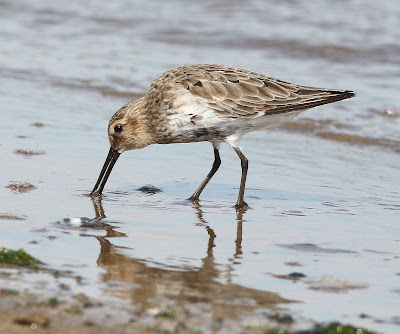
Dunlin: Littor Strand (28 Aug 16)
Sanderling: Littor Strand (28 Aug 16)
That was until an ignorant dogwalker decided to walk her dog right past where I was clearly photographing the Waders & boot them all. Good to see the dog was on a lead which is slightly better than most Studland dogwalkers. But when you walk past a birdwatcher with a camera standing back to avoid disturbance & right up to roosting birds, it makes very little difference if the dog is on a leash or not. It wouldn't have been difficult to walk a few meters away from the water's edge, but clearly some Irish dogwalkers are just as ignorant of wildlife as their UK counterparts.
Sanderling: Littor Strand (28 Aug 16)
Sanderling: Clearly, being a selfish idiot with a dog isn't restricted to the UK. Littor Strand (28 Aug 16)
Before leaving the area for the last time, we quickly tried Beale Point again, but there was no Terns there. So we decided it was time for us to head in the direction of the Rosslare ferry, with a few Birding stops en route. We had planned to stay over that evening in Ireland & catch the ferry on the Monday morning. I've tried this option on my last two Irish trips & enjoyed the seawatching on both crossings.

11 Jul 2016

11 July 16 - Lepidopterists Society Announce The Winner Of The 2016 Summer Photo Competition

It is less than three weeks since the shock announcement from the Lepidopterists Society that they were to hold a summer photo competition. Normally, these photo competitions only occur every ten years or so & this news took everybody by surprise & left photographers scrambling around for photos to submit. The judges stated they would eliminate one photo at a time until there were only two finalists left.
Fox(glove) Pug: Despite picking up a handful of votes from a few of the elderly judges, the majority of the judges quickly rule out Mr Fox(glove) as being totally unsuitable as he was far to dull, uninspiring & unpopular. Swanage (30 June 2010)
Following this initial rejection of Mr Fox(glove), another photographer decided to abandon the competition stating he hadn't read the rules & didn't realised the competition was only open to Moths & that his photo wasn't suitable. But he said he had been please to have got further in the competition than Mr Fox(glove).
'Red-faced' Crab: Mr Crabb decided it was better to retreat into his shell than be eliminated by the judges in the next round. Strawberry Hermit Crab, Tenararo, French Polynesia (13 Nov 2014)
This left just three in the competition & the judges got to vote one more out of the competition at the next stage. With the votes cast, it was clear which was the most unpopular photo: the Grey Dagger (or is it the Dark Dagger).
Grey Dagger or maybe Dark Dagger: They are very hard to tell apart & perhaps the best way is to check the genitalia. This does mean killing the Moth, which following recent events a number of the judges were in favour of doing, but in the end the judges agreed it would be too unpleasant to have to examine the genitalia. Swanage (26 May 2012)
The judges decided it was in very poor taste to have the dagger tattooed all over its back. This is believed to have been the very same dagger it has used only the previous week to eliminate the leading photographer & stop him from submitting his highly praised photo at the last minute. Many expected this photographer, Mr John Boriston, to have romped home with this photo.
Pop(u)lar  Hawk Moth: Laothoe populi subspecies johnsoni. This Moth is often to be found in a trap full of Maiden's Blush Moths. Most people had clearly expected the Hawk Moth to easily win the competition. Swanage (22 June 2010)
With just two photos left, the judges announced they would open up the voting to their full membership over the summer. Some members of the public had thought such an important competition should have been open to everybody & had recently joined the Lepidopterists Society in expectation they would get the chance to choose between the final two. They will now be bitterly disappointed & frustrated to have wasted their money.
Lead(som)-coloured Drab, but Moth experts have been quick to point out that this is in fact a Brussels Lace & not the far duller Lead(som)-coloured Drab. Supporters of the photographer were quick to rally around their favourite photographer & rebut suggestions that a more interesting sounding Moth that had been substituted to appeal to the elderly & mainly male voters. They stated this was yet another dirty tricks campaign by their opponents who have substituted this European sounding Moth to discredit their photographer. Swanage (4 July 2010)
In another unexpected announcement today, the Lepidopterists Society said that they have a clear competition winner, despite telling everybody that they weren't going to announce the winner till September. This follows the shock announcement this lunchtime, that one of the two finalists has just announced that she would be withdrawing her photo. The photographer complained that her recent statements over the weekend has been misquoted, especially the ones where she said her photo was the best one & she should win as it will appeal to "All Moth-ers". She was highly critical of The Lepidopterists Times misspelling this as "All Mothers". This left a clear & decisive winner for the 2016 Summer Photo Competition: May Highflyer.
July Highflyer: You will have to make do with this timely July Highflyer rather than the May Highflyer: we are not allowed to publish the winning photo prior to official approval by the Queen later this week. Swanage (17 July 2010)
Tonight the Lepidopterists are celebrating the unexpected quick results & news of their 2016 Summer Photo Competition winner. A happy spokesman said "This is how to do it. We want to show clear & decisive decision making". We have announced our winner today in less than three weeks, while the Red Rose Natural History Society are still deciding whether to hold a competition or not. One journalist missed the breaking news & turned up for the press conference of the Red Rose NHS to learn that they have had just one photo of an Eagle submitted for their Summer Photo Competition so far. There has also been a lot of argument within the Red Rose NHS as to whether the clear winner of the 2015 Summer Photo Competition can reuse his winning & clearly popular photo of a Limpet.
The Drinker: A leading spokesman from the UK Insect Party are expected to complain that it is wrong for the May Highflyer photo to win as the Moth isn't leaning far enough to the right for their liking. Swanage (21 July 2010)

26 Jun 2016

26 June 16 - European Bins & Scopes To Be Banned

Following the tumultuous vote in the British Union For Ornithology (BUFO) referendum on the question "Do you wish to Remain to be allowed to use European Optics" or "Leave the European Optics alone", then there have been traumatic times for British Birders in the last few days.

With the vote unexpectedly going in favour of the Leave campaign, then there have been major drops on the FTSE & sterling. The Leave team had campaigned to stop Birders from being able to buy expensive European optics. As a result, shares in camera and optics companies have plummeted on the news of their victory. Similar big drops in the share prices of banks have occurred as Birders will no longer be asking for loans to buy expensive optics.

The Outers, who had no plan for the future, have reacted to the news of their victory with joy, but panic (as they never expected to win). When asked for his thoughts & his favourite optics, the leader of the Leave campaign, John Boriston said "Cripes. So we won, crikey. Old JoBo's favourite optics have always been my eyes. I've always been a keen birdwatcher & I'm especially keen on those two-legged Birds". At that point, he saw a good looking Bird go past & cut the interview short to cycle after her.

Another Leave supporter quietly admitted "I only voted Leave, so I could moan for the next few years, everything was the fault of the Remain camp. What have I done?".

Another more candid comment came from an unnamed Birder who said "I could never afford the prices of a pair of Leica or Swarovski bins on my benefits. Therefore, it was natural I voted Leave. Why should other Birders have what I can't afford? If the Remain camp were serious, then they should have increased my benefits, not cut them".

Many Birders woken up shocked & stunned, at the Leave news on Friday morning. A Birder who didn't want to be named, told our reporter "The problem is the referendum was opened up to the wrong people. The decision should have been left to the experts, namely Birders. We care passionately about our optics. By opening the referendum up to the families of Birders, then you allowed my wife a vote as well. She was swayed by the Outer's promise, that if I wasn't spending the money we should have being saving to allow our children to go to university, then she could have a new kitchen. Where the logic in that?". He the added "Please don't publish my name as I can't afford a divorce at the moment, especially as I still have to pay off my now worthless telescope for the next two years. I only told my wife about the initial deposit, not the monthly repayments. She hasn't spotted my new camera body either".

Perhaps the strongest opposition have come from the Next Generation Birders (NGB) community of Birders, who are all under 25. One prominent NGB Birder said "I will be permanently in debt for many years to come. My bank refused me a huge expensive loan to buy my European optics. My only option was to go to university & spend much of my student loan to buy a top of the range Swarovski bins & telescope. Now I have to study for the next two years & I don't know where the money for that will come from".

As the pound crashed following the news of the Leave vote & the expected ban on European optics, then traders rushed to put their money into the traditional safe havens of gold & silver. But market watchers were surprised that the price of scrap brass doubled in the first hours after the result was announced. Initially this confused market analysts, until news started filtering out that the only British telescopes ever made were a long forgotten range of brass draw tube telescopes. It is thought they will be the only ones allowed in the future.

This has led to long retired Birdwatchers searching their lofts for their old brass draw tube & up to now, worthless telescopes. Back in the 60s & 70s, keen seawatchers could be seen huddled stretched out on cold beaches using long brass draw tube telescopes looking out to sea. Photos are rare of these telescopes, but check out this photo of one in use at the first British Forster's Tern twitch.

In the 80s, the first of the new generation telescopes appeared and Birders suddenly realised you didn't need to lie down on a cold sloping beach & balance a five foot long brass telescope on your feet. Instead you could see more using a modern shorter, light-weight, telescope balanced on a tripod. The European telescope manufacturers flooded the UK market & Birders quickly dumped their useless telescopes, putting the UK telescope companies out of business.

NGB Birders have complained, the result of the referendum is the fault of the Birding Old Timers (BOT). It's alright for the BOTs, they still have their old optics. We can't afford to buy these antique telscopes, whereas they still have them. It's bad enough that the BOTs all have big lists, whereas we still have to race off all the time to slowly try to close the huge gaps in our lists. But now they have the only optics that are likely to be legal to use in the future. They won't even complain that the quality of the optics is poor, as they will assume it their failing eyesight anyway & just book up for another eye test. It's so unfair.

2 Jun 2016

2 Jun 16 - The Final Finnish Ticks

I was half way through the second Finnature trip on my Owl trip to Finland with Mark Edgeller, Andy Rhodes & Simon Ingram. It was only 06:30 in the morning, but we had met the guide Olli at 03:00 & been at a hard Birding pace since we started. In the previous Blog Post, I had covered some of the crazy species seen including a Willow Grouse sitting on a lamp post & very close views of a male Capercaillie. But we had come to Finland for its Owls & so far we had seen only three of the five key species: Pygmy Owl, Ural Owl & Great Grey Owl on the first Finnature trip in the Oulu area. We had also seen a Short-eared Owl, but that didn't count as they aren't hard to see in the UK. Our final two target Owls were Tengmalm's Owl & Hawk Owl. I had seen Hawk Owl before after twitching one in the centre of the small town of Zwolle, Holland in Nov 13, but it was a Tick for Simon. As Hawk Owls are such cracking Owls, I was keen to see another. Fortunately, Olli said the right words when we met, that he knew a site where we can see a Tengmalm's Owl & we will start by looking for that first. Both of the small Owl species are happy to nest in nest boxes & by the start of June, they are bringing food to the chicks. There is little chance of upsetting their breeding cycle by brief visits to the nest box at this time of the year. The only drawback is the light was very poor & I was trying to hand hold an unstablised 400mm lens on ISO 10,000.
Tengmalm's Owl: This nest box was near to a quiet road where we waited. Olli walked over & scratched the tree, which was the cue for his friend to appear
Tengmalm's Owl: This is the nominate funereus subspecies which occurs from Scandinavia to the Pyrenees & the Urals. The overall range of Tengmalm's Owl is huge as it is occurs in all the conifer forests across Northern Europe to China & Alaska, Canada & the Northern US (where it is called Boreal Owl)
After looking for the Willow Grouse, Black Grouse & Capercaillie (see the previous Post), it was time to head off to look for Siberian Tit. This was another nest box stakeout.
Siberian Tit: This pair were actively feeding the youngsters in this nest box
Siberian Tit: It quickly popped out again
Siberian Tit: This is the lapponicus subspecies which occurs in Scandinavia & European Russia
Siberian Tit: They occur from Scandinavia to Alaska & NW Canada
Siberian Tit
Northern White-faced Darter: Female
Grey-headed Wagtail: Male
Next on the itinerary was Hawk Owl. The numbers of breeding Owls fluctuate annually, depending on fluctuations in Vole & Lemming numbers. This year, the numbers of breeding Hawk Owls weren't high, but Olli had a site a few miles before the Russian border. It was a bit of a drive, but worth it. It was such a remote site, we could have spent a month trying to find this pair without local information.
Hawk Owl habitat: There was a lot of similar habitat
Hawk Owl: Olli said the youngsters of this pair has recently fledged. We decided to stick with the parents, rather than cause them concern by looking for the youngsters
Hawk Owl
White-tailed Sea-eagle: Adult
By late morning, we were back in Kuusamo. We had enough time for a leisurely drive back to Oulu to catch the plane home to the UK. Our short four day trip was over, but it had been a good trip & four days was long enough. If you are planning a trip to Finland at this time of year, I can thoroughly recommend booking the guided trips at Oulu & Kuusumo with the Finnature guides. They seem expensive for an eight hour long morning, however, they will have most if not all of the speciality species staked out. But book early to ensure you can get onto a trip as spaces are limited. Finland is such a vast area & it would be very time consuming to try finding these species without very good local information. However, as a cost-effective compromise, you can hire cars at a reasonable price & driving in Finland is easy. There is plenty of self-catering accommodation available online. Therefore, it is reasonable to book the two Finnature trips & have a few days Birding on your own seeing the easier species. There were a few other Scandinavian goodies I didn't see, but they occur several hundred miles further North. They were Pine Grosbeak, Brunnich's Guillemot, King Eider & Steller's Eider. However, these are best seen by a trip to Varanger Fjord in Norway. I've seen all of these species as vagrants in the UK over the years, but I am still tempted to go to Varanger Fjord for a few days at some point in the future. One final thought, I wish I had bought one of the mozzie head nets before the trip. Olli lent us some for the final morning & having one for the rest of the trip would have been good.

2 Jun 16 - You Don't Have To Be Mad To Live Here, But It Helps

s
Only a few hours sleep again, before the alarm went at 01:45 for an early breakfast. The bags we quickly packing the bags into the car as we weren't going to have time to return to the chalet after the Finnature tour finished. We were first to the meeting point in Kuusamo, with the other three punters appearing a few minutes later & finally our guide, Olli, appeared just after 03:00. After a quick discussion on key species, we were heading off to cruise a few roads on the edge of Kuusamo in the hope of Hazelhen. But again, we were unlucky. Next on the list was Willow Grouse, the continental versions of the UK Red Grouse. We pulled up on a road just outside of the town, with five metre high Conifers & Birch trees on either side. It looked completely wrong for a Red Grouse cousin. But Olli played a tape & almost immediately a Willow Grouse came bounding out of the trees & landed on the road. Why couldn't a Hazelhen have been so obliging.
Red (Willow) Grouse: Unlike our Red Grouse subspecies which stay brown all year, Willow Grouse have a brown & white plumage in the summer & turn all white with just a red eyebrow in winter
It was still quite distant & so Olli said he would play the tape again as it had yet to do its party trick.
Red (Willow) Grouse: An out of focus photo after it had flown past us which shows how much white they retain in the summer 
Red (Willow) Grouse: It quickly responded to the tape & then decided on the obvious place to land for its party piece of sitting on top of a lamp post: I had though he was taking the piss when he said that's where it likes to perch
Red (Willow) Grouse: In the early morning sunshine
We had to push on. The next stop was a Black Grouse lek, where they come out of the forests to an open grassy field. It was possible to park on a side road next to this field. It is difficult to call it a lek on this occasion, as we only saw one male in the field & another briefly flying around the distance trees. But I guess we were late in the season.
Black Grouse: The views weren't close, but given it's a species we had all seen on various occasions in the UK, we weren't too bothered at the views
We carried on & the next stop was a ski centre. Olli said there were a number of cross-country skiing tracks & we were heading along the start of one of the tracks for his next target species.
The ski centre
Me at the ski centre: Modelling the latest must have clothing range
The ski centre: Andy, Edge & Simon: the Southampton boys
The ski centre: There was some good forest in the area
After walking for a few minutes up one of the tracks, Olli took off the main track & told us to wait. He then picked up a pine branch off the ground & headed over a small ridge with a running commentary. A minute or two later he reappeared with a male Capercaillie following him. The branch was to protect him from the Capercaillie, whilst not hurting the Capercaillie. He then stepped back out of its territory & the Capercaillie continued to walk up & down in front of us, call regularly & occasionally trying to attack Olli (hence the pine branch). He later explained that this was a well-known & well-liked male Capercaillie which lived close to one of the cross-country ski routes. It was well-used to people & despite regularly harassing the cross-country skiers, they had no wish to harm it. At this time of year, it probably had regular visits from Olli to show his punters. Fortunately, there isn't the same problem here, as has occurred on a number of occasions in Scotland where dog owners have failed to control their dogs & the dogs have attacked & killed Capercaillies. This behaviour by Olli would be clearly be illegal in Scotland where Capercaillie numbers are declining, but Capercaillies are a common species in Finland & they are hunted in the early winter.
Capercaillie: Male. Uncropped
Capercaillie: Male
Capercaillie: Another uncropped photo of this totally stunning, but crazy male
Capercaillie: A final uncropped photo
After a few minutes, we decided to leave the Capercaillie in peace & victory, until the next Finnature tour. We carried along the main footpath to a viewpoint over the forest. We did see a Red-flanked Bluetail singing from one of the tops of the pine, but far too far away for any photos.
Waxwing: While we were looking for the Red-flanked Bluetail, our only Waxwings flew over & briefly settled near to where we were standing
One of the key species we were keen to see was Siberian Jay, as we had failed to find that ourselves on the previous afternoon. Fortunately, a small party of Siberian Jays appeared to make up for our dip the previous day.
Siberian Jay: We had good views of three individuals, but this was the best photo I managed to take
Black Woodpecker: This was the only photo before it flew & disappeared out of sight
It was only 06:30 in the morning & I was already feeling tired. However, we had several more hours of Birding left before our guided tour was over. I'll cover the rest of the species in the next Blog Post.

1 Jun 2016

1 June 16 - June Started Early

June started early with an 03:00 departure to allow us to drive on the dirt track back roads near to our chalet, about twenty kilometres SE of Kuusamo. We were hoping to find a Hazelhen on these quiet back roads, but unfortunately, we were not that lucky.
We found this great view over the lake next to the accommodation as we crossed a nearby bridge
Looking South from the same bridge
Nearby we found three male Smew on a lake which apparently breed in small numbers in the area.
Smew: Male. They were surprisingly jumpy considering they were at the back of the lake. But they gave a brief & much closer flight view as they circled on the lake
Whooper Swan: Nearby were two Whooper Swans
We also saw a few Mountain Hares. Closer to Oulu, we had seen a number of Brown Hares, but all the Hares we saw in the Kuusamo were Mountain Hares: we were far enough North for Mountain Hares to be found at low level (Kuusamo is about 260m above sea level). The adults all seemed a bit too keen to get off the road as they saw us, even when we stopped at a reasonable distance. So perhaps the suffer from being hunted at some times of the year.
Mountain Hare: Great to see this superb Mammal. Sadly, I only seen a few in the UK & none have been really close. They are still a heavily persecuted Hare wherever there are Grouse shooting interests in the UK
Mountain Hare: The black ears with the white edges, white bellies & white legs were great to see
Mountain Hare: Eventually, I saw this youngster disappear off the road & then freeze not too far in. Like the pale eye ring
We spent some hours birding in one of the Gosney's hillside sites, but it was surprising at how quiet the forests were: apart from the ever present mozzies. Frustratingly, we flushed a Hazelhen as we were walking up the main path on the hillside, but it didn't fly until after I had walked past it & the first I knew was of a shout behind me: I never saw it.
Reindeer: Youngster. Getting desperate for another Mammal to add to this post. They weren't very common. On one occasion, we saw a couple in an office car park just feeding on vegetation. An early morning youngster
Reindeer: We saw a few each day in the Kuusamo area, including this roadside party
Reindeer: Male
In the afternoon, we tried a lake on the edge of Kuusamo. The highlight of the visit was a distant breeding plumage Red-necked Grebe.
Red-necked Grebe: Nice to see it in summer plumage rather than the winter plumage I normally see at Studland. Unfortunately, it was well beyond realistic photographic range & all I could end up with was a record shot from the SX60 on a ridiculous 130x magnification, with a delayed timing to try reducing vibration on this high magnification
The mid afternoon rain set in again & make it even harder to find Bird activity. So we decided to try a layby site to the North of the Ruka ski centre, where we had a chance of seeing Siberian Jay. We ended up putting food into the empty feeders & sat it the car, hoping that some Siberian Jays would appear. At least, we managed to stay dry & catch up on some food & drinks, but no sign of the hoped for World Tick. Finally, it stopped raining & there was a chance to walk one of the hillside paths. By now it was early evening & as the Bird activity seemed to drop off in the evening, we were not surprised we didn't see that much. Time to call it a day, head back to the chalet for an early night. We had a 01:45 alarm call to get some breakfast, before heading off to Kuusamo to meet our guide for the Kuusamo guided tour the following morning.
Whooper Swan: Party of a twenty strong flock on the way back to the chalet