3 Oct 2014

3 Oct 14 - Return To Blashford Lakes

Back in the Spring I visited Blashford Lakes to look for a Mealy Redpoll, but I had no success on the day: having left it for a long time before making the effort. At the time I was fairly fazed with UK Winter Birding, having just had a long trip to India & the Andamans. This trip was followed soon after by a trip to Morocco & the Western Sahara. Having known the area since the early 80s when it was a selection of unmanaged private lakes & working gravel extraction pits, where it was only possible to check some of the lakes from the road, it's great to see what they have done with the Wildlife Trusts reserve here.
Great Crested Grebe: Adult. Looks like it uses Barbour wax on its back
The reason for straying out of Dorset was I had been arranged to meet up with regular blog reader, Clare, who is an ex-pat currently living, working & Birding in Delhi. Over the last few months, Clare has sent a number of interesting emails of short Birding trips to Kashmir & Bhutan, as well as, emails on the problems of Birding around Delhi during the recent hot Summer. But being back in the UK for a short holiday, the plan was to met up for Clare's first UK Birding. The New Forest seemed a suitable compromise, being vaguely inconvenient for both of us to get to: Blashford Lakes was the first destination. The great thing is the how good the hides are for general photography compared to the Studland & Middlebere hides that I normally frequent. The first stop was the Tern hide as the mist was clearing, where they were a few Photo Ticks to deal with.
Grey Heron: 1st Winter. The grey forehead, crown & nape & lack of any ornamental long crown feathers indicates this bird was born this year
Grey Heron: 1st Winter. It obligingly stretched out so I could get the reflection in as well. It's not often I wish I had a smaller lens than the 400mm
Grey Heron: 1st Winter
Egyptian Goose: They are quite common in the Avon Valley these days, but only about one sighting a year in Poole Harbour (just about the right frequency, especially as they rarely hang around)
Tufted Duck: Female
Coot
Lapwing
Lapwing: The head markings are great from the front
Then it was onto the Southern side of the reserve. The Woodland hide was disappointing on this visit with few birds coming to the feeders. But this Coal Tit & Nuthatch made up for it on the feeder by the visitors centre as both were Photo Ticks.
Coal Tit: With a Blue Tit above
Coal Tit: The white nape is the key feature for separating Coal Tits from other Tits
Nuthatch: One of my favourite UK birds

1 Oct 2014

1 Oct 14 - Family Photo Tick & Some History

It's been a while since the last Bird Family Photo Tick, but the opportunity came by after the visit to Portland Bill for the putative blythi Lesser Whitethroat. For the last week or two, a Black Guillemot has taken up residence in the Southern end of Portland Harbour. This is an uncommon species in Dorset & it's possible to go two or three years without any records, other than a brief flyby (at best) past Portland Bill. Therefore, it was worth a quick stop to try & get some photos. But I had been warned it wouldn't be close it. Frustratingly, some boat owner decided to row a small boat out to his moored yacht & it decided to quickly drift further out in the harbour. So the photos are barely better than record shots & only made it onto the blog, as it's a Bird Family Photo Tick.
Black Guillemot: Good view of the underwing
Black Guillemot: It is the only UK Auk with a big white panel in the wing
Black Guillemot: At least it's polite & waves goodbye
Black Guillemot: Spot the Guillemot competition. The last photo without the massive cropping (look for the pink buoy in the middle of the shot) 
The Black Guillemot is best viewed from the English Heritage Portland Castle or adjacent to it. The castle was built in the 1540's on the orders of Henry VIII as one of a series of forts to protect the South coast from invasion from the French or Spanish.
Portland Castle: The Black Guillemot is visible from the English Heritage Portland Castle
A few days after DD in June 1944, the Allies towed across the components to make two temporary Mulberry Harbours at Omaha & Arromanches to support the US & UK bridgeheads, respectively. In total, there was 10 miles of floating roadways. The US Mulberry Harbour was severely damaged by a storm & was taken out of service, but the Arromanches Mulberry continued to be used for 8 months (against a designed period of 3 months). The floating bridges were protected by huge concrete breakwaters, known as Phoenix breakwaters. Two Phoenix breakwaters remained in Portland harbour.
Phoenix Breakwaters: Parts of the Mulberry Harbour still remains off the Arromanches coast, whilst a few bits were salvaged & used elsewhere for bridge reconstruction at the end of the Second World War

1 Oct 14 - An Interesting Opportunity To Learn About A Siberia Rarity

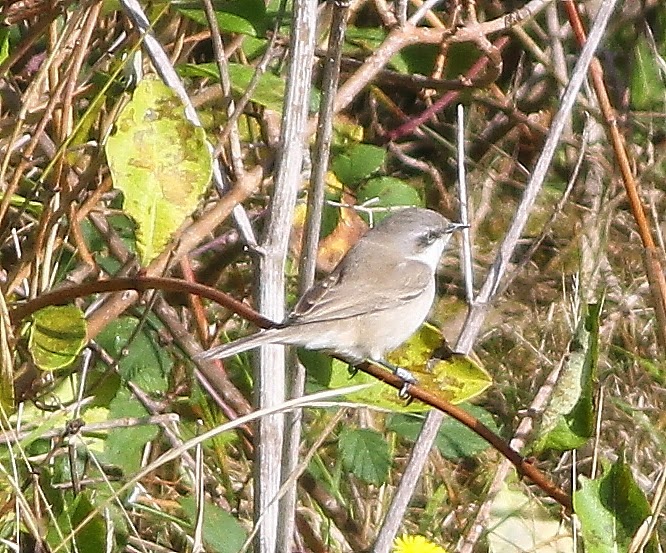
There was an interesting blog post from Dorset Birder, Brett Spencer, yesterday about a brown backed Lesser Whitethroat at Portland Bill yesterday which Brett is confident is a blythi race, which is the Siberian subspecies. Following this Martin, posted the hand photos last night on the Portland Bird Observatory website and classified it as a putative blythi. Both of these sets of photos are worth looking at. But unfortunately, this bird has caused some tension between Brett & Martin as a result of comments published on the respective blogs/websites. So here is some background & my views. Hopefully this won't offend either party as it's something I wouldn't want to fall out with either of these first rate & very experienced Dorset Birders. Secondly, I hope you two guys can quickly resolve this disagreement. It's right for Birders to get really passionate about Birding, but the frustration side needs to be directed against the illegal hunting problems we have & other threats to Birds, not to other Birders. What I will also say is this is a great opportunity for many of us to learn about a tricky species & that's an opportunity that not worth missing.
blythi Lesser Whitethroat: Initial views. All photos have been cropped & sharpened, but there have been no other changes to colour balance or tone
To cut a long story short, it turns out this Bird was originally trapped on the 22 Sep and the bird looked interesting in the hand and a dropped feather was sent off for DNA analysis. It was still around on the 29 Sep, but it wasn't until it was retrapped that day, that it was realised it was the same individual as seen on the 22 Sep. While it looked interesting, I think the Portland Bird Observatory website missed an opportunity that evening to post the photos & draw a bit more attention to this individual while it is still a putative blythi, especially as it was then clear it was sticking around. I can understand the lets wait and be certainty approach. But I also prefer a come & look at it while you have the opportunity approach, even if it's only a putative identification, as it is still a chance to learn some new stuff. Especially, as the likelihood is by the time there is certainty, there is also a strong probability that the individual will be much further South.
Blythi Lesser Whitethroat: It showed best on the East side of the Obs quarry, but I was sitting quietly on the West side
Talking to Martin this afternoon, it sound like there have been a number of other similar looking individuals like this in recent years later into the Autumn, so I can partly understand the wait & see approach, as it's not unique. But I also think on this occasion, this individual is different for the following reasons. Firstly, it has been trapped so there are excellent photos in the hand. Secondly, there is the probability that there will be feedback from the feather sent off for DNA analysis. Thirdly, it is showing well at times in the Obs quarry in the current good weather, allowing further opportunity for in the field photos & field observations without disturbing the individual. Therefore, while there have been other individuals that have been putative blythi Lesser Whitethroats, this has more chance of being confirmed. I think it is also a good opportunity for other local Birders, who like me haven't seen this subspecies before to go along & enjoy it & learn more about their identification. I sure Martin is right that they might be more regular later in the Autumn. But Siberian Chiffchaffs in Dorset have been discussed for quite a few years as putative, but after the combination of field observations & ringed birds, sound recordings & Birders going to seeing them, talk about them & getting their eye in on their identification features, more are now getting found. The result is we now are more confident Siberian Chiffchaffs are an uncommon, but regular Dorset visitor. Maybe we will be able to say the same of blythi Lesser Whitethroats in 5 or 10 years time.
blythi Lesser Whitethroat
So look at the excellent photos on both Brett's blog & the PBO website, but ignore the emotive words. Then go and have a look at this very interesting individual. It certainly looks striking in the field. Also have a read of the excellent Lesser Whitethroats section in the new Birding Frontiers Challenge Series Autumn book, which has lots of bang up to date detailed information as well. I won't tell you how to identify blythi as Martin Garner & contributors (including Brett) have already done a better job in the Challenge book. Given my lack of previous experience of blythi, I'm going to stick to putative blythi for now, but from what I've read I think Brett will be proven right on his definitely a blythi statement. But credit to Martin & the Obs team for also believing it was worth sending the photos off for DNA analysis.
blythi Lesser Whitethroat
blythi Lesser Whitethroat: Eventually, it flew into the Brambles in the NW corner of the Obs quarry where it was much closer
blythi Lesser Whitethroat: A bit of quiet pishing & it popped out
blythi Lesser Whitethroat
blythi Lesser Whitethroat: At last a decent shot of the bird
blythi Lesser Whitethroat
But again, I would say go & look at it, use the opportunity as a learning experience & if nothing else, like me you will be better informed if you are fortunate to bump into one on your own patch. Finally, if there are any people who haven't seen this individual, who wants to be critical & take the view of you should have identified it for certain by now, as I don't want to travel a few miles to see it, when it's not certain, then you are missing the point of being a Birder (go & start watching trains).
The Obs quarry with the Obs (the old lighthouse) in the background: the bird favoured the base of the bushes below the telegraph pole
After completing the post, I went back to look at my photos of Lesser Whitethroat complex taken in the Winter in India. This photo of a blythi Lesser Whitethoat looks pretty similar. Based on range & Rasmussen's recent book & older Indian books it would be a blythi.
blythi Lesser Whitethroat: CEDO, Gujarat, India (!9 Jan 14)
There are also photos of Desert Lesser Whitethroat & Hume's Lesser Whitethroat on this post from India. Note, this is based upon the recent treatment of this Lesser Whitethroat complex by Rasmussen & other Indian books. They now might be at odds to the very latest DNA information in Birding Frontiers Autumn book, regarding Desert Lesser Whitethroat. But I'm sure this is a subject that will still be in some flux in 20 years time across parts of the range of the Lesser Whitethroat complex.

Just been sent this link to a really interesting article on the Birdguides website of a Siberian Lesser Whitethroat watched & ringed in Tynemouth in Jan 14. Well worth a read.


Breaking news on the Portland Bird Observatory website on 29Oct 14 has confirmed that this was a blythi Lesser Whitethroat. I have removed the word putative from the photos, but left the rest of the Post unchanged. I'm glad for the opportunity to see this individual in the UK, especially as it was a good opportunity to learn more about them & test out one of the chapters in the Birding Frontiers Challenge Autumn book.

30 Sept 2014

30 Sep 14 - The New Studland Great White Egret

Just when the Studland Great White Egret & story was looking settled, a pager message on the 28th said 2 Great White Egrets on Littlesea. But there was nothing on the local email group about the second individual, so there was no clue as to the observer. Given this is the most frequently misidentified species in Poole Harbour, then I was interested, but cautious. But the caution was removed by a call 30 minutes later from my mate, Richard Webb, to say he was watching 2 GWEs on Littlesea. This confirmed there was a new individual in town, but he hadn't phoned the original news out. Having just got used to the news we finally had a showy GWE in Poole Harbour, then to have a second individual at Studland was even more remarkable. I was on the end of Old Harry at the time & by the time I had finished Birding there & got to Littlesea & Brands Bay, both GWEs had departed. I did managed to see both late on the follow afternoon at Littlesea, but no chance of any photos. So a couple of return visits were scheduled to look for them. This mornings visit on the rising morning tide to Brands Bay was unsuccessful, but a distant Osprey in the bay was good to see as were the first returning Grey Plovers that flew into the bay. A quick look at Littlesea, failed to find any GWEs, but it wasn't a thorough look as I was keen to get onto Middlebere (but more on that in a future post).
Teal: The only bird close enough to be photographed on this visit & a new species for the blog
Teal: Great to see them back in numbers
By the time I was finally leaving Middlebere, I decided to give Brands Bay another look as the tide should be starting to drop. I arrived to find a couple who I had met earlier at Middlebere by their car. They were just giving up & heading home. Before they left, they confirmed the water was still high & there were no GWEs in the bay. Oh well, it was a bit of a long shot. I then got a non birding phone call before I had had chance to get the scope & camera out of the car. While I was on the phone about 6 Egrets went up from the bay including a GWE: must have been in the side creek & out of sight of the hide after all. Finally, the call ended & I could grab everything & get to hide to see if it was still there.
Great White Egret: Here I am. Before I could get a decent shot it flew to the middle of the bay
The light in Brands Bay at this time of the day is always grim, as checking the best parts of the bay means looking straight into the sun. When it gets really bad, Redshanks can be almost as contrasty as Oystercatchers in some parts of the bay. So the photos aren't great, but even so, I can't see any sign of buff edgings to the coverts in the photos or with the scope. As such, it looks like we should be able to separate these two individuals (if good views or photos are obtained).
Great White Egret: The new individual
Hopefully some better photos will follow in the next few days. Photos of the first GWE can be found here.

30 Sep 14 - It's All Happening At Middlebere

Middlebere is a site that is best to visit on the rising tide as it's one of the last places in that part of the Poole Harbour to flood. But the height of the tide is also a factor. On spring tides it can go from fully out to high water in about an hour, on some neap tides the creek doesn't get flooded. But today I hit it perfectly. The tide pushed up but left a reasonable amount of mud exposed for Waders to roost on through the hide tide. As I walked into the hide, the creek was a mass of 1029 Black-tailed Godwits & 354 Avocets in two tight clusters. There was always some mud exposed on the high tide so there was the chance for prolonged views of the Waders. Sadly, no small Waders, but 10 Bar-tailed Godwits, 7 Greenshanks & 7 Spotted Redshanks also kept things interesting.
Avocet: Part of the 354 flock. They normally roost on Brownsea, but will roost at Middlebere on the lower high tides
Black-tailed Godwit: Part of the 1029 flock. Again normally they roost in numbers on Brownsea, although they often roost in smaller numbers (generally less than 150) at Middlebere, Brands Bay etc to avoid flying back & to be ready to feed as the mud is exposed again
A first Winter Green Sandpiper was back on the pool in front of the hide. This pool has been well visited of late by both a first Winter & an adult Green Sandpiper.
Green Sandpiper: 1st Winter. The broad spotting on the tertials indicates this is a Juvenile/1st Winter
Green Sandpiper: 1st Winter. Which is my better side, this side?
Green Sandpiper: 1st Winter. Or maybe this side?
Green Sandpiper: 1st Winter. After all that, it's time for a rest
Later on this Little Egret dropped into the same pool to feed.
Little Egret: They are commonly seen here, but it has taken a lot of visits to photograph one this close
Mute Swans are erratic visitors at Middlebere and this is only my second sighting here this year after one in the Spring.
Mute Swan
Mute Swan: After circling it did set down on the water
The visit continued to get better when a first Winter Marsh Harrier, grabbed something & settled down on the kill.
Marsh Harrier: 1st Winter birds look very dark & uniform at this time of the year
Marsh Harrier: 1st Winter. Note the pale tips to the primary & secondary coverts and the uniform flight feathers
Marsh Harrier: 1st Winter. Not a great shot, but it shows the uniform flight feathers also have pale tips to them
Marsh Harrier: 1st Winter
It was later joined by a female Marsh Harrier, but it wasn't interested in sharing the food. After a chase, the female departed and the first Winter bird went back to the kill.
Marsh Harrier: Female being seen off by the 1st Winter Marsh Harrier
Marsh Harrier: Female. On first impressions, this looks like another 1st Winter bird as it has the buff tips to the primary & secondary coverts and the flight feathers. But it also shows contrast between dark & light secondaries which points to a bird that has a mixture of old & new flight feathers. The more extensive buff-yellow patch on the leading edge of the wing can occur in some 1st Winter birds, but is more prominent in older females 
Marsh Harrier: Female. The contrast between the old & the new secondaries is quite obvious as is the dark wedge of outer primaries
At one point, the subadult male that was around a few days before put in another appearance.
Marsh Harrier: Subadult male
Marsh Harrier: Subadult male: A distant record shot view of the upperwing (which will have to do until I can get some decent shots)
With all this Harrier action it was no surprise to see the Avocet & Black-tailed Godwit flocks spooked a few times.
Avocets
Black-tailed Godwits: Still trying to work out how I found feel if one of these had dark underwings
The best point of the afternoon was finding a 1st Winter Mediterranean Gull on the foreshore. Despite being a common breeding bird in the upper harbour and a common wintering species around the Studland area, it is a rare bird at Middlebere. In 17 years, I have seen Mediterranean Gulls here on 4 occasions, including a flock of 3 on one visit this Summer. Whilst directing the other visitors in the hide onto the Med, I then realised there were 3 more 1st Winter individuals. Soon after an adult joined them, followed by a 2nd Winter. In the space of 10 minutes, I had doubled my number of Mediterranean Gulls for the site. They hung around for an hour or so, but despite good numbers of Black-headed Gulls being there, they departed as one of the Marsh Harriers booted everything again. Unfortunately, I failed to get any worthwhile photos of the group. I finished off the day, by returning to the Brands Bay hide for the late afternoon falling tide & got my first photos of the new Great White Egret.