28 Sept 2014

28 Sep 14 - Southern Hawker Egg Laying

I spent several hours out Birding locally on Old Harry & Studland today with a selection of commoner typical migrant Bird species seen, but nothing unexpected. Jays were on the move with a flock of 7 North over Studland. An additional 12 heading West from Old Harry, having realised that they were on the end of a headland with water on the Northerly direction that they wanted to go. The Westerly direction would have got them back onto a land route North.
Jay: Part of the flock of 12 which rose out of the front wood by Old Harry
I am always happy to see Long-tailed Tits & I spent some time grilling a couple of mixed Tit & Warbler flocks: but only Chiffchaffs and Blackcaps tagging along today. But the Long-tailed Tits are always great to watch.
Long-tailed Tit: The only European species in my top 10 Birds of the world that I've seen
Long-tailed Tit: It finally got bored with my pishing & after a final look, it decided to move on
There were also a few Butterflies on the wing with Clouded Yellows, Red Admirals, Speckled Woods, Large Whites & a singles of Small Copper & Peacock (the first I've seen for several weeks). The car was showing 23 degrees when I got back to it, so no surprise the Butterflies were enjoying the weather.
Clouded Yellow: The commonest Butterfly seen today with at least 14 individuals. This one appeared to be trying the "If I can't really see you, then you can't see me approach", which didn't really work
The wildlife highlight of the day was this cracking female Southern Hawker which greeted me on my return home. She was egg laying around the main pond. But unlike the other species of Dragonflies & Damselflies, which I've seen lay eggs in water, she was laying eggs in the moss, a few inches above the waterline on the rocks that edge the pond. This is something I've seen before on a few occasions in the last 2 years. From what I've read this evening, it seems that the eggs will not hatch until the following Spring, so perhaps this is a safer strategy for this species than laying the eggs in the pond over the winter. At one point, she even landed on my arm, but wisely decided that a green Rohan fleece was not the right place to lay an egg!
Southern Hawker: Female. This egg was a good 6 inches above water line, with some even higher
Southern Hawker: Female
Southern Hawker: Female. The final 2 segments have bands on them which separates this species from all the other Hawkers

27 Sept 2014

26 Sep 14 - The Birding Gods Are Listening

Back to Middlebere, but I still managed to miss the rising tide. But the weather was mild & the light OK, so I decided to see if any Raptors came along. I wasn't disappointed with 6 species of Raptors (in order of appearance): Kestrel, a first Winter Ringtail Hen Harrier, sub adult male Marsh Harrier, Merlin, Peregrine & finally a Buzzard. Must be my best Raptor day in terms of numbers of species. The 2 Harriers & the Merlin are freshly into the area. Unfortunately, the Harriers kept their distance & the Merlin did a quick fly past (but long enough to enjoy it with the bins).

In a recent post, I photographed a 1st Winter Green Sandpiper on the pool in front of the hide. I ended up saying I wished I had some photos of an Adult for comparison at this time of year. The first bird of note seen was an Adult Green Sandpiper on the same pool. I'm sure this is just luck, but in case the Birding Gods are following the blog, I would like to be able to show you photographs of a Siberian Rubythroat on Old Harry in the next few days!
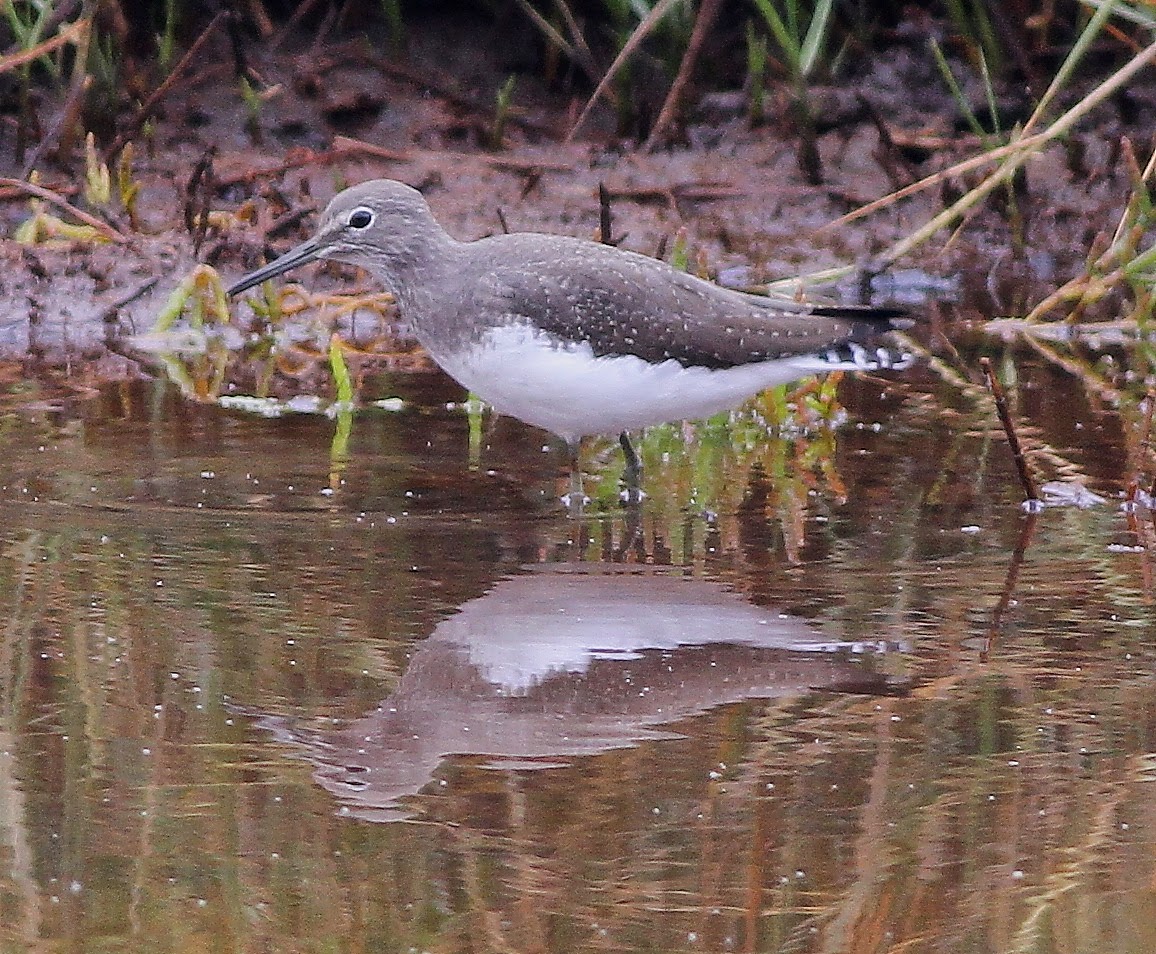
Green Sandpiper: Adult. Note the streaky breast. This is more uniform on 1st Winter birds
Green Sandpiper: Adult. Note the fine spotting on the wings, especially the tertials. The tertials have broader spots on 1st Winter birds
Even better a Green Sandpiper dropped into the pool later in the morning & it was a 1st Winter bird. This was very photogenic & allowed me some better photos.
Green Sandpiper: 1st Winter: This bird has far more uniform breast without the obvious streaking on the adult. Also the spotting on the tertials is larger & more distinctive
Green Sandpiper: 1st Winter. The centre of the breast was more streaky, but still not as streaky as the Adult
Green Sandpiper: 1st Winter. A nice view of the rump & tail. Pity there wasn't a central dark band to the rump & tail. That would have a sparked a major Dorset twitch, given Solitary Sandpiper has not been seen in the county before
Green Sandpiper: 1st Winter. Just posing for the camera now
Black-headed Gull: This Black-headed Gull also wanted its photo taken on the pole
As I was planning on leaving the Great White Egret from Studland flew in & dropped into the back of the marsh: but not before I got the chance to get the scope onto it. I saw it a couple of times over the next hour while I hung around, hoping it would appear on the creek as the water started to drop. But both views were less than a minute as it flew, before landing out of sight again. This is the first time, the GWE has been seen from the main hide (as it was first seen from the Harrier hide on the 7 Sep).

25 Sept 2014

25 Sep 14 - Migrants, Residents & Idiots At Studland

After a few grotty overcast days, the sun was out early & I was looking forward to getting out around the Studland patch. First stop was South Haven and a chance to look around for some migrants in the bushes. There were good numbers of Chiffchaffs and a few Goldcrests in the Tit flocks and the highlight around the lake area was this Spotted Flycatcher. There seems to have been good numbers of Spotted Flycatchers this Autumn, so hopefully they have had a good breeding season.
Spotted Flycatcher: I never get tired of seeing Spotted Flycatchers, especially as they tend to be erratic locally in the Spring & therefore the August & September tend to be the best months to see them
It's just getting to the time of the year to start checking the Heather Walk. This is a trail which heads off from the beach with some good trees in it. It is a good spot for mixed Tit & Warbler flocks & there is always a chance of a rarity in the flocks, although it's probably a bit early. In Autumn 2011 there were 3 Yellow-browed Warbler sightings over a 4 week period. Each of the birds looked different, but with no photos taken we will never know for sure.
Reed Bunting: There are usually a few around at the start of the trail. The first Reed Bunting for the Blog
Migrant Hawker: Female. Migrant & Common Hawkers have 2 spots on each of segments 9 & 10 (nearest the end of the abdomen), whereas Southern Hawker has bands on these segments. Migrant Hawkers have a prominent yellow triangle on segment 2. Additionally, the costa (leading edge to the forewing) is brown which separates this species from Common Hawker (which had a yellow costa)
Migrant Hawker: Female. Showing the brown costa & yellow triangle. This is easily the commonest Hawker flying locally at the moment. I've seen the occasional Southern Hawker in the last few weeks & yet to find a Common Hawker this year: it is definitely not common locally
Migrant Hawker: Female. Head on view
Migrant Hawker: Female. A nice face
The Great White Egret was on view again in the Little Egret roost at Littlesea. Although visible from the High Hide, it is too far at that point for photos. But the High Hide is about the only place to see this roost clearly. Still there have been plenty of photos of this GWE in recent posts.

The final site was Brands Bay, just as the tide was starting to drop. Highlights were 2 Greenshanks, a Whimbrel & a Knot. All seen until 2 idiot canoeists decided to come into the bay & explore all the side inlets. They must have been able to see the bird hide & the open windows. They must also have been able to see they were flushing all the Ducks, Waders & Gulls in the bay. But in a totally selfish way they insisted on flushing everything & then going to the back of the back of the bay, to flush many of the Birds a second time. I have nothing against canoeists in principal, but they need to consider that there are some bays such as Brands Bay, Middlebere & a few other bays around Poole Harbour, that get good numbers of roosting Birds & it is just irresponsible & selfish to disturb them. Non Birdwatchers probably only think these Birds are sitting around. Often they have been up half the night feeding or potentially migrating at this time of the year and are resting & sleeping whilst they wait for the water levels to drop again to be able to feed. If you are a canoeist and you see a large group of Birds in a bay, please turn back & don't disturb them. If they had done this a few days ago, it would have been even worse as they would have flush Birds into the back of the bay where another antisocial person, a hunter was waiting.
Irresponsible canoeists: Do you know these people. If so, perhaps you could ask them not to try & flush every single Bird in sight next time. I was fairly polite in this request & very polite at this time given the presence of a small kid with his dad in the hide

21 Sept 2014

21 Sep 14 - The Day Isn't Over Yet

Having seen good views of the Masked Shrike, then there was still a couple of hours for Peter Moore & myself to have a look at some of the other good Birds at Spurn. The combination of the favourable winds & the number of Birders had found Olive-backed Pipit, 2 Red-breasted Flycatchers, Barred Warbler & a Yellow-browed Warbler in the general area. However, the bad behaviour at the Olive-backed Pipit by Birders trying to flush it to see it, had meant that it had disappeared. Peter Moore & I were keen to see the Barred Warbler as it was only about 300 metres walk up the road. First stop was the chance to have a quick chat with friend & keen blogger, Ewan Urquhart, who writes the Black Audi Birding blog. Regular readers will remember I spent a couple of great days on Rum last October with Ewan on the Mourning Dove twitch. Unfortunately, it was only a short catch up as we were moving in opposite directions & time was short. Next stop was another 40 metres up the road, where there was a Red-breasted Flycatcher. But it hadn't been seen for about 15 minutes, so we didn't linger. 5 minutes later we arrived on the beach to look for the Barred Warbler.
Barred Warbler bushes: The Barred Warbler was skulking in these bushes, but eventually it popped out completely for a minute or two
Spurn Fashion Week: It's a smaller, low key, event compared to the London Fashion Week. But the number of motor drives going when the Barred Warbler popped out a few minutes later, would have impressed the catwalk. Peter is on the extreme right, trying to pretend it's cold up North
Barred Warbler: Being typically shy. My first Barred Warbler for about 19 years since Edge who featured in the Masked Shrike post found one in Winspit
Barred Warbler: A quick check to confirm Peter had moved to the other side of the hedge
Barred Warbler: After confirming he isn't there, it popped out
Barred Warbler: Look at the size of that bill
Barred Warbler: This is a species that doesn't raise many eyebrows on the East coast, but being much less than annual in Dorset, it's a good bird for us
Barred Warbler: Note, the white tips to the outer tail feathers
Having had good views & reasonable photos of the Barred Warbler, it was time to start drifting back to the car. But with a stop for the Red-breasted Flycatcher, which was now moving around in trees & bushes next to the road.
Red-breasted Flycatcher: Another species which is only every few years in Dorset. Having seen my first in Dorset, last year, I guess I've got another 3 or 4 years before the next one even turns up
Red-breasted Flycatcher
We finished off back at the Masked Shrike field, but it was skulking & only erratically showing at the far edge of the field. But a male Roe Deer had appeared. This one has a much darker face than the my local Roe Deer.
Roe Deer: Male happy sleeping by the Masked Shrike hedge
The final stop before leaving was the Bluebell cafe: You could tell we weren't in Dorset, when it was only £5.60 for a pasty, slice of chocolate cake & pot of tea.

21 Sep 14 - Up Narff

Over the last couple of weeks there have been a lot of early starts & plenty of local birding. Despite a lot of looking, it just hasn't been as good as hoped locally, although the Great White Egret around the Middlebere & Studland patches have been a definite bonus. While it's been good for commoner migrants & Waders, the hoped for Wryneck or Passerine goodie just hasn't appeared. Of course to increase the chances of finding or seeing something better, I could have had a day or two at Portland. Or to increase the chances more, a trip to the East coast, which seems to be dripping in Wrynecks, Red-breasted Flycatchers and other goodies, could have been planned. But being loyal to the local area, I've kept Birding mainly around Poole Harbour. At the end of the day, I keep telling myself finding a Wryneck on the patch is more exciting that one on the East coast.
Wryneck: One of the problems with Studland is there is just so much cover for a Wryneck to hide in. Beit Yatir, Israel (8 Apr 14)
Finally yesterday, I had decided to give myself a decent lie-in, after a quick look at the weather at dawn, showed it was still conditions & misty again. Next thing I knew it was nearly 09:30 & the lie-in had been achieved. But soon after the pager mega alerted: Masked Shrike at Spurn. By the time, I had finished breakfast & could have reacted, a calculation of what time I could get there after the 6 hour, 310 mile trip), had me arriving about 16:30, assuming no traffic holdups etc. So getting a bit tight. I should have gone anyway at this point, but a bit of untypical dithering (when a British Tick was involved) & it was looking very tight. Later in the day, I was frustrated, I hadn't got going sooner, as this was only a third for Britain & I hadn't see either of the previous two. It was also the first mainland Tick for me this year, as all the potential Ticks had been on Fair Isle (Swinhoe's Petrel, Hermit Thrush & Cretzschmar's Bunting), Crag Martin (whilst I was in Israel) or a scattering of flyby Fea's Petrels. The following morning, I was up early, in case it had stayed, but with clear overnight skies on the East coast, I expected I would be heading early to Studland. But a quick check of twitter & it was still there. Urgent phone calls with my mate, Peter Moore, to confirm he could abandon his parental football duties. He could & better still, he had it confirmed that he would still be married on his return, despite missing the football. So by 07:30 we were heading North. A good run & arrived in early afternoon. Even better as we pulled into the car park, we met my mates, Edge & Gav from the Croatia trip, who were just leaving. They had taken the really courageous approach of driving Southampton to have breakfast in a Nottingham motorway services. So we quickly jumped into their car & were chauffeured back to the Masked Shrike field. It only saved a 1/4 mile walk back up the road, but it was really a great help. We arrived to find the Masked Shrike sitting in the hedge, only 40 metres from the crowd. By the time, we would have got there on foot, it would have been further back in the field. On subsequent visits to the field, it remained, stubbornly much further away, so that lift really helped.
Masked Shrike: 1st Winter. UK & Ireland Tick 516 (following BOU/IRB rules) & no Mickey Mouse Club species to pad out the list. My full list can be found on Bubo
Masked Shrike: 1st Winter
Masked Shrike Hedge: It was generally in the far end of the hedge, but the above photos were taken when it was about 40 metres away
The first record was a well twitched individual at Kilrenny, Fife which was around from 29 Oct - 14 Nov 2004. This was followed by a single day bird on the 1 Nov 2006 on Scillies. The latest individual is still present for it's third day on the 22 Sep 14. I think that Masked Shrike is the best looking of the Western Palearctic Shrikes and here are some photos of adults taken in Israel this Spring.
Masked Shrike: Adult. Yotvata 11 April 14

19 Sept 2014

19 Sep 14 - Ageing A Close Green Sandpiper

It's not uncommon to hear or see Green Sandpipers at Middlebere from July to the following Spring. But normally they are either flying over the marsh or flying rapidly in front of the hide before landing one out of view. So it was a real bonus when one dropped in on the small pool in front of the hide for 2 or 3 minutes. Not long enough to really enjoy it, but long enough to get some photos. But I'm not going to complain, given it's only about the second time I've seen one on this pool. This is a first Winter Green Sandpiper. Now I just need to photograph an adult Green Sandpiper.
Green Sandpiper: The fine spotting on the dark upperparts, clean cut white underparts, short eye stripe, strongly barred tail & dark green legs separates this from a Wood Sandpiper. Hearing the distinctive call as it flew in & seeing its black underwings & clear white rump also sorted the identification out before it landed
 Green Sandpiper: The broad spotting on the edges of the tertials indicates this is a juvenile/1st Winter. An adult would have much finer spotting
Green Sandpiper: The relatively unstreaked head and lightly streaked breast indicates this is a 1st Winter bird. There are some great photos of aging of Green Sandpipers available in the excellent ringing PDF download Green Sandpiper from the Identification Atlas of the Birds of Aragon. It certainly is a lot more useful than my ancient Guide to the Identification and Ageing of Holarctic Waders
Wood Sandpiper: A winter Wood Sandpiper to compare. Note, the more scaly edgings to the golden brown upperparts, the less defined breast which runs more into the white belly. Also the stronger pale supercilium and the more yellowish-green legs. Desert Coursers, Gujarat, India (18 Jan 14)

17 Sept 2014

17 Sep 14 - More From Brands Bay

After a lot of waiting in recent weeks, the winds had finally swung to the NE & so I tried South Haven for a Vis Mig watch. But the wind strength was to great for more than a handful of Meadow Pipits to be on the move. There was also some Hirundines moving on a very broad front, mostly over the harbour. However, counting this movement was compounded by a significant number of Hirundines feeding in the same area. But I did see my first Sanderlings of the Autumn.
Oystercatcher: There are good numbers centred around Brownsea, but there are always a few to be found at South Haven
Sanderling: This is a wintering species around South Haven & the Poole Harbour mouth
Had hoped that the Great White Egret would be in Brands Bay, but had to make do with about 20 Little Egrets feeding: including this bird which was just in front of the hide.
Little Egret: Up to 1987, the annual total of Little Egret in Dorset only exceeded 3 in 1 year, when 11 were seen in 1970. However, this is the commonest Heron in Poole Harbour with a recent daytime roost count of 122 on Littlesea. There are probably over 200 in Poole Harbour at the moment
Little Egret: Showing the characteristic yellow feet
It was all fairly quiet & settled in Brands Bay, until an Osprey flew over. At that point, everything went up, despite the reality that the Osprey is unlikely to have a go at the Birds in the bay. Normally, when I photograph flying Birds, I set the focus area on the Canon 7D to a wider area (shown by squared brackets). In my hurry I set it to the widest setting (shown by rounded brackets). This is a autofocus setting I've not tried before for flying birds & won't try again. The Osprey flew closer to the hide than I've every seen them do in the past & the autofocus just kept focusing on the background sky, not the very large Osprey in the middle of the viewfinder. Eventually, after several failed attempts, I switched back to the squared brackets setting & it immediately found & focused on what was now a more distant Osprey. Good job it was only an Osprey & not anything rarer. But it's the first time, I been really unimpressed with the 7D.
Osprey: Despite being a regular passage species with at least 4 around in early Sept, they are most common around the Wareham channel, Arne & Middlebere and are noticeably less common around the Studland area. This is about my 6th sighting of the Autumn around Studland, which is my best year for Ospreys at Studland
Osprey: The heavy white spotting on the upperparts confirms this is a juvenile/1st Winter bird