11 Aug 2014

11 Aug 14 - Homage To Gilbert White - The Migrant Hawker Tree

In his classic book 'The Natural History of Selborne', Gilbert White explained the disappearance of the Swallows in the Winter, by explaining that they spent the Winter hibernating at the bottom of ponds. 225 years on, it is all a bit far fetching as an explanation. But he was a pioneering amateur naturalist and it fitted the facts as he saw them. They regularly were seen touching the water (actually drinking in flight) & they disappeared in the Winter. As a homage to Gilbert White, this blog can shake the scientific world & explain where Migrant Hawkers come from. Up to now the popular theory is they are migrants to the UK & some breed. This 'breeding' can now be confirmed as I have confirmed photos of their breeding in the UK. As I watched them, the sun melted their connection to their mother Migrant Hawker Tree & they flew off for their first time. It is surprising this behaviour doesn't appear to have been documented before, but I cannot find evidence when I looked on the font of all wisdom & knowledge: the Internet.
Migrant Hawkers Tree: With 2 males & 1 female fully grown Migrant Hawkers. Looks like it will be a good year next year, given the number of 'eggs'
Migrant Hawker: Male. Note, the prominent yellow triangle on segment 2 of the abdomen. Also, there is only a pair of short pale marks on the top of the thorax. Note, the final segments have 2 spots on each segment, whereas the Southern Hawker has a broad blue band
Migrant Hawker: Female. They have the same markings as the male, but are yellow or brown, instead of blue

8 Aug 2014

8 Aug 14 - Evil Looking Brute

Seen this evil looking Robberfly recently on a few occasions. It is the Hornet Robberfly, Asilus crabroniformis. They are really big & obvious once I got my eye in, due to their pale brown colouration & large size (About an inch long). Quite often I saw them basking on dried horse dung on Downland. The larva live around these dung pats for a couple of years, before hatching out in June. The adults will be on the wing till around the end of Oct. Their prey includes Grasshoppers, Beetles (especially Dung Beetles), Bees, Wasps & other Robberflies. They sit around a lot as they hunt from low perches or the ground. Other delightful facts is they can take 10 - 30 minutes to suck out the contents of their latest prey item. But don't worry they aren't known to attack humans.
Hornet Robberfly
They are fairly widespread over the Southern counties of England, especially South of Bristol to the Home counties. After that records seem to become more scattered heading into Wales, the Midlands & East Anglia, with just the one site in North Yorkshire.
Hornet Robberfly
The great advantage of carrying a camera around nearly all the time I am out, is it allows me to quickly grab a photo of something like this & then try & figure it out later. 

8 Aug 14 - Putting Names To The Map Collection

This morning, I had a call from Brian Arnold, to say they are watching the Map & it's being quite obliging in front of the camera. I get there & it is still there when I arrived about 15 minutes later. I was about to take some photos, when I see there are clearly two broken orange bands on the rear edges of the wings. This makes it a female and so we have a second individual. After getting some shots, I quickly bring out my mobile as they are photos from yesterday's blog on it and show Brian & Derek that the previous day's Map was a male (with only a single broken orange band). I had the advantage of getting better upper wing shots yesterday & having more time to look at those photos. So now we are looking at two Maps here. That rules out the chance of both arriving together, given their extreme potential vagrancy to the UK.  But that still didn't help with the vagrancy verses release theory, except it now means that the vagrancy would have had to have been a previous generation into a Spring generation which is less migratory.
Map: Individual B Female. The double orange band indicates it is a female
Map: Individual A Male. This is the male from the previous day. The single orange band indicates it is a male
Map: Individual A Male. Another photo of the same individual from today. Individual A has 2 strong, 1 weak & then 2 strong orange bars on the hindwing counting from the body
The female flew, but happy settled on a low white Umbellifer flower & started to nectar. Next thing is we see a second individual flying. We leave the female settled on the ground & nectaring & go off in chase of that individual which clearly is going to be yesterday's male (or so we thought). But we put up 2 more which start flying as well & but couldn't get any photos (as too flighty). But I was happy I had just seen 3. Several minutes later, we go back to look for the female & she is still there happily nectaring where we left her. So that has to be 4 individuals. Excitement is kicking in now at what we have just seen. I've never taken drugs, but reckon I should be talking about a new drug called MAP, with a near instant hit for all serious fans of Butterflies. Time to put a few updates & calls out as I knew several friends who were waiting on news.
Map: Individual B Female. She was still sitting on the Umbellifer & happy to show off her underwings
I spent the rest of the day at the site, getting photos as Maps were found. As the sun disappeared or they felt uneasy, they seemed to retreat to the surrounding bushes & trees. As the sun reappeared, then we were seeing them. The female seemed to be more of a natural model & easier to photograph. The males were more flighty & easier to disturb. As the day progressed, I started to look at differences in wing patterns, focusing on the fine detail of the orange band & the dark markings in the white band & seeing more males as I was getting more photos. Then I picked out a second female. So a multiple number of individuals present & as I write this I don't have a clear idea of how many I saw, but think it is 9 (with 7 males & 2 females). Hopefully, I will be able to prove this at the end of the post, but I'm sure that will be added to over coming days & when I see other photos. But for anybody who read my Swallowtail Mugshot post, you can figure where the rest of this post will be going. Time to get into the analysis & to prove the individuals. My Butterfly & Birding mate, Nick Urch, went into teacher mode (Nick you are on holiday) & suggested they should all have names Albert, Bettie, Colin etc, but I will settle for simple letters.
Map: Individual C female. Single band so looks like a male. But abdomen shape confirms it's a female. Considered most likely to be a female. But not Individual A as the hindwing has 5 strong orange bars (Individual A has 2 strong, 1 weak & then 2 strong orange bars counting from the body). Also the black marks in each of the white bands nears to the body are a different shape
Map: Individual C female. A better angle confirming the body shape as a female. Many thanks to Nick Urch for allowing me to publish this image. Copyright remains with Nick
Map: Individual D Male. Single band so a male. But the hindwings (counting out from the body) has 1 strong, 2 missing & 2 final orange bars. Also the black mark in the white band nears to the body are pretty small marks 
Map: Individual E Male. Single band so a male. Looks like A as the hindwings (counting out from the body) are 2 strong, 1 missing & 2 strong orange bars on the left hindwing. On the right hindwing, orange bars 4 & 5 are different shapes in Individual A. Also the orange on the right forewing stops after 2 marks. Individual A is more worn, but has orange continuing onto the right forewing 
Map: Individual F Male. Single band so a male. No problems picking out this one given the extreme wear. All the others have been pretty fresh, although Individual A has some wear to the upperside
Individual F is interesting as it looks like it has been flying for a week or more, so hatched earlier? Does this help with the release/locally bred considerations.
Map: Individual G Male. Single band so a male. Looks superficially like A & E as the hindwings (counting out from the body) are 2 strong, 1 missing & 2 strong orange bars on the left hindwing. On the right hindwing, orange bars 4 & 5 are different shapes in Individuals A & E. Also the 2 white patches in the band on the right forewing stops are a very distinctive shape.
Map: Individual H Female. Two bands so a female. Right this is easier to pick out as I only have to worry about Individual B as they others so far are males. Individual B has a broader outer orange band, whereas Individual H has the broader inner orange band 
Map: Individual I Female. Single band so looks like a male, but abdomen shape actually indicates it's a female. Looks superficially like C as the hindwings (counting out from the body) are 5 strong. But distinctive small white spot next to 2 white squares on right forewing (no white spot on Individual C)
Map: Individual J Male. Single band so a male. Looks superficially like A, E & G as the hindwings (counting out from the body) are 2 strong, 1 missing & 2 strong orange bars on the left hindwing). But the shape of these orange marks eliminate each of these individuals. Note, the 3 parallel white lines on each forewing along with an extra offset white line on the right forewing
So we are no further forward in being able to say where these have come from a vagrant from a less migratory Spring brood or a release. I suppose there is always the option C of a local breeder having an escape which started everything off. Guess we will never know. Just hoping the next thing I find will be a nice obvious bird with no doubts to its credentials.

7 Aug 2014

7 Aug 14 - Releasing Of A New Swanage Map???

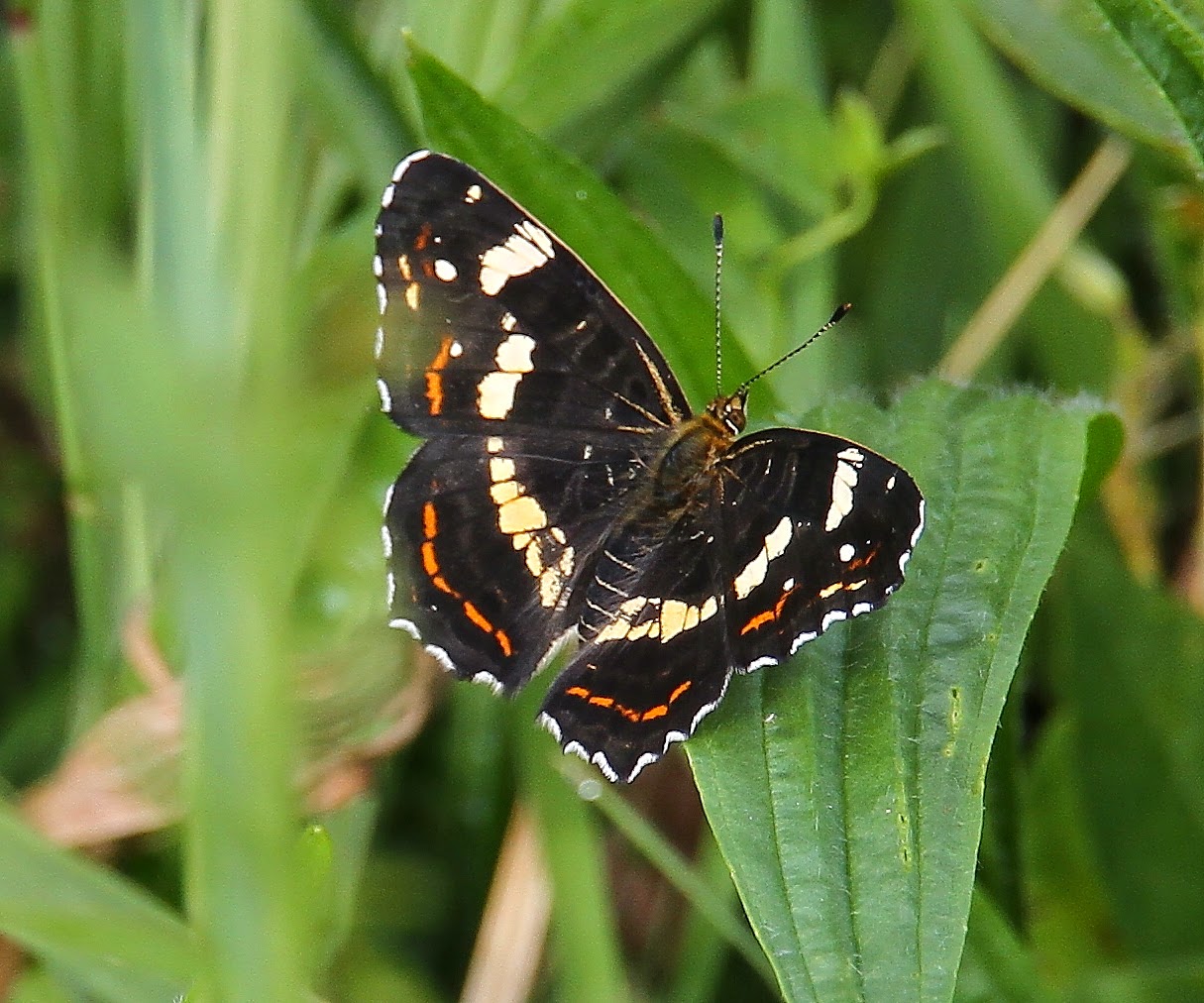
Decided to pop out with the camera & bumped into my local mate, Brian Arnold, who has been taking his friend Derek around Dorset in recent days. We had a great morning as I spotted what I thought was a Speckled Wood sitting on a bush a few metres away. Went to take some photos & was shocked to see it wasn't a Speckled Wood, but looked like a Speckled Wood sized White Admiral. But it wasn't right for that either. Panic ensured as Brian & Derek lifted their cameras, as I stepped back. Frustratingly, it flew off & we still didn't know what it was. All of us were relieved when Derek relocated it a few minutes later about 20 metres away. More photos were taken as it sat sunbathing on a tree, about 3 metres off the ground. We still didn't know what it was, other than it was either an species none of us could put a name to (but I am not up on my European Butterflies) or an unusual aberration of a commoner UK species. But Derek thought he had seen it in Europe in the past. It then moved again to an even higher tree before disappearing out of view. Here is what it looked like.
Map: Second generation male (females would have a second orange band)
After another half hour of not seeing it, I headed home to grab some books & quickly confirmed it was a second generation male Map Butterfly. I returned to tell Brian & Derek & then put some news out on the local birding email group (as there are a number of Butterfly fans on there) as well as phoning a few friends. Brian did the same to alert his Butterfly friends. We saw it on & off on several occasions over the next few hours, before finally deciding to give up about 16:00 (after not seeing it for the previous 45 minutes).
Map: Second generation male. It is just as stunning from the underside
At this point, I was in two minds about the Map. I checking the UK Butterflies website whilst the others were trying to relocate it. This mentioned a record from Surrey in 1982 which was never established whether it was an extreme vagrant, a deliberate release or an accidental escape from captivity. On the plus side, Studland has a good reputation for migrant Moths. But, I have some feedback (via a mutual friend) from one of the most respected Moth guys in the UK, that it would be unlikely to be a genuine vagrant as Maps are not a migratory Butterfly. Therefore, on balance the release option is the most likely.

So this begs the question, why would anybody release Maps into the UK countryside. There have been attempts to do this before. There was a well documented attempt in 1912 to release them to establish colonies at Symond's Yat & the Forest of Dean. These colonies were deliberately wiped out by a purist who didn't agree with a foreign introduction into the UK. I gather there has been other smaller attempts subsequently that have failed. As I understand the law, it is illegal to attempt to introduce an alien species into the UK. Clearly there are some well documented Butterfly introductions that have taken place over the years. Probably, the most well known Butterfly one was the well documented & successful Large Blue introduction. But this is a re-introduction of a former species (albeit the UK subspecies is extinct & the re-introduction stock is the Swedish subspecies). I fully support re-introductions like this. Because it will have been properly planned & I'm sure the appropriate approvals would have been obtained. From memory, I believe the in-depth study of their habitat requirements & the interdependence of their associated Red Ants was just becoming understood as the original extinction occurred. But this understanding allowed the other factors of habitat etc to be managed to support the re-introduction.
Large Blue: Collard Hill (22 June 10). A well planned re-introduction which has helped to re-establish this species in former haunts & a re-introduction I fully support
But if this was released, I do not believe this would be the case with the Map. I think it has probably come from a misguided individual, who wants to get their nice photos of a Map Butterfly & rather than spend some money to travel to France to see them in the wild, has paid their a tenner per pupua to buy them on line & has released them into the wild. The result probably would be they got some nice photos of a great looking Butterfly & the irresponsible subsequent release has probably broken the law. The reality is assuming they bought more than 1 pupae there might be the possibly of a release of both sexes & the slim chance of them breeding. Could they survive in the UK. Well I can't imagine there is a big difference between a sheltered corner of Swanage & Northern France, so no reason why not. They appear to have survived for more than one year from 1912 to 1914 (when they were deliberately wiped out). The other big objection I have to these people who do this & there is a Guy who lives in Bournemouth who I pretty confident was releasing Butterflies to get photos of rare UK species in Dorset back in the 80s, is they almost won't be reporting their actions to the county Butterfly recorder to allow these records to be monitored or ignored. If you think this is all conspiracy theories from me then here is another take on these type of releases. One of the local Birders sent out a warning email within the previous week. He had been out running around Wimborne & had bumped into 2 guys photographing a Butterfly he didn't recognise. On asking, it turned out to be a Large Copper & they were releasing it into the wild for photos. What wasn't established was whether it was subsequently re-caught afterwards or was left to fly away (which is potentially a breach of the law as I understand it). Apparently, they are working on a book, presumably on UK Butterflies. If anybody knows who these guys are, I would love to know (please leave a comment on the blog but I won't publish the comment, as I would like to ensure that I never buy the book from people who have this irresponsible attitude). I would commend people for writing books on wildlife, but if you want to include species that have died out in the UK or are vagrants, then spend a few quid, have a great week on the continent & photograph these species in the wild. Also, make it clear where the photos were taken.

So in summary, I would love this to be a wild Butterfly, but I suspect it's a deliberate release, by a misguided individual. However, a few weeks ago, there was a lot of discussion when a handful of Scarce Tortoiseshells appeared in East Anglia. With only 1 previous UK record, there was discussion of releases from weddings. But at the same time, there were a few tens of sightings in Holland. Within a few days, it was clear there had been an invasion of Scarce Tortoiseshells, with records from Lincolnshire to Kent, but none stayed long enough to be twitchable from Dorset. For now my money is it's a release, but would like to see if it has been caught up in the widespread Clouded Yellow migration that has occurred in the last 10 days or so in Dorset (& doubtless along the rest of the South Coast). I saw about 15 Clouded Yellows here today. About to check the weather forecast for tomorrow morning, to see if it's worth getting out to look for it again.

4 Aug 2014

4 Aug 14 - Third Time Lucky

Having tried 2 different sites the previous day without success, I was out looking for Scarce Blue-tailed Damselfly again at another site, as this was the only Dorset breeding species that I hadn't seen in the county. Given this is an apparently rare species in Dorset, I think it is best to withhold the name of this site. Fortunately, this site was different as I had heard that they had been seen at this site this year. However, I still didn't have any detailed directions. But I got lucky & after about 30 minutes of looking, I spotted one. It was useful that I had seen the Scarce Blue-tails in the New Forest earlier in the year, as I had a better idea of their habitat & habits. Unlike Blue-tailed Damselflies, they seem to be more reluctant to fly & are weaker fliers. Perhaps this is has contributed to their relative scarcity compared to the Blue-tailed Damselflies, which might be able to expand & find new locations in good years.
Scarce Blue-tailed Damselfly: Male. Note, the turquoise blue is on segment 9 & the tail end of segment 8. This compares with Blue-tailed Damselfly which has the turquoise blue restricted to segment 8
Scarce Blue-tailed Damselfly: Male. Note, the bicoloured pterostigma of the males is short & fat compared to Blue-tailed Damselfly
I also saw a few Blue-tailed Damselflies, Black Darters and Keeled Skimmers here, but none were photographed today.
Blue-tailed Damselfly: Male. Note, the turquoise blue is restricted to segment 8. Poole Harbour (3 Aug 14)
Blue-tailed Damselfly: Male. Note, the long & thin bicoloured pterostigma, compared to Scarce Blue-tailed Damselfly. Poole Harbour (3 Aug 14)
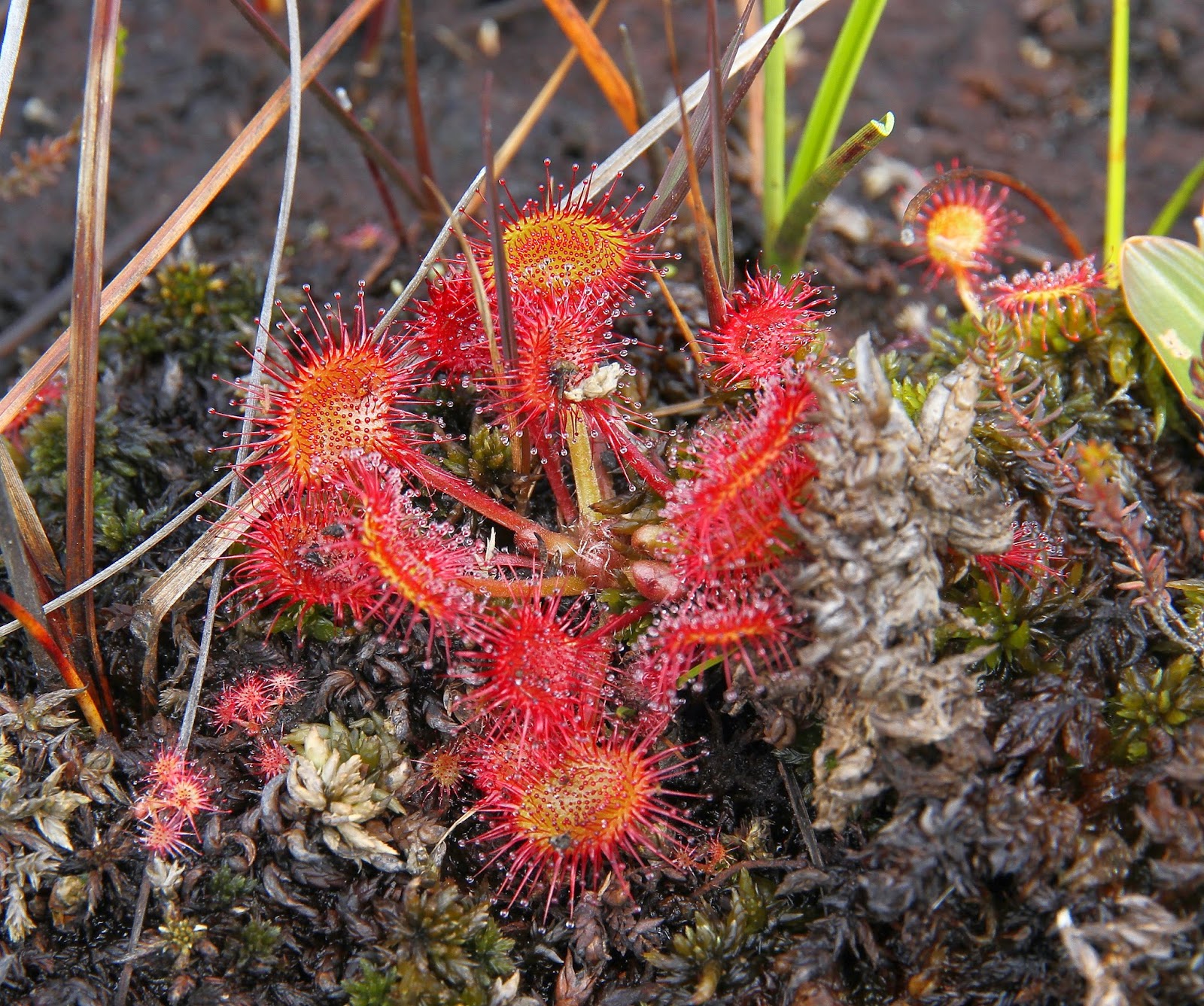
Like other Dorset bogs there were also good numbers of Round-leaved Sundews.
Round-leaved Sundew

3 Aug 2014

3 Aug 14 - Beautiful, Black, Blue & Emerald

With no joy in the first 2 bogs tried, I carried on into Rempstone Forest to check out the final local historical site for Scarce Blue-tailed Damselfly. En route, there were a few commoner Dragonflies, Butterflies & a Wasp Spider. For those of you that don't like Spiders, well don't go to the bottom of the post. But best to continue as this is one of the best looking UK Spiders. But first there was a great Helice Clouded Yellow. Clouded Yellows are a great migrant Butterfly that appear in varying numbers in Dorset. A smaller variable percentage come in the pale Helice form. This only affects females (like the Valesina Silver-washed Fritillaries), but I've yet to understand why only females have this aberration.
Clouded Yellow: Helice female. A percentage of the females have a pale form know as a Helice, where the butterfly is much paler than the normal dark yellow colouration. They are even whiter on the upperwing
Clouded Yellow: This is the typical form taken at Fontmell Down as part of the same recent invasion (30 July 14)
 
Common Blue
Common Blue
There were also a few Black Darters, Common Darters, Beautiful Demoiselles & a good selection of Emerald Damselflies. But unfortunately, the Scarce Blue-tailed Damselfly site was as dry as a bone. So no chance of any there.
Black Darter: Male
Common Darter: Female
Common Darter: Female closeup of the face. The black line above the frons (nose) does not turn down by the side of the eyes & this is diagnostic of Common Darters: it turns down in all the other species
Common Darter: Female. the 2 yellow bands on the side of the thorax also confirms it is a Common Darter
Beautiful Demoiselle: Male
Emerald Damselfly: Male. The pale blue covering the first 2 segments in Emerald Damselfly & the pterostigma are long & relatively thin separate this from a Scarce Emerald Damselfly (which has the pale blue over the first & half of segment 2. Scarce Emerald also has a broader, shorter pterostigma
Emerald Damselfly: Female.
Emerald Damselfly: Female. Emerald Damselfly has a narrow white stripe on the side of the thorax and an isolated green spot just above the middle leg. Scarce Emerald does not have the green spot and the white stripe on the side of the thorax
Emerald Damselfly: Immature female
Emerald Damselfly: Immature female. Just about possible to see the green spot & the orange side stripe on the thorax
Finally, the Wasp Spider. I remember seeing my first Wasp Spiders at Radipole in the early 80s. In those days, they were apparently reasonable well established on the Kent to Dorset coastline, having only been found for the first time in the UK in 1922 in Rye, Sussex. I don't know how they got there in the first place from the continent. They have expanded their range considerably since & are now well established from Cornwall to Suffolk, with scattered localities elsewhere as far as Birmingham.
Wasp Spider: Female. This is a female, the males are much smaller than this large Spider

3 Aug 14 - Searching Old Haunts For Scarce Blue-tails

About the rarest of the breeding Dorset Dragonflies is the Scarce Blue-tailed Damselfly. It is also the only one I haven't seen in Dorset. Therefore, I've been keen to try & see if I could refind this localised & nationally scarce Damselfly at an old haunt. The problem is compounded as one of the types of habitats they like are more open slow flowing water habitats, with bare substrate or limited vegetation. By their nature, some of the newer habitats, end up getting covered with vegetation in time and become less unsuitable for the Scarce Blue-tailed Damselflies. But they also like bog pools. In the absence of current sites or negative news from old sites, I decided to have a look around a number of local historical sites in Poole Harbour area. So it on with the wellies on a nice hot & dry day and I was ready for some strange looks from other walkers at my footwear: still it was in a good cause. While I wasn't ultimately successful with finding any Scarce Blue-tailed Damselflies, it was still a really good day out with the camera.
Keeled Skimmer: Male. The commonest Dragonfly in the bogs, but also the most active & hardest to photograph
Black Darter: Male. This is a small black coloured darker with 2 yellow stripes on the thorax & small yellow dots between the stripes. There are also dark red markings towards the end of the abdomen
Black Darter: Male. Note, the black pterostigma, black legs & unmarked bases to the wings. They also have a narrow waist but this isn't the best angle to see this
Small Red Damselfly: Male. Note, the all red abdomen
Small Red Damselfly: Male. Note, the red eyes, legs & pterostigma and bronzy-black thorax
Blue-tailed Damselfly: Male. Unfortunately, all the Damselflies with blue tails were Blue-tailed Damselflies. They have a clean cut turquoise blue marking on segment 8 & black on the final 2 segments of the abdomen. Scarce Blue-tailed Damselflies have the turquoise blue on segment 9 & the end part of segment 8 & only the final segment is black