13 Sept 2024

13 Sep 24 - A Resident Migrant

The St Aldhelms patch doesn't have a lot of obvious water and so it has a limited number of resident Dragonfly species. Over the recent few years of watching the patch, I've only seen six species of Dragonflies that I believe breed : Southern Hawker, Migrant Hawker, Emperor Dragonfly, Golden-ringed Dragonfly, Broad-bodied Chaser (only suspected breeder) & Common Darter. I've only see Large Red Damselfly, but Phil Saunders has also seen Azure Damselfly. I suspect that I would find additional records Damselfly records, if I could search some of the garden ponds in Worth Matravers or if I visited the Pier Bottom pools in the Spring. However, the latter idea is isn't particularly safe, given the soft clay cliffs are still wet in the Spring and more prone to mudslips.
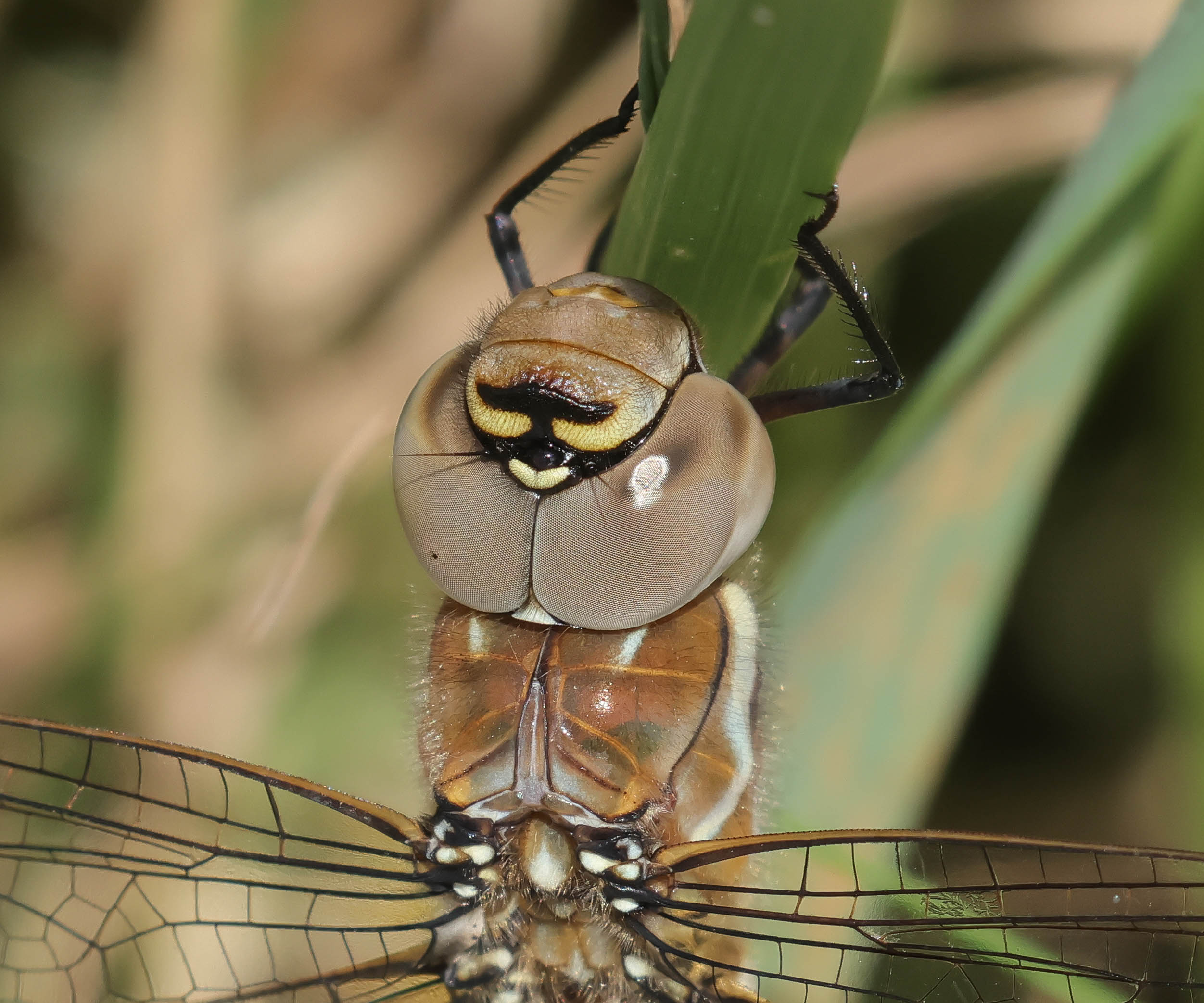
Migrant Hawker: Female. In this case, this Hawker along the final section of track towards the Chapel proved to be a female Migrant Hawker. Maybe my next Dragonfly sighting will be a migrant species
Given the limited number of resident species Dragonflies, it is always worth checking any Dragonflies seen on the patch as it can also pick up migrant species. In recent years, I've seen Vagrant Emperor (found by fellow patch Birder Phil Saunders) & Red-veined Darter. Phil has also found a Norfolk Hawker, Four-spotted Chaser (a presumed migrant) and Small Red-eyed Damselfly. None of these migrant sightings have lingered for more than a few photos for either of us.
Migrant Hawker: Female. Despite their name, they are a resident species which breeds on the Pier Bottom pools, as well as, in water tanks at Trev's quarry. There are a few scattered water tanks for cattle at St Aldhelms and perhaps they also breed in them. Worth Matravers and Winspit would be worth searching for other breeding sites, if access was possible
Migrant Hawker: Female. Dragonflies have such fantastic eyes
I've often wondered how Dragonflies see the world with these superb eyes. This BBC Senses clip on youtube provides a fascinating explanation of how much better their eyes are at processing motion than our eyes.

13 Sep 24 - Fri 13th: When Night Meets Day

The conditions looked good for St Aldhelms this morning with light winds & sunny conditions. I was expecting the first Merlin of the Autumn given the date, as well as, a few Autumnal migrants. It all looked hopeful with a few Chiffchaffs and Whitethroats by the car park & more by the open barn. I tried a side track & flushed what I assumed would be a small Sparrowhawk from the track. It stayed low as I raised the bins, but it was too small & slim and almost as soon as I got the bins on it, it landed on the track again. I was now looking at a cracking Nightjar about twenty metres ahead of me. I hadn't noticed any white in the wing or tail, so it wasn't an adult male. Wow: St Aldhelms & Valleys Tick number 180. A Nightjar has never been on my radar for St Aldhelms, except for possibly on a seawatch hawking over the sea. This sounds silly, but that's how St Aldhelms stalwart Steve Morrison saw his first St Aldhelms Nightjar: albeit it was back in the last 80s when Birders didn't realise Nightjars fed over the sea in the daytime & thought they might be Matsudaira's storm petrels. I lifted the camera, but it was watching me & it lifted off the track & flew around thirty or more metres & disappeared from view. Fortunately, as I got closer I could see it had landed back on the track. I took some distant photos, then walked forward two or three metres to take some more shots.
Nightjar: This is easily my best views of a Nightjar in the UK. Perhaps Fri 13th isn't always as bad as the movies make out
I stopped to take the final set of photos before backing out & leaving it in peace. But as I moved back, it lost its nerve & flew again. I saw it fly along the track before appearing to head off into some trees. I retraced my steps to check out a side-track. I had only been there a few minutes, when I heard two noisy walkers chatting as they came down the track. Well they would certainly have flushed it, if it hadn't spooked itself. After I finished on the side track, I headed back along where I had last seen it, to give the fields a scan. To my surprise, the Nightjar was sitting on a fence post only a few metres off the track. I walked past it and stopped for some more photos. It was watching me, but comfortable as I took the extra photos. I checked the fields, but there was nothing of note in them. The only problem was I needed to walk back past the Nightjar to collect my scope and head back towards the main track. I deliberately looked the other way as I walked past the Nightjar, but that wasn't good enough. It spooked again and flew a few metres deeper into cover. Still at least it won't be disturbed where it landed for the rest of the day.
Nightjar: The dark band and the line of white coverts on the closed wing rules out it being a Common Nighthawk. But based upon the last UK record, Common Nighthawk prefer garden fence panels to big heavy posts to roost on
According to Steve Morrison's All Time St Aldhelms & Valleys list on Bubo, this appears to be only the fifth record for the patch. Albeit given their camouflage and nocturnal nature, there will be other Nightjar occurrences that were overlooked. By early afternoon, I had added a few Wheatears, a Spotted Flycatcher, a few Blackcaps and a female Reed Bunting, but nothing else more unusual. The Nightjar had used up all my luck for the day, but it was worth it.

12 Sept 2024

12 Sep 24 - Autumnal Garden Butterflies

I returned from a visit to Brands Bay, to find a pristine Comma had joined the recently emerged Red Admirals in my Swanage garden.
Red Admiral: One of the two pristine individuals
Comma: They must have the best wing shape of any of the UK Butterflies
Comma: Showing the white comma, which is how they got their name

11 Sept 2024

11 Sep 24 - Natural Red Squirrel

Regular readers of this Blog, know I have a big passion for the Brownsea Red Squirrels. I've published a couple of recent Blog Posts of the Red Squirrels on Brownsea, but the Red Squirrels have been around the DWT feeders. So, it was nice to see this young individual running along the main track. When it saw me, it headed up into the nearest tree, before posing for a couple of minutes.
Red Squirrel: This time of year is great on Brownsea as the Red Squirrels are very active and often they can be very confiding

9 Sept 2024

9 Sep 24 - I Don't Spend Enough Time Looking At Grasshoppers

I don't spend enough time looking at Grasshoppers as I should. Plus their identification isn't easy & I know I'm going to need some time reading the book to figure out the species involved. In reality, that's how many of us started out with other groups of wildlife, before we learnt the common species well enough to not need a field guide for them. I saw this Grasshopper on the path to my house & grabbed a photo with the mobile. On this occasion, I thought this individual was probably going to turn out to be a Field Grasshopper, which I confirmed after checking the excellent Photographic Guide to the Grasshoppers & Crickets of Britain & Ireland by Evans & Edmondson. Maybe some of the commoner Grasshopper species are finally sinking in.
Field Grasshopper: I remembered the pale stripes on the pronotum were one of the key features to focus on, albeit I couldn't remember what I needed to note about them
The key features of Field Grasshoppers are: they are a medium-sized Grasshopper with sharply angled pronotal side keels. The pronotum forward of the sulcus is shorter than the length of the area behind it. Put in English, this is the white line on the top of the thorax is kinked and shorter in front than behind. Also, the dark wedges on the pronotum do not reach the rear edge (there is a grey band separating the dark from the start of the abdomen). Additionally, the wings reach beyond the hind knees. There are a few similar species:
  • Heath Grasshopper: This also has the sharply angled side keels and the dark wedges reach to the rear of the pronotum. The habitat also helps,; as I don't live close to any heathland
  • Mottled Grasshopper: They are smaller than Heath Grasshoppers. The males have clubbed antennae and the females have thicker antennae
  • Rufous Grasshopper: They have pale-tipped clubbed antennae
  • Woodland Grasshopper: They have distinctive contrasting white-tipped palps
  • Common Green Grasshopper: They have moderately incurved side keels and they do not have any orange or red on the abdomen.

9 Sep 24 - Scant Compensation

I started out at St Aldhelms in a North West wind that was at the limited of whether it was worth continuing or not. A Wheatear by the car park convinced me to continue. As I reached the open barn, I had a call from local Birder, Nick Hopper: which I assumed meant he had just found or heard of something good in Poole Harbour. I was half right: Nick said there had been a strong movement of around seven hundred Great Shearwaters East past Portland Bill that morning in thirty minutes. I had a fast eight minute walk back to the car. But I still had to get to Durlston, not helped by a bin lorry who saw me & then moved to block the road for several minutes. I then had another twelve minute walk from just outside the park to the seawatch hide. Local Swanage Birder, Rob Johnson was already there as he only had to drive from his house. He had seen three Great Shearwaters about fifteen minutes earlier, but it turned out they were the Tail End Charlies. Three hours later, I gave up having seen ten Manxies and another thirty or so small Shearwaters that were too far out to identify. But were most likely more Manxies, with maybe the odd Balearic Shearwater among them. The only consolation was had I walked without stopped to the coastguards lookout at St Aldhelms, I would probably have still been too late arriving at the sea. Had I stayed at home & waited for the right tide at Brands Bay I would have seen some Great Shearwaters.
Wall Lizard: The first individual
On the way back to the car, I stopped to photograph two showy introduced Wall Lizards on the Durlston Castle walls. They were scant compensation for missing the Great Shearwaters. Who could have predicted this unprecedented movement on a noticeable North West wind. I tried the following morning as the wind hadn't dropped, but had gone around to the South West. A dark phase Arctic Skua was the avian highlight. But the pre-dawn breakfast was worth it, for a cracking Bluefin Tuna which breached five times when I was looking through the scope at the sea from mid-distance. My first mainland Bluefin Tuna & obviously a nice Purbeck Tick.
Wall Lizard: A head & shoulders close up of the first individual
Wall Lizard: Head & shoulders close up of the second individual

4 Sept 2024

4 Sep 24 - Brownsea Waders

The DWT Brownsea lagoon can be a really nice place for photography of close Waders. However, this isn't always the case in early morning, when the light can be challenging. I arrived at the Avocet hide about 09:00, to find that the Curlew Sandpiper that had been seen the previous day, had been joined by a second individual. They were on the mud just outside the hide. This is often an ideal hide for photography, but I was looking into some very challenging & harsh early morning light. I took some pictures & went to improve the camera settings. When I looked again, something had spooked them & they had disappeared. They spent the rest of the day at the very back of the lagoon.
The two Curlew Sandpipers
A closer crop of the left hand Curlew Sandpiper: They really are a lovely Wader
Earlier in the Summer some of us had taken part in public guided walk training with Jonny, one of the two resident DWT rangers. We now were sufficiently staffed with volunteers on a Weds to offer a guided walk to the visitors. The plan was I would share the leading of this guided walk with one of the other volunteers, Stephanie. Unfortunately, nobody turned up, so we did the guided walk anyway with Stephanie doing the guiding & me playing the part of a visitor. It was a useful session for both of us, to help hone the guided walk before we had any real visitors.
Common Lizard
Common Lizard: A head & shoulders view with a frustrating piece of grass
Later in the afternoon, one of the lagoon's Greenshanks was feeding close to the Avocet hide. Fortunately, the light was significantly better than it had been during the early morning.
Greenshank
Greenshank
It had been another enjoyable day as a volunteer on the DWT Brownsea reserve and with lots of good public engagement & I even got the chance to be a member of the public during the late morning.