Showing posts with label Wheatear. Show all posts

23 Sept 2025

23 Sep 25 - Standing To Attention

As I walked back from Pier Bottom Valley, after finding a Little Stint at St Aldhelms (see the last Blog Post), I noticed this Wheatear sitting on a fence post. It looked remarkably upright. It flew a couple of posts, but again it was remarkably upright. I took this photo on the second fence post.
Wheatear
At the time I was wondering if it was a Greenland Wheatear, given it had such an upright posture. This subspecies is generally larger and bulkier. However, without measurements, it's not going to be possible to figure this out. Greenland Wheatears are described as having a more orangey wash to the underparts. So, perhaps it was just a regular Wheatear, which was looking more upright due to how it was sitting on the edge of the posts.

8 Jun 2022

8 Jun 22 - Birding On The Irish Mullet

After seeing the Least Tern, I had decided to return for a second attempt to get good views of the American Black Duck at Cross Lough on The Mullet on the North West Irish coast. The weather was predicted to get wet & windy as a front moved through on my first evening in Ireland and it was probably better as an option, than to look for Cryptic Wood White. Having had no success in the last hour of light on the first evening, I was hoping the wind & rain would have easied by dawn. The disadvantage of sleeping in the car was I heard the wind & rain was still hitting the car at dawn. The advantage was I could turn off the alarm & get some more sleep.
Cross Lough (12 Mar 22)
Cross Lough: The Lough is surrounded by these Machair fields
The rain had finally stopped by mid-morning, but there was still a strong wind blowing. I started looking for the American Black Duck along the shoreline, while brewing the first cuppa tea with the car kettle. It looked like most of the Ducks present on the previous evening had disappeared to feed locally or were skulking out of site in the reed edges. Eventually, I found a road that overlooked the Southern shore of the Lough, but I still no joy. Perhaps that was where it had been seen from the previous afternoon. I was glad I had seen it back on the Egyptian Vulture trip, even if it was only a flight view into this Southern section. I have only seen two previously in the UK: at Aber & on Tresco with both sightings in 1981.
A very breezy Atlantic, looking North from the beach
The Atlantic, looking South from the beach
The New York coastline is clearly a long way away
Cross Lough is a lovely place to go Birding as it resembles the Uist islands. I saw several breeding Wheatears.
Wheatear: Male
Wheatear: There were a pair of Wheatears around this small stone wall. I saw the male go inside the wall, so I suspect they were feeding young still in a nest in the wall
Wheatear: The Male showing how well camouflaged they are in the local stony walls
Wheatear: The equally well camouflaged female
This juvenile Wheatear has already fledged closer to the Lough.
Wheatear: Juvenile. I was pleased to see this recently fledged & independent juvenile Wheatear. Really hoping one year to see a juvenile Wheatear this young in the Isle of Purbeck to confirm local breeding
Linnets
Lesser Black-backed Gull: My favourite regular UK Gull species
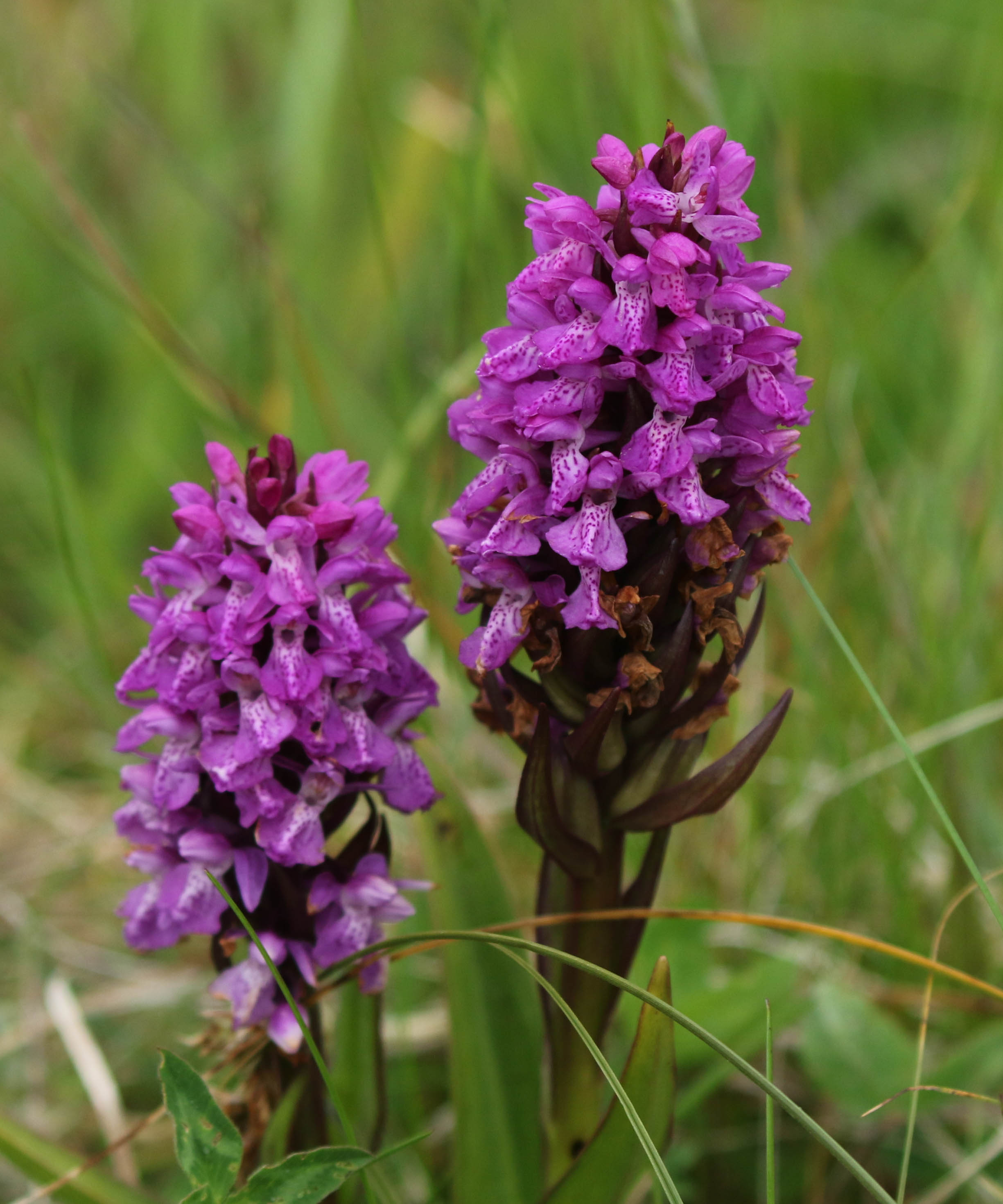
There were a reasonable number of Northern Marsh Orchids around the Lough.
Northern Marsh Orchid
Another Northern Marsh Orchid
It was now mid-afternoon and I had to start driving back to Rosslare. There was time for some brief roadside stops for some more Irish roadside art. Having always been a fan of traditional Irish Folk music, I couldn't resist stopping to take this photo.
Traditional Irish Folk band in a small housing development in Swinford
The impressive four Tullamore statues were along another of the main roads.
One of the four Roadside Tullamore Saints
Another of the four Roadside Tullamore Saints
A third of the four Roadside Tullamore Saints
I managed to get to the Wexford Waterfowl Centre just outside Rosslare to find the reserve shut & heavily secured to ensure you couldn't enjoy it out of hours: which was very disappointing. I did manage to see a little bit of the reserve by looking from the seawall & saw my second Irish Hare of the trip. It was getting dark & time to find somewhere to park the Focus Hotel for the night.
An Irish Hare record photo

8 Jun 22 - #30DaysWild Day 8 - A Gorgeous Baby

Rather than race across to Ireland & back for the Least Tern, I made it into a mini trip with a second day of Birding, before returning on the third morning to allow some seawatching for Seabirds & Cetaceans. With the weather predicted to get wet & winds as a front moved through on my first evening & with no detailed sites for the Irish endemic Butterfly, Cryptic Wood White, I decided to head off to The Mullet. I had visited The Mullet after the Egyptian Vulture twitch & immediately moved it up to my favourite part of Ireland, given its similarly to the Uist Islands. I was hoping to get better views of the currently resident American Black Duck on Cross Lough, having only had a flight view of it disappearing into the Southern corner of the lake on the previous visit. In the end, I didn't manage to find it on the first evening. The following day was wet & windy as the front appeared later than the forecast. It should have cleared by dawn, but the rain didn't stop till mid-morning. Still I needed to catch up on some sleep after the overnight crossing to Ireland. It looked like most of the Ducks present on the previous evening had disappeared to feed locally or were skulking out of site in the reed edges.

Cross Lough is a lovely place to go Birding & I was pleased to see this recently fledged & independent juvenile Wheatear. Really hoping one year to see a juvenile Wheatear this young in the Isle of Purbeck to confirm local breeding.

I will write a longer Blog Post at a later date. As I was driving back to Rosslare than evening, I was wishing I had booked to stay longer in Ireland. However, 24 hours later, I was really pleased with the decision to travel home after two full days in Ireland. More on that in the next Blog Post.
Wheatear: Juvenile

30 Sept 2015

30 Sep 15 - September: A Great Month On The Studland & Ballard Down Patch

The month started as August ended, with a good selection of common migrants, especially at Greenlands Farm, and smaller numbers on Old Harry & at South Haven. The first highlight was a skulky Pied Flycatcher at Greenlands Farm on 2 Sep.
Spotted Flycatcher: One of eight I saw on Greenlands Farm on 2 Sep 15
Wheatear: Greenlands Farm (7 Sep 15)
I visited Old Harry on 3 Sep. There were a few common migrants, but none of the hoped for Grasshopper Warblers: which I still needed for the patch Year List. As I was getting back to Studland village, Graham Armstrong rang me to say he was watching a Great White Egret at the South Haven Houseboats. It was quickly flushed by a fisherman & later appeared in Brands Bay. It has now settled down into a routine of being seen erratically around Littlesea, Brands Bay, Brownsea & may or may not be the GWE that has been seen in the Arne area. As such it is tempting to believe it is the long staying GWE that overwintered around Studland, but visited Middlebere & Brownsea on some days.
Great White Egret: Brands Bay (16 Sep 15)
The next highlight was on 8 Sep: a long overdue Grasshopper Warbler near the front wood at Old Harry. This took the patch Year List to 169.
Grasshopper Warbler: The first of two seen in September, with the other individual being in Brands Bay on 16 Sep. This is the Old Harry individual (8 Sep 15)
Grasshopper Warbler: Old Harry (8 Sep 15)
Rock Pipit: This showy individual was photographed after seeing the Grasshopper Warbler (8 Sep 15)
I managed to get out for a few hours on nearly a daily basis somewhere on the Studland/Ballard patch & this persistence was finally rewarded on the 11 Sep with finding a Studland Tick: a Red-backed Shrike from The Rare Gate at Greenlands Farm. Frustratingly, it didn't stick around for long. Within a few minutes, it flew across the field & out of sight behind a bush. Despite looking for a further five hours, I was unable to relocate it.
Red-backed Shrike: Year Tick no 170. Greenlands Farm (11 Sep 15)
The Rare Gate at Greenlands Farm: These private fields visible from this gate have had Rose-coloured Starling, Hoopoe, Wryneck & now Red-backed Shrike
Up to 3 Ospreys were appearing in the Brands Bay up to 12 Sep, although my last sighting was on 10 Sep.
Osprey: Adult. This was my last Osprey sighting. Brands Bay (10 Sep)
Kingfishers are a more regular species around Brands Bay & Studland at this time of year. There are usually one or two which appear to set up wintering territories, but they tend to be most obvious in the Autumn. This year is no exception with almost daily sightings in Brands Bay, especially in early September.
Kingfisher: Brands Bay (6 Sep 15)
The first of the Winter visitors appeared back in Brands Bay, including the first handful of Brent Goose, as well as, up to twenty Pintails & Wigeon.
Pintail: Brands Bay (6 Sep 15)
More interesting visitors to Brands Bay were a Black Tern on 18 Sep & a Little Tern on 21 Sep. Neither lingered for more than five to ten minutes. But as I only see each species about once every couple of years somewhere in the Studland/Ballard patch, even a few minutes of views were good to see: especially as I had already seen both species earlier in the year.
Black Tern: Record shot from Brands Bay (18 Sep)
One of the most exciting Bird spectacles on the Studland/Ballard patch are the Vis Mig movements. This is best watched at South Haven, when Hirundines, Finches, Thrushes, Wagtails & Pipits & other species move North on light North based winds. Even after a few years of Vis Mig watching at South Haven, it isn't always certain whether the next day will have a good movement until the Birds start moving. But generally, Oct & early Nov are the main months for Finch movements. Therefore, I was a little bit surprised to find Siskins moving on 9 Sep & 16 Sep. Not only were they moving, but they were moving in stunning numbers. On 9 Sep I saw 888 Siskins moving North by 09:50. The following week produced a new UK total of moving Siskins with 2423 moving North, with 2071 Siskins moving in a two hour period from 09:20. This record didn't last long, as the following day over 5000 Siskins were seen flying over that morning. My first Redpolls for the patch Year List (number 171) passed over South Haven on 16 Sep. Their numbers as migrants will build up in Oct & Nov, but they are never guaranteed on any reasonable Vis Mig day.
Siskin: Just 24 of the 2423 Siskins seen on 16 Sep
The second half of Sep turned into a fairly similar pattern. Common migrants & the same species on most visits to Brands Bay, with a few days with reasonable Vis Mig movements. A call from Paul Morton who is the main man running the Birds of Poole Harbour charity, sounded interesting. He had been up at Ballard Down from pre-dawn, recording calls of Vis Mig migrants & had a Woodlark. Woodlarks are barely annual at South Haven, but Ballard Down seems to get a few more records. Presumably they don't move North or perhaps they pass high overhead at South Haven & we miss them. But more intriguing Paul said the Woodlark was in one of the fields to the East of the Glebelands estate & was occasionally singing. I decided to leave South Haven as it was too still for any Vis Mig & quickly walk up from Studland village. Paul had heard it several times, but not seen it. As I might not get to see one later in the year, I hung around on the down & finally heard it singing. It wasn't easy to pin the field down, as it didn't sing for long. After an hour, I had worked out the field & was scanning it with bins & scope, when I finally picked up a couple of Larks. Just as I got the scope on one, it flew up & started climbing & I confirmed it was a Woodlark (species number 172). Even better it started singing & was joined by a second individual. I had only given myself a 50-50 chance of seeing Woodlark for the Year List, so this was a nice bonus.
Woodlark: No photos from Ballard Down, so a recent photo from the Hartland Moor part of Poole Harbour (3 Sep 15)
The last noteworthy Bird was a Cetti's Warbler found by Graham Armstrong on 28 Sep at South Haven. Cetti's Warblers are a common breeding species around the top of Poole Harbour especially the Swineham & Wareham Valley areas and Lytchett Bay. But they rarely seem to wander from the traditional haunts & they are a major rarity at Studland. Up to about 2000, there were three records of four Cetti's Warblers & there has probably only been one or two records since. Therefore, I was keen to look for this as it wasn't just a patch Year Tick, but a Studland Tick. A couple of hours were spent at lunchtime, but I failed to even heard it. Plan B was to return in late pm to the South Haven boardwalk where I immediately heard it singing. Only a few metres into the reeds, but not visible. It moved around & sang occasionally, but finally ended up singing more from the Northerly most end of the South Haven pool. Finally, I saw a movement at the base of some reeds. Raising the bins, I was surprised to find it was a Water Vole. I had heard there had been recent sightings of droppings here, but this was a Studland Mammal Tick. I watched it for a couple of minutes before it swam off. Great to see this sadly uncommon Mammal which have declined a lot since my teenage Birding days. Finally, the Cetti's sang again & I could see it sitting in one of the trees by the waters edge. Species number 173 & more importantly, it took the Studland/Ballard patch list to 219, excluding Crap (Feral) Pigeon & Nightingale (which I've only heard). It would be great if I could make this 220 before the end of the year.
Grey Squirrel: South Haven boardwalk. The habitat isn't great for Grey Squirrels so I am guessing that fairly quickly it headed back to where it came from (6 Sep 15)
Another unusual Mammal sighting in early Sep on the patch was a Grey Squirrel at South Haven. Grey Squirrels are resident in the woods around Littlesea, Studland Village, the edges of Greenlands Farm & Old Harry. However, the appearance of one on the South Haven boardwalk was noteworthy as this is only my second sighting in the South Haven area. The previous record was of one running along the road to South Haven. But it's that time of year when young Grey Squirrels get kicked out of their family territory & wander around looking to find a new home. So they have a habit ofappearing  in unusual locations.
Autumn Lady's Tresses: Old Harry (8 Sep 15)
All good slide shows seem to end on sunset. Instead here is a dawn photo of the Isle of Wight from South Haven.
Island of Wight from South Haven: Dawn on 27 Sep 15
Looking forward to October which is traditionally a great month of Birding on the patch.

1 Jul 2015

1 Jul 15 - Turkey - More Birds At Demirkazik

We started the day with a successful dawn visit to the top of one of the mountains near Demirkazik. After seeing all the hoped for goodies, including a singing Radde's Accentor, we returned to the hotel.
Looking at the mountains from the hotel: I think we spent the morning at the top of the slope on the photo's left hand side
After a late breakfast or early lunch, we tried some nearby woodland.
Turkish Orchid sp.: I've not tried to figure this species out
Unfortunately, it quickly became very wet in the woodland area and we abandoned that option, in favour of a long dry valley at the base of the mountains near to the start of the Emli Valley. We spent some time here scanning the area.
The first stop in the long dry valley
A closer view of the large rocky cliff within the valley
Yet another large Sheep flock: I wonder how much damage they do to the environment
Little Owl: This is the indigena subspecies which occurs from the Balkans to Turkey, South Russia, Transcaucasia & South West Siberia
Chough: A red-billed Adult at the top with two yellow-billed youngsters. This is the docilis subspecies which occurs from Crete & South East Europe to North Arabia, North Iraq, Iran & Afghanistan
White Wagtail: This is the nominate alba subspecies which occurs from South East Greenland, Iceland to Faeroes, Europe, Turkey & the South Urals
White Wagtail
Rock Bunting: This is the nominate cia subspecies which occurs in Morocco to Tunisia, the Iberian Peninsula & Southern Europe East to Turkey & Lebanon
Rock Bunting
Red-fronted Serin: Male
Red-fronted Serin: Female
Red-fronted Serin: Male
Taurus Souslik: There was a colony of these adorable Taurus Sousliks to entertain us
Taurus Souslik: If you sat quietly they would happily pose for you
Taurus Souslik: They have a vegetarian diet
Taurus Souslik: Every now and then, they stand up to look for danger
Taurus Souslik: Head and shoulders
Taurus Souslik: Nigel showing how approachable the Taurus Souslik were
The previous close up photos were taken with my Canon SX60. Many Birders raved about this camera and initially I liked it. However, after a few years of using it, I grew to dislike the photos it produced, as they were always over-saturated and there wasn't a setting in the camera to set it to realistic colours. I guess if I knew more about Lightroom, I might be able to correct the colour imbalance within the camera. In comparison, the Canon 7D and R7 cameras I've owned, have been good at providing a realistic colour balance, so it's frustrating that Canon just sell this poor quality camera. In the end, I just stopped using the SX60 and was pleased to be able to sell in on at a reasonable second hand price.
Taurus Souslik: A final photo with my Canon 7D Mark II with realistic colours
Lesser Spotted Fritillary
Next, we carried on into a better vegetated part of the Emli Valley, where there was a campground at the base of the mountains. Another Finsch's Wheatear was the highlight here.
An entrance hut close to the campground
Finsch's Wheatear: Male
Red-backed Shrike: Male. This monotypic species occurs from Europe & Turkey to West Siberia, West Kazakhstan & North West Iran
Red-backed Shrike: Male
Red-backed Shrike: Female
Wheatear
Taurus Souslik: A quick photo of another Taurus Souslik near the campground
Chamois: A couple of distant Chamois on the top of one of the valley's crags. Chamois are native to the mountains in the Pyrenees, the Alps, the Apennines, the Dinarides, the Tatra to the Carpathian Mountains, the Balkan Mountains, the Rila–Rhodope massif, Pindus, mountains in Turkey, & the Caucasus. Additionally, it is yet another environmentally-damaging introduced Mammal on New Zealand's South Island
We returned to our hotel in Demirkazik for a second night.