Showing posts with label Northern Fantail. Show all posts

5 Nov 2022

5 Nov 22 - Indonesia - Banda Sea Cruise Day 10 - The Best Of The Rest On The First Day On Wetar

In the previous Blog Post, I covered the Pigeons & Doves that we saw on the first morning on Wetar. This Blog Post will cover the remaining species seen during the morning.

Based upon the Clements taxonomy that my Birding database still follows, there were only six Ticks for me on Wetar. Wetar shared a lot of species with Timor & while there are a good selection of species on Wetar, this low number is indicative that I had seen a large number of those species when I visited Timor, Flores & Sumba, during the 3.5 months I spent in Indonesia back in 1991. However, there are a number of splits that have been recognised by IOC or proposed by the Birds of the Indonesian Archipelago field guide that are likely to be split in the future.
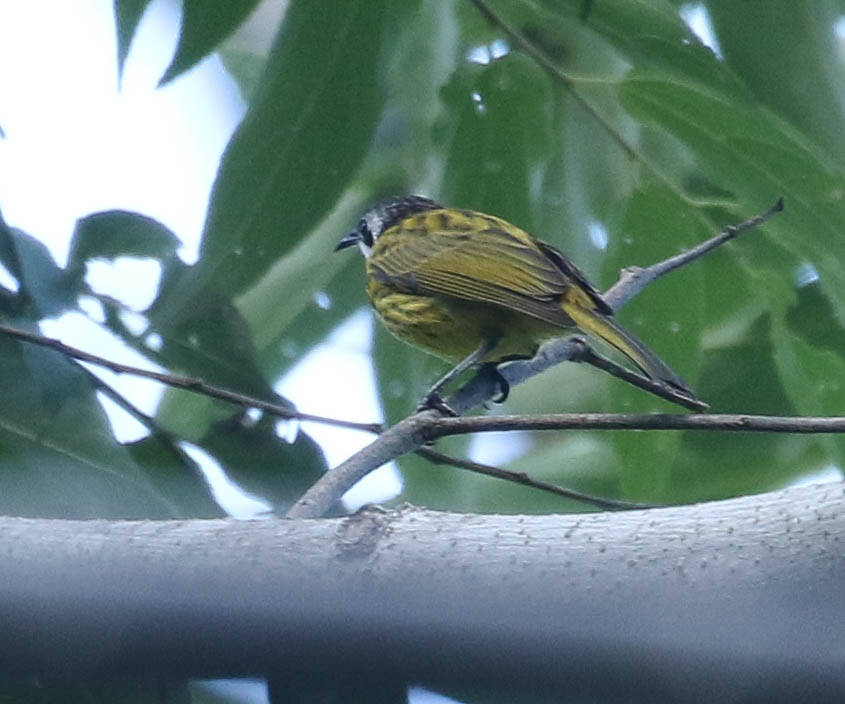
Yellow-throated Golden Whistler: The Birds of the Indonesian Archipelago field guide suggests that there may be a case to split the Wetar subspecies of Yellow-throated Golden Whistler as Wetar Golden Whistler, on the basis of extremely divergent mtDNA, but similar appearance to other subspecies of Yellow-throated Golden Whistler. The field guide states further investigation is needed
Northern Fantail: According to Clements & IOC, this is the pallidiceps subspecies of Northern Fantail which occurs in the Indonesian Lesser Sundas & Moluccas islands, as well as, New Guinea, the Bismarck Archipelago & Northern Australia. The Birds of the Indonesian Archipelago field guide have proposed to split the Indonesian subspecies as several new species, based upon pronounced vocal and plumage differences. This including Timor Fantail, which includes this subspecies, which occurs in Timor, Semau & Wetar Islands
Olive-brown Oriole: This is another of the Indonesian brown Orioles that is a mimic to the local Friarbird. It's another potential armchair Tick for me. Clements considers that the Wetar finschi subspecies & the nominate subspecies on Timor are the same species which they call Olive-brown Oriole. Whereas, IOC & the Birds of the Indonesian Archipelago split them as Wetar Oriole & Timor Oriole, respectively
Birding Along The Road
Wetar Forests: One of the good things about Wetar, is the island's economy is significantly based upon mining. While the mine is clearly destroying part of the hills around the village where we landed, it does mean that currently the extensive forests aren't being commercially logged
There doesn't seem to be any disagreement on the taxonomy of the following species.
Black-necklaced Honeyeater: A Black-necklaced Honeyeater showing how it got its name
Black-necklaced Honeyeater: This is a Wetar endemic
Wetar Figbird: Male. This is another monotypic Wetar endemic
Timor Blue Flycatcher: Male. This is the kuehni subspecies which is endemic to Wetar. The other subspecies occurs on Timor, Semau & Rote
Timor Blue Flycatcher: Female. This is also known as Timor Warbling-flycatcher
Pied Bushchat: This is the pyrrhonotus subspecies which is found on Timor, Wetar, Kisar, Sawu, Semau & Rote. There are other subspecies that occur from the Caspian part of the Western Palearctic to Afghanistan, the Indian Subcontinent, South East Asia, the Philippines, Java, Bali & Wallacea in Indonesia, New Guinea & the Bismarck Archipelago
There was a good selection of Insects along the road.
Indonesian Butterfly sp.
Indonesian Yellow Butterfly sp.: I have seen similar looking Butterflies in the Southern Philippines & the Moluccas
Bee Nest: we decided to quickly move on when we saw this Bee nest, just in case the swarm decided to fly
Bee Nest: A close up from the last photo
Indonesian Dragonfly sp.: This is a gorgeous Dragonfly
Indonesian Dragonfly sp.
This is a superb looking Damselfly
It was time to head back to the Lady Denok for lunch. There was time for a roadside stop just outside of the village for a White-bellied Sea-eagle.
White-bellied Sea-eagle: This cracking Sea-eagle is found along the coasts & islands of Southern Asia to the Philippines, Indonesia & Australia
White-bellied Sea-eagle
Tony Palliser waiting for the boats
One of the local canoes
Getting into the boats wasn't always elegant
It was fair to say we were frustrated on the Lady Denok to hear the news that we were to be returning to Wetar soon after lunch. This wasn't to return immediately for Birding, but because we had to travel about 25 miles across the island to the town on the South coast which was the regional capital. Apparently, a new police chief had just arrived on the island & we had to take the passports & check in with him. It was an hour & a half journey on the back of the slow lorry with the knackered engine to get there, albeit about thirty minutes beyond where we stopped for Birding on the way back.

Once there, it was one of those pointless exercises where we all were ushered into the office to meet the police chief, some dreary talk about German football teams for ten minutes, before having to go out to the front steps for team photos with the police chief & his team. Basically, he just didn't seem to have a lot to do & it was the chance to have some photos taken with some of the few tourists who land on Wetar. Nobody asked to see the passports. All in all about an hour & a half wasted, when we could have been relaxing on the Lady Denok or spending more time Birding. Finally, we were told we could continue Birding for the rest of the three days on Wetar, but we would need a police escort.
Our Police Escort: A nice enough guy, who didn't stop us Birding. Every morning he rode his motorbike back along road on his motorbike to find us
After about a half hour of driving on the way back, we stopped at a flatter part of the road with more open area forest. The plan was to scan for Parrots, especially Olive-shouldered Parrot (also known as Jonquil Parrot), which we hadn't seen so far. This species also occurs on Timor & I had seen it on there in 1991. However, it is a different subspecies on Wetar & was a Tick for most of the group. We did see a distant Parrot perch up in the tree which some of the group thought was an Olive-shouldered Parrot, but not all of us were convinced & the views were inconclusive. A couple of Marigold Parakeets did put on a better show for us. The highlight for the site was our first Wetar Myzomela.
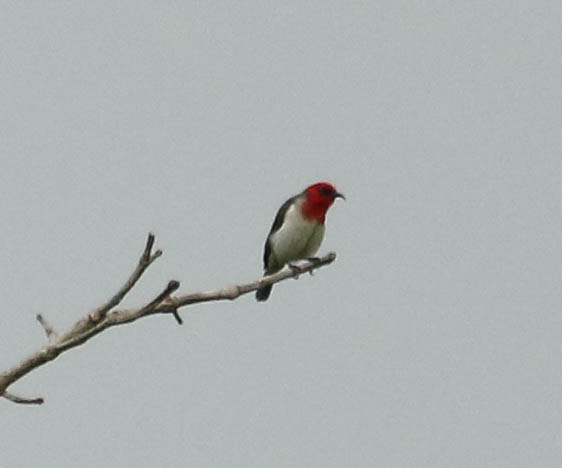
Wetar Myzomela: This is a Wetar endemic
Wetar Myzomela
Finally, it was time to move as we had another half hour drive to where we were going to look for the recently split Wetar Scops Owl, which previously had been considered a distinctive subspecies of Moluccan Scops Owl.
Wetar Scops Owl: This is a Wetar endemic
Wetar Scops Owl
Wetar Scops Owl
It had been a long, but successful first day on Wetar, apart from the pointless journey to see the police chief.

3 Nov 2022

3 Nov 22 - Indonesia - Banda Sea Cruise Day 8 - Birding On Damar

We had a pre-dawn landing in the Muslim village on Damar to allow us to walk through the village & meet our guides at the far end of the long village at first light. It was about a two & a half miles of walking along a steadily ascending track until we reached the better forest around 300m. This was our site for the main target species: Damar Flycatcher. This is a single island endemic species. We saw a few birds along the walk in the early morning light, but we didn't linger for too long as everybody was keen to push on to look for the Damar Flycatcher, before it got too hot.
The rising track passed through a lot of secondary edge
Little Bronze-cuckoo in the early morning light: This is the rufomerus subspecies that occurs on the Romang, Kisar, Leti, Moa, Sermata and Damar Islands in the Lesser Sundas
Northern Fantail: This is the hoedti subspecies of Northern Fantail that occurs on the Romang, Leti, Moa, Sermata and Damar Islands in the Lesser Sundas. It has been proposed to be split as a monotypic species, Banda Sea Fantail, by the Birds of the Indonesian Archipelago due to pronounced vocal & plumage differences within the Northern Fantail complex. Currently, Clements & IOC haven't split the Northern Fantail complex
The forest looked better by the time we reached an elevation of around 300m. Fairly soon we were watching our first Damar Flycatchers. The males were very active & didn't stay for long in any perch. It was another endemic species with a very limited range for the trip.
Finally, the forest improved
Damar Flycatcher: Male. We saw three Damar Flycatchers in the morning
Damar Flycatcher: Male
Damar Flycatcher: Female
We also saw a few other forest species on Damar.
Yellow-throated Golden Whistler: This is the dammeriana subspecies which is another potential future split that has been proposed by The Birds of the Indonesian Archipelago field guide, from the Yellow-throated Golden Whistler complex. Currently, Clements and IOC treat it as a subspecies of Yellow-throated Golden Whistler. There is further work required in this group before the taxonomy becomes finalised
Spectacled Monarch: This is the trivirgatus subspecies that occurs in the Lesser Sundas. Other subspecies occur in the Moluccas & Australia
It was time to slowly wander back to the village.
These locals raced past us on the track down the hill carrying heavy-looking sacks of nuts
We took the walk down the hill at a more leisurely pace
As we reached the edge of the village, a damp grassy patch held a Wood Sandpiper & four Eastern Yellow Wagtails.
Wood Sandpiper: Wood Sandpipers breed across Eurasia & winter from South Africa to South Asia & Australia
Eastern Yellow Wagtail: Wilbur confirmed this is the tschutschensis subspecies
Spider sp.: There is a small brown Spider just behind the large Spider's head & I'm assuming this is a male as many species of Spiders have very large females and very small males. The males take their lives into the hands when trying to mate & too often become the next meal for the female
I hadn't expected to see paintings of Father Christmas on a police station wall
We returned to the Lady Denok for lunch. I skipped the early afternoon PADI diving & snorkelling session in favour of catching up with lost sleep. I wanted to be awake for the seawatching in the late afternoon when we left Damar & headed for Leti Island. In hindsight, this was probably a bad decision, as it was a quiet crossing with a Wilson's Storm-petrel, some Brown & Red-footed Boobies and a reasonable numbers of Common Noddies.
Some of the local kids getting used to a local fishing canoe
Brown Boobies
Common Noddy
Raja, our birding Mr Fixit, seawatching
One of the inter-island ferries
We finished the evening with some stunning sunsets.
This was one of the best sunsets I saw in Indonesia
The sunset looking forward
The sunset continued to impress us