Showing posts with label Common Lizard. Show all posts

20 Jun 2025

20 Jun 25 - Searching For Shiny Emeralds

I had managed to see Highland Darters, now a subspecies of Common Darter, as well as, Common Hawker and Golden-ringed Dragonfly in the Beinn Eighe area. All of these species had eluded me on my first visit during overcast conditions before the ORCA surveys. So, it was good that the sun had emerged and encouraged them to start flying. However, I was still looking for my first Northern Emerald. The problem is on sunny conditions, Emeralds love to fly at tree-top levels. There were at least three appearing erratically over the area where the Hawkers were flying. My early encounters were not hopefully and I can only label them as Emerald sp.
Emerald sp.: I presume this and the other photos in flight are Northern Emeralds. However, as all are flying away, it isn't possible to see their diagnostic yellow facial markings
Emerald sp.: The Dudley et al site guide only lists Northern Emerald for this site. But I needed to see a perched individual to be happy I had seen a Northern Emerald. After having seen a perched Male, then this looks like a Male Northern Emerald based upon the very pinched waist
Emerald sp.: Like the other aerial photos, this Emerald was flying at tree-top levels. After having seen a perched Male, then this looks like a Male Northern Emerald based upon the very pinched waist
Finally, one of the others spotted a Northern Emerald that had landed.
Northern Emerald: Female. Females have a broad abdomen with orange spots on segments 1 - 3 of the abdomen, whereas Brilliant Emerald has yellow spots. Downy Emeralds are not spotted on these segments
Northern Emerald: Female. All three species of Emerald have bright green eyes, but teneral individuals will show brown eyes
A second individual landed later in the afternoon: this was a Male.
Northern Emerald: Male. Males have these Earwig-like anal appendages and a very narrow waist. Male Downy Emerald has a less pinched waist and outwardly pointing anal appendages
A Dorset Downy Emerald for comparison: Morden Bog (26 May 13)
A Brilliant Emerald for comparison: Male. Esher Common (13 Jun 14)
It was still warm and sunny around late-afternoon, and I decided it was time to leave and head across to the Loch Garton area. This had several sites for Northern Damselfly which was my last British breeding Damselfly. Although the forecast was for the sunny weather to continue the following day, I gambled that the currently weather might last into the evening. It was about seven in the early evening by the time I arrived. As soon as I got out of the car, I could feel the temperature had probably dropped too low for the Northern Damselflies to still be active. I checked a couple of nearby sites and there was no Damselfly activity. Still I could get an early night in the Focus Hotel, after a number of recent long days and be fresh for the following morning.
Common Lizard: The Northern Damselflies might have gone to roost, but this Common Lizard was still active

4 Sept 2024

4 Sep 24 - Brownsea Waders

The DWT Brownsea lagoon can be a really nice place for photography of close Waders. However, this isn't always the case in early morning, when the light can be challenging. I arrived at the Avocet hide about 09:00, to find that the Curlew Sandpiper that had been seen the previous day, had been joined by a second individual. They were on the mud just outside the hide. This is often an ideal hide for photography, but I was looking into some very challenging & harsh early morning light. I took some pictures & went to improve the camera settings. When I looked again, something had spooked them & they had disappeared. They spent the rest of the day at the very back of the lagoon.
The two Curlew Sandpipers
A closer crop of the left hand Curlew Sandpiper: They really are a lovely Wader
Earlier in the Summer some of us had taken part in public guided walk training with Jonny, one of the two resident DWT rangers. We now were sufficiently staffed with volunteers on a Weds to offer a guided walk to the visitors. The plan was I would share the leading of this guided walk with one of the other volunteers, Stephanie. Unfortunately, nobody turned up, so we did the guided walk anyway with Stephanie doing the guiding & me playing the part of a visitor. It was a useful session for both of us, to help hone the guided walk before we had any real visitors.
Common Lizard
Common Lizard: A head & shoulders view with a frustrating piece of grass
Later in the afternoon, one of the lagoon's Greenshanks was feeding close to the Avocet hide. Fortunately, the light was significantly better than it had been during the early morning.
Greenshank
Greenshank
It had been another enjoyable day as a volunteer on the DWT Brownsea reserve and with lots of good public engagement & I even got the chance to be a member of the public during the late morning.
20 Mar 2024

20 Mar 24 - Brownsea Common Lizards

It was good to be starting my third season as a volunteer on the DWT Brownsea reserve. As a bonus it was the first warm & sunny day of the spring. On of the visitors spotted my first Common Lizards of the year on one of the paths. There were six half grown individuals along with a full-sized adult.
Common Lizards: Shame about the piece of vegetation at the front of its head
A close up of the adult Common Lizard

22 Jul 2018

22 Jul 18 - Some Of The Resident Wildlife At Studland's Littlesea

In addition to the resident Birds photographed at Littlesea since I found the Purple Heron at Littlesea, I've managed to get some nice photos of some of the other commoner residents, while I've been looking for the Purple Heron during the daytime.
Sika Deer: They often appear around Littlesea & are quite comfortable in the water. This individual was feeding on the fern behind it (20 Jul 18)
Common Lizard: Enjoying the sun (18 Jul 18)
Large Skipper: Male (18 Jul 18)
Emerald Damselfly: Female. This is the only Emerald Damselfly type in Dorset, but I'm checking the ones I see as it can't be long before one of the other recently UK established species appear in Dorset (18 Jul 18)
Emerald Damselfly: Male (21 Jul 18)
Red-eyed Damselfly: Good to see this is relatively abundant at Littlesea after seeing it for the first time in there in 2017. Although I assume it has been there for the last few years (18 Jul 18)
Red-eyed Damselfly: (18 Jul 18)
Blue-tailed Damselfly: A common resident (18 Jul 18)
Water Strider: I saw a few so perhaps this is reasonable common along the edges (22 Jul 18)
White Water-lily: Hopefully I've got the id correct. Not quite Monet standard. The White Water-lilies are a popular haunt of the Red-eyed Damselflies and Small Red-eyed Damselflies (20 Jul 18)

8 Jun 2014

8 June 14 - Walking On Water

I seem to remember hearing a story about walking on water when I was a kid. Well this is nothing remarkable for the UK's largest Spider, the Raft Spider, which will have been doing it in the UK since the end of the Ice Age. The local RSPB Arne reserve is a good place to see them, but I've had no luck when I've looked in the past. A warm, sunny day seemed a good idea to have another attempt. Also I knew there would a good selection of Dragonflies to photograph. Given it's Heathland, then there is also less grass to set off another hay fever attack.
The Dragonfly pool on Coombe Heath
Raft Spider: Female. The body is just under an inch long with a leg span of almost 3 inches. This one was at the back of one of the pools near the Shipstal hide 
Raft Spider: Female. The other UK Raft Spider is Fen Raft Spider which occurs in a few Fenland sites
I ran into a large party of Long-tailed Tits, which must have been a couple of successful family parties given the number of calling birds in the trees. The youngsters doing their best to out-compete their siblings in the demands for food.
Long-tailed Tit: Adult with a youngster behind adds another family photo tick to the list
Migrant Butterflies were represented by a fly past Clouded Yellow: my first for the year & 3 Painted Ladies.
Painted Lady
There was a good selection of Dragonflies on the pools at Arne.
Emperor Dragonfly: They were spending hours hawking over the pools without stopping. This shot shows the typical large bulky body
Emperor Dragonfly:Female egg laying
Four-spotted Dragonfly: The spots in the middle of the leading edge of each wing identifies this as a Four-spotted Chaser
Azure Damselfly
Perhaps the most surprising event of the day was watching something swim across one of the pools. I got some photos and then as it got to the far side & sat on a convenient reed in the water, I checked in with the scope & realised it was a Lizard. I didn't appreciate they could swim, but it seemed to be doing a good job at it.
Common Lizard: Female. It looked like swimming was something this female had done before 
Common Lizard: Female. She was too heavy to walk on the water
The RSPB Arne reserve sits on a large heathland peninsula which sticks out into the Western end of Poole Harbour. It separates the Wareham Channel from the rest of the Harbour. I don't tend to go there that much, as I end up driving past Studland, Rempstone Forest & Middlebere and one of those sites will generally convince me to stop. But there are great views overlooking Poole Harbour from Arne's Shipstal Point.
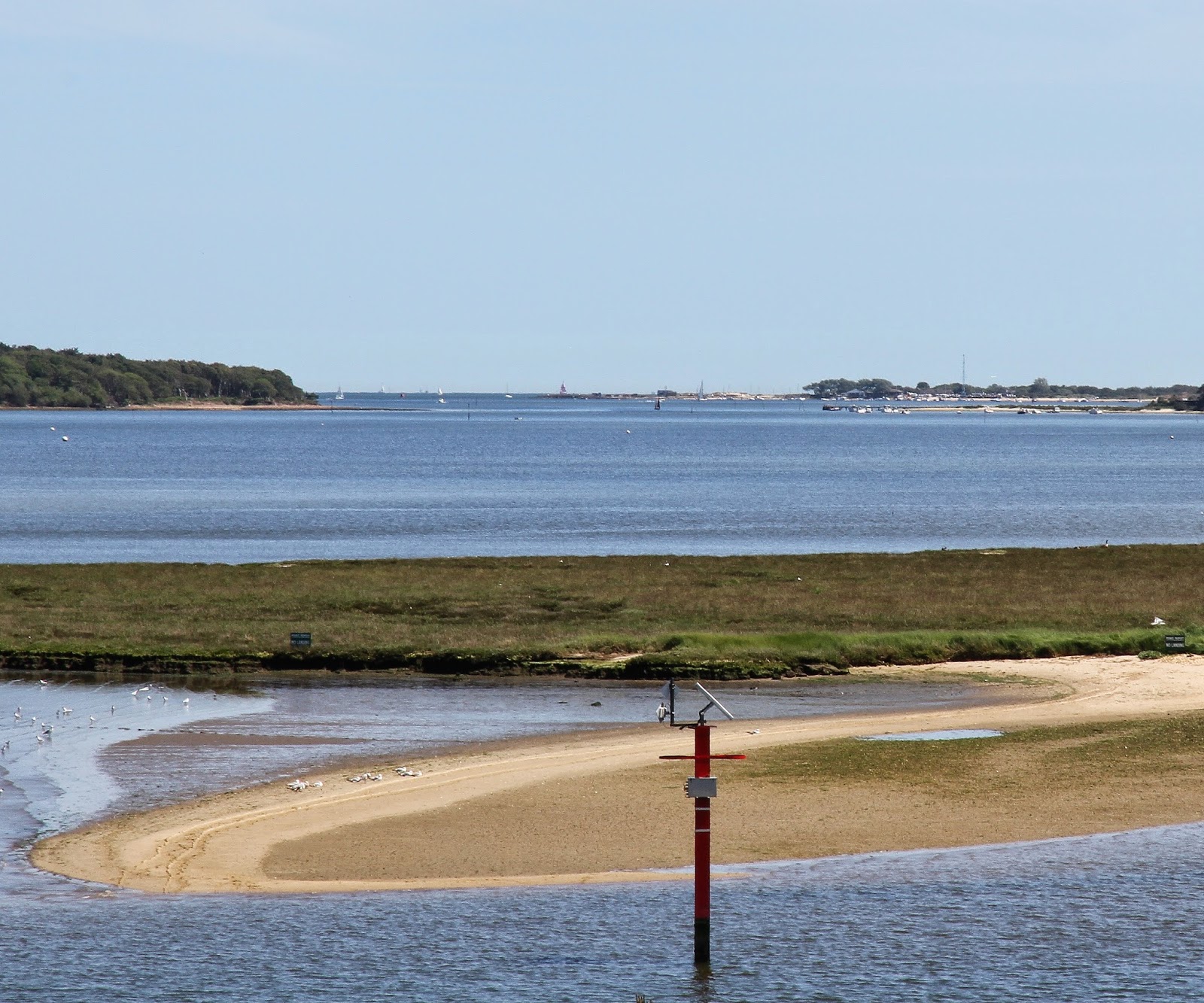
Looking towards the Harbour mouth
Looking a little further left is Brownsea
Poole town quay is just across the water
Looking up the Wytch (left) & Middlebere (right) channels