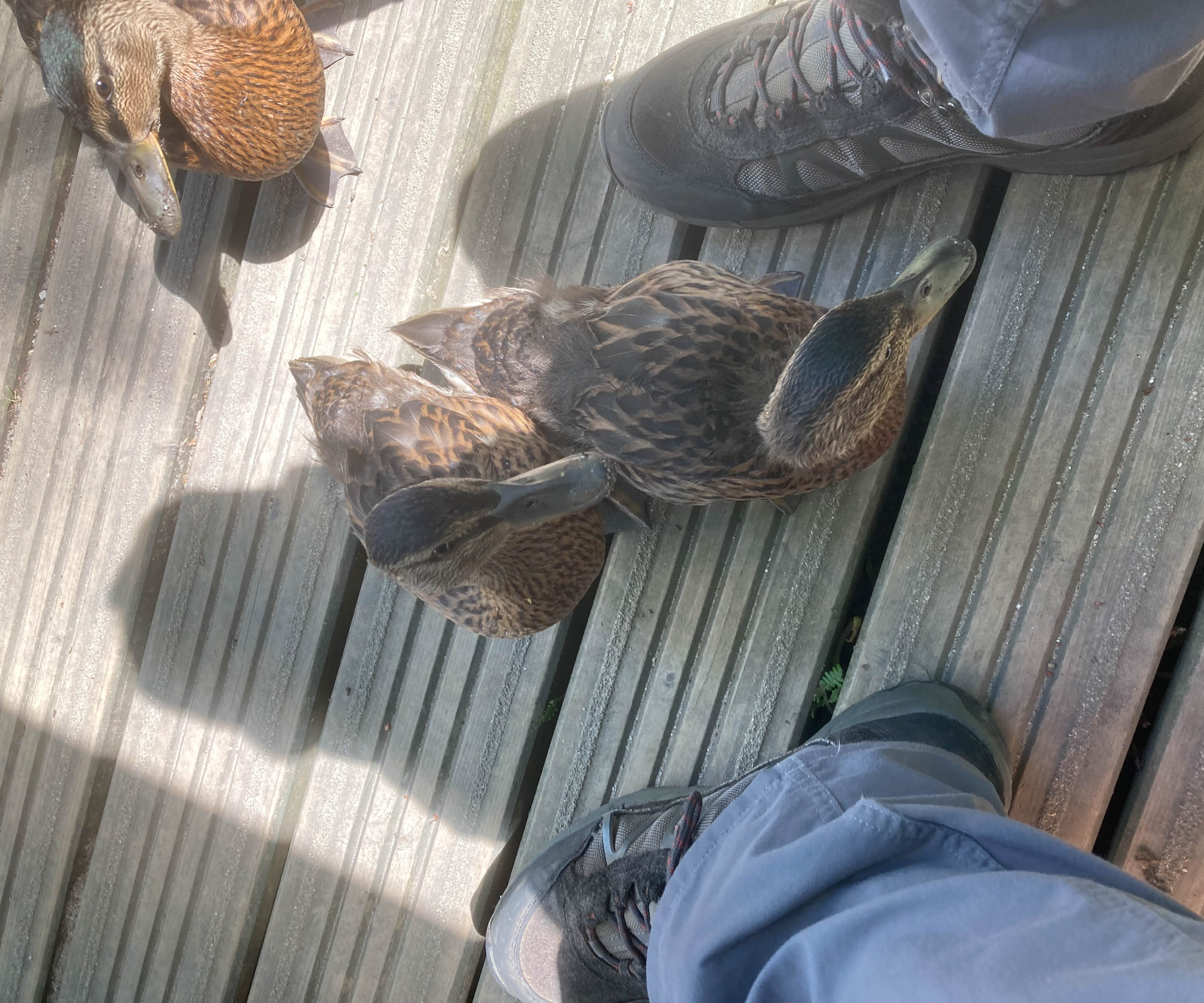
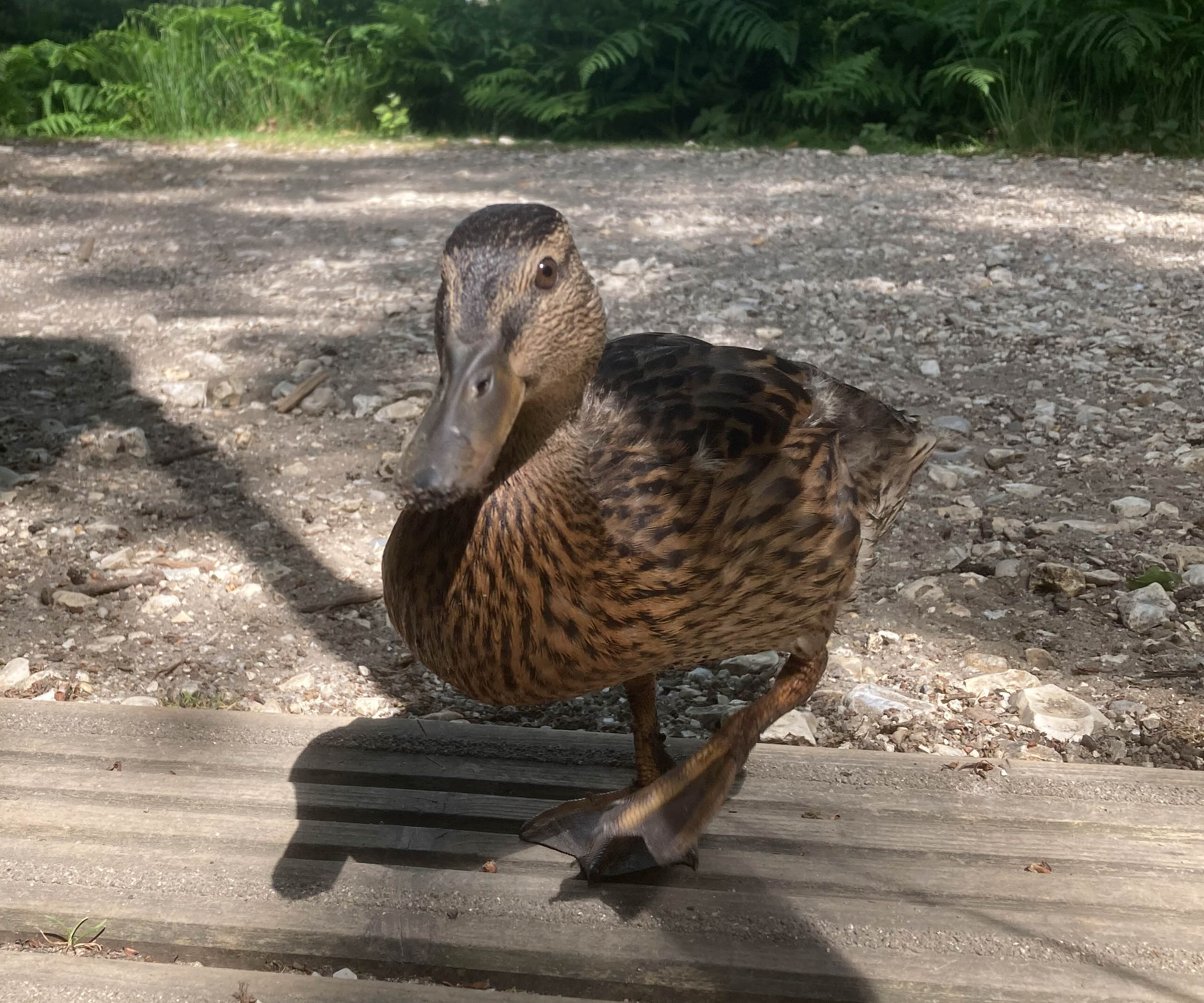
On of the great things about Spring is seeing the next generation of Birds. I had seen my first group of five Mallard ducklings with mum on Brownsea on 1 Apr, however, I didn't manage to get any photos. A week later, this female Mallard wandered along the main National Trust path next to the DWT gazebo. There were eighteen ducklings, albeit I only managed to fit the first fifteen into this photo. Hopefully, these will be the first of many chicks on the Brownsea reserve this year.
Showing posts with label Mallard. Show all posts
8 Apr 2026
2 Apr 2025
2 Apr 25 - Arnie The Tern
I can't remember anything of the film, other than the often-repeated phrase "I'm back" that Arnold Schwarzenegger used in one of his dull Terminator films from decades ago, when there were few TV options to watch in the evening.
On a much more interesting note, in Apr 23, a Forster's Tern was found at Lytchett Bay and it was only the second Dorset record, albeit it had turned up a couple of weeks earlier at Sutton Bingham reservoir. It stayed until mid-May and travelled widely around central and Northern Poole Harbour away, when it wasn't at its regular Brownsea haunt. It reappeared in Poole Harbour in mid-July. Just as we thought it would overwinter, it disappeared in mid-Nov and was seen soon after in North France. We weren't surprised when it reappeared the following Spring and Autumn. Several UK and Irish records have settled into long staying patterns, so nobody was suprised when it popped up again in late Mar 25 at Arne: one of its favourite locations. I didn't make any effort to chase it as I was expecting it to reappear on Brownsea. Sure enough, it was seen on the lagoon a couple of days later. I was expecting it to be there on my next volunteering day. I arrived into the new Lookout hide and scanned the Boomerang Island: Sandwich Tern, Sandwich Tern, Sandwich Tern, Forster's Tern. That was easy. It spent most of the day on the lagoon that day.
I spent the morning chatting to members of the public in the Lookout hide and it wasn't until the afternoon, that I managed to visit to the Avocet hide. It was good to see this close Redshank just in front of the hide. Every now and then a Wader will happily feed on the mud close to the hide.
After I was relieved from operating the vid-scope in the Avocet hide, it was time to head to the villa for a break. This Female Mallard must take the record for the greatest number of ducklings I've seen a Mallard with: nineteen is a pretty good clutch. I wonder how many will survive?
It had been a good day volunteering on the Brownsea lagoon.
Labels:
Forster's Tern
,
Mallard
,
Redshank
Location:
Brownsea, Poole Harbour, Dorset, UK
3 Aug 2024
3 Aug 24 - Old Brownsea Friends?
Back in Summer 22, we were visited most days when we standing at the Dorset Wildlife Trust gazebo at the entrance to the main track on the DWT reserve by a family of Mallards. Mum would bring the three half grown ducklings right up to our feet in the hope they would get fed. As the Summer wore on, they tended to spend most of their time on the adjacent National Trust track, where presumably they were better fed. Mum and the ducklings were fearless as this Blog Post showed. We did see the Mallards during the following Summer, however, understandably we weren't allowed on the island during the Avian Flu period from mid Jun to mid Aug 23.
Mallard: These Mallards are perfect models to introduce visitors to the reserve to the fun of taking mobile photos at a Mallard's eye level
There was a second female Mallard with a couple of younger ducklings.
Given the behaviour compared to Summer 22, then it feels likely that one or both of the adult females are individuals that visited us back in Summer 22.
Hopefully, we will see these Mallards regularly next Summer.
Labels:
Mallard
23 Nov 2023
23 Nov 23 - A Bonus Tick On A DWT Brownsea Members Day
Brownsea Island closes for the winter at the end of October school holiday. This allows the National Trust & Dorset Wildlife Trust to get on with essential maintenance work on the island. However, there are a few days when the island is open for visitors e.g. the DWT Members Days. As a volunteer, I get the chance to visit on some of these days to show the members the Birds on the lagoon and to get involved with general public engagement. It's also an excuse to have a look at the lagoon over the winter. There was a reasonable selection of Waders on the lagoon to show to the members. But as the tides were heading to neap tides, many Waders were roosting closer to their preferred feeding grounds, rather than on the lagoon.
I spent most of the day in the Avocet hide talking to members and showing them the Spoonbills, Waders & Ducks on the lagoon and telling them how to identify them and various other snippets of information. Finally, in mid-afternoon we had a change over with volunteers in the hides and I decided to have a wander around other parts of the DWT reserve. There was time for a quick visit to the Lake hide, which confirmed there was nothing on the lakes, other than a couple of Mallards & a couple of Canada Geese. Then I spotted this Western Conifer Seed Bug on one of the windows. It's a species I've seen photos of on a number of occasions from the Weymouth area, but it was a Tick for me.
Western Conifer Seed Bug: This is an introduced Bug from North America that occurs to the West of the Rocky Mountains from California to British Columbia and as far East as Idaho & Nevada. In recent times, it has expanded its range to Eastern North America and it has been introduced to the UK, parts Europe, Chile & Argentina through imported timber products
I walked off the reserve with one of the other volunteers & as we had a few minutes to spare, we decided to walk up to look for some more Red Squirrels by the church. In normally don't walk up to this area, as it's usually very disturbed by visitors in the summer. But it was quiet today as the members were heading to the quay for their boat. As expected, there were several Red Squirrels in the area. But as we heading off the reserve to find the gentle path to the area, we saw this female Mallard right next to the path & typical for Mallards in this area, she was very tame & approachable.
It soon became clear, why she was particularly approachable as she wasn't on her own. She had three youngsters in tow & this was late Nov and not early June. I hope there is a mild winter which will increase their chances of survival.
The members had a four hour trip onto Brownsea & there has been a lot of positive feedback to the DWT team from the members. It had been a good day.
Labels:
Mallard
,
Western Conifer Seed Bug
Location:
Brownsea, Poole Harbour, Dorset, UK
6 Jul 2022
6 Jul 22 - Young Brownsea Friends
Wednesday is my regular volunteering day on the DWT Brownsea reserve. One of the key activities for the volunteers is to man the entrance desk to the reserve, where the volunteers get to meet & greet the visitors.
Over the last three weeks, there has been a female Mallard in this area where the DWT reserve meets the National Trust part of the island. This female has been mum to four ducklings which have grown in size, confidence & now character. Today, it looks like something has happened to one of the four ducklings, but the other three have been doing well. When they came into view this afternoon, the three ducklings were chasing after some of the visitors with mum following on behind along the main NT track. They then came to see us on the entrance desk.
It was time to get the mobile out & get some photos from ground level. I don't often get to photograph Birds from this angle, but I always enjoy the results when I get the chance.
Birds don't always have to be rare, to be fun to see.
7 Apr 2020
7 Apr 20 - Three More Lockdown Birds #BWKM0
Looking out of the study window on the previous day while I was on work calls hadn't produced much out of the ordinary. I was expecting a similar day for the calls on the Tuesday, but it was a lot more varied. Firstly, one of the local Kestrels & a couple of the local Sparrowhawks were flying around quite a bit, along with several Buzzards. I had a couple of passes over the house from a Peregrine, which was great as they can be very erratic visitors. But things picked up when a Mallard flew over, with a second sighting later in the afternoon.
Check tomorrow to see the next day's wildlife sighting at when I will be confined at #BWKM0.
Mallard: This is an erratic species which I see once or twice most Springs of individuals that are presumably trying to find places to nest. Santa Cruz Island, California (21 Nov 14)
Not long after the second Mallard sighting, I saw my first Swallow flying North in a hurry. It had probably only arrived a few minutes earlier & wasn't hanging around. Quite a few locals have reported seeing Swallows in the previous week, but they are lucky enough to be within walking range of one of the wetland parts of Poole Harbour: which are more likely to attract one of the earlier arrivals.
Swallow: Middlebere (21 May 14)
It was a clear, still evening & about 22:00 I popped out into the garden for a couple of minutes. My plan came up trumps within thirty seconds: my third Garden Year (48) & Lockdown (44) Tick on the list: a calling Tawny Owl.
Owl statue: It wouldn't have looked much like this, but I've not managed to get any Tawny Owl photos yet
Check tomorrow to see the next day's wildlife sighting at when I will be confined at #BWKM0.
Location:
Swanage, Dorset, UK
5 Apr 2015
5 Apr 2015 - History Repeats Itself (Finally)
35 years ago, in late March 1981, I spent a weekend twitching in the Penzance & Hayle area of Cornwall looking for my first Bonaparte's Gull. After an unsuccessful first day, we finally caught up with it on the Sunday morning, after Keith Vinicombe located it a long way out on the Hayle estuary mud. Two weeks later, we were planning the next weekend of Birding. There were no major ticks to take our fancy, so a weekend of camping at Portland Bill was the plan. It should have had migrants, but my notebooks said it was a quiet weekend. But we did see the Bonaparte's Gull again. It would have been a Dorset Tick, but living in Southampton, Hampshire in those days, meant I wasn't interested in a Dorset List. It was the highlight of the weekend & gave great views down to 10 metres at Radipole on 4 Apr 1981. We didn't see it on the following day, but it was still in the Weymouth area as we saw it a couple of weeks later.
Herring Gull: Just getting the camera set up for photographing Gulls
Moving forward to this year on 7 Mar, a Bonaparte's Gull was found at Ferrybridge before moving to Portland Harbour. I didn't make the effort to go down to look for it, which was clearly a good plan as it was very elusive in these early days. Peter Moore ended up having to make three attempts to photograph it, although he did see it, on the first occasion. After a couple of weeks of no sightings, it looked like it had quickly moved through. Then it reappeared at Radipole & quickly settled down into a pattern of showing from mid-morning to mid-afternoon. I planned to visit on 4 Apr, which would have been exactly 35 years on from my first Dorset sighting. But following the brief appearance of a singing Serin at Corfe Castle, I ended up spending several hours unsuccessfully trying to relocate that individual. So one day later, I was down at Radipole looking. As soon as I started arrived at the tennis courts, I could see it feeding off the Buddilea loop trail. Heading to the end of the Buddilea loop trail, got me close at times, but frustratingly it often moved to the tennis courts end to feed. Eventually, I ended up back there again. So 35 years & a day after my first & only Dorset Bonaparte's Gull at Radipole, I was back there again to see my next. Maybe if there is another Bonaparte's in another 35 years & a day, I won't have to lug a heavy 400mm lens & Canon 7D around, as the technology will have moved on so I can produce as good an image from a camera in my glasses or watch. Having said that I probably won't be around in 2050 to find out!
Bonaparte's Gull: 1st Summer. This is only the sixth Dorset record with 3 one day records: Durlston (Mar 1970); Portland (Mar 1990) & Weymouth (Apr 2006). The 1981 Weymouth individual stayed from 2 Apr to 8 June. The other record was a four day individual at Stanpit (Apr 1975)
Bonaparte's Gull: 1st Summer. A really striking upperwing clean-cut pattern
Bonaparte's Gull: 1st Summer. They are a small Gull, but this Herring Gull was the only Gull it sat next to for a size comparison
Bonaparte's Gull: 1st Summer. It gets the name from Charles Lucien Bonaparte (a nephew of Napoleon Bonaparte) who was a member of the Academy of Natural Sciences in Philidephia in the 1820s & worked as a zoologist on American ornithology
Bonaparte's Gull: 1st Summer. The extent of the translucency in the wing is striking
Bonaparte's Gull: 1st Summer. Note, the fine black bill
Bonaparte's Gull: 1st Summer. It spent a long time catching small flying insects above the water
Bonaparte's Gull: 1st Summer
Bonaparte's Gull: 1st Summer. Note, the small flying insect below its legs
Bonaparte's Gull: 1st Summer. A really striking upperwing clean-cut pattern
Bonaparte's Gull: 1st Summer. They are a small Gull, but this Herring Gull was the only Gull it sat next to for a size comparison
Bonaparte's Gull: 1st Summer. It gets the name from Charles Lucien Bonaparte (a nephew of Napoleon Bonaparte) who was a member of the Academy of Natural Sciences in Philidephia in the 1820s & worked as a zoologist on American ornithology
Bonaparte's Gull: 1st Summer. The extent of the translucency in the wing is striking
Bonaparte's Gull: 1st Summer. Note, the fine black bill
Bonaparte's Gull: 1st Summer. It spent a long time catching small flying insects above the water
Bonaparte's Gull: 1st Summer
Bonaparte's Gull: 1st Summer. Note, the small flying insect below its legs
Every now & then, it would disappear to feed for five to ten minutes on the tennis courts end. This gave me a chance to photograph a few of the other local species. While not being particularly unusual species, Radipole, is a good place to get close views & photographs of these species.
Mallard: Male. Some individuals just would not keep a reasonable distance to allow me to photograph the whole body
Labels:
Bonaparte's Gull
,
Coot
,
Gadwall
,
Herring Gull
,
Mallard
,
Teal
Location:
Radipole, Weymouth, Dorset UK
21 Nov 2014
21 Nov 14 - Off To The Other Channel Islands
Today I was off to the Prisoners Harbour landing on Santa Cruz Island on a day trip. The boat left Ventura harbour at a civilised 09:00 & returned at 14:45. It was around a ninety minute crossing, plus an extra few minutes to drop the majority of the passengers at Scorpion Anchorage on the island. I was down at the quayside early to get a good breakfast before heading off, as it would be late afternoon before I was back on land. Getting a filling breakfast is rarely hard to find in the US. There were a few Birds in Ventura Harbour, before we set off.
Black-necked Grebe: This is the californicus subspecies
Double-crested Cormorant
Western Gull: Adult
Great-tailed Grackle
Finally, we were all aboard the boat & ready to head out. The first few minutes were nice & calm as we were within the harbour. But as soon as we headed out into the open water, it became pretty choppy. There were a number of the passengers who were not enjoying the motion, but after two weeks on the Braveheart, I was able to cope.
Brown Pelican on the outer harbour wall
Californian Sealion: Female. One of the features is the flat head, gently sloping forehead & blunt nose
The Channel Islands lie about twenty miles offshore & are part of the Channel Isles National Park
Map of the Channel Islands National Park
There are a lot of oil platforms off this part of the Californian coast
Cassin's Auklet: There were several hundred on the two crossings, but they were difficult to photograph given the bumpy crossing & they tended to fly well before the boat was close to them
Cassin's Auklet
Santa Cruz Island is a dry & arid island
Map of the Channel Islands National Park
There are a lot of oil platforms off this part of the Californian coast
Cassin's Auklet: There were several hundred on the two crossings, but they were difficult to photograph given the bumpy crossing & they tended to fly well before the boat was close to them
Cassin's Auklet
Santa Cruz Island is a dry & arid island
Scorpion Anchorage on Santa Cruz Island: We dropped nearly all the passengers here. There were only three postgrad students & myself carrying onto Prisoners Harbour
Santa Cruz Island: The island is dry & looks to be sedimentary in origin
The Captain's map of Santa Cruz Island: Scorpion Anchorage is the top right red marker & Prisoners Harbour is shown by the red boat on the map
Brandt's Cormorant: With one or two Double-crested Cormorants enjoying this well-used rock just offshore of Santa Cruz Island
Mallard: Male. One of several species of Ducks around Santa Cruz Island
Eider: Female. This is the v-nigrum subspecies
Surf Scoter
I had around three & a half hours to explore the valley & hillside paths behind the quay.
Labels:
Black-necked Grebe
,
Brandt's Cormorant
,
Brown Pelican
,
Californian Sealion
,
Cassin's Auklet
,
Double-crested Cormorant
,
Eider
,
Great-tailed Grackle
,
Mallard
,
Surf Scoter
,
Western Gull
Location:
Santa Cruz Island, California, US
Subscribe to:
Posts
(
Atom
)