Happy Birthday to the Blog - 1 year old today & the 225th Blog Post. It's been an amazing year with a great selection of Birds seen, both in the UK, but also on the trips abroad. I have also seen & photographed an amazing amount of other wildlife over the last year. Too many great species to cram into a single post, so I will focus on 13 of my favourite stories or photos, one from each of the last 13 full or partial calendar months to hopefully wet your appetite to go back & explore some of the posts. It is traditional for many bloggers to do a round up of the year. I'm going to do that on the Blog's anniversary instead.

 Nov 13 - Hawk Owl: A great Owl & a World Tick. Zwolle, Holland (27 Nov 13)
December saw me heading off to the Andamans & mainland India for a 7 week trip, the first 3 weeks of which were with old mate, Brian Field. Choosing the best Birds for the 400+ species seen (about 75% photographed) is very difficult, so I am going for this Andaman Flowerpecker. A small, subtle endemic species. Anybody who have travelled in SE Asia will be used to Flowerpeckers being small, active Birds high up in the rainforest canopy & rarely giving good views. So it was great to see this Andaman Flowerpecker only a few metres away for an extended period. Initially, I had to step back as it was closer than the 3.5 metre minimum focus on the 400mm lens.
Nov 13 - Hawk Owl: A great Owl & a World Tick. Zwolle, Holland (27 Nov 13)
December saw me heading off to the Andamans & mainland India for a 7 week trip, the first 3 weeks of which were with old mate, Brian Field. Choosing the best Birds for the 400+ species seen (about 75% photographed) is very difficult, so I am going for this Andaman Flowerpecker. A small, subtle endemic species. Anybody who have travelled in SE Asia will be used to Flowerpeckers being small, active Birds high up in the rainforest canopy & rarely giving good views. So it was great to see this Andaman Flowerpecker only a few metres away for an extended period. Initially, I had to step back as it was closer than the 3.5 metre minimum focus on the 400mm lens.
 Dec 13 - Andaman Flowerpecker: Ghandi Park, Port Blair (22 Dec 13)
The Indian trip carried on to the end of January & I travelled through the Western Ghats, Gujarat & Rajasthan before finishing in Delhi. India is a great country for wildlife, although there are often long, slow journeys to the good sites. The other good thing is there are plenty of great mammals to see out there. It would be well worth looking at the Indian posts for anybody thinking on visiting any of these parts of India.
Dec 13 - Andaman Flowerpecker: Ghandi Park, Port Blair (22 Dec 13)
The Indian trip carried on to the end of January & I travelled through the Western Ghats, Gujarat & Rajasthan before finishing in Delhi. India is a great country for wildlife, although there are often long, slow journeys to the good sites. The other good thing is there are plenty of great mammals to see out there. It would be well worth looking at the Indian posts for anybody thinking on visiting any of these parts of India.
 Jan 14 - Wild Ass: This was my favourite mammal of the year & it's a real shame as these 4 Wild Asses had walked for a mile or two across the bare dried up lake bed for a mile or two & then crossed a 1/4 mile salt bed, only to find Bill, myself, the guide & the jeep parked up by the only vegetation for miles. After sniffing the air for a few minutes, they turned & headed back to where they had just come from. Desert Coursers, Gujarat, India (17 Jan 14)
 Feb 14 - Sudan Golden Sparrow: An excellent bonus Western Palearctic & World Tick. Oued Jenna (11 Feb 14)
 Mar 14 - Chinese Pond Heron: Dropping down to a concealed garden pond after its last prolonged view (8 Mar 14)


 Jun 14 - Brilliant Emerald: This Brilliant Emerald was one of five Dragonfly Ticks for me this year & I was really pleased to get this flight shot, especially as it captured the yellow U shape on the face, which separates it from the more widespread Downy Emerald. Esher Common (13 Jun 14)
Another piece of fun with the camera has been the ability to compare photos to pick out different individual Butterflies. I assume this must have been tried before for Butterflies, I know it has been tried for Birds. So it was interesting to try this out on the Swallowtails at St Aldhelms Head. These were found at the end of June 14, by walkers on the coastal footpath close to the Coastguards lookout at St Aldhelms Head. One was pointed out to local Dorset Birder, George Green, along with the news the finders had seen two earlier that day. I finally connected with one on 2 July and made a couple of extra return trips to photograph them. The result was from looking at the photos I had taken & photos kindly forwarded from other photographers, I was able to show there were five different Swallowtails involved. Since that time, I've shown the photos to Neil Hulme, who confirmed that all five Swallowtails were males. Therefore, it begs the question as to whether any females hatched out. If so, they are likely to have quickly mated & presumably dispersed. I did return at the end of August to see if I could find any second brood Swallowtails, but I had no joy. There is the risk of collectors having been there looking for caterpillars to collect, but then it's also possible that if a female hatched out, She might have mated & dispersed to start a new colony. So something to look out for elsewhere in Dorset in 2015.
Jun 14 - Brilliant Emerald: This Brilliant Emerald was one of five Dragonfly Ticks for me this year & I was really pleased to get this flight shot, especially as it captured the yellow U shape on the face, which separates it from the more widespread Downy Emerald. Esher Common (13 Jun 14)
Another piece of fun with the camera has been the ability to compare photos to pick out different individual Butterflies. I assume this must have been tried before for Butterflies, I know it has been tried for Birds. So it was interesting to try this out on the Swallowtails at St Aldhelms Head. These were found at the end of June 14, by walkers on the coastal footpath close to the Coastguards lookout at St Aldhelms Head. One was pointed out to local Dorset Birder, George Green, along with the news the finders had seen two earlier that day. I finally connected with one on 2 July and made a couple of extra return trips to photograph them. The result was from looking at the photos I had taken & photos kindly forwarded from other photographers, I was able to show there were five different Swallowtails involved. Since that time, I've shown the photos to Neil Hulme, who confirmed that all five Swallowtails were males. Therefore, it begs the question as to whether any females hatched out. If so, they are likely to have quickly mated & presumably dispersed. I did return at the end of August to see if I could find any second brood Swallowtails, but I had no joy. There is the risk of collectors having been there looking for caterpillars to collect, but then it's also possible that if a female hatched out, She might have mated & dispersed to start a new colony. So something to look out for elsewhere in Dorset in 2015.


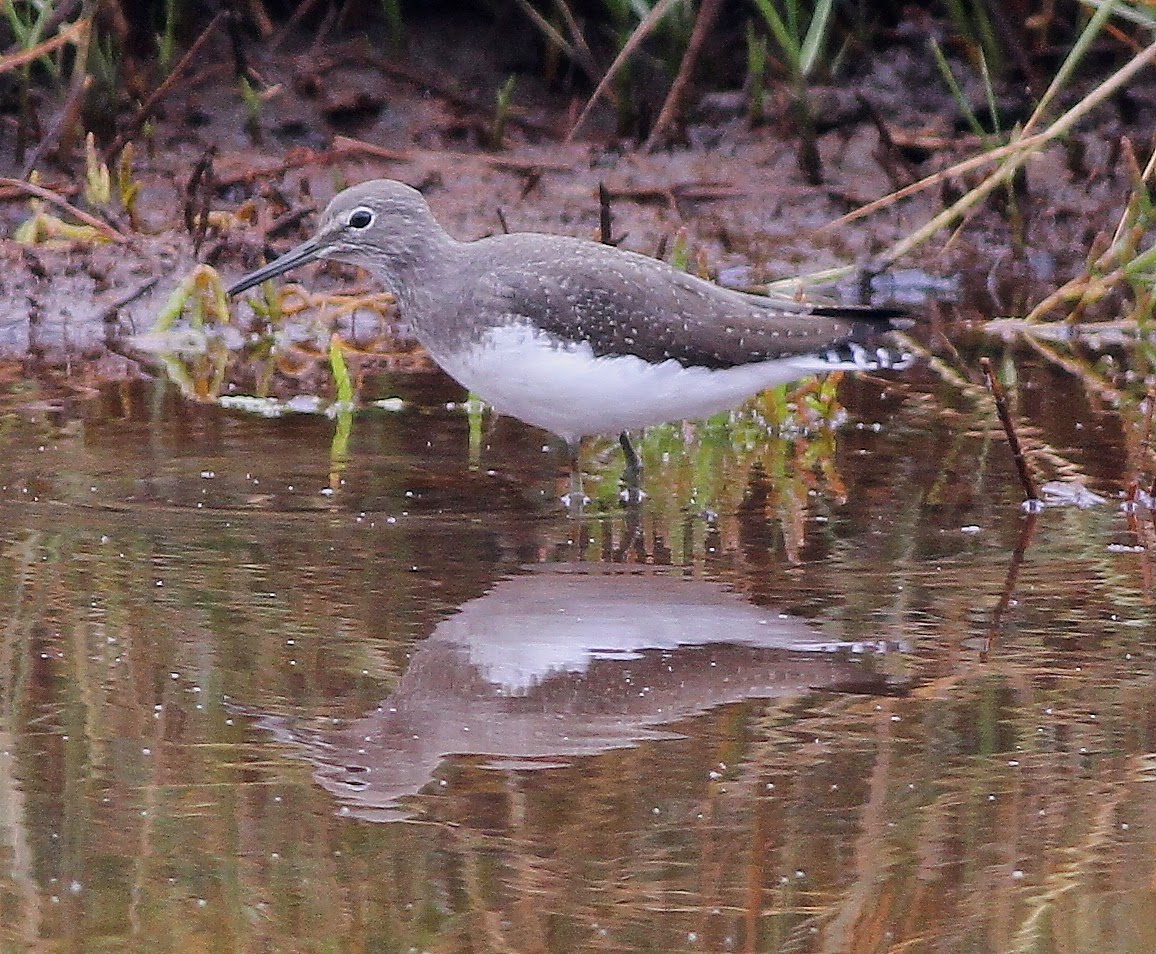
 Sep 14 - Adult Green Sandpiper: A fairly common Wader in Poole Harbour, but great to look at a Green Sandpiper closely to age it as a 1st Winter. Even better, when I returned the next week & found this Adult Green Sandpiper for comparison. Middlebere (26 Sep 14)
Back to the subject of using the camera for helping to identify tricky species. The choice for Oct 14 was difficult as there were 2 very interesting Sylvia Warblers seen and photographed. First was the putative Blyth's Lesser Whitethroat at Portland Bill & this was followed mid month by the putative Moltoni's Subalpine Warbler at Porthgwarra, Cornwall. Fortunately, the first Bird was caught and DNA has been send off. The Moltoni's was only seen in the field, but reaction to playback & its partial moult are good supporting evidence, to go along with the more subtle plumage details. Whether that will be sufficient to get it accepted, given the only call that was heard is given by both Moltoni's and Western Subalpine Warblers and the other distinctive call of Moltoni's was not heard, is probably a decision we will be waiting for over the next few years.
Sep 14 - Adult Green Sandpiper: A fairly common Wader in Poole Harbour, but great to look at a Green Sandpiper closely to age it as a 1st Winter. Even better, when I returned the next week & found this Adult Green Sandpiper for comparison. Middlebere (26 Sep 14)
Back to the subject of using the camera for helping to identify tricky species. The choice for Oct 14 was difficult as there were 2 very interesting Sylvia Warblers seen and photographed. First was the putative Blyth's Lesser Whitethroat at Portland Bill & this was followed mid month by the putative Moltoni's Subalpine Warbler at Porthgwarra, Cornwall. Fortunately, the first Bird was caught and DNA has been send off. The Moltoni's was only seen in the field, but reaction to playback & its partial moult are good supporting evidence, to go along with the more subtle plumage details. Whether that will be sufficient to get it accepted, given the only call that was heard is given by both Moltoni's and Western Subalpine Warblers and the other distinctive call of Moltoni's was not heard, is probably a decision we will be waiting for over the next few years.

Oct 13 - Cape May Warbler: The highlight of October was the day twitch to Unst for the Cape May Warbler, just for the whole craic of the day, as well as seeing such a massive UK rarity. I wasn't that impressed when I saw the first photos of the Cape May when it first turned up, but it was a more subtle & great looking Warbler than I was expecting. Unst, Shetlands (29 Oct 13)
November's Bird has to be the stunning Hawk Owl in Zwolle, Hollard. This was an opportunity for me take the car over to Europe for the first time & it was a great 2 day trip with a good mate, Dave Gibbs. The Hawk Owl was amazing as it sat completely unfazed only 30 metres away from the assembled crowd of admirers.
Within a week of being back from India I was off again to the Western Sahara & Southern Morocco for 10 days. This was a great trip to an infrequently visited part of the Western Palearctic. Not a huge number of Birds & Mammals, but some good species seen in this interesting area. It was interesting, but worrying, to talk to Trevor Charlton, the finder of the putative Moltoni's Subalpine Warbler recently, about one of the main Birding areas, Oued Jenna. This is the Cricket Warbler site and conventional information is, this area wasn't mined in the recent civil war. From what Trevor was told, it may well have been mined & cleared and mine clearance isn't 100% certain. This was an area we visited twice as we had to return after hearing about two Sudan Golden Sparrows which weren't on our expected list: we found them along with an additional two.
I didn't managed to get out much in March as I was spending most of my time wading through the thousands of photos from the Indian & Western Saharan trips. But my interest picked up following the news that a Pond Heron at Hythe, Kent had been confirmed as being a Chinese Pond Heron. I teamed up with local Birder, Marcus Lawson, who has only recently moved from Kent for the trip. Our timing was perfect as it was located when we were about 10 minutes away, but flew just before we arrived. Fortunately, Dave Gibbs saved the day with a phone call to say it had been relocated, allowing views sitting in a garden tree before it dropped out of sight. We later found out we were even more lucky when it transpired this was the last time it was seen well. A brief flight view that evening was its last sighting. Sadly, its long dead corpse was found a few weeks later, allowing confirmation of its identify by DNA. The next question is will the BOU allow this onto the UK List? Having seen the target Bird, we went onto Dungeness & saw Great White Egret, Glossy Ibis, Glaucous Gull, Hume's Yellow-browed Warbler & a number of good, but commoner, species. A great day out to one of my old pre-university stomping grounds.
There is no problem trying to work out the best bird for April. It clearly goes to this obliging Scops Owl seen during the 10 day Spring Israel trip. Owls & Nightjars have long been a favourite group of families for me. I have spent many happy evenings abroad out looking for them & trying to sound record them. In this case, I didn't even need to worry about using a recording, as there were a number of different males all winding each other up throughout the evening. So all I had to do for the 2 nights I stayed at the Kfar Ruppin kibbutz was to try & get some good photographs. This particular bird sat a few metres from the camera & wasn't unset by my presence or the flash as it continued to call.
Apr 14 - Scops Owl: Kfar Ruppin, Israel (13 Apr 14)
May was a difficult month to work out the best story, given the successful trip to look for Rock Partridge in Croatia: which we saw by 06:00 on the first morning of the trip. However, the story has to go to the end of May Bird. The camera has also been invaluable for getting a documentary record of many of the species seen. Like many of the other local
Birders, I tend to cover my patches on my own, so it's good to have the
ability to get some record shots to support a description, in case the Bird disappears before others arrive. This was one of the reasons why I bought the camera, having seen how other Birders have documented rarities they have found on the Northern Isles. Additionally, there is
always that risk that having found something good, you fail to note one
of the key details needed to clinch the record. The camera proven its worth when I heard a Yellow Wagtail calling behind me at Old Harry at the end of May. Turning round, I was surprised to find it wasn't a Yellow Wagtail & it had a grey head. I grabbed some photos as a record shot, so I could work it out later. Later didn't happen in the end until late that evening as within 5 minutes I was hearing the news of a probably Short-toed Eagle at the nearby Morden Bog. The rest of that story is well known. This really upstaged my Grey-headed Wagtail, which if accepted, will be a 7th for Dorset & 1st for Poole Harbour.
May 14 - Grey-headed Wagtail: Female. Getting good photos were essential to help confirm the identification of this rare race in Dorset. Old Harry (31 May 14)
It has also been a good opportunity to look closely at Dragonflies & Damselflies this year. Dragonflies are a group, I've been getting into in recent
years, but having the camera has certainly made it a lot easier to
figure out the different species. Having a camera is a great way to see those small subtle
details that separate some of the similar species.
Jul 14 - Swallowtail: Individual D. The full set of mugshots & how I was able to separate the different individuals can be found in the Swallowtail mug shots post. St Aldhelms Head (6 July 14)
August 14 is clearly an easy decision as to the species for the month, but trying to work out the best photo was more difficult. It has to go to the Map Butterflies which dominated the month. This was a totally unexpected find and for a couple of weeks it was looking like not only had I found a very rare Butterfly, but also there was a fledgling colony with 20 proven individuals photographed. As a result, news had to be shutdown down on the site to try & provide some protection for the colony, whilst starting to work with the local landowners & Butterfly Conservation to see what could be provided for longer term protection. Sadly, the news did get out & the site was visited by both a commercial & a private collector. It was a really frustrating & unexpected bombshell to then find that somebody had come forward via a reliable conservation body, to admit to a release at the site. This individual's story that it was an accidental release, is blatantly a lie. But it's more than likely a cover story to try to avoid potential prosecution, given it is illegal to deliberately release an alien species in the UK. We have never got the real story of how the release occurred & it is unlikely this will ever happen. But it is a really shame as it would have been my best UK find ever had it been untainted. I still need to return to this story at some time with the evidence as to why it had to be a deliberate release and not an accidental release. In the mean time, you can enjoy the story as it develops about the initial discovery of a Map, the realisation there was a Map colony present & the news of the release in the 3 posts.
Aug 14 - Map: Individual B. This was the second individual found at the site & the first female. Therefore, it was the individual which changed the story from a lone male to multiple individuals. Swanage (7 Aug 14)
The last year has also been a lot of fun looking at the Birds seen from another & more detailed angle. Up to
when I bought the camera, I tended to look at something until I had
identified it. Sometimes I would then carry on watching the Bird, but
often my eyes would start wandering to look for something else. With the
camera, I have found that while I might even pick up the camera &
stop watching my subject quicker than I would have done without the
camera, I am spending a lot more time looking closer at the subsequent
photos. Consequently, I am noticing a lot more than I would have probably seen in the
field e.g. the ability to freeze a wing & then look at the
individual feather markings is rarely possible in the field on a moving
subject, but with a good photo it is often possible. This has lead to me becoming far more interested in trying to age or sex some of the Birds
I've seen & in turn, this has helped broaden my knowledge. I am now using this new knowledge to start looking at ageing & sexing of Birds in the field.
Oct 14 - Putative Blyth's Lesser Whitethroat: Portland Bill (1 Oct 14)
Hopefully the coming year will be as exciting as this first year has been. One final thing that has also been exciting is how much I've enjoyed the blogging & how popular the blog has been been. Yesterday, the blog passed 51,000 hits. I had no idea when I started how much interest there would have been in the blog, but I certainly wouldn't have predicted it to be that popular. What has also been exciting is how well viewed the blog is, as since I added the flag counter in May (which counts internet countries so Jersey, Guernsey & the Isle of Man were bonus countries), the blog had been read from 96 different countries, with the 96th, Seychelles, being added today. I wonder which will be the 100th country. Anyway, I hope you have enjoyed the blog as much as I have & you continue to follow it. In the meantime, there are links back to each of the stories behind the monthly photo to look in more detail at those that interest you.