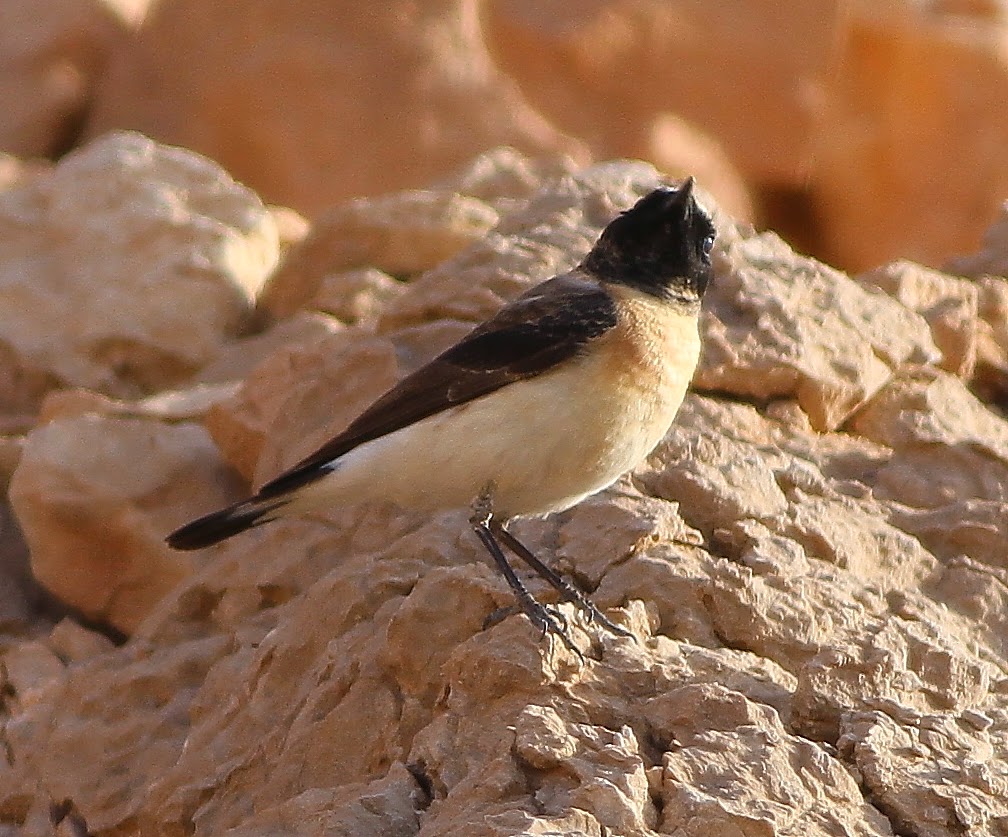
Showing posts with label Isabelline Wheatear. Show all posts

30 Jun 2015

30 Jun 15 - Turkey - A Dry Country Turkish Valley

The previous two Blog Posts covered the our visit to the excellent Kayseri Sultan Sazligi Wetlands. We had one final stop that afternoon in a nearby dry country valley.
A scenery view of the upper part of the valley
These Sheep were well worth avoiding: These flocks are generally guarded by large aggressive guard dogs which defend the flocks from Wolves. Keeping well away from them is always a wise precaution
It's a wise decision to back off when the Turkish guard dogs spot you: The collars are to protect the dogs from Wolves. This photo was taken at Demirkazik (1 Jul 15)
The local shepherd
The others have clearly found something: There are no new species for me in this area, so I was happy to be more laid back and look for my own Birds and do a bit of photography
Another scenery shot
There was a nice selection of dry country species in the valley.
Lesser Grey Shrike: This monotypic species occurs from the Iberian Peninsula to Siberia & central Asia. They winter as far South as Southern Africa
Upcher's Warbler: This monotypic species occurs from Turkey to Israel & East to South Kazakhstan, Kyrgyzstan, Tajikistan, Afghanistan & Pakistan. They winter in North East Africa & South Arabia
Isabelline Wheatear: This monotypic species occurs in South-central Eurasia. They winter in North East Africa, Arabia & India
Bimaculated Lark: This monotypic species occurs from West-central Turkey to South Kazakhstan, Kyrgyzstan, North East Iran & North Afghanistan, as well as, Lebanon, North Israel, West Syria & North Iraq. They winter in North East Africa & India
Bimaculated Lark
Bimaculated Lark: Doing a bit of song-flighting
After a bit of searching, we located a family of White-throated Robins.
White-throated Robin: Worn Male
White-throated Robin: Female
White-throated Robin: Juvenile
White-throated Robin: Another Female
White-throated Robin: This monotypic species occurs from Turkey to Iraq, Iran & South Turkestan. They winter in East Africa
Taurus Souslik: This lovely species is endemic to the Taurus Mountains
Taurus Souslik
Taurus Souslik
Taurus Souslik
We left late afternoon and arrived in Demirkazik in time for an early evening meal. The plan was to get to an early night, as we had a pre-dawn start for the following morning.

25 Jul 2014

25 July 14 - Photospot6 - Palearctic Wheatears

I wonder how many Birders living in the Western Palearctic don't have a soft spot for the Wheatear group. Living in Dorset, we only really see Wheatears as migrants with the very occasional bird hanging onto into the Summer suggesting they might occasionally breed. But I like seeing them as it means that when I see them, there will also be other migrants on the move. Also all the Wheatear species are great characters. The only regular species we get in the UK is the Wheatear (I don't do the trendy name of Northern Wheatear), with another 5 species having appeared once or more as vagrants. They are White-crowned Black Wheatear, Pied Wheatear, Black-eared Wheatear, Desert Wheatear & Isabelline Wheatear. Fortunately, I've managed to see them all over the years, including the only record of White-crowned Black Wheatear: which I suspect will remain high up on the wanted list of many twitchers who weren't twitching in the early 80s for many years to come.

I have been lucky this year to see a number of different Palearctic Wheatear species in Gujarat & Rajasthan parts of India, Morocco & the Western Sahara, Israel & Croatia. They have all appeared on this blog in various posts (or are new Croatian photos), but I thought I would bring them all together in one post, as I'm sure I won't be the only person who thinks the Wheatear group are great. So sit back & enjoy. The backgrounds are all bright & sunny, which goes with the current UK weather. Ironic as when I started writing this post it was bright & sunny and as I come back to put the finishing touches to it, I can hear the rumble of thunder.
White-crowned Black Wheatear: Adult. Eilat Mountains, Israel (10 April 14). This photo had the approval of the local Israel army checkpoint guys
White-crowned Black Wheatear: 1st Winter bird. Aoussard Road, Western Sahara (8 Feb 14). The black crown with a single white crown feather indicated this was an immature bird. The tail pattern was checked & found that the black was primarily on the black central tail feathers & did not have the strong T shape (that the Black Wheatears have)
Black Wheatear: Dakhla Bay, Western Sahara (11 Feb 14). The brown plumage & broad T shaped tail pattern, confirmed the identification
Wheatear: Aoussard Road, Western Sahara (12 Feb 14). A nice bright male showing off its tail pattern
Wheatear: Ne'ot Smadar, Israel (12 April 14). Female
Wheatear: California Farm, Swanage, Dorset (2 May 14). Guess I had better sneak in a shot from the UK
Eastern Pied Wheatear: Desert Coursers, Gujarat, India (15 Jan 14). Also known as Variable Wheatear as there are 3 distinct colour forms across its range. This is the picata form
Eastern Pied Wheatear: Desert Coursers, Gujarat, India (16 Jan 14). This is the picata form 
Eastern Pied Wheatear: CEDO, Gujarat, India (20 Jan 14). Male of the picata form transforming into adult plumage
Eastern Pied Wheatear: Tal Chappar, Rajasthan, India (25 Jan 14). This is the opistholeuca form & would normally winter in Northern Pakistan, rather than Gujarat
Red-rumped Wheatear: Male. Tan-Tan, Morocco (6 Feb 14). This is the moesta subspecies which occurs from Western Sahara to Egypt
Red-rumped Wheatear: Female. Tan-Tan, Morocco (6 Feb 14)
Black-eared Wheatear: Beit Yatir, Israel (8 April 14). Male. Eastern melanoleuca subspecies
Black-eared Wheatear: Male. Amran Pillars, Israel (10 April 14). Eastern melanoleuca subspecies
Black-eared Wheatear: Male. Velji Do, Croatia (5 May 14). Eastern melanoleuca subspecies
Black-eared Wheatear: Female. Velji Do, Croatia (5 May 14). Eastern melanoleuca subspecies
Persian Red-tailed Wheatear: CEDO, Gujarat, India (20 Jan 14). This is the Red-tailed chrysopygia subspecies. Note, the pale grey upperparts & slim, weak build for a Wheatear. This bird was wintering on a small Kopje (a small stony hill on the sandy plain)
Persian Red-tailed Wheatear: CEDO, Gujarat, India (20 Jan 14). It occurs from Transcaucasia to Afghanistan & winters in Pakistan & NW India. This is the Eastern of the two species (the Western xanthoprymna species being the one that occurs in Turkey and is now split as the monotypic Kurdish Wheatear
Desert Wheatear: Desert Coursers, Gujarat, India (16 Jan 14). This is the atrogularis subspecies (which is combined with the nominate deserti by some authors)
Desert Wheatear: CEDO, Gujarat, India (20 Jan 14). This is the atrogularis subspecies
Desert Wheatear: Aoussard Road, Western Sahara (8 Feb 14). This is the homochroa subspecies which occurs from Western Sahara to Egypt
Isabelline Wheatear: Tal Chappar, Rajasthan, India (24 Jan 14). Note, the upright stance & heavy bill
Isabelline Wheatear: Tal Chappar, Rajasthan, India (25 Jan 14). Note the black tail, uniform pale upperparts, black alula, and heavy bill & head
Unfortunately, there are a few gaps here. I did see a Hooded Wheatear, but right next to the Israeli-Egyptian border & an Isreali road checkpoint. The army guys on the checkpoint weren't worried about us being there, but were insistent no cameras were used along the border. They did check my camera earlier that day, but fortunately, they were happy with the White-crowned Black Wheatear (above) & didn't look further. As for the other gaps, hopefully I will get to fill some of those in the next few years & maybe give me the opportunity to republish this post.

25 Jan 2014

25 Jan 14 - More Birds At Tal Chappar

Rather than head straight to the Tal Chappar sanctuary, we spent the first couple of hours birding to the North of Chappar village. There are scattered groups of trees here which are home to the enigmatic Indian Spotted Creeper. I was luck enough to have seen one at Bharatpur in 91, but was keen to see another & it was still an Indian tick for Bill. Unfortunately, after a couple of hours we had drawn a blank, not helped by some fairly imprecise directions (again) for the best area.
Wryneck: Always happy to see this strange Woodpecker
Indian Red-winged Busklark
White-eared Bulbul: Me & my shadow
Desert Lesser Whitethroat
Eastern Pied Wheatear: This is also known as Variable Wheatear as there are 3 distinct colour forms across its range. All the other Eastern Pied Wheatears seen were the picata form which have a white belly. However, this looks like the opistholeuca form which is essentially black with a white vent & it should be wintering in Northern Pakistan 
Large Grey Babbler: The dark bill, black lores & intense yellow eye separate it from Jungle Babbler
Finally, we abandoned the Indian Spotted Creeper site & headed of to the pakora stall for a filling breakfast. Next stop was the Tal Chappar sanctuary where the main quest was Stoliczka's Bushchat. This looks an obvious species in it's male Summer plumage, but given it was still January it was going to be a lot harder to pick out from the female Siberian Stonechats in the park. This wasn't helped by Stoliczka's Bushchat being far more of a ground feeder than the Siberian Stonechats are & hence much easier to overlook in the knee high grass.
Red-naped Ibis: The white shoulder patch immediately separates this species from Glossy Ibis
Red-naped Ibis: They are much broader winged than Glossy Ibis (see the The Grey & Brown Of Gujarat post for a Glossy Ibis in flight)
Red-naped Ibis: I think this is a better name than it's alternative name of Indian Black Ibis
Pallid Harrier: Male. The black is limited to a narrow wedge in the wing, compared to the male Montagu's & Hen Harriers, where the black continues to the leading edge. Note, the clean grey underwing, which separates it from a male Montagu's Harrier
Montagu's Harrier: Male. Note the black on the leading edge of the upperwing primaries. This photo also shows the 2 dark bars on the underwing secondaries & fine rufous barring on the underwing coverts. Montagu's Harriers also have a black bar on the upperwing secondaries (the far end of which is just visible on this photo)
Tawny Eagle: Worn adult. This Eagle has a shorter, narrower hand (end of wing) & doesn't have the bulging secondaries of Steppe Eagle
Tawny Eagle: Immature. The underwing coverts are paler than the flight feathers & it has a pale inner primary flash & a narrow white trailing edge to the secondaries
Tawny Eagle: Immature. A second individual
Tawny Eagle: Dark phase adult
Imperial Eagle: Juvenile with broad white tips to secondaries & greater coverts & pale streaking on the rest of the wing & mantle. Note, the fairly long yellow gape
Demoiselle Crane: Showing how difficult it will be to find a ground feeding Bushchat in a small clearing in the grass
Demoiselle Crane: The track we were on went close to where they were feeding
Demoiselle Crane: Unfortunately, there weren't any other tracks we could have taken to avoid flushing them
Indian Roller: I needed to brighten up this post
Paddyfield Pipit: Quickly back to dull coloured birds again
Siberian Stonechat: Female
Isabelline Wheatear: Note, the black tail, uniform pale upperparts, heavy bill & head and black alula
Wild Boar: We saw several parties of Wild Boar in the sanctuary which had some domestic or inbred genes in them as well as the normal grey looking Wild Boar