Showing posts with label Spoonbill. Show all posts

2 Jul 2025

2 Jul 25 - A Brownsea Spoony

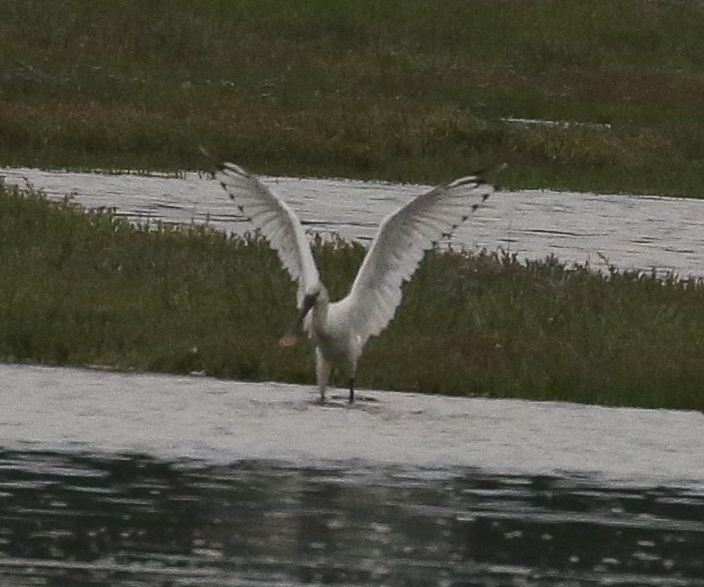
There were four Spoonbills on the lagoon on my regular DWT Brownsea volunteering visit on 25 June. They had been seen earlier in the Summer in other locations around Poole Harbour, but it was the first time I had seen them on the lagoon. I could see they all looked like First Summer individuals with dull pinky-grey bills and black markings in the wing tips. One was colour-ringed, but it was too far away to read the ring number. They were still present on the next visit at the start of July and they were actively feeding on the lagoon. I saw one walk between the Tern hide and the Sandwich Tern islands. So, it would have been really close, if I hadn't had been in the Avocet hide. Naturally, it was well out into the lagoon, by the time I reached the Tern hide.
Spoonbill
Unfortunately, this wasn't the colour-ringed individual. However, that Spoonbill was close enough to read its ring number: NHB9. This looked like a Dutch colour-ringed scheme to me.
Spoonbill: I wonder if this is also a Dutch individual
Local Birder, Garry Hayman had already seen and reported this individual from Middlebere and received confirmation that it was from the Dutch ringing scheme. It was ringed on Schiermonnikoog Island, very close to the Dutch - German border:
  • 20 Jun 24 - Schiermonnikoog Island, Holland - Ringed as a chick
  • 25 Oct 24 - Brownsea, Poole Harbour
  • 1 Nov 24 - Brownsea, Poole Harbour
  • 9 Nov 24 - Holes Bay, Poole Harbour
  • 24 Dec 24 - Arne, Poole Harbour
  • 18 Jan 25 - Poole Harbour
  • 20 Jun 25 - Middlebere, Poole Harbour.
Unfortunately, it's impossible to tell the origin of the other three Spoonbills. Some of the autumnal and wintering individuals may be from the Norfolk colony. However, most of these aren't colour-ringed and so that is pure speculation. What we can prove if most of the colour-ringed individuals are Dutch.

23 Oct 2024

23 Oct 24 - An Eighteen Year Female Or An Old Lady?

Whilst checking the Spoonbill flock on the DWT Brownsea lagoon for colour rings, I saw an old friend was back in Poole Harbour again: Spoonbill AE. She has been returning for many winters now. The full history of who has reported to the Dutch Spoonbill ringing scheme is a who's who of Poole Harbour Birders. One week later & I managed to get some photos of her.
Some of the Spoonbill flock
Spoonbill: AE trying to look good for the camera
Spoonbill: AE
The ring details of AE are:
  • Left leg - Pink on Blue AE & a metal ring
  • Right leg - Black on White AE (which now appears to be a yellowish colour presumably down to the age of the ring).
I haven't added in the full history of AE's movements, but here is a summary of her UK movements. Spoonbill AE was ringed as a chick at Schiermonnikoog, Oosterkwelder in Holland on 19 Jul 06. She spent her first winter three hundred miles away around the Somme in France, before returning to Holland. Subsequent winters she was seen at:
  • 2007-08: Poole Harbour, Dorset (Kevin Lane)
  • 2008-09: Devon and then on the River Tamar in Cornwall in February 2009
  • 2009-10: Yealm estuary, Devon, then back on the River Tamar in January 2010
  • 2010-11: France in September/October, Dorset a week later (Pete Moore) & River Lynher, Cornwall in December 2010, then back to Devon & Poole Harbour (Bob Mould) in January
  • 2011-12: Poole Harbour, Dorset (Pete Moore)
  • 2012-13: Poole Harbour, Dorset (Steve Smith, Pete Moore & Shaun Robson)
  • 2013-14: No sightings
  • 2014-15: Poole Harbour, Dorset (Chris Thain, Steve Smith & Shaun Robson)
  • 2015-16: Poole Harbour, Dorset (Chris Thain & Ian Ballam)
  • 2016-17: Poole Harbour, Dorset(Ian Ballam, Shaun Robson & Nick Hopper)
  • 2017-18: Poole Harbour, Dorset (Nick Hopper)
  • 2018-19: Poole Harbour, Dorset (Shaun Robson)
  • 2019-20: France in October, then Poole Harbour, Dorset (Terence Thirlaway)
  • 2020-21: France in October, then Poole Harbour, Dorset (Shaun Robson)
  • 2021-22: Poole Harbour, Dorset (Shaun Robson & Mark Wright) & Needs Ore, Hampshire
  • 2022-23: Poole Harbour, Dorset from 12 Oct 22 (Steve Smith & Ian Ballam)
  • 2023-24: Poole Harbour, Dorset from 25 Oct 23 (Steve Smith, Shaun Robson & Ian Ballam) & River Lynher, Cornwall on 16 Jan 24
  • 2024-25: Poole Harbour, Dorset from 16 Oct 24 (Steve Smith).
Having passed her eighteenth birthday, she is getting on a bit now. A quick search online suggested a good lifespan might be fifteen to twenty years, with the oldest known Spoonbill in the wild reaching thirty years. So with luck, we could see AE returning to Poole harbour for the next few years.

21 Aug 2024

21 Aug 24 - There's A Storm Coming

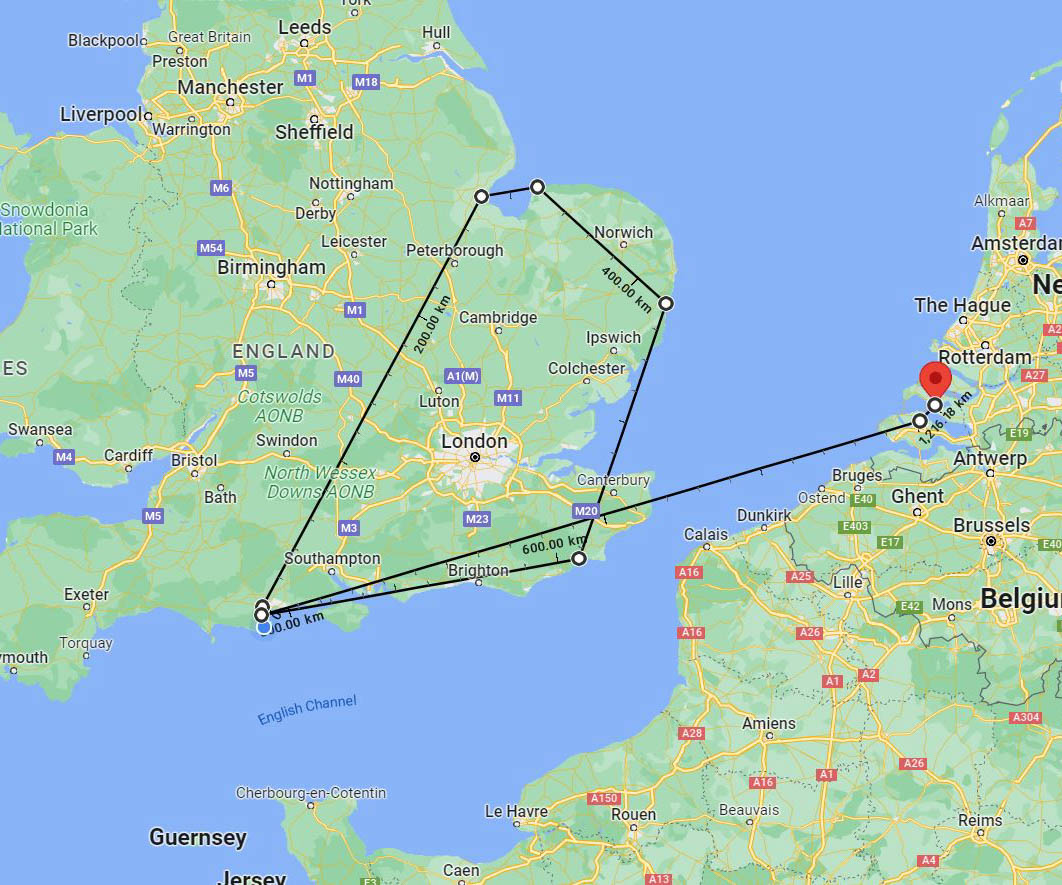
On 17 Aug, the Global Flyway twitter account announced that a Storm had hit Poole Harbour: something that the local weather teams overlooked. But it was understandable as it was Storm the female Spoonbill, AKA colour ring NH45. Storm was ringed as an adult female Spoonbill on Schiermonnikoog Island in early Jun 2024 and she was also given a satellite-tag. She left the Wadden Sea early, on 31 Jul and spent twelve days in Oostvaardersplassen. The next stop was Hellevoetsluis, south of Rotterdam, where she spent five days. She left at dusk, flying overnight to Lymington after passing over Dungeness, before continuing onto Poole Harbour to arrive on the evening of 17 Aug.

Since her arrival, a number of local Birders have been looking for her. I'm sure we saw her on Brownsea on 20 Aug from the Birds of Poole Harbour Bird Boat, when we saw a CR Spoonbill with a large white ring and a red ring above that. This is the first Spoonbill I've seen with a red ring above the white ring. I have seen at least three CR Spoonbills on Brownsea this Autumn with large white rings which is the 'normal' Dutch Spoonbills we see. Paul Morton & Shaun Robson were also on the boat and didn't recognise this ring combination either. But nobody could read the letters on the white ring from the boat and the toggers didn't fare any better either.
Spoonbill Storm (NH45): She was one of twenty-three Spoonbills on the DWT Brownsea lagoon
Fortunately, I could see a CR Spoonbill with a large white ring and a red ring on the following morning from the Tern Hide on Brownsea on my regular volunteering day. My photo isn't good enough to see the ring number, but I could clearly see it was NH45 with my scope. It was good to see Storm in Poole Harbour, albeit the Dutch team will have known her movements over the last few days.
Spoonbill Storm (NH45): She stuck around for a few weeks, then disappeared. It turns out she has carried on flying South & she reached the Senegal river delta by the start of Nov 24, according to this image copied from the Global Flyway Network (@GlobalFlyway) on twitter

21 Oct 2023

21 Oct 23 - Goodbye & Thanks For (All) The Fish

I planned to go looking for an Eastern migrant on the Purbeck coast this AM, but early morning rain changed that plan. When the rain stopped, it was clear it was only going to be a brief interlude, so I opted for the last of the rising tide in Brands Bay hide as Plan B. The mud had just been covered by the time I arrived, but there were still a reasonable selection of typical Waders and Wildfowl in the Bay. Some were feeding, but others were hiding in the marshes, but the rising tide forced them to show as they moved locations.

The first highlight of the visit was a party of four Spoonbills flying in high from Ower. They circled the Bay, but didn't stop & left in the direction of Littlesea. I wondered if they were new in, as the Ower & Middlebere Spoonbills generally return directly to Brownsea as the tide rises in Poole Harbour. While there have been up to 81 on Brownsea this Autumn, this is the first Spoonbills that I have seen in Brands Bay this Autumn. They are always an erratic visitor to Brands Bay.
The four Spoonbills: The one with the pinkish bill, black wingtips & trailing edge is a Juvenile
The other highlight was a Great White Egret that dropped in at 10:30. Typically, it was a long way out on the marshes in the middle of the bay. However, after fifteen minutes there, it flew & dropped in just to the left of the hide on the near bank: which is the closest I've seen a Great White Egret in Brands Bay.
Great White Egret: The classic S bend neck
Great White Egret: This isn't looking good for the fish
Great White Egret: Goodbye & thanks for (all) the fish
These days in Poole Harbour, none of the local Birders are surprised to hear of a Great White Egret or two at any of the waterside parts of the harbour between the Autumn and late Winter. It's hard to remember that when I bumped into one at the Middlebere end of the Wytch Channel on 7 Sep 14, it was first easily twitchable individual for the Poole Harbour Birders. It lost its quality reputation within a few days.
Great White Egret: Finally, the classic long neck
It had been a good visit to Brands Bay.

17 Aug 2022

17 Aug 22 - Brownsea's Colour-ringed Spoonbills

Spoonbills are continuing to build up on Brownsea with increases to the population occurring several times a week. There are now three colour-ringed Spoonbills in the current flock of twenty Spoonbills.
Fifteen of the Spoonbills
Spoonbill: These Spoonbills are NC6U which has been present since 10 Aug at least and NB2V which I've seen for the first time this week (back individual)
I've had an update on Spoonbill NB2V which was ringed as a pullus on 7 Jun 20 at Ouwerkerk, Ouwerkerkse inlagen, Holland and present until 9 Aug 20, after which it was seen at:
  • Wolphaartsdijk, Kwistenburg, Holland on 12 Aug 20
    Middlebere, Poole Harbour, Dorset, UK on 1 Jan 21
  • Long Island, Poole Harbour, Dorset, UK on 13 Feb 21
  • Rye Harbour, Sussex, UK on 1 May 21
  • Walberswick, Suffolk, UK on 6 May 21
  • Holme-next-the-sea, Norfolk, UK on 7 May 21
  • Frampton Marsh Lincs, UK on 4, 6 & 11 Sep 21
  • Middlebere, Poole Harbour, Dorset, UK on 31 Oct 21
  • Brownsea, Poole Harbour, Dorset, UK on 17 Aug 22
The travels of Spoonbill NB2V

Spoonbill: This Spoonbill has been present since 10 Aug at least. The rings are left leg yellow over metal over green and right leg yellow over green over yellow flag

8 Aug 2022

8 Aug 22 - Brownsea's "Roseate" Spoonbills

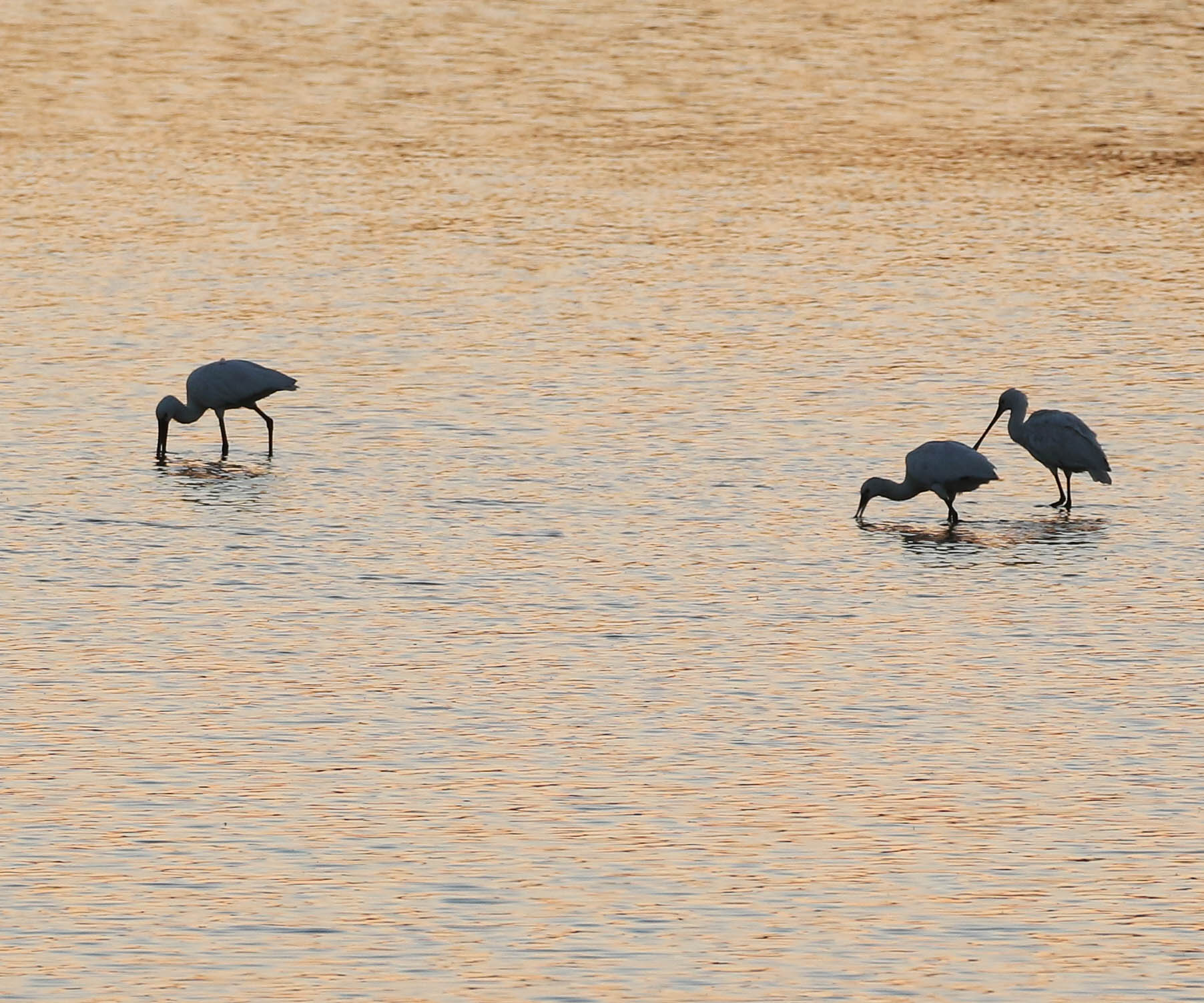
There was a private boat trip this evening as an excuse for a number of local Poole Birders to catch up with ex-Poole birder James Lidster while he was in town. We started with a trip up the Wareham Channel & the Frome & we finished off with a late evening visit to overlook the Brownsea lagoon. Five of the Spoonbills decided to cooperate & move to the Castle end of the lagoon for a quick snack before returning for a final pre-roost preen. This provided some nice opportunities for some sunset photos. Like the two private boat trips in July, it was a very enjoyable evening with even better weather than July.
Spoonbills: Enjoying a last snack
Spoonbills: A sunset shot posing for the camera. I've not played around with any of the colour settings on these final two photos
Spoonbill
The Birds of Poole Harbour team will be running a lot of their Bird Boats in Aug & early Sep into the Wareham Channel in the expectation of multiple Osprey sightings & the hope of other sightings including White-tailed Sea-eagles. Obviously, the birds seen & the views are always going to be a matter of luck of the day, but hopefully they will get some good sightings on those boats. A full list of the boat trips they will be running & how to book a trip is on their website.

25 Jun 2022

25 Jun 22 - #30DaysWild Day 25 - An Evening Walk

I left today's walk to an evening walk to Middlebere to catch the rising tide & in the hope that it wouldn't be as bad for hay fever. I did get the tide right, but the hay fever was worse that I hoped. The highlights from a short watch from the main hide was a 1st Summer Spoonbill flying from Middlebere to the Wareham Channel. There were also 14 Black-tailed Godwits at the water's edge. Twenty 20 Swifts were feeding over the creek or seen on the walk back to the car: sadly none had white rumps.
Spoonbill: 1st Summer. I didn't take a camera so have to make do with one of my old Spoonbill photos from Middlebere. Today's individual was in a heavier wing moult with more extensive black wing tips (11 Jul 18)

11 Jul 2018

11 Jul 18 - Ageing The Middlebere Spoonbills

Question which to watch? World Cup England verses Croatia or Middlebere. Answer: Middlebere. There was a selection of recently arrived Waders and a few breeding Shelduck showing off their surviving chicks. But the stars of the show were the two Spoonbills.
Spoonbill: A fairly typical early evening view of some sleeping Spoonbills (just how I remember my first ever Spoonbills at Minsmere in the late 70s)
Spoonbill: 1st Summer. The right hand individual which I think is the Spoonbill I saw & photographed here on 24 Jun 18. This individual has no crest
Spoonbill: 2nd Summer. The left hand individual which has a short crest. This is a newly arrived individual
Spoonbill: They finally woke up & started a bit of grooming
Spoonbill: 2nd Summer. A stretch of the wings followed
Spoonbill
Spoonbill: 1st Summer. The left hand original individual looks like a 1st Summer
Spoonbill: 2nd Summer. The newly in (crested) individual looks like a 2nd Summer. This is the individual showing a short crest & less extensive yellow on the spoon
Spoonbill: 1st Summer. The original individual has a more extensive yellow patch on the spoon
Spoonbill: 2nd Summer. The new individual. It is being photobombed by a few Black-tailed Godwits
Spoonbill: (12 Jul 18)
Spoonbill: 1st Summer. A final wave from the original Spoonbill (12 Jul 18)
Spoonbill: 1st Summer. Only the original Spoonbill was present on 13 Jul 18. There was a Spoonbill at Lytchett Bay so presumably that's the 2nd Summer individual
Spoonbill: Tradition demands a final sunset picture (occasionally)

24 Jun 2018

24 Jun 18 - One That Got Away

I had a mid morning call from Paul Morton from the Birds of Poole Harbour team. He had just seen an email from a member of the public. A distant summer plumage Plover, but which he though looked like an American Golden Plover. The initial photo taken by Debbie Derrick has been published on the BoPH June 18 Sightings page. It had been seen on 4 occasions between 18 & 22 Jun. Looking at the photo, it certainly looked a reasonable identification, albeit it was distant. I was about to leave when Paul rang back. He had forwarded the photo to Killian Mullarney & Paul had a thumbs up to the identification.

It had been photographed on the outer side of Redhorn Quay, which is the point that separates Brands Bay from what most locals regard as the outer Brands Bay (but pedantically is Plateau Bay). I arrived about ten minutes later & headed straight for Redhorn Quay, while local Poole Birder, Shaun Robson headed to Jerry's Point. Jerry's Point is closer to the ferry & gives views over the outer part of the Studland peninsula. We both had excellent views of people, uncontrolled dogs & people who are into the latest craze of standing on boards & paddling around on them close to the shoreline. But sadly, no sign of the American Golden Plover. We both planned to meet up in the Brands Bay hide. This gives better views of Brands Bay, but I had already had a fairly reasonable view of Brands Bay so I was fairly confident it wouldn't be on view from there: I was correct. On the way to the hide, I ran into my mate Peter Moore who having arrived & already heard the negative news was getting distracted with the Silver-studded Blues. It seemed the best option in the circumstances.
Silver-studded Blue: They seemed to be having a good year locally with the current heatwave
A had another look at Brands Bay in the early evening as it should have quietened down & there was footie to keep most of Joe Public indoors. Unfortunately, still no joy. Then it was onto the Middlebere hide in the hope it might have relocated to Middlebere on the rising tide. Again, no luck, but there was a reasonable selection of Waders to keep me occupied & a 1st Summer Spoonbill.
Spoonbill: 1st Summer. This was presumably the individual that had been moving around Poole Harbour in recent days. It disappeared to roost soon after I arrived. Middlebere is a popular Spoonbills pre-roost site, but they don't roost there
After grabbing a few photos of the Spoonbill, I carried on scanning the exposed mud in the hope that the American Golden Plover would arrive. As a result, I never saw the Spoonbill depart. Subsequently, this would have been interesting to have seen it go to see the extent of the black in the wing tips. At the time, I aged this Spoonbill as a first summer on the basis of the bill colour, lack of plumes & white breast. As I'm writing this Post I thought I would have a quick check on ageing of first summer Spoonbills & found an article on Surfbirds by Alexander Hellquist. This shows that ageing isn't as straight-forward as I though & second summer individuals Spoonbill should also be considered. First summer individuals sometimes show a white tuft instead of full plumes, but often won't show a crest, do not show the adult's yellow breast band, have an extensive yellow tipped bill with a grey base, grey legs, a (brownish) red iris (far too far away to determine iris colour) & have extensive black in the wing tips (not seen in flight). In comparison, second summer individuals generally show a short white plume, will not show the adult's yellow breast band, have more yellow in the bill tip than adults, have darker grey legs than a first summer (but no others for comparison), have an intensive red eye & little in the way of black in the wing tips. There appears to be a bit of fleshy pink colouration in the base of the bill (which juvenile individuals show) & coupled with the lack of a crest (although that isn't diagnostic), then I guess this is still a first summer individual. But I would welcome any comments.
Spoonbill: 1st Summer
Spoonbill: 1st Summer. A closer crop. Does the pinkish edges to the bill & the lack of any crest make it more likely to be a first summer
Spoonbill: 1st Summer
Spoonbill: 1st Summer. A closer crop. The bill tip looks fleshy, but there is generally a warm evening light at Middlebere at this time of the year
There was no sign of the American Golden Plover, but I was pleased to see a flyover Great White Egret which was in heavy wing moult on the innermost primaries. We weren't aware there had been a Great White Egret in Poole Harbour since early Spring, so had it just arrived or been overlooked. I saw it again in flight on the following evening. I've now given up on the search for the American Golden Plover & as the tides aren't great for Middlebere at the moment, I've not been down to see if I can get more views of the Great White Egret. Only four years ago, we had the first properly twitchable Great White Egret in Poole Harbour. After four years of overwintering involving up to three individuals then we are now fairly balse about local Great White Egrets: how times change.
Sika Deer: Seen enjoying the evening sun on the following evening's visit to Middlebere (25 Jun 18)

8 Aug 2015

8 Aug 15 - Black Stork Madness

Late afternoon, I was about to grab some food when I thought I should check the RBA news. With a few migrants in Dorset, there was always a chance something mildly interesting might have been found. I wasn't hopeful & I certainly wasn't expecting the breaking news of a Black Stork at Arne. There was no further information as the news had only got onto the breaking news feed at that point. A few quick calls to locals to get the news out while I was making a coffee to take with me: I expected a long search. By this point, the local RBA channel was saying it had been seen from the Arne approach road at 17:25-17:40 before flying West. But it was still only 17:50 so very recent news. I rang Paul Morton again, who couldn't get away & got Paul to phone the news on. He couldn't drive or get away to look for it, and I needed to be on the road at this point. First stop was just after six on Soldiers Road: but no joy. Then a drive along the Arne Road & back again as far as Sunnyside Farm. Plenty of potential places for it to pitch down, but no joy. The next stop was probably where I should have gone first, the Slepe Heath viewpoint which gives views over Swineham & the lower Frome valley. A quick scan over the water meadows didn't reveal any Black Storks. Then I looked towards Arne & realised it was flying just to the East of the Arne Triangle. I had a good view as it flew low toward the upper end of the Middlebere channel & appeared to drop into the fields.
Black Stork: Juvenile. Flying over the upper Middlebere fields toward Middlebere farm
I made a quick call to Nick Hopper who was the nearest Birder, to send Nick to the viewpoint overlooking Middlebere & another call to Paul & a couple of locals to get the news out. Nick got there first, but no sign of the Black Stork. He left for the high ground by the Middlebere Harrier hide, while I stayed put, in case went up again. Twenty minutes later, there was no news from Nick & I had had no further sightings, but I had made more phone calls to locals. So I decided to join Nick. I arrived close to the first viewpoint over the Harrier hide creek, only to see the Black Stork appear over where I had just been on the road. I rang Nick, but the call was going to answerphone, so had to resort to the old fashion communication & shouted as loud as I could, thinking Nick was within 100 metres. Fortunately, I was on high ground & my shout carried the 600 metres or so to where Nick was. He looked up to see the Black Stork flying towards him as it passed over the cottages. It then swung around & came back into my view as it went across the creek in front of the Harrier hide & off towards the Wytch causeway area. This is an area of private roads, with a few public footpaths. A few of the locals (myself included) have permission to enter this area for survey work. Forty-five minutes later, it reappeared from the Wytch causeway area & dropped in into the marshy field, at the far end of the creek in front of the Harrier hide. By this time Nick & I had been joined by Aidan Brown.
Black Stork: Juvenile. In the marshy field in front of the Harrier hide. No sign of any rings (or a bill). It's grainy, but the SX60 was being balanced on top of the telescope & was on 260x (65x optical & 4x digital: the biggest zoom)
Black Stork: Juvenile. With the Spoonbills
More phone calls to update the locals as more were now out looking. The calls were brief as I was trying to get photos as well as get the news out. I knew Nick's mobile had been dead for over an hour & my battery life was now on its last legs. Fortunately, the Black Stork walked into the creek & dwarfed the three Spoonbills feeding in the water. After been on view for about thirty minutes, locals, Ian Lewis, Mark & Mo Constantine & Graham Armstrong had joined us. Soon after it flew again. This time it disappeared into the trees & presumably went to roost. I would expect anybody at the Harrier hide first thing in the morning, will have a good chance of connecting with it. This is not only the best viewpoint, but about the only public accessible area that it is likely to be visible from.
The Black Stork twitch: Mo Constantine, Mark Constantine, Graham Armstrong, Julian Thomas, Nick Hopper, Aidan Brown, Ian Lewis & Mike Cross (who unfortunately arrived five minutes too late) (left to right)

15 Mar 2015

15 Mar 15 - My Head Hurts (Wagtail Confusion)

After publishing the photos of yesterday's putative White Wagtail at Studland, I had some feedback from Dorset Birder, Brett Spencer that it was a first Summer female Pied Wagtail. Brett is one of those Birders in Dorset that when he is talking about tricky identification, then it's worth listening to what he has so say. Having read some more up about White Wagtail/Pied Wagtail identification & followed up with calls then to a couple of other Dorset Birders, then I agree with the Pied Wagtail identification. I will have to wait until I find a nice adult White Wagtail, rather than try to figure out first Summer individuals. I'm still trying to work out in my mind exactly what a first Summer White Wagtail should look like, but think it would have been a bit paler on the mantle, with a less extensive bib & a general cleaner look. I haven't had chance to talk to Brett yet so will be interested to understand what was wrong for him with this individual. Here are the photos again along with another photo. I will be interested to hear any other thoughts on this individual, so feel free to leave a comment with the reasons why.
Pied Wagtail: First Summer (14 Mar 15)
Pied Wagtail: Another photo showing a better view of the bib (14 Mar 15)
On an easier identification subject, Brands Bay still had good numbers of typical Wildfowl & Black-tailed Godwits today along with this first Summer Spoonbill. It's frustrating that despite having a Bird hide overlooking the bay, that the National Trust have made no attempt to request people do not walk along the shoreline. This was the result of some bloke taking his bicycle for a walk along the shoreline.
Spoonbill: First Summer