Showing posts with label Black-tailed Skimmer. Show all posts

23 May 2026

23 May 26 - Signs Of Spring Part 15 - Black-tailed Skimmer

One of the signs of Spring I enjoy is when I see the first old friends in the year. In this case, I had already seen a female Black-tailed Skimmer a few days earlier at Studland, but today's Blog Post features the first individual I managed to photograph in 2026.
Black-tailed Skimmer: Female. Brands Bay, Studland

17 Jul 2018

17 Jul 18 - A Studland Patch First

On 16 Jul 18 I decided to pop down to Littlesea on my Studland patch for the first Little Egret roost count of the Autumn. Part of the hope was that I would also find a Great White Egret as there has been one, & occasionally two, Great White Egrets regularly around the Studland patch in the Autumn & Winter since one appeared in Sep 2014. It was a fairly quiet night with 42 Little Egrets in the roost & most were in before I arrived. At 21:30, I decided it didn't look likely that a Great White Egret would appear & so I packed up to leave. As I was walking off, I spotted another Heron coming into the roost. I stopped to check it, although I knew it would be a Grey Heron, but it looked like a Purple Heron. I only had a short view in the failing light, but enough to be happy with the identification, but not to be able to write a description on that view. It landed in the trees, but out of sight. I quickly walked back up the hill to my viewing point & fortunately, it was still there, but not close. The tripod was unpacked & bingo, it was a Purple Heron. At this point, it flew & I lost it, due as it flew behind a tree I was standing next too. I quickly returned to the high hide as that had a much clearer viewing position. I carried on scanning whilst phoning local Poole Harbour Birders. Realistically, only one had much of a chance to get there before dark from his home, but it was academic as he didn't answer his phone. Still the news was out locally so people had the chance of a pre-work visit the following morning. While I was on the phone to Paul Morton, from the Birds of Poole Harbour team, it flew back towards the roost. I cut the call to get more views as it circled the roost a few times before disappearing into the Southern most bay in Littlesea. I stayed till last light, but I had no more sightings. This was a third record for the Poole Harbour area & a Studland first.
Black-tailed Skimmer: Female
The following morning I spent a couple of hours looking around the Studland area checking South Haven, Littlesea & Brands Bay, but I drew a blank. I didn't check all the possible places as I skipped the Eastern Lake. Too close to the nudists beach to want to carry bins & a decent camera at this time of year. Annoying, as this is the most likely place it would be feeding in, if it was still around. Paul has already had the same result at Littlesea earlier in the morning. I assumed it had probably moved through. But to be sure I decided to pop down to check the roost for a second night. I arrived earlier & there were only a few Little Egrets in the roost. Checking them, one was tucked well in & only showing small parts of its bill at any time. A pale-yellow bill & looked far too thick-based to be a Little Egret. But it really was a struggle to see it clearly. At this point, Graham Armstrong arrived & I tried getting Graham onto it. Before he saw it, it had flown deeper into the trees & was only showing parts of its back. Fortunately, it flew again & sat in the open. Clearly, a juvenile Cattle Egret. This is only the fifth Studland record. I was happy as this was the second good Heron on the patch in 24 hours. The obvious question is, where is this Cattle Egret feeding during the day?
Cattle Egret (with a Little Egret to its right): Only the fifth Studland patch record
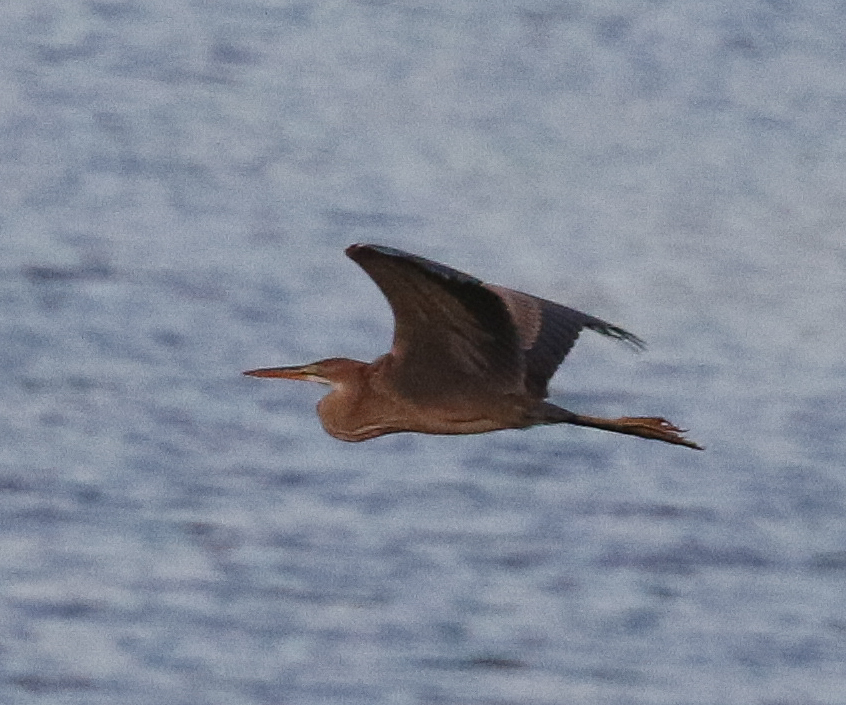
We were just admiring the Cattle Egret through our scopes, when the Purple Heron flew in. It circled briefly before landing in the treetops. Frustratingly, I hadn't set the camera up that evening & so all the flight photos were blurred as the camera was still set up from the morning.
Purple Heron: Juvenile. Surprisingly, this photo wasn't too bad given the poor camera settings
I bumped the ISO setting up (probably too high), but at least I would get something it the Purple Heron flew around again.
Purple Heron: Juvenile. It sat in the tree tops for around ten minutes while I was ringing locals as there was enough light to allow people to belt down if they wanted
Purple Heron: Juvenile. After ten minutes it flew again & dropped out of sight into the marsh in Littlesea
Purple Heron: Juvenile
Purple Heron: Juvenile. It stayed hidden out of view in the marsh, until it finally flew into the roost at 21:32 (the same time as the previous evening)
If anybody is looking for it this evening, please only view from the high hide. This can be reached by parking on the road at the entrance to Greenlands Farm. Cross the road & walk East up the obvious path up the small hillside. Follow this through a gully to the hide. It's best to stand in front of the hide, rather than look from this old hide. Please do not try getting closer to the Little Egrets as you are likely to disturb the roost & due to trees, you are unlikely to get a decent view anyway. Also keep off the heaths as there there are nearby Nightjar territories. Any time after 20:00 would be worth a look. But we still don't know where it is spending its time during the day, so there is a chance of seeing it during the day.

2 Jul 2017

2 July 17 - Still in the Summer Doldrums

In an earlier post, I mentioned I had gone looking for White Admirals in the Nature trail woods at Littlesea on the Studland patch. Whilst looking I decided to have a quick look at Littlesea. Sadly, the lakes Diving Ducks, Coots & their following Gadwalls have been decimated due to the large numbers of Carp that have plagued the lake in the last decade. But I still occasionally feel I need to look at Littlesea to prove to myself it's still largely devoid of Waterfowl. It was. But I did notice a handful of Black-tailed Skimmers in front of the hide.
Black-tailed Skimmer: Male. A relatively common Studland species
More interesting on the lily pads were about 8 Red-eyed Damselflies. This is a species that I wasn't aware occurred on the patch. So it was great to see them, even if they were a bit too far out for photography.
Red-eyed Damselfly: Note the all blue final 2 segments of the abdomen & black shoulders. They are also larger & stouter in build to the Small Red-eyed Damselflies
Even better whilst looking at the photos taken at Littlesea, I realised I had also photographed a Small Red-eyed Damselfly. Frustratingly, it is out of focus, but the black & blue penultimate segment on the abdomen & the chestnut shoulders are still visible. My first Small Red-eyed Damselflies in Poole Harbour. No longer a doldrum day.

3 Jul 2014

3 July 14 - Kentish Hawkers (nee Norfolk Hawkers)

In recent weeks I've discovered Marc Heath's excellent blog focusing mainly on Dragonflies in Kent. As well as the excellent photos (don't look too hard as you might stop following my blog), there had been a number of posts about Norfolk Hawkers at Westbere. These look to have recently been found in Kent & as it was considerably closer than a trip to the Norfolk Broads, it was a better option. I was all set to give Westbere a go, when the news of local Swallowtails broke. Having finally seen my first local Swallowtail, the weather was still looking good for a trip to Kent. Having been born & brought up on the Kent/London border, my early days of birding was dominated by trips down to Dungeness, the North Kent coast & Stodmarsh (as well as plenty of local birding). Westbere is part of the same collection of lakes as Stodmarsh, but surprisingly I had only visited the site once before. So armed with directions from my mate Ewan Urquhart who had just visited & seen the Norfolk Hawkers, I was ready for my first visit. It was a straight-forward drive to Kent & I was there for lunchtime (having decided against an early start to avoid the commuters). I arrived at Westbere & after crossing the railway was straight into some cool woodland shade for the first few hundred metres, before emerging back into the sun. There was a good patch of reedbed on my left with reed fringed ditches on both sides of the path.
Westbere: The path passes through this cool woodland, much appreciated on a hot sunny day
The path then emerged into the reedbeds
With some great reed fringed ditches either side of the path
Another more open ditch
Walking through the wood & the early part of the reedbed area, there were plenty of Banded Demoiselles and small blue Danselflies: The few I looked at were all Azure Damselflies. I quickly saw a Hawker, but it quickly disappeared from view before I could clinch it. Carrying on, I found a plank across a ditch to a lake & there was a perched Norfolk Hawker on the ditch's reeds. It's great to travel to see something new & to connect soon after arriving.
Norfolk Hawker: The confusing species are Brown Hawker (which flies later in July with blue patches on the brown body & golden brown wings), vagrant Lesser Emperor (which has blue at the base of the abdomen & green eyes) or even rarer Vagrant Emperor (which has blue at the base of the abdomen & brown eyes)
In total, I saw at least 6 Norfolk Hawkers patrolling different ditches. However, I was pleased to see they were happy to land for photos as some of the other Hawker species seem to constantly fly around.
Norfolk Hawker: The distinctive features are the brown body, green eyes, pale yellow base to the hind wing, clear wings & a yellow triangle on the second segment of the abdomen
Norfolk Hawker: The yellow triangle on segment 2 (at the base of the abdomen) was more orange than the books show
There was also a good selection of other interesting insects to photograph.
Black-tailed Skimmer: Male
Green-veined White
Whirligig Beetles: These were very common in all the ditches
Harlequin Ladybird larva

21 Jun 2014

21 June 14 - Brownsea Island - Surely It Should Be LotsToSee Island

In the last post, I was focusing on one of the DWT Brownsea's main attractions at this time of year: its breeding Sandwich & Common Terns. But there is so much more to see on the reserve. The lagoon is the obvious centre of the reserve.
Brownsea lagoon: Looking towards the Mac hide
Brownsea lagoon: Looking towards the landing jetty. The Tamarisk island behind the Canada Geese is always worth checking as it's a favourite place for the Spoonbills
Brent Goose: Brent Geese should be on the Arctic coasts breeding grounds in Central & Western Siberia at the moment. However, it's not unusual to find the odd bird remains in Poole Harbour. For the last 2 years, 1 or 2 have over-summered around Studland, this individual seems to have chosen Brownsea instead
Canada Goose: The Canada Geese always seem to have good breeding success around Poole Harbour
Shelduck: Lunch doesn't look appetising
Oystercatcher: Displaying
Oystercatcher
Oystercatcher: They really are stunning birds close up
Black-headed Gull: Adult. It really is a poor name as they have a brown head
Black-headed Gull: There are a number of breeding pairs on the lagoon, but the adults are not great at keeping an eye on wandering chicks. Not a good idea given there are usually a few Great Black-backed Gulls around
Finally, it was time to explore more of the reserve. Although the lagoon is the centre piece of the DWT reserve, there are also extensive woodland areas, a reedbed blind (screen to look from) & a woodland hide overlooking some freshwater pools. The woodland habitats are more similar to other parts of the island. But with most of the visitors here for the wildlife, it was a lot quieter than the rest of the island on this glorious sunny day. Also the visitors were more interested in the wildlife & thus there is more chance of seeing the birds & animals well on the reserve. The first stop was the woodland hide.
View from the woodland hide: The hide was pretty quiet on this occasion with just a few Shelduck on the lake & a Dabchick calling. There was a Golden-ringed Dragonfly on the Bracken, but it kept perching on obscured perches (so no photos this time)
As well as the reedbed areas, there are a number of Dragonfly ponds around the reserve which provides good views of a number of  the many species of Dragonflies found on Brownsea.
Black-tailed Skimmer: Male
Four-spotted Chaser: One of the commoner Dragonflies on the reserve at the moment
Four-spotted Chaser: Looking at bit tatty
Large Red Damselfly: Mating pair (male at front). The black legs, black segments on the abdomen & broad black stripes on the body (thorax) identify these as Large Red Damselflies. Small Red Damselflies would have red legs and all red abdomens on the males
One of the great thing about Brownsea is it is an island. This has meant that the Grey Squirrels which were introduced into the UK from the States in the mid 19th Century, never managed to reach Brownsea & the other islands in Poole Harbour. This is very important as these islands had populations of the UK native Red Squirrels. Sadly, the impact of these Grey Squirrels have resulted in the complete loss of Red Squirrels over most of the mainland of England & Wales. There are small surviving populations on the Isle of Wight & a few isolated parts of Wales, Lancs & North Yorkshire. There are larger populations in Cumbria & Northumberland & Scotland. A lot of visitors to Brownsea visit specifically to see the Red Squirrels and the DWT reserve is one of the best places to see the Red Squirrels. They are normally around the villa buildings. I did see one there, but it was proving to be very elusive on this occasion. However, as I was talking to my mate, Graham Armstong, who is one of the regular volunteers on the reserve, one came running along the track. It stopped briefly, before taking to the trees to avoid a couple of visitors & then ran right past us.
Red Squirrel: Just checking out these visitors
Red Squirrel: An action shot as it ran past us
Red Squirrel: Now calm again
Five-spot Burnet: heading back to the ferry I found a few on these on the wet meadow next to the reserve boardwalk. Some  populations occur where the spots tend to run together as seen on this individual
Just time to catch my boat back to Sandbanks & as often happens, see the Studland ferry put out just as we pull alongside. Another 20 minute wait until I can get to the drink in the car. Still it was still a glorious summer's day & the Sandwich Terns were feeding just off the landing jetty. So I can't complain too much.
Sandwich Tern
Sandwich Tern: Getting ready to plunge dive
Sandwich Tern: They plunge dive vertically

13 Jun 2014

13 June 14 - A Brilliant Emerald Jewel

Two years ago, I looked for Brilliant Emerald Dragonflies on the Fleet Canal. However, I was right at the end of their flying period & had no luck. Therefore, as it's one of the Southern Dragonflies I've yet to see, I was keen to have another look for them. Having seen the first were flying at the Black Pond at Esher Common in Surrey, then that looked a good place to try. Two advantages over the first attempt, I was going at a good time when they were freshly emerged. Secondly, it was a pond & therefore it should be easier to find them, compared to a canal which had no end to the extent to potential habitat. They like to fly in shady areas, but also on sunny days. So with the weather forecast predicting good warm weather with sunshine & some cloud, the conditions were looking good.
The Black Pond on Esher Common
The Black Pond on Esher Common: The Brilliant Emerald was at the far end of this bank, patrolling over a small area of shallow water. Unfortunately, the many dog walkers seem to think it's essential to throw a stick into the pond at the near end then have their dog swim the length of the pond's edge & walk out where the Brilliant Emerald is patrolling. Thus flushing it for several minutes. Glad I went mid week as a sunny weekend day would have been near impossible due to disturbance by dogs & unimaginative dog owners
The first Dragonfly I saw was a Black-tailed Skimmer & there were several males flying around the edge of the lake.
Black-tailed Skimmer: Male. Another blue Chaser with the combination of a slim abdomen, the black end to the abdomen, yellow edges to the blue abdomen & no dark wing bases
Initially, there was no sign of any Brilliant Emeralds, but then an Emerald came along the edge of the lake a couple of times, but quickly disappeared. On the brief views I had seen it, I couldn't rule out the similar looking Downy Emerald. I had no further sightings in the next few minutes, so carried on to the end of the pond, where I saw the Emerald again flying low over the water. After a couple of minutes of not being able to get any worthwhile photographs, I switched to the binoculars & could see the distinctive green and yellow face pattern of a Brilliant Emerald: success. The sun then came out & it flew into a small patch of sunlight under the trees where I managed to get some flight shots.
Brilliant Emerald: Male. They are brighter & more metallic, but this is very subjective. But they have a flattened yellow U band across the top of the forehead that turns up at each end which Downy Emerald doesn't have
Brilliant Emerald: Male. A close up of the flattened yellow U. This was even more obvious when fully face on, but I was using the bins & not the camera at the time
Brilliant Emerald: Male. Females have a downward spike at the end of the abdomen. Note, the sides of the yellow U are even visible side on (in this photo)
With the new Dragonfly seen & photographed, there was a few minutes to photograph some of the other residents of the Black Pond.
Dabchick
Moorhen
Coot