Showing posts with label Common Blue Damselfly. Show all posts

30 Jun 2019

30 Jun 19 - Little White Legs

I had spent most of my visit to Longham Lakes to look for & photograph Red-veined Darters. However, I did spent a few minutes photographing this White-legged Damselfly.
White-legged Damselfly
Also, there were good numbers of Common Blue Damselflies in the grassy edges to the lakes.
Common Blue Damselfly

27 Jul 2014

27 July 14 - Digiscoping A Big Flock of Big Egrets

I still had a couple of hours of warm weather left on the Somerset Levels, so the obvious next place was Ashcott Corner. The car park allows you to walk West to the Shapwick Heath national nature reserve or East to the RSPB Ham Walls reserve. This whole area is well worth a visit, especially in the Spring when there are a number of pairs of booming Bitterns to be heard. This has been an area where the habitat has been improved & as a result it has become incredibly good for Birds. I decided to try Ham Walls as I had only been here once before.
Glastonbury Tor: Just to prove I'm still in Somerset (see last post for the reasons for the photo)
After a half mile walk, I reached a viewing position on the left & a series of hides on the right side of the main track which I hadn't visited before. A few typical Waterbirds from the hides, but otherwise fairly quiet. Still it was late afternoon & not the best time for bird activity.
Cormorant
Gadwall
 Coot: Juvenile
Lesser Black-backed Gull: With Mallards
There were also some fairly typical Butterflies & Dragonflies on the wing, although as many were commoner species, I resisted the temptation to get too carried away with photographing them.
Red Admiral
Red-eyed Damselfly: A species I struggle to photograph well due to their insistence of sitting well away from the water's edge
Blue-tailed Damselfly
Common Blue Damselfly: Female. Note, the bomb markings on the abdomen
Carrying on along the main track for another half mile brought me to the second viewing position on the left hand side of the main track. Here there is a large open area of shallow water surrounded by reeds.
The view from the second viewing position
There was more bird activity here, including 5 Grey Herons and 5 white Egrets: 4 big & 1 small. With most of my birding in Poole Harbour, I am very used to seeing Little Egrets as the commonest (& only Egret). I've seen one Great White Egret in the Harbour. But here was a party of 4 Great White Egrets, with a lone Little Egret for size comparison. This area of the Somerset Levels is one of the best places in the UK to see Great White Egrets these days. Once a national rarity, I assume they are now resident here.
Great White Egret: Individual 1 (Always kept to left of lagoon on its own with black legs & orange bill)
Great White Egret: Individuals 2, 3 & 4 with 2 Mute Swans & a scattering of Mallards
Great White Egret: Individual 2 (Black legs & dark tip to bill)
Great White Egret: Individuals 3 & 4 (Note Individual 3 has black breeding season legs, whereas Individual 4 is already going back to orange winter legs)
This was a good excuse to have another go at getting used to digiscoping (using my Leica scope & Iphone). A lot of people have written in other blogs about their digiscoping experiences, but I've not seen anybody using a Leica scope yet. So I'm still learning. One of the things that is really easy to do on the Canon 7D is to change the exposure to under expose large white birds like Egrets & Spoonbills. This is more of a challenge on digiscoping. However, I've just searched on the internet & found it is possible to change the auto exposure light settings. Wish I had looked this up before trying to photograph these Egrets. Still I will know this for next time. When looking at the image you are planning on photographing, tap & hold on the part of the image on the screen you want to correctly set the exposure for, until a message 'AE/AF Lock' appears. At that point, the camera should be compensating the exposure correctly on your chosen subject. A quick tap on the screen will clear this & go back to exposure setting for the overall picture. As I didn't know this then most of my Great White Egrets photos were overexposed. But the following 3 photos of Individual 1 came out OK, using the normal Iphone exposure settings.
Great White Egret: Individual 1 (digiscoping)
Little Egret
Clearly, still got a lot of practice to get some decent results. But to compare it, here is the first Canon 7D photo of Individual 1 blown up. It really isn't as good at the digiscoping photos.
Great White Egret: Canon 7D of Individual 1 - The first picture with a very tight crop & blow up
Also I'm using the Canon editing software, which allows me to adjust the exposure settings for the picture. What it doesn't allow me to do is to select part of the photo e.g. the Great White Egret & selectively change the exposure on that part of the photo. This is a good example of where some additional editing software might help. But I'm trying not to spend even more money on this photography hobby at the moment. So the next stage will be trying to get the exposure correct on the Iphone when digiscoping.

3 Jul 2014

3 July 14 - A 30 Year Reunion With A Fritillary

Having seen the Norfolk Hawkers at Westbere, it was a 10 minute drive to East Blean Woods to look for Heath Fritillary. There is a small car park at the Eastern end of the wood. Some people had recently seen the Heath Fritillaries around the car park. So I had a quick look. No joy, but a nice female Broad-bodied Chaser.
Broad-bodied Chaser: Female. Note, the broad brown bases to all wings, the lack of a dark spot half way along the leading edge of all wings & the yellow spots to the sides of the abdomen
I followed the main path from the car park & within a few hundred metres, entered a coppiced clearing. As soon as I got to the sunny part of the clearing, I saw my first Heath Fritillary. In the end, I saw at least 8, but they were all charged up given how sunny it was. I had forgotten about how small they were, appearing even smaller than a Marsh Fritillary.
Heath Fritillary
Heath Fritillary
It was good to see a couple of White Admirals, albeit they weren't very cooperative for photos.
White Admiral
There were a few Common Blue Damselflies in the clearing. 
Common Blue Damselfly: Male
Common Blue Damselfly: Male 
Common Blue Damselfly: Female
Having got some reasonable Heath Fritillary photos, it was time to start the journey back to Dorset.

28 Jun 2014

28 June 14 - The Moral Of Not Carrying The Book

After some help from my mate Kevin, I was off to try another site on Dorset's River Stour. This is further upstream on the site tried on the 23rd for White-legged Damselfly & near to the large village of Sturminster Marshall. After driving through the large village of Sturminster Marshall, the road crossed the Stour next to the White Mill. There is a small National Trust car park here. Walking upstream & away from the Mill, for about 50 metres brought me to a path leading to the river bank. Very quickly, the path opens up into the first of several fields alongside the river bank. This is the site for the White-legged Damselflies. There are a lot of Stinging Nettles alongside the river as well as areas of other plants & bushes, but the vegetation in the first field had been severely strimmed. There were excellent numbers of Banded Demoiselles along the full length of the main river bank with about 10 or so Scarce Chasers in the first field & an Emperor Dragonfly hawking over the river. The path then carried in into a couple of short grass Cow fields. The Stinging Nettles along the riverbed edge of the fields were good for Banded Demoiselles, but little else.
Looking downriver along the main river bank
Looking upriver along the main river bank
Little Egret: Closer to the Mill. Once a national rarity, now a common sight in Dorset
Mallard: Male entering its dull eclipse plumage which they adopt during their moult phase (when the replace their feathers)
By the entrance into the first Cow field, there is an alternative path into long, thin sided field of rough grass with a sloping bank alongside an overgrown ditch. There were about 6 Common Blue Damselflies & one White-legged Damselfly in the long grass in this field. Despite checking the book before I left the house, I ended up failing to appreciate the potential confusion of the immature female Common Blue Damselfly (which look different from the mature blue females). As a result, I ended photographing a couple of Damselflies, thinking they were White-legged Damselfies, which I later reidentified as Common Blue Damselflies (when I checked the photos against the book). I did manage to see & photograph a real White-legged Damselfly, but the photos aren't as good as they would have been, had I realised my error at the time: as I would have spent longer photographing it. Still I always think you learn, & more importantly remember, more by making these mistakes. It also shows the importance of having a camera to get some photos of these insects to be able to check all the features. 
The side field: This looked more interesting habitat & I did finally see one White-legged Damselfly in the long grass, with a couple of immature female Common Blue Damselflies
Common Blue Damselfly: Male. Nice & easy to identify as lots of blue on the abdomen and the head & shoulders marking on the second segment (which separates it from the other small blue Damselflies)
Common Blue Damselfly: Immature female Common Blue Damselfly. Mature adult females would still be as bright blue as the males. They have this missile like marking on their abdomen and crucially some white on the legs
Common Blue Damselfly: Another photos of the immature female Common Blue Damselfly. Again note the white on the legs
White-legged Damselfly: The legs are more white, the tops of the eyes are blue & the pterostigma markings are light brown (black on Common Blue Damselfly)
The Scarce Chasers & the Banded Demoiselles were dominating the main river bank. The Scarce Chasers were very active and rarely settled. When they did settle, they would fly at the slightest movement even several metres from them. When they met another male, both would go an impressively fast vertical climb for about 20 metres, in an attempt to other climb each other.
Scarce Chaser: Male. Due to the angle of this photo it's not possible to see the black base to the hind wing. However, the lack of yellow-orange edges to the sides of the abdomen & the dark pterostigma still confirms it is a Scarce Chaser
Scarce Chaser: Male. This tatty male shows how limited the black on the hind wing is the Scarce Chasers here 
Scarce Chaser: Male. Finally a head on view
Banded Demoiselle: Male
Banded Demoiselle: Female. We think they look great, the Bug this female is eating wouldn't have agreed they are anything other than dangerous predators
Banded Demoiselle: Female. I couldn't resist a final photo
The sunny conditions were also good for Butterflies. There were reasonable numbers of Small Tortoiseshells, a few Red Admirals & Meadow Browns & a Green-veined White.
Green-veined White
Red Admiral
Red Admiral: They become a lot more cryptic when they close their wings up
Small Tortoiseshell: Although not as common as they were when I was a kid, this species seems to be around in better numbers than recent years

6 Jun 2014

6 June 14 - Dragons & Dungeons

The forecast is not looking hopeful for the weekend, so I decided to get out today with the camera in the breezy & intermittently sunny conditions. I had only got as far as the car, when I saw the first thing of interest. It was a Hercules flying low over Nine Barrow Down towards Studland. Presume it's tied in with the D-Day 70th celebrations as Studland Bay was used for some of the live firing rehearsals.Today is the 70th anniversary of Normandy landings.
Hercules: Flying low over Nine Barrow Down towards Studland. Low flying Hercules are fairly regularly seen locally, but that's something for a future posting
There have been no follow on sightings of the Short-toed Eagle up to when I left the house, so I decided that I would have a look around the Lulworth Ranges as that was the last direction it was seen flying in when it left Morden Bog. I didn't expect to relocate it, but it was a good excuse to have a look around the area. There is a public road from East Lulworth to Kimmeridge which provides excellent views of the Lulworth Ranges, however, part of this road is often closed as the Lulworth Ranges & the coastline to the South are part of a military training ground. But I figured it would be open as there wouldn't be any training on the 70th anniversary of D-Day. Parking up in a layby gave me a great view over the tank training grounds.
Looking over the Lulworth Ranges: There is some great looking heathland in the distance, but no sign of any Eagles (much to the relief of the local Snake population)
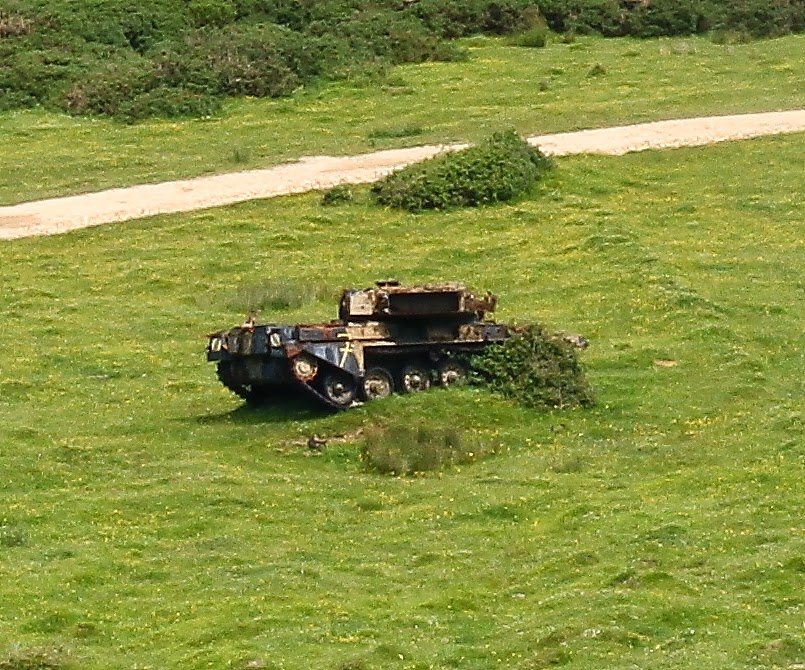
Old tanks never die: A few lucky ones end up at the nearby Bovington Tank Museum, the best Tank Museum in the world, but many end their days here
Another tank skulking in the bushes
Looking West is Lulworth Castle: Not a real Castle, just a early 17th Century Hunting Lodge & Stately Home. I guess it hasn't got any dungeons
Corfe Castle: Now this is what I call a proper Castle & I'm sure it has some real dungeons (Nov 13)
Looking North East is Poole Harbour: This is the Wareham Channel & the Arne Peninsula to the right
Sika Deer
Sika Deer
Sika Deer
Sika Deer: I had suspected these might have been Fallow Deers, but thanks to Richard Webb who confirmed they were Sikas
Next stop was Holmebridge in the Lower Frome Valley to look for Dragonflies. This is a great area of water meadows with access via a public footpath, but I quickly realised it was also a great day for grass pollen & I quickly started suffering from a bad hay fever attack. I persisted for a couple of hours, before finally having to give it up. But there was a good selection of Dragonflies & Damselflies on view.
Small Tortoiseshell
Peacock Caterpillars: I don't find caterpillar identification easy, so let me know via the Comments if I've got this wrong
Hairy Dragonfly: Female
Golden-ringed Dragonfly: Female. The female has slightly different gold rings to the male & a long pointed ovipositor
Broad-bodied Chaser: Female. The broad abdomen & dark bases to all 4 wings makes this an easy Chaser to identify
Banded Demoiselle: Male with the strikingly easy to identify banded wings. There were a few here, but generally pretty mobile
Large Red Damselfly
Azure Damselfly
Azure Damselfly: Mating pair
I find identifying the small blue Damselflies difficult as you need to look for the shape of the black markings on the second segment of the abdomen (counting from the head end) & that means getting a reasonably good view. Then there is the really tricky bit of being able to remember which markings belong to which species. In Dorset, we have to worry about 3 species: Azure, Common Blue and Southern. There is a possibility of Variable also occurring, as they are found in neighbouring Wiltshire & Hampshire, but currently the previous historical records have been rejected.
Azure Damselfly: The shape on the second segment is an U shape
Common Blue Damselfly: The shape on the second segment looks like a head & neck sticking out from the black base line (Stocker's Lake, Herts, June 2012)
Southern Damselfly: The shape on the second segment is an the most complicated. I think of it as a Viking with the big horned helmet and standing with legs together (Dorset, July 2012)
Chrysotoxum bicinctum: A good looking Hoverfly
I returned home to find one of my local Bullfinches pairs has had the first fledged juvenile. I get frequent daily visits from at least 2 pairs of Bullfinches (bribery with black Sunflower seed really works with them). I always happy when I see this cracking bird as they are one of my favourite UK Birds. Although they are happy to feed at the feeders within a metre of the kitchen door, they won't come in if the kitchen door is open. So I ended up having to photograph through the window.
Bullfinch: Juvenile. Superficially they are like the females, but they do not have the dark cap of the females. This youngster also seems to have that dazed look that I've seen on a few recently fledged birds (Phew I just managed to get a Bird into the post)