Showing posts with label Grey-necked Bunting. Show all posts

19 Jan 2014

19 Jan 14: White-naped Tit (Wow)

The good news was Bill had managed to contact Jugal & he had space for us to stay at CEDO for the next couple of nights. Therefore, it was off to CEDO soon after dawn. While we were waiting for Shiva to bring the car, we spotted a couple of Common Koels in the sole tree in our busy side street. A closer scan of the tree revealed 7 birds sitting there.
Common Koel: Male
Common Koel: Female
Cow pen: Cows are sacred in India & clean up a lot of the vegetable waste on the Indian streets. These ones were lucky? as they had a pen to stay in overnight next to a small temple by our hotel
Vegetable seller: There always seems to be a good selection of vegetables on sale in Indian towns
The good news is Jugal has expanded his accommodation area & now has 8 rooms. I had tried to contact him by email from the Western Ghats, but the email addresses I had were out of date & had no responses. Jugal's current contact details are cedobirding.com or cedoindia@yahoo.com.
Jugal: In front of the CEDO entrance
Another view of CEDO
After unloading the car of the bags into our rooms, we were soon heading out again. The Great Rann of Kutch area has a good selection of species within an hour or two of driving, but the main target for both of us was the tricky to see, dry country White-naped Tit. I had looked for this on my first Indian trip, but didn't have a good site & it was one of the main birds to hopefully see in Gujarat. Jugal was free to come along as our guide for the morning, which was great as this was a bird he has extensively studied in the past. But our first stop was when a dog sized mammal appeared on the road & stopped to look at us. As we got closer, we realised it was a Caracal (like a small Lynx) & all shouted at Shiva to stop. He did annoyingly, using only friction to break the car, so we ended up stopping close to where it had run into the impenetrable bushes (obviously never to be seen again). This was only the third Caracal that Jugal had seen locally in 20 years of living there. The chances are it would have disappeared had we stopped sooner. We were all elated, but a bit disappointed at the brief views. Soon after was the first birding stop: an arid rocky slope to look for Sykes's Lark.
We had some help to flush the Sykes's Larks
Indian Red-winged Bushlark: Also know as Indian Bushlark. The streaked crown, streaky breast & white surrounding the cheek patch separate it from Singing Bushlark. In flight, the rufous in the wing was obvious
Ashy-crowned Finchlark: Female
Sykes's Lark: They like bare, stoney ground & this area looked perfect 
Sykes's Lark
Sykes's Lark: The breast had a strong chestnut wash to it
Tawny Pipit
Rufous-fronted Prinia: Showing a good rufous forehead, as well as the whitish lores, supercilium & underparts 
Rufous-fronted Prinia: The pale tail tips show well in this photo
Moving further down the road, we reached the White-naped Tit area. This was an area of decent bushes on an arid, rocky hillside with a small temple nearby. Jugal quickly located a pair which hung around for long enough for reasonable photos to be be taken. Soon after he picked up a Marshall's Iora, which was very approachable & carried on feeding despite me getting fairly close.
The small temple: Indian temples are often the best kept of buildings in India
Jugal & Bill looking for the White-naped Tit
A typical view of the arid bush country
Indian Grey Francolin
Small Minivet: Male
Marshall's Iora
Marshall's Iora: Couldn't resist another photo
Black Redstart: Female
White-naped Tit: A pair quickly appeared to Jugal's tape
White-naped Tit: It looked even better when it turned around
White-naped Tit: A photo of the white nape
Bay-backed Shrike
Grey-necked Bunting
Butterfly
Finally, it was time to head back to CEDO for lunch. After the excellent food at Desert Coursers, the food whilst good vegetarian food, was a bit disappointing.
Booted Eagle: Pale phase over CEDO

17 Jan 2014

17 Jan 14 - Wild Asses In The Salt

The plan for the day was a trip well out into the dried up lake & to be out for most of the day. It was to be a long day & sun glasses were going to be essential to reduce eye strain from the harsh light & dust. It was also a day for harsh lighting & the photos have suffered in some cases.
Life for some of the local kids is pretty basic: But they are all very friendly. Perhaps because Desert Coursers puts money into the local schools
A local villager demonstrating how easy it is to balance things on her head
We stopped by a small well pumping water for the cattle & where there was a small pool by its side. This produced a Grey-necked Bunting & a small party of Bimacs.
This was the only fresh water we saw all day after leaving the village areas
As we carried out into the lake, it got more & more arid until there was nothing, save a few white painted stones to act as track markers.
Mirage: It certainly was arid out in the dried up lake bed
Eventually, we reached a small area of vegetation on a small hill a few metres above the rest of the land. This was like a small island & had a selection of typical bush species & several unphotogenic Sykes's Nightjars.
View from the small hill over a 1/4 mile wide area of dried salt
I generally like to think that my birdwatching hobby has little adverse impact on the wildlife, so was upset when we saw 4 Wild Asses that had walked across this bare lake bed for a mile or two & then across the final 1/4 mile of dried salt. They were almost at our hill, when they stopped as they detected us parked up. After a few minutes of looking & waiting, they turned around & walked back from where they had come. I'm sure they would have coped with the walk much better than I would have done, but I still felt sorry for them.
Wild Asses: Crossing the salt pan
Wild Asses: They stopped about 100 metres out when the sensed our presence
Wild Asses: Unfortunately, they then turned & walked back from where they had come
This is the pick of the birds & other mammals for the day.
Peregrine: This looks like the winter visiting calidus subspecies. Amazing to see this is a totally dried up lake bed with no vegetation for about a mile in any direction. But if a bird came by, it wouldn't be getting away
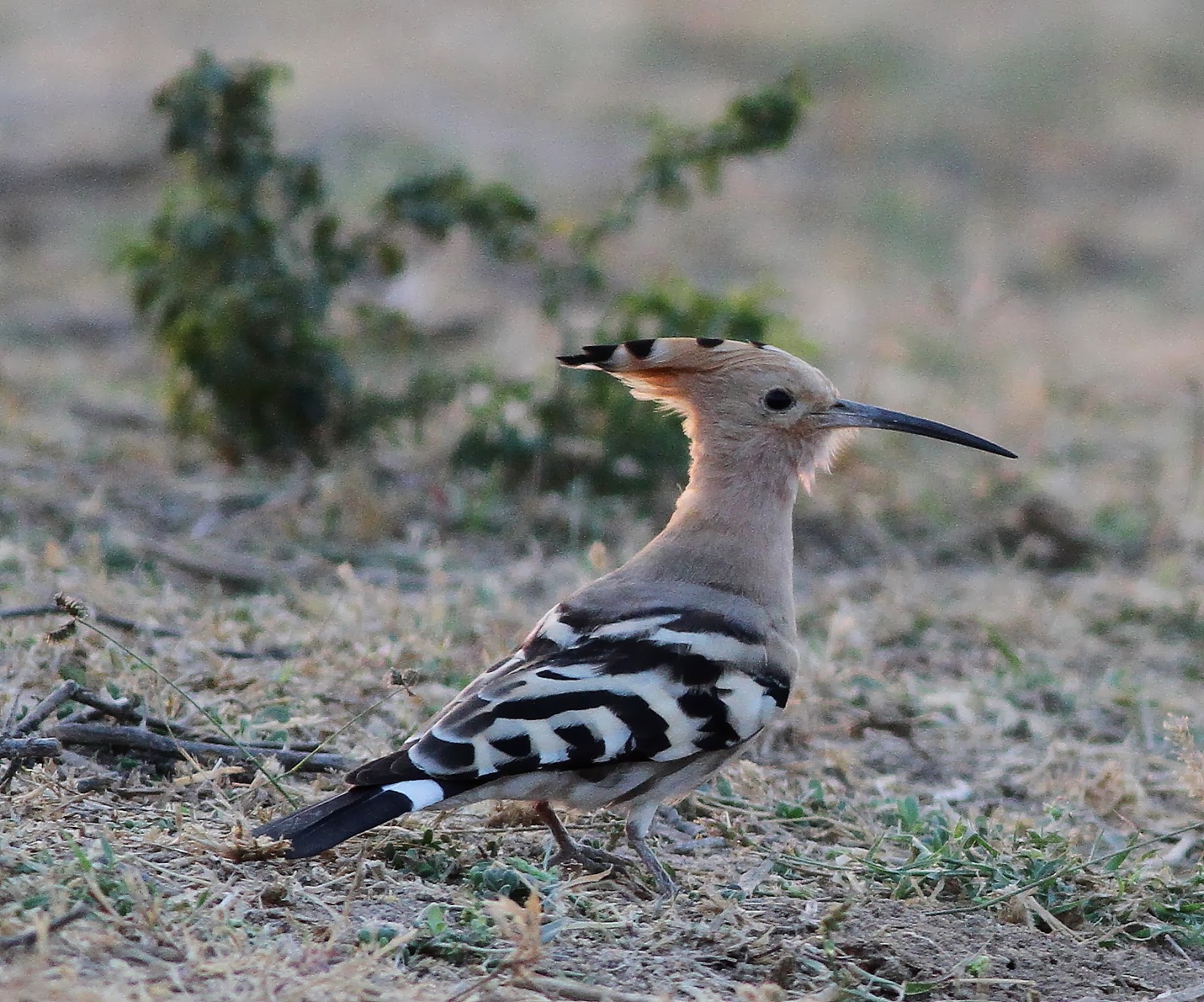
Hoopoe
Bimaculated Lark: The bulky shape, stout bill, dark streaks on the crown & mantle, pale scapulars, dark eyeline behind the eye, brown cheeks & dark chest patch all help to confirm the identification
Asian Desert Warbler
Eastern Pied Wheatear: Female
Desert Wheatear: Male
Daurian Shrike
Baya Weaver 
Grey-necked Bunting: Male
Nilgai: Distant views of this large, ungainly mammal in the heat haze
Indian Fox: Quite a striking mammal & a Subcontinent endemic (thanks to Richard Webb for the identification)
Life on the lake bed is pretty basic
Even more basic for this family