Showing posts with label White-crowned Black Wheatear. Show all posts

25 Jul 2014

25 July 14 - Photospot6 - Palearctic Wheatears

I wonder how many Birders living in the Western Palearctic don't have a soft spot for the Wheatear group. Living in Dorset, we only really see Wheatears as migrants with the very occasional bird hanging onto into the Summer suggesting they might occasionally breed. But I like seeing them as it means that when I see them, there will also be other migrants on the move. Also all the Wheatear species are great characters. The only regular species we get in the UK is the Wheatear (I don't do the trendy name of Northern Wheatear), with another 5 species having appeared once or more as vagrants. They are White-crowned Black Wheatear, Pied Wheatear, Black-eared Wheatear, Desert Wheatear & Isabelline Wheatear. Fortunately, I've managed to see them all over the years, including the only record of White-crowned Black Wheatear: which I suspect will remain high up on the wanted list of many twitchers who weren't twitching in the early 80s for many years to come.

I have been lucky this year to see a number of different Palearctic Wheatear species in Gujarat & Rajasthan parts of India, Morocco & the Western Sahara, Israel & Croatia. They have all appeared on this blog in various posts (or are new Croatian photos), but I thought I would bring them all together in one post, as I'm sure I won't be the only person who thinks the Wheatear group are great. So sit back & enjoy. The backgrounds are all bright & sunny, which goes with the current UK weather. Ironic as when I started writing this post it was bright & sunny and as I come back to put the finishing touches to it, I can hear the rumble of thunder.
White-crowned Black Wheatear: Adult. Eilat Mountains, Israel (10 April 14). This photo had the approval of the local Israel army checkpoint guys
White-crowned Black Wheatear: 1st Winter bird. Aoussard Road, Western Sahara (8 Feb 14). The black crown with a single white crown feather indicated this was an immature bird. The tail pattern was checked & found that the black was primarily on the black central tail feathers & did not have the strong T shape (that the Black Wheatears have)
Black Wheatear: Dakhla Bay, Western Sahara (11 Feb 14). The brown plumage & broad T shaped tail pattern, confirmed the identification
Wheatear: Aoussard Road, Western Sahara (12 Feb 14). A nice bright male showing off its tail pattern
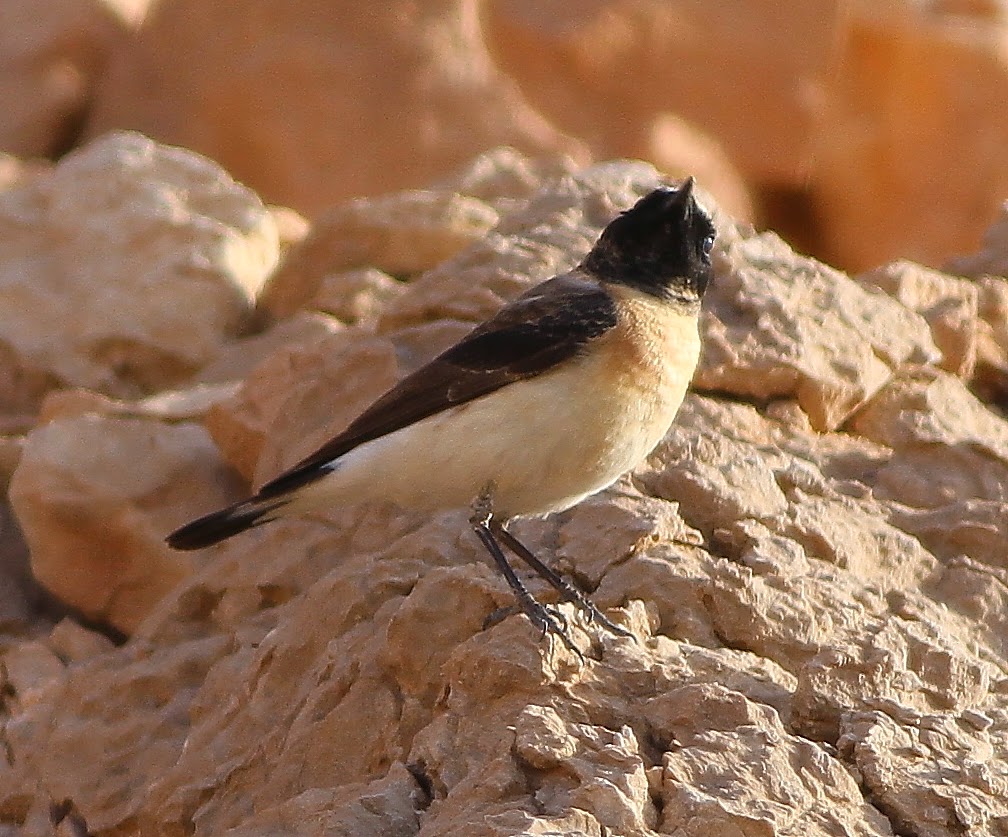
Wheatear: Ne'ot Smadar, Israel (12 April 14). Female
Wheatear: California Farm, Swanage, Dorset (2 May 14). Guess I had better sneak in a shot from the UK
Eastern Pied Wheatear: Desert Coursers, Gujarat, India (15 Jan 14). Also known as Variable Wheatear as there are 3 distinct colour forms across its range. This is the picata form
Eastern Pied Wheatear: Desert Coursers, Gujarat, India (16 Jan 14). This is the picata form 
Eastern Pied Wheatear: CEDO, Gujarat, India (20 Jan 14). Male of the picata form transforming into adult plumage
Eastern Pied Wheatear: Tal Chappar, Rajasthan, India (25 Jan 14). This is the opistholeuca form & would normally winter in Northern Pakistan, rather than Gujarat
Red-rumped Wheatear: Male. Tan-Tan, Morocco (6 Feb 14). This is the moesta subspecies which occurs from Western Sahara to Egypt
Red-rumped Wheatear: Female. Tan-Tan, Morocco (6 Feb 14)
Black-eared Wheatear: Beit Yatir, Israel (8 April 14). Male. Eastern melanoleuca subspecies
Black-eared Wheatear: Male. Amran Pillars, Israel (10 April 14). Eastern melanoleuca subspecies
Black-eared Wheatear: Male. Velji Do, Croatia (5 May 14). Eastern melanoleuca subspecies
Black-eared Wheatear: Female. Velji Do, Croatia (5 May 14). Eastern melanoleuca subspecies
Persian Red-tailed Wheatear: CEDO, Gujarat, India (20 Jan 14). This is the Red-tailed chrysopygia subspecies. Note, the pale grey upperparts & slim, weak build for a Wheatear. This bird was wintering on a small Kopje (a small stony hill on the sandy plain)
Persian Red-tailed Wheatear: CEDO, Gujarat, India (20 Jan 14). It occurs from Transcaucasia to Afghanistan & winters in Pakistan & NW India. This is the Eastern of the two species (the Western xanthoprymna species being the one that occurs in Turkey and is now split as the monotypic Kurdish Wheatear
Desert Wheatear: Desert Coursers, Gujarat, India (16 Jan 14). This is the atrogularis subspecies (which is combined with the nominate deserti by some authors)
Desert Wheatear: CEDO, Gujarat, India (20 Jan 14). This is the atrogularis subspecies
Desert Wheatear: Aoussard Road, Western Sahara (8 Feb 14). This is the homochroa subspecies which occurs from Western Sahara to Egypt
Isabelline Wheatear: Tal Chappar, Rajasthan, India (24 Jan 14). Note, the upright stance & heavy bill
Isabelline Wheatear: Tal Chappar, Rajasthan, India (25 Jan 14). Note the black tail, uniform pale upperparts, black alula, and heavy bill & head
Unfortunately, there are a few gaps here. I did see a Hooded Wheatear, but right next to the Israeli-Egyptian border & an Isreali road checkpoint. The army guys on the checkpoint weren't worried about us being there, but were insistent no cameras were used along the border. They did check my camera earlier that day, but fortunately, they were happy with the White-crowned Black Wheatear (above) & didn't look further. As for the other gaps, hopefully I will get to fill some of those in the next few years & maybe give me the opportunity to republish this post.

10 Apr 2014

10 April 14 - Finding A Rare Wader

It was another early start as you can never have enough early starts when you're on holiday. First stop was back to Eilat's North Beach to see if we could get better views of the White-cheeked Terns. In one word - No: didn't even see them.
The lads on the beach
Squacco Heron: At least this bird was around to photograph
Squacco Heron
Indian House Crow: There was one or two around
It was fairly quiet, so we quickly headed onto the km 20 saline ponds. Scanning the Waders on the Southern pool showed there was a interesting pale Phalarope feeding with the main group of Waders. Was waiting to get a chance to have a look through one of the scopes (didn't take a tripod for my small scope which was in the car anyway), when Simon called it as a Grey Phalarope. We all had a look at it & didn't think too much of the record, other than it was a new bird since we were there the previous day. At that point, Itai arrived & we mentioned it and I was a little surprised when he said he was about to send out a rare bird alert on it: as it's a vagrant & description bird for Israel. Not really sure if we found it or not, as there had been some other birders there when we arrived, but they had moved on, by the time we got to the Grey Phalarope area.
Grey Phalraope: I'm not sure how many records there have been, but sounds like it's no more than about 30 records. The Israelis call this Red Phalarope (following the American name), but the British name is clearly more appropriate for this bird
Red-necked Phalarope: This is the common Phalarope with several present on each visit
It was a quick dash back to the hotel for breakfast, before they stopped serving it. Feeling refreshed, the next stop was the car park next to Dolphin Reef for another look for the Little Green Heron. After a while, both birds appeared, but too far away for a photo. While we were waiting, we watched some White-eyed Gulls on the Dolphin Reef pontoon.
White-eyed Gull: Adult. This Gull has a restricted range of the Red Sea & the Gulf of Aqaba to Yeman
We headed off on the Eilat Mountains road to look for the Hooded Wheatear that was around an army checkpoint on the road. It doesn't take long for the scenery to get very arid. The soldiers on the checkpoint were fairly relaxed about us birding there, but warned us not to take photos of the Egyptian border fence. We spent about a couple of hours looking around the wider area, but no sign of the Hooded Wheatear.
The mountains are very arid
Looking back to Eilat
Bird hide: Israeli Army style (small). They didn't tell us we couldn't photograph the gun emplacements (but the photo was taken through the car window to avoid any hassle with the army)
White-crowned Black Wheatear: Fortunately, this bird was sitting on a road sign near the border fence, but sufficiently far enough away to get away with a photo. When the army checked the camera, they were impressed with the photo & didn't ask to look at the other photos so I got away with the bird hide photo
Selfies are all the rage these days: Proving I'm not too old to take one (badly)
Late afternoon saw us heading off to the Amran Pillars. A scenic site a few kms further north of the km 20 water tanks & on the West side of the road, but didn't see a lot of birds there. After that we headed down to the fresh water tanks at km 19 to look for Lichtenstein's Sandgrouse, but there were a lot of other people there along with a local nature tour group. The Lichtenstein's Sandgrouse did appear, but right on last light.
Amran Pillars: The pillars are tucked away at the top of this dried wadi
Amran Pillars: The geology is fairly complex here
Amran Pillars: Finally the Pillars
Sand Partridge
Black-eared Wheatear: Not the first bird seen in Israel keeping a careful eye on the skies. Not surprising with the numbers of Raptors moving North

8 Feb 2014

8 Feb 14 - Suddenly Cricket Becomes Interesting

It was an uncivilised 04:00 departure from the hotel. After getting past the 3 police checkpoints we had covered the first 50 kms from the hotel to the start of the road heading inland to Aoussard. This is also known as Awsard, but I will stick to Aoussard in this blog. Soon we were spotlighting on both sides of the road to Aoussard. We managed to see a few Lesser Egyptian Jerboas which are excellent small mammals: they look like a small Gerbil with long legs and an even longer tail. When disturbed they hop rapidly over the ground like miniature Kangaroos. There were also a few unidentified Gerbils and a large African Savanna Hare. Unfortunately, I failed to get any worthwhile photos of these mammals. Despite the early start it was getting light soon after 07:00.
Sunrise over the Aoussard road
A Warning sign: No problems understanding this warning
The sign was right
This sign was trickier: But it means 'Warning - deposits of sand blown onto the road'. Due to the constant strong wind, there were a couple of places where there was sand on the road, but it not enough to be a problem 
As the sun came up, we switched to from looking for mammals to birds. It was apparent as we drove down the road, that the desert in this area was quite variable. In places, it was quite sandy, in other areas more stoney. Also the amount of vegetation changed. This partially explains why the bird & mammal sightings are grouped around certain hotspots along the road. I suspect in some cases that is where people have seen something good & others have focused their attention on the same places on subsequent trips, to the detriment of other parts of the road. This is probably more the case with some of the birds. With the mammals, the searching is by spotlights from the cars and the early trips would have probably covered the road more consistently. However, a lot of the Larks & other desert Passerines, have been found by people walking around & as the road is 140 miles long, I'm sure there are a lot of interesting areas that have never been checked by birders. That said, there are some key areas which are clearly focus points for birds. There is a small waterhole next to a pumping station at Gleb Jidane at km 21 (all distances are from the start of the road) which is well worth a visit. There are also a rubbish tip at km 119 next to a small military post, which was good for Desert Sparrows. Much closer to Aoussard, there are a couple of places where bands of Acacia trees & more luxuriant grassland cross the road. While completely dry while we were there, it looks like there must occasionally be water in this area on the rare occasions it rains. One of these is Oued Jenna at km 192 which is the main birding site along the road.
Closer to Aoussard are these hills: I wonder if birders have ever been able to explore them?
Another hill
As I was reading up about this trip, there were a number of warnings about landlines. The area close to Aoussard had clearly been close to the front line in the fighting between the Moroccan army & the separatists, in the past. As a result there had apparently been a lot of mines laid & never cleared. The general consensus is to the West of Aoussard wasn't mined. Seeing a large ongoing military exercise to the West of Aoussard, was another indication that that area was safe. But beyond Aoussard is clearly a different case as we saw warning signs telling us not to leave the road soon after leaving the town. I've birded in the past close to minefields, in Israel & Zimbabwe, but these have been fenced off areas & clearly signed. Here there is nothing to stop you walking off the road, apart from these few warning signs.
This sign beyond Aoussard is pretty clear
As we were driving towards Aoussard, we saw our first party of Cream-coloured Coursers & some more Hoopoe Larks. We didn't encounter many Cream-coloured Coursers or Stone-curlews, but every time we did, there was always a group, rather than just a lone individual. The following photos were taken between about km 100 and Aoussard.
Lanner Falcon: This is the erlangeri subspecies which occurs in Mauritania, Morocco & Tunisia
Lanner Falcon
Lanner Falcon
Cream-coloured Courser: This is the nominate cursor subspecies which ranges from the Canaries, across North Africa to the Arabian Peninsula
Hoopoe Lark
Bar-tailed Desert Lark
African Desert Warbler: Another perfectly camouflaged desert species
White-crowned Black Wheatear: Immature birds, like this one at Aoussard, have black crowns. A quick check of the tail pattern will confirm the solid black is only on the central tail feathers & does not form a strong T shape as found in Black Wheatears
Desert Wheatear: This is the homochroa subspecies which is found as far East as Egypt
Desert Sparrow: Part of the approximately 50 strong flock at km 119. Surely the best looking Sparrow 
Desert Sparrow: Male at Oued Jenna. This is the saharae subspecies with the nominate subspecies being found further South in the Sahara
Desert Sparrow: A pale sandy female showing her wing pattern in a bigger flock of males
Until I read the Punkbirders report, had you asked me if there was anything interesting about the word Cricket, then all I could have to told you about were members of the order Orthoptera (Grasshoppers, Crickets & Bush Crickets). I certainly wouldn't be considering that dull game that goes on for days & where half the supporters start praying the weather will force a draw, when their team is losing. But now I realise from the Punks there is also Cricket Longtail. Most birders who have travelled to Southern Europe, Asia or Africa will have come across members of the Prinia & Cisticola family. They are generally dull Warblers inhabiting grassland & scrubby habitats with songs resembling Crickets and Grasshoppers. Not so Cricket Longtail. It was probably the main reason for coming to the Western Sahara & it's a stunning Warbler.
Cricket Longtail: This has a wide range from Mauritania to Senegal & Mali and across to central Sudan & Northern Eithopia. It is right on the edge of it's range in the Western Sahara & as a bonus just into the Western Palearctic
Cricket Longtail: They move around the Acacias in family parties so when you find them you get an excited group
Uromastyx dispar: Please let me know if you believe it's one of the other Uromastyx lizards. This medium sized lizard was enjoying the safety of sitting under the beware of mines sign
Dumeril's Fringe-fingered Lizard
Desert Locust