A week earlier I had responded to a request for a replacement ORCA surveyor on a trip to St Mary's on 11 Oct. It didn't take more than a few seconds before I said I was available. I left early for the early hours' drive to Penzance: as there had been overnight road closure signs for October, when I drove down for the Cornish Northern Harrier. In the end, the road closures were restricted to a closure where I had to exit the A30 & immediately re-join the road. I was in Penzance nice & early for the sailing. As we got closer to the boarding time, the team leader, Phil Taylor & the third surveyor, Mike Taylor (no relation) appeared. it turns out that Mike had trained Phil, who had recently qualified as a team leader. Both lived in Cornwall & were very use to trips on the Scillonian.
We left on time & we quickly started the ORCA survey. The sea wasn't as choppy as I expected, but a stiff SW wind wasn't helping, especially as we were surveying from the outer bridge deck. But we managed to find positions on the outer bridge deck to survey from. The crossing out was good: I saw ten Short-beaked Common Dolphins and another five Dolphins that appeared too briefly to identify. There were still reasonable numbers of large Shearwaters with at least one hundred and fifteen Cory's Shearwaters, ten Great Shearwaters, two Sooty Shearwaters and a few Manx Shearwaters. There were another twenty five large Shearwaters sp. that I didn't spent more than a few seconds looking at, as we were there to survey for Cetaceans, not Seabirds. Other highlights included six Storm-petrels and an Arctic Skua. Fortunately, we encountered a mixed Shearwater flock off the Scillies, when I was the recorder: which allowed me the chance for a bit of photography.
A nice Shearwater montage: Sooty Shearwater, Great Shearwater & Cory's Shearwater
A close up of the Sooty Shearwater
Great Shearwater: I do like Great Shearwaters
Great Shearwater: It's always a treat to see them in UK waters
Great Shearwater with a trailing Cory's Shearwater
Cory's Shearwater: It's unusual for Cory's Shearwaters to still be in Scillies waters in October
Cory's Shearwater: All the ones I looked at looked to be regular Cory's Shearwaters
We arrived at the Hugh Town quayside on time. This gave me about three hours for Birding on St Mary's. I said goodbye to the others, as we had all planned different activities for our time on St Mary's.
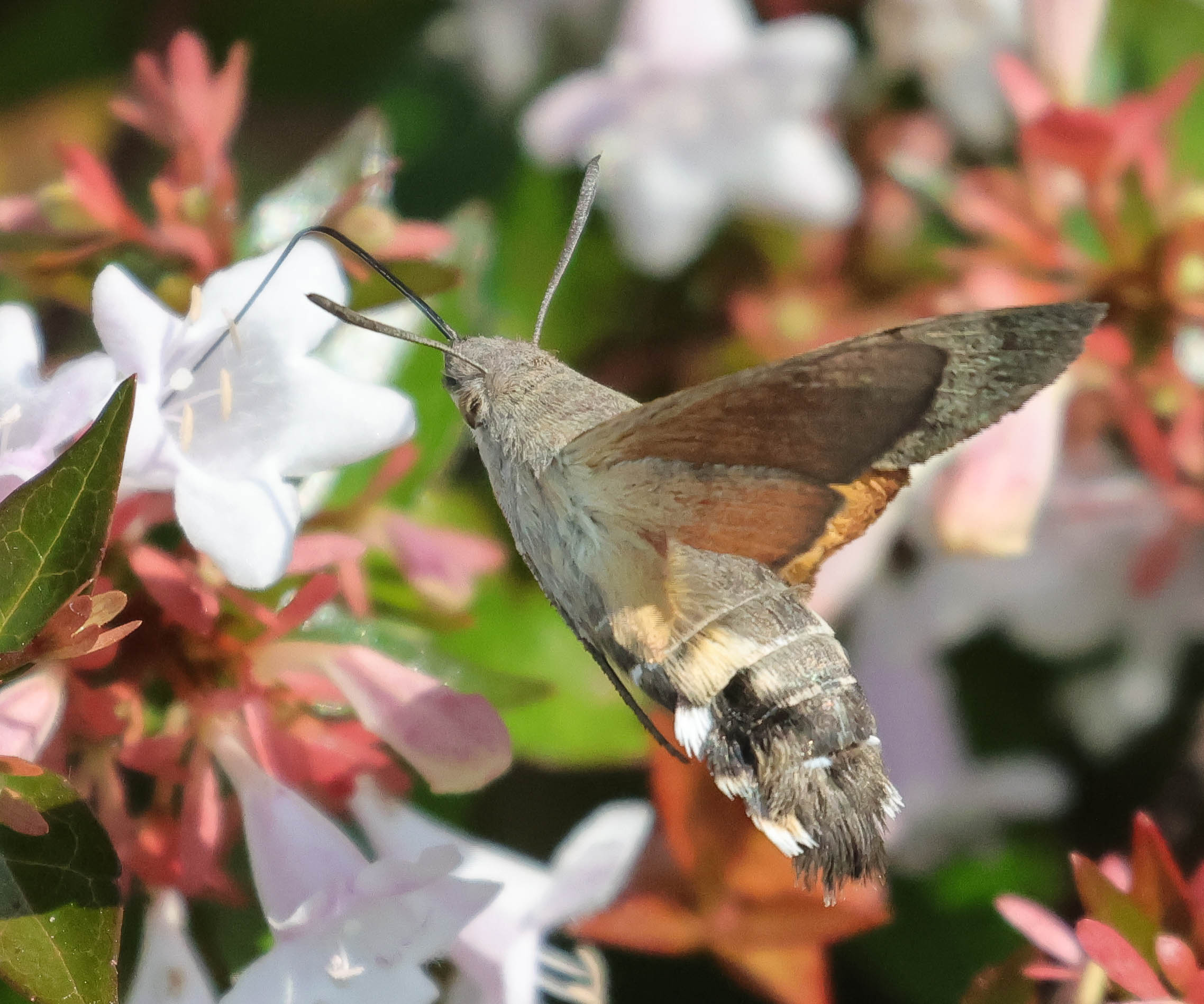
I checked RBA on my mobile as we arrived and there were no major rarities on the islands. I decided to head out to check the Old Churchyard, before crossing Lower Moors & having a look at Porthloo Lane. This took in some of my favourite old stamping grounds when I used to stay on St Mary's back in the 80s. The island appeared very quiet and in that walk, I was disappointed to not even see a Warbler or Crest. The highlight was seeing my first White-speck that flew up from the churchyard, before landing again. Unfortunately, it hadn't settled down when it landed & was soon on its way again.
White-speck: I was struggling to figure out what this Moth was & wasn't surprised to find the reason why: is was a Moth Tick
I carried on & bumped into a small crowd by the ex-Old Town cafe. I hadn't bothered to pay any attention to where the scarce species were when I checked RBA, so I wasn't sure what was where on the islands. I asked the first Birder & got told, "It's on the fence". It was & it was a nice Wryneck sat fully in the open, until I raised the camera: at which point it flew into the back gardens of the bungalows. I wasn't going to hang around for longer views, so headed on to check the Lower Moors hide. Sure enough there was a Jack Snipe in front of the hide. No real surprise that one was on view, given this hide must be one of the best places in the country to see a Jack Snipe in the open.
After getting some photos, I carried on along the Lower Moors path. I wasn't surprised to note that only about five of the fifty plus Birders I saw that day were actually looking. I wonder what would be found if some actually looked, rather than just walking between somebody else's Birds. But that isn't much better than the twenty percent of people Birding on the islands that I remember from the 80s. But too be fair, there were probably more Birders looking elsewhere on the other islands, or they had already checked my route & moved on elsewhere on St Mary's. I bumped into a Spotted Flycatcher which was proof there were a few migrants tucked away on the island. I was running out of time, so I decided to knock the Birding on the head, pick up a coffee for the return journey and meet Phil & Mike on the quayside.
Mike Taylor (left) & Phil Taylor as we were leaving Hugh Town
The wind had eased and the skies were nice & overcast: which were helpful conditions for the survey. I saw another six Short-beaked Common Dolphins, a Risso's Dolphin & 2 Harbour Porpoises on the return trip.
Short-beaked Common Dolphin: The priority on seeing a Cetacean is to alert the recorder, note the angle from the ship's course and how far they are below the horizon on the ORCA binoculars (which have a vertical scale in the right eye-piece)
Short-beaked Common Dolphin: Having passed the details of the species, number of individuals, their initial position, course & behaviour to the recorder, there is rarely time for any photographs. So, it was nice to be able to get a couple of shots of one of the Short-beaked Common Dolphins
Again, there were over a hundred Cory's Shearwaters, along with a handful of Great Shearwaters, Sooty Shearwaters, Manx Shearwaters, two Storm-petrels and a Bonxie.
Sooty Shearwater: This Sooty Shearwater wasn't impressed that the Scillonian was heading straight for it
Far too quickly, we could see Mousehole and the survey was coming to an end as the light gave out. It had been a long, but enjoyable day. We had been lucky with the weather on the return trip, as the forecast was for rain setting in during the late afternoon. Fortunately, the timing worked out perfectly and the rain didn't set in until I reached the chippy at the Hayle. The rain didn't ease for the rest of the drive back to Dorset. With two sets of road closures and over an hour of diversions, then I ended up getting home a lot later than planned. Still better the diversions were on the return trip, than the drive to Penzance.