Showing posts with label Insect Photospot. Show all posts

28 Nov 2014

28 Nov 14 - Insect Photospot4 - Dorset Damselflies

This is the second Dragonfly Photospot, covering the Damselflies & Demoiselles that are found in Dorset. The main aim is to give the readers an appreciation of the variety of species that can be seen in Dorset, rather than focusing on the identification. There are plenty more photos of these species as well as useful identification features in earlier Posts: just click on the Label links on the right hand side of the Blog.
Banded Demoiselle: Male. This is a common species on a number of the clean Dorset rivers. Throop Mill (23 June 14)
Banded Demoiselle: Female. White Mill, Sturminster Marshall (28 June 14)
Beautiful Demoiselle: Male. This is more of a heathland pond species. Rempstone Forest (3 Aug 14)
Emerald Damselfly: Male. Currently, this is the only Emerald Damselfly found in Dorset, but there are other species that have recently colonised Kent & East Anglia and hopefully in time, they will reach Dorset. Rempstone Forest (3 Aug 14)
Emerald Damselfly: Female. Rempstone Forest (3 Aug 14)
White-legged Damselfly: Male. Canford School Water Meadows (29 June 14)
White-legged Damselfly: Female. Canford School Water Meadows (29 June 14)
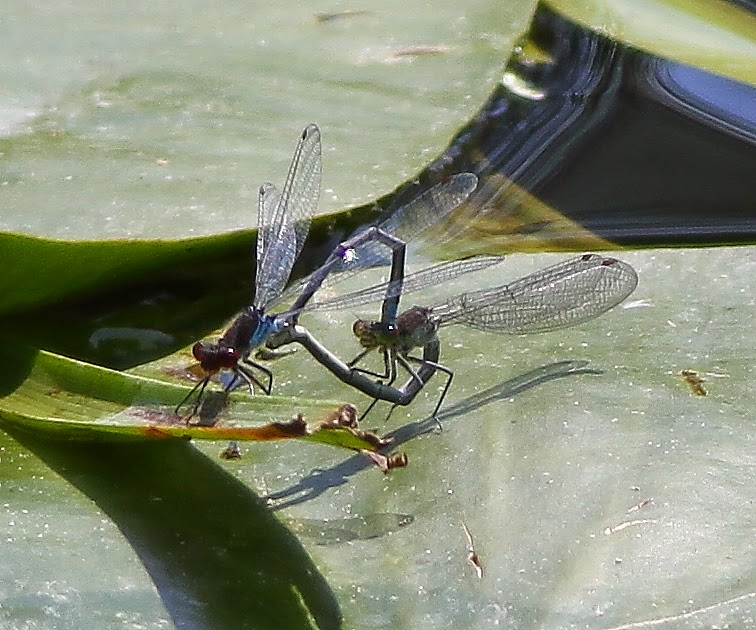
Red-eyed Damselfly: This species seems to really like resting on water lilies well away from the water's edge. Throop Mill (23 June 14)
Red-eyed Damselfly: Mating Pair. Throop Mill (23 June 14)
Small Red-eyed Damselfly: This species is less widespread than Red-eyed Damselfly in Dorset with the Weymouth area being one of the more reliable sites to see it. It is a species I have yet to photograph
Large Red Damselfly: East Holme Water Meadows (6 June 14)
Large Red Damselfly: Mating Pair. Brownsea (21 June 14)
Small Red Damselfly: This species is smaller & daintier than Large Red Damselfly and is a heathland specialist. Arne (11 July 14)
Blue-tailed Damselfly: This is the common Blue-tailed Damselfly species in Dorset. Bestwall (19 June 14)
Scarce Blue-tailed Damselfly: This is a rarer of the two Blue-tailed Damselfly species in Dorset with a limited number of sites. It likes good boggy conditions or habitats with open edges to water and doesn't seem to be much of a flier compared to its commoner relative (4 Aug 14)
Common Blue Damselfly: Male. White Mill, Sturminster Marshall (28 June 14)
Azure Damselfly: Arne (8 June 14)
Southern Damselfly: This is the scarce species of the three Blue Damselflies. The main features to separate the 3 Dorset Blue Damselflies can be found here (9 July 12)

27 Nov 2014

27 Nov 14 - Insect Photospot3 - Dorset Dragonflies

Following on from the Butterfly Photospots, then now is a good time to look back on my other big Insect passion this Summer: the Dragonflies. I've really enjoyed looking at the Dragonflies & Damselflies. I have been looking at Dragonflies for the last few years now, after initially dabbling with the first Dragonflies back in my university days for a few years. However, it is only really this year that I think I've really got a good grasp on their identification features & I have been generally able to recall the features from memory, without having to dig out the field guides. I have still got a long way to go to get more knowledgeable, but it has been fun improving my knowledge significantly this year. So here is a Photospot on the Dorset Dragonflies. I will cover Dorset Damselflies & Demoiselles in another Photospot. Both Photospots are designed to give the readers an appreciation of the variety of species that can be seen, rather than focusing on the identification. There are plenty more photos of these species as well as useful identification features in earlier Posts: just click on the Label links on the right hand side of the Blog.
Emperor Dragonfly: Female egg-laying. This is one of the larger Dragonfly species & can be commonly found in Dorset over Summer
Living in Dorset is a real privilege as it is one of the best counties for seeing  Dragonflies on your doorstep. We have such a good selection of heaths, clean rivers & freshwater lakes that allows a great variety of species to be seen. They are not always straight-forward to identify, but that's part of the fun. Having a camera is one of the best ways to help identify them as it is a good idea to get some photos & then compare them against the book. The photos taken before Oct 13 were taken with an inexpensive Lumix camera, whereas the photos taken after that date were with the Canon 7D and usually a 15-85 Macro lens, although some of the more distant shots were taken with the 400mm f5.6 lens.
Banded Demoiselle: Male. The Demoiselles will be covered in the next post. An out of county photo from Goring-on-Thames (13 June 14)
There are a couple & inexpensive of excellent field guides to get you started:-
The Field Guide to the Dragonflies and Damselflies of Great Britain and Ireland by Steve Brooks and Richard Lewington
Watching British Dragonflies by Steve Dudley, Caroline Dudley and Andrew Mackay
Both of these field guides provides excellent identification sections for each species as well as some cracking illustrations. A few of the vagrant species are not covered in the latter guide, but it has a lot of good site directions and species to help you find all of the regular UK species.
Common Blue Damselfly: The Damselflies will also be covered in the next post
One thing I have learnt this year, is it a good idea to get photos from as many different angles as possible. So while a top down view will provide a good in focus photo, it might not provide all the features. Often a side view of the thorax & abdomen is important to get & sometimes a face on view is also needed. The other good thing about photos taken with a good digital camera, is it allows some of the key features to be quickly zoomed up on the back of the camera to see those fine details, that might not be as easy to see in the field. Most of the Dragonflies & Damselflies are approachable with care, although some of the Hawkers can be really challenging to get a perched photo. The other good thing is like the Butterflies, you can often get some good photos with a relatively cheap digital camera, providing it can cope with close focus. Then you just need to learn how to get close without flushing your subject.
Southern Hawker: Adult with the larval case. Swanage (11 July 14). I was surprised to find this species egg-laying in moss next to my garden pond. I had assumed most species would lay their eggs in the water, but it seems this species lays eggs near to ponds & the eggs don't hatch until the following Spring. I guess the larva quickly move to the water at this point
Common Hawker: Despite its name this is not a common species in Dorset. I have seen it on the heaths around Studland, but failed to find any this year to photograph. It's always good to have a target for next year
Brown Hawker: Longham Lake (18 Aug 12)
Migrant Hawker: Male. This was one of the commoner Hawkers I saw this Autumn in Dorset and despite its name it breeds in Southern England (7 Aug 14)
Migrant Hawker: Female. South Haven, Studland (25 Aug 14)
Emperor Dragonfly: Bestwall (19 June 14)
Golden-ringed Dragonfly: East Holme Water Meadows (6 July 14)
Vagrant Emperor: I was lucky to hear this vagrant had gone to roost on a fence panel of one of the Weymouth Birders. Well worth twitching as I've not heard of any since in Dorset. Weymouth (11 May 11)
Hairy Dragonfly: This is easy to identify as it is the first of the Hawkers to fly. Soldiers Road, Hartland Heath (18 May 14)
Hairy Dragonfly: Mating pair. East Holme Water Meadows (12 July 14)
Downy Emerald: Morden Bog (26 May 13)
Downy Emerald: Studland (14 May 14)
Black-tailed Skimmer: Male. Brownsea (21 June 14)
Keeled Skimmer: Male. Greenlands Farm, Studland (3 Aug 14)
Keeled Skimmer: Female. Godlingston Heath (1 June 14)
Broad-bodied Chaser: Male. Higher Hyde (10 June 14)
Broad-bodied Chaser: Female. East Holme Water Meadows (6 July 14)
Four-spotted Chaser: Brownsea (21 June 14)
Scarce Chaser: Male. East Holme Water Meadows (12 June 14)
Scarce Chaser: Female. East Holme Water Meadows (12 June 14)
Black Darter: Rempstone Forest (3 Aug 14)
Ruddy Darter: Higher Hyde (11 July 14)
Ruddy Darter: South Haven, Studland (10 Sep 14)
Red-veined Darter: The only one I have seen was this individual at West Bexington (13 July 13)
Common Darter: As the name suggests this is a Common species which flies in the second half of the Summer & will typically carry on until the end of October or sometimes even later for the occasional individual. Arne (11 July 14)
Common Darter: I have covered the identification pitfalls between Common Darters & Red-veined Darters in this post. Rempstone Forest (3 Aug 14)
Additionally, Lesser Emperor & Yellow-winged Darter have occurred as vagrant Dragonflies in Dorset. I have been lucky enough to see Lesser Emperor at Longham Lakes in Aug 12 & Yellow-winged Darter at Holt Heath in 1994. I wasn't really into seeing Dragonflies for the latter species, but I'm glad I was persuaded to go & look for them, given how rare they are.

26 Nov 2014

26 Nov 14 - Insect Photospot2 - Dorset Butterflies - The Nymphalidae (Aristocrats, Fritillaries & Browns) and Skippers

This is Part 2 of my Insect Photospot on the Dorset Butterflies. A big part of the intention of these two Dorset Butterfly blog posts is to show what a good diversity of Butterflies we are lucky to have in Dorset. Another good thing is with a modesty priced Lumix camera you can get some good photos of these species, as all of the photos taken before Oct 13 demonstrates. Most of the Dorset Butterflies are either fairly common & widespread or can be found at well known sites. There are a handful of scarce breeding species in Dorset, where the site is potentially more sensitive. But all of these species can be found at well known sites in the neighbouring counties. So next January, set yourself a New Years challenge & go out & enjoy the Butterflies in your local county.
Duke of Burgundy Fritillary: Cerne Abbas (2 June 13)
Purple Emperor: Dorset (12 July 14)
White Admiral: East Blean Woods, Kent (3 July 14)
Peacock: St Aldhelms (20 July 14)
Red Admiral: Sturminster Marshall (28 June 14)
Painted Lady: St Aldhelms (20 July 14)
Painted Lady: Aberration Rogeri (14 July 14)
Small Tortoiseshell: Sturminster Marshall (28 June 14)
Comma: Alner's Gorse (27 July 14)
Silver-washed Fritillary: Male. Dorset (9 July 14)
Silver-washed Fritillary: Female. Dorset (9 July 14)
Silver-washed Fritillary: Female aberration Valesina. Dorset (9 July 14)
Dark Green Fritillary: St Aldhelms (2 July 14)
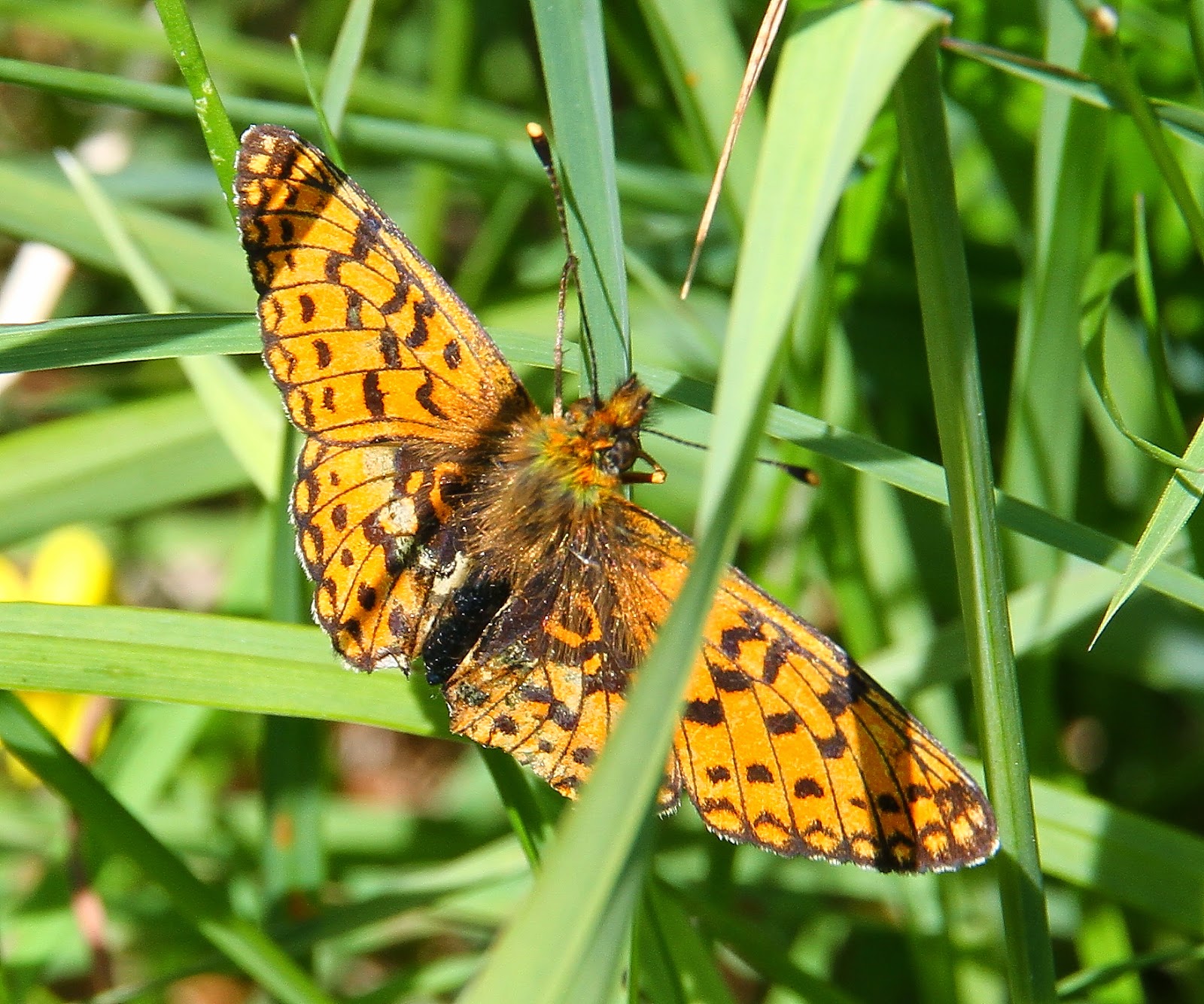
Small Pearl-bordered Fritillary: Purbeck. (9 June 14)
Marsh Fritillary: Powerstock Common (18 May 14)
Marbled White: St Aldhelms (1 July 14) 
Grayling: St Aldhelms (14 July 14)
Meadow Brown: Throop Mill (23 June 14)
Ringlet: Higher Hyde (11 June 14)
Ringlet: Alner's Gorse (27 July 14)
Gatekeeper: Dorset (9 July 14)
Gatekeeper: Soldiers Road (11 July 14)
Small Heath: Powerstock Common (17 May 14)
Speckled Wood: Old Harry (1 June 14) 
Speckled Wood: Alner's Gorse (27 July 14)
Wall: Powerstock Common (18 May 14)
Grizzled Skipper: Powerstock Common (17 May 14)
Dingy Skipper: Powerstock Common (17 May 14)
Lulworth Skipper: St Aldhelms (1 July 14)
Essex Skipper: Unfortunately, a species I have yet to photograph
Small Skipper: Higher Hyde (11 July 14)
Large Skipper: Male. St Aldhelms (1 July 14)
Silver-spotted Skipper: Fontmell Down (30 July 14)
Additionally, I've seen 3 vagrant species in Dorset: Swallowtail, Monarch & Large Tortoiseshell. Unfortunately, I've no photos of the Large Tortoiseshell which spent several days at Durlston in July 2008. I will just have to hope another one appears & hangs around in Dorset in the future.
Swallowtail: There are plenty more photos on Mugshots post of the July 2014 Swallowtails so I've used one of my favourite ones instead. This is Individual B at St Aldhelms (6 July 14)
Monarch: Easton, Portland (8 Sept 12). I've also seen them in Winspit on 2 Autumns in October 1995 & October 1999
Monarch: Easton, Portland (8 Sept 12)
Finally, there are the Map Butterflies that were found in Aug 14. This now looks like it was a deliberate release, although the person responsible is claiming it was accidental, to avoid a potential prosecution for releasing them.
Map: Swanage (Aug 14)
The majority of the UK breeding species occur in Dorset. However, the following UK breeding species do not occur or have died out in Dorset: Wood White (potentially recently died out), Black Hairstreak, Large Blue, Northern Brown Argus, High Brown Fritillary, Pearl-bordered Fritillary (has probably been lost to Dorset in the last couple of decades), Glanville Fritillary (has occurred as the Isle of Wight population has briefly expanded to the mainland), Heath Fritillary, Mountain Ringlet, Scotch Argus, Large Heath & Checkered Skipper. In addition, there is one Irish species which occurs in Northern Island & which I've not seen as I cannot justify the costs of a trip to Northern Ireland to see it: Real's Wood White.

There are a number of vagrant species to the UK which haven't occurred or have rarely occurred in Dorset. Camberwell Beauty is the one of the commonest vagrants to the UK (but mainly on the East Coast) & a species I am yet to see in the UK. There have been the occasional Camberwell Beauty records in Dorset in the 17 years I've lived in the County. The problem with seeing a Camberwell Beauty in Dorset, is some photographers are so desperate to photograph species like Camberwell Beauties is they will buy some commercially bred pupae & then release them into the UK countryside to take their photos. I do know one local Butterfly photographer (& well known Bird stringer from the 80s) was prone to doing this. Not only is this environmentally unsound, but it also significantly tarnishes the reputation of real migrants as it can be difficult to assess the vagrancy of individual Butterflies. Where there is a local appearance e.g. the St Aldhelms Swallowtails then that is a good indication they are locally bred from a Butterfly or Butterflies that arrived at an earlier date. The case is helped where there are also similar occurrence elsewhere in the UK (like the similarly timed Sussex Swallowtails).  Alternatively, a vagrant appearing in Dorset with a good supporting cast of migrant moths will support a vagrant Butterfly's case.