
After some help from my mate Kevin, I was off to try another site on Dorset's River Stour. This is further upstream on the site tried on the 23rd for White-legged Damselfly & near to the large village of Sturminster Marshall. After driving through the large village of Sturminster Marshall, the road crossed the Stour next to the White Mill. There is a small National Trust car park here. Walking upstream & away from the Mill, for about 50 metres brought me to a path leading to the river bank. Very quickly, the path opens up into the first of several fields alongside the river bank. This is the site for the White-legged Damselflies. There are a lot of Stinging Nettles alongside the river as well as areas of other plants & bushes, but the vegetation in the first field had been severely strimmed. There were excellent numbers of Banded Demoiselles along the full length
of the main river bank with about 10 or so Scarce Chasers in the first field & an Emperor Dragonfly hawking over the river. The path then carried in into a couple of short grass Cow fields. The Stinging Nettles along the riverbed edge of the fields were good for Banded Demoiselles, but little else.


 The side field: This looked more interesting habitat & I did finally see one White-legged Damselfly in the long grass, with a couple of immature female Common Blue Damselflies
 Common Blue Damselfly: Male. Nice & easy to identify as lots of blue on the abdomen and the head & shoulders marking on the second segment (which separates it from the other small blue Damselflies)
 Common Blue Damselfly: Immature female Common Blue Damselfly. Mature adult females would still be as bright blue as the males. They have this missile like marking on their abdomen and crucially some white on the legs
 Common Blue Damselfly: Another photos of the immature female Common Blue Damselfly. Again note the white on the legs
 White-legged Damselfly: The legs are more white, the tops of the eyes are blue & the pterostigma markings are light brown (black on Common Blue Damselfly)
The Scarce Chasers & the Banded Demoiselles were dominating the main river bank. The Scarce Chasers were very active and rarely settled. When they did settle, they would fly at the slightest movement even several metres from them. When they met another male, both would go an impressively fast vertical climb for about 20 metres, in an attempt to other climb each other.
White-legged Damselfly: The legs are more white, the tops of the eyes are blue & the pterostigma markings are light brown (black on Common Blue Damselfly)
The Scarce Chasers & the Banded Demoiselles were dominating the main river bank. The Scarce Chasers were very active and rarely settled. When they did settle, they would fly at the slightest movement even several metres from them. When they met another male, both would go an impressively fast vertical climb for about 20 metres, in an attempt to other climb each other.
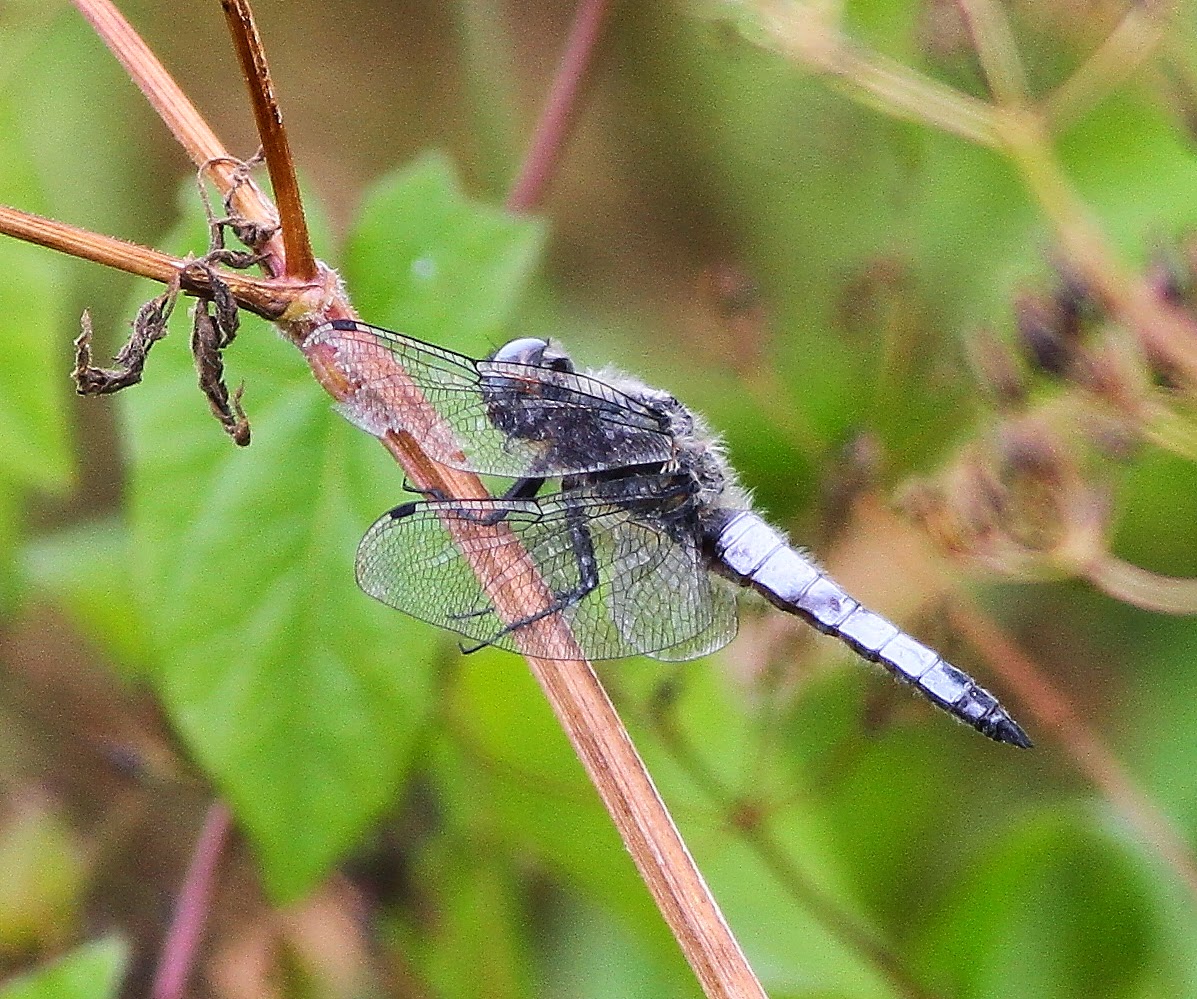 Scarce Chaser: Male. Due to the angle of this photo it's not possible to see the black base to the hind wing. However, the lack of yellow-orange edges to the sides of the abdomen & the dark pterostigma still confirms it is a Scarce Chaser
 Scarce Chaser: Male. This tatty male shows how limited the black on the hind wing is the Scarce Chasers here
 Scarce Chaser: Male. Finally a head on view
 Banded Demoiselle: Male
 Banded Demoiselle: Female. We think they look great, the Bug this female is eating wouldn't have agreed they are anything other than dangerous predators
 Banded Demoiselle: Female. I couldn't resist a final photo
The sunny conditions were also good for Butterflies. There were reasonable numbers of Small Tortoiseshells, a few Red Admirals & Meadow Browns & a Green-veined White.
Banded Demoiselle: Female. I couldn't resist a final photo
The sunny conditions were also good for Butterflies. There were reasonable numbers of Small Tortoiseshells, a few Red Admirals & Meadow Browns & a Green-veined White.


Looking downriver along the main river bank
Looking upriver along the main river bank
 Little Egret: Closer to the Mill. Once a national rarity, now a common sight in Dorset
 Mallard: Male entering its dull eclipse plumage which they adopt during their moult phase (when the replace their feathers)
By the entrance into the first Cow field, there is an alternative path into long, thin sided field of rough grass with a sloping bank alongside an overgrown ditch. There were about 6 Common Blue Damselflies & one White-legged Damselfly in the long grass in this field. Despite checking the book before I left the house, I ended up failing to appreciate the potential confusion of the immature female Common Blue Damselfly (which look different from the mature blue females). As a result, I ended photographing a couple of Damselflies, thinking they were White-legged Damselfies, which I later reidentified as Common Blue Damselflies (when I checked the photos against the book). I did manage to see & photograph a real White-legged Damselfly, but the photos aren't as good as they would have been, had I realised my error at the time: as I would have spent longer photographing it. Still I always think you learn, & more importantly remember, more by making these mistakes. It also shows the importance of having a camera to get some photos of these insects to be able to check all the features.
Green-veined White
Red Admiral
Red Admiral: They become a lot more cryptic when they close their wings up
Small Tortoiseshell: Although not as common as they were when I was a kid, this species seems to be around in better numbers than recent years


