Showing posts with label Round-leaved Sundew. Show all posts

26 Jul 2018

26 Jul 18 - UK Sundews

After seeing the Sooty Tern, I decided to head West to the Loch Garton area to look for some of the speciality Scottish Dragonflies: Azure Hawker (slim chance), Northern Emerald & Northern Damselfly. All of these would typically be still flying in the second half of July, although it was close to the end of their flying seasons. There were several sites in the Loch Garton area. By the time I arrived, it was early evening & had cooling down quite a bit. However, at least there was no sign of the cold Easterly breeze from the Ythan estuary. There were quite a few Emerald Damselflies going to roost in the long grass & sedges around the pools & a single Common Hawker, which was far too active.
Common Hawker: I was pleased to see this individual at Loch Garton, as I had been unsuccessfully looking for Common Hawkers on my Studland patch in the previous week (where they are a scarce species) (25 Jul 18)
Emerald Damselfly: Female. There are no identification problems here as the other Emerald Damselfly species that occur in the South East of England haven't made it as far as Scotland (yet). Boat of Garton (25 Jul 18)
The plan for the second day in Scotland had been to try getting out on a rib from Gairloch to look for Minke Whales, Short-beaked Common Dolphins & Harbour Porpoise. All three species were being seen regularly on the trips from Gairloch. Given it was a last minute trip to Scotland, I didn't have a booking, but thought I would try my luck by turning up first thing at Gairloch harbour. Not having a booking wasn't a problem, as due to the expectation of strong winds, all the rib trips for the day had been cancelled. Not deterred, I headed to the nearby coastline to the North of Gairloch where I could scan over the sea looking towards the Northern end of Skye & the distance island of Harris & Lewis. A good scan failed to produce any Cetaceans during the morning, but it was a great view. I will be back on a future Scottish trip.
The view looking towards Skye (to the left) and distantly Harris & Lewis (to the right of the photo)
Gairloch is well placed for another of the good Scottish Dragonfly sites I wanted to visit. This was the Bridge of Grudie on Loch Maree which lies alongside the road to Gairloch. Again, the Dragonflies were disappointing with a reasonable number of Emerald Damselflies & a lone patrolling Common Hawker. It certainly seemed that the good summer has meant that the Scottish Summer speciality Dragonflies had gone over early. 
Loch Maree: Looking over to Slioch (3218 ft) which is one of the 282 Monros in the UK
The Sphagnum bog at Bridge of Grudie on the South East side of Loch Maree
I was pleased to see there were some Sundews in the bogs at the Bridge of Grudie on the South Eastern side of Loch Maree. I've never been that interested in Flowers, except for Orchids. However, I am more interested in Sundews given they are carnivorous plants. These Sundews had long, thin leaves, instead of the small round leaves of Round-leaved Sundews. Checking the photos has confirmed that these were Great Sundews.
Great Sundew: I will have to look harder locally as they also occur in the Dorset & New Forest bogs. They also occur on some of the East Anglian heaths, West Wales, the Northern Welsh borders & West Scotland
I am used to seeing Round-leaved Sundews around my local heathland bogs.
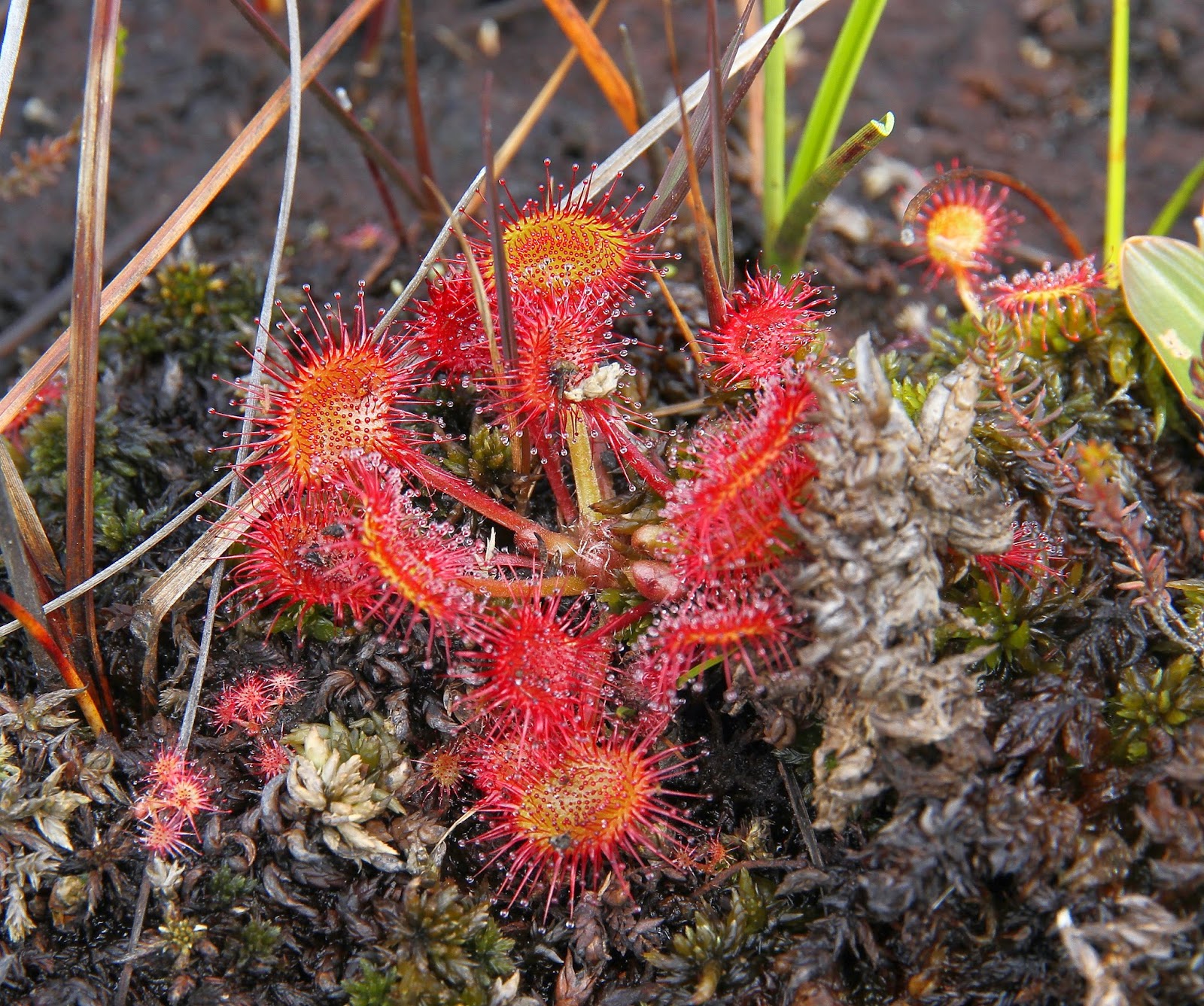
Round-leaved Sundew: This is a common species in the Dorset & New Forest bogs like these at Latchmore Brook in the New Forest (23 Jun 14)
Round-leaved Sundew: They are also commonly found in Wales, the Lakes, the East Anglian coastal heaths & Scotland. These were photographed in Dorset (4 Aug 14)
Round-leaved Sundew: Showing how the sticky droplets trap insects like this unfortunate Large Red Damselfly which are ultimately digested. Foulshaw Mere (5 Jun 18)
Finally, it was time to head home to Dorset. It was clear that I wasn't going to make it home in one journey without driving through the night, so I planned to find somewhere to kip en route. In the end the decision of where to stop was taken for me, as the M6 was closed in the Blackpool area & the warning signs as I headed South changed from a 2 hour to a 3 hour delay. Clearly, this looked like a major accident in the area. So, I decided to pull off the M6 as I passed the Lake District & head for Ullswater. There were a number of laybys next to the lake which looked quiet enough to get some sleep. It proved not only a good night's sleep, but an incredibly pretty view in the morning.
The view of Ullswater from the hotel window: I will have to explore this area on a future trip
The hotel was in need of a clean: Old school twitching hotel
It clearly was a good idea to abandon the overnight drive home at Ullswater as the following morning, the M6 was still closed around Blackpool & there would have been very long delays in the area. I was well placed to pop over the Northern Pennines to Scotch Corner & drive home down the A1/M1 route.

5 Jun 2018

5 Jun 18 - Northern Triathlon: Part Two

This Post covers the second part of my Northern Triathlon to try to see my first White-faced Darters at Foulshaw Moss. The first part of the Triathlon was seeing my first Mountain Ringlets at Irton Fell. When I was doing the final planning for the trip, I was considering whether it would be possible to combine the Mountain Ringlet trip with looking for White-faced Darters at Whixall Moss in Shropshire. However, one of the first responses I saw on google was for White-faced Darters at Foulshaw Moss in Cumbria. This blog confirmed they had been flying since late May. I had forgotten there were Cumbrian sites. A bit of further searching online confirmed the site details & the White-faced Darters at Foulshaw Moss were the result of a successful re-introduction to the reserve. I am happy to consider looking at successful re-introductions into documented recent native range. Therefore, combining Foulshaw Moss into the Triathlon looked to be the obvious option. Even better I would be driving right past the entrance road to Foulshaw Moss.
Foulshaw Moss: Foulshaw Moss is an excellent looking Cumbria Wildlife Trust reserve
Foulshaw Moss: The reserve covers a large area of lowland peat bog which is a rare English habitat
Foulshaw Moss: The peat bog is fairly extensive
Foulshaw Moss
Foulshaw Moss: This drier part of the peat bog had patches of Cotton Grass
Foulshaw Moss: There were also areas of trees that had become established on the peat bog
The reserve has several hundred metres of boardwalks which allows access to the Northern part of the reserve. The boardwalk passes past a number of excellent small & medium sized ponds amongst the trees, all of which were very busy with Dragonflies. This included several hundred Four-spotted Chasers, as well as, a few hundred Azure Damselflies.
Four-spotted Chaser: This one shows the top of its-white facial pattern
Four Spotted Chaser
Four-spotted Chaser: The pools within the woodland had plenty of these atmospheric perches for the Dragonflies
Four-spotted Chaser: The numbers of Four-spotted Chasers on the reserve was the highest I've seen
Four-spotted Chaser
Four-spotted Chaser: Showing its white face which was why more than one person present misidentified the commoner Four-spotted Chasers as White-faced Darters
Blue-tailed Damselfly: This was the only one I saw
Azure Damselfly: I saw at least a couple of hundred
Azure Damselfly: There were good numbers egg laying
Round-leaved Sundew
Round-leaved Sundew: This Large Red Damselfly's luck has run out
After an hour of looking, I hadn't seen any White-faced Darters. All I knew was that they had been photographed somewhere on the boardwalk. Knowing that they are only on a limited number of pools at Whixall Moss that they like, I assumed that I still needed to keep walking along the boardwalk to find the correct micro habitat. After several hundred metres the boardwalk emerged from the flooded forest across more open peat bog. There were a couple of viewpoints, one of which was raised, from which it was possible to see the distant trees in the bog where there was a pair of nesting Ospreys. This was the main highlight for the reserve. However, I was looking for something with six legs, not six legs spread over three baby Ospreys. I did have brief look though a volunteer's telescope, but the nest was distant & the female was sitting low in the nest. The volunteer didn't know a lot about the White-faced Darters, but he did say that they had been seen around his lower viewpoint. This was reinforced by some locals who arrived & were also looking for the White-faced Darters. The lady promptly walked off the boardwalk to look at the pool beyond. She was quickly stopped by the volunteer as the Wildlife Trust quite rightly do not want people walking around off the boardwalk. It's quite amazing that some people just don't know how to behave on a nature reserve. But this did at least confirm the place I should be looking. I did see a probable White-faced Darter soon after quite a way out onto the bog, but quickly lost it & it didn't reappear.
Large Heath: I saw at least 8 here, but they were all active in the sunshine. This was the only photo I managed to get when one briefly landed
I thought I would have a quick look at the raised viewpoint to see it that looked promising for White-faced Darters as it was only 50 metres away. This was surrounded by another pond, but didn't have the Cotton Grass that the lower viewpoint pond had. A White-faced Darter was claimed by another visitor, but when I checked it, it was a Four-spotted Chaser. Four-spotted Chasers have an off-whitish front to the face, which can be confusing when you initially see one flying towards you. However, checking the rest of the markings on the abdomen & wings, then there is no confusion between Four-spotted Chasers & White-faced Darters. Four-spotted Chasers are also a different shape with a distinctive wide, flat abdomen, rather than the narrow, rounded abdomen of White-faced Darters. So it was time to head back to the Cotton Grass pond by the lower viewpoint. Fortunately, another guy had now appeared who also knew his local Dragonflies. He said he had seen several White-faced Darters flying around & occasionally landing on the distant pond. He borrowed another guy's telescope & after a couple of minutes, pointed out one that was perched up. A bit too far for a photo, but it was clearly a male White-faced Darter when it was my turn to take a look through the scope. All that was needed now was a bit of patience. About 15 minutes later, I picked up a White-faced Darter that flew over the boardwalk. It was  close to where we were standing, but didn't stop for a photo. Ten minutes later, another male White-faced Darter appeared & this time it landed on the boardwalk allowing some photos. It hung around the boardwalk & eventually became a bit more approachable. Finally, it settled on some natural vegetation for a better looking photo. It was now late afternoon & I needed to head off for the final part of my Northern Triathlon.
White-faced Darter: Male. My penultimate breeding English Dragonfly Tick. I just need to see Southern Emerald, as well as, the four Scottish speciality Dragonflies
White-faced Darter: Male. The white face is very distinctive when seen properly
White-faced Darter: Male. Males are the only black & red Darter. Bright yellow replaces the red in females with additional yellow at the base of the abdomen
White-faced Darter: Male. The nearest they get to Dorset is Whixall Moss in Shropshire
White-faced Darter: Male. Finally a natural background photo
Artificial Osprey nest: Almost the nearest I got to actually seeing the Osprey's was this artificial Osprey nest close to the car park (although I also saw the nest in use). The reserve has cameras on the real nest so visitors can see the latest action. I walked past the visitors hut, in my hurry to looked for the Dragonflies. I intended to stop on the way back. However, it was all shut up when I reached the car park at 17:00

4 Aug 2014

4 Aug 14 - Third Time Lucky

Having tried 2 different sites the previous day without success, I was out looking for Scarce Blue-tailed Damselfly again at another site, as this was the only Dorset breeding species that I hadn't seen in the county. Given this is an apparently rare species in Dorset, I think it is best to withhold the name of this site. Fortunately, this site was different as I had heard that they had been seen at this site this year. However, I still didn't have any detailed directions. But I got lucky & after about 30 minutes of looking, I spotted one. It was useful that I had seen the Scarce Blue-tails in the New Forest earlier in the year, as I had a better idea of their habitat & habits. Unlike Blue-tailed Damselflies, they seem to be more reluctant to fly & are weaker fliers. Perhaps this is has contributed to their relative scarcity compared to the Blue-tailed Damselflies, which might be able to expand & find new locations in good years.
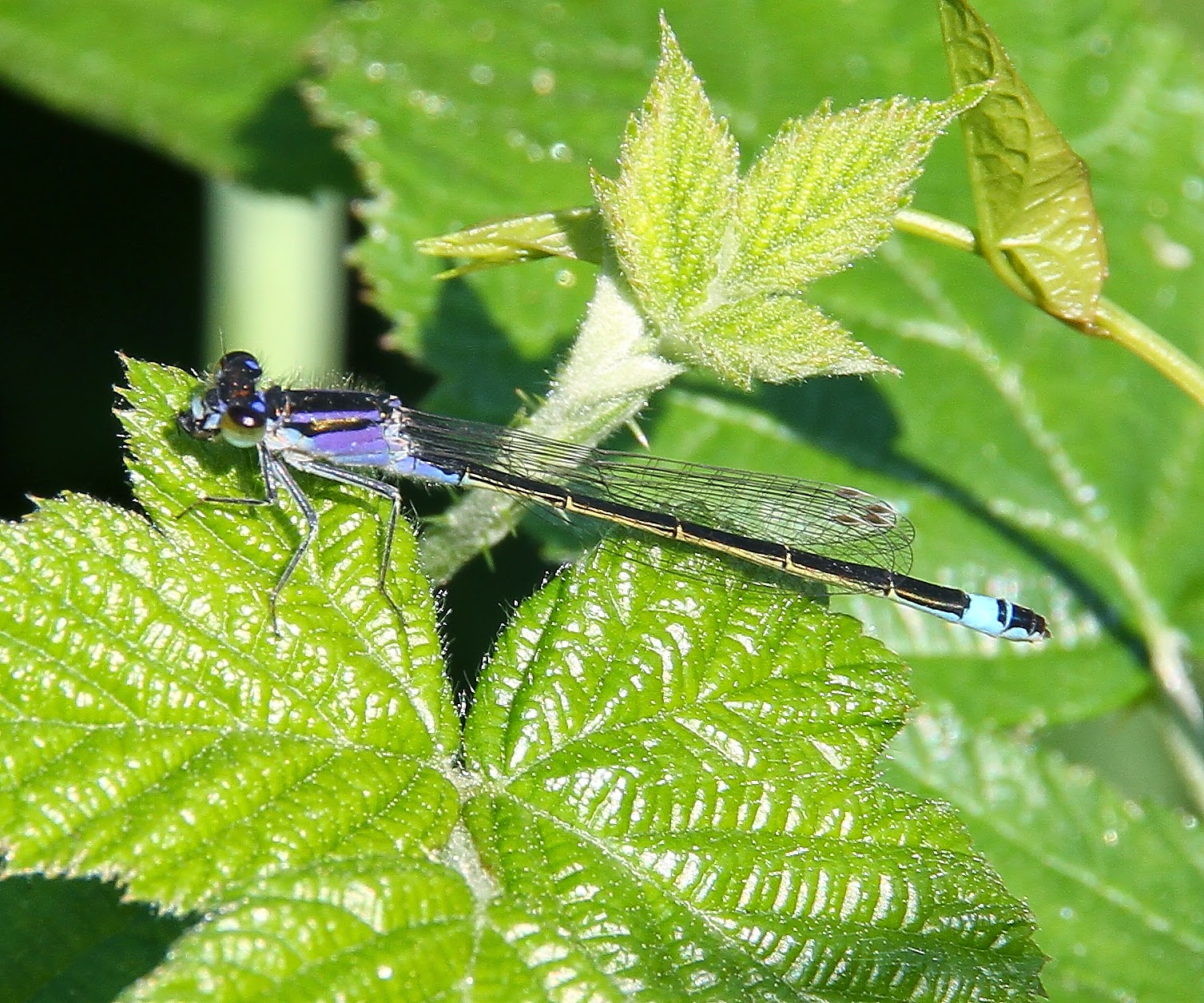
Scarce Blue-tailed Damselfly: Male. Note, the turquoise blue is on segment 9 & the tail end of segment 8. This compares with Blue-tailed Damselfly which has the turquoise blue restricted to segment 8
Scarce Blue-tailed Damselfly: Male. Note, the bicoloured pterostigma of the males is short & fat compared to Blue-tailed Damselfly
I also saw a few Blue-tailed Damselflies, Black Darters and Keeled Skimmers here, but none were photographed today.
Blue-tailed Damselfly: Male. Note, the turquoise blue is restricted to segment 8. Poole Harbour (3 Aug 14)
Blue-tailed Damselfly: Male. Note, the long & thin bicoloured pterostigma, compared to Scarce Blue-tailed Damselfly. Poole Harbour (3 Aug 14)
Like other Dorset bogs there were also good numbers of Round-leaved Sundews.
Round-leaved Sundew

23 Jun 2014

23 June 14 - Confusing Blue-tailed Cousins

One of the things I've been trying to do this Summer is see a few of the Dragonflies & Damselflies that I've not seen before. Also, I'm trying & get some decent photos of each of the UK species. There is only one Dorset species I've not seen before & that is Scarce Blue-tailed Damselfly. A good birding mate of mine, Kevin Lane, got in touch to say he had seen them over the weekend in the New Forest. So it seemed a good idea to take advantage of the ongoing decent weather & head over there. It would give me a better idea of the habitat, before trying to find this uncommon species in Dorset. There are a couple of historical sites around the Poole Harbour & Purbeck areas close to me, which I would like to check out in the coming weeks.
The Latchmore Brook: These slow flowing streams are typical of the New Forest
The New Forest is just over the border in Hampshire. It will be a well known area to UK residents, but for the overseas readers of this blog, I'll give you a quick overview. The name is very misleading as it is some of the oldest forested and unfenced lowland in the Southern England. It was created as a protected area for hunting of Deer in 1079 by King William 1, also known as William the Conqueror, soon after William's invasion of the UK.  It covered over 200 square miles in the South West corner of Hampshire, to the West of Southampton. This constant protection has resulted in a rich tapestry of heathland, woodland & more open grassland. The protection has continued for the area to this day, albeit the Deer are no longer hunted by the Royal Family. One of the good things is development within the New Forest has been limited, so that there are still large areas of open countryside. The local inhabitants have Commoners rights to graze Horses, Ponies & Cows throughout the New Forest & this has also helped to maintain this important habitat. Most of the New Forest is owned by the nation & the area was designated as a National Park in April 2006. It is a major tourist area & getting out on a Monday to avoid the crowds was a good idea. Having said that, the area I was visiting is on the North Western boundary of the New Forest & is probably one of the quieter parts.
Latchmore Brook & New Forest Horses
A typical New Forest view: The gentle slopes, grassy areas, low areas of Heather & patches of forest are all very typical
The Dragonfly areas are along the Latchmore Brook. As I started to walk from the car park I quickly ran into a Green Woodpecker & a party of Long-tailed Tits. There were a pair of Stonechats on the heath along with a few Meadow Pipits. But generally the birdlife was pretty quiet.
Green Woodpecker: The females have black moustachials whereas the males have obvious red moustachials
Long-tailed Tit: Juvenile
The first Dragonflies seen were these Beautiful Demoiselles. They were along the length of the small river. The males were fairly approachable, but the females provided to be too skittish in the sunshine.
Beautiful Demoiselle: Male have a completely dark metallic blue underwing, whereas the similar Banded Demoiselles have a distinct band with a clear base & tip to the wing
Beautiful Demoiselle: Male. I couldn't resist another photo
After about half a mile of walking, but a lot of looking, I reached Kevin's site where he had seen the Scarce Blue-tailed Damselflies. I walked around the area, but there was no obvious sign of any Scarce Blue-tailed Damselflies, amongst the other more obvious species: Golden-ringed Dragonfly, many Keeled Skimmers, my first Common Darter of the year, Large Red & Azure Damselflies.
Keeled Skimmer: Male. Note, the wings face forward, the thin blue abdomen with no yellow edges and the black restricted to the extreme end of the abdomen 
Keeled Skimmer: Male. Also note the lack of dark markings at the base of the wing, which indicates this is a Skimmer & not one of the Chasers. The oblong marking (pterostigma) at end wing is yellow-brown in Keeled Skimmers, compared to dark brown or black in Black-tailed Skimmers
Common Darter: Immature Female. Note, the black legs with a yellow line down the outer edge (Ruddy Darters would have all black legs)
Common Darter: Immature female
Common Darter: Immature female Common Darters have a yellow thorax (while a female Ruddy Darter has a black T on the top of the yellow thorax)
Common Darter: Immature Female. Note, the black marking in the face is a line which does not continue down the sides of the eye (which it does in the other Darter species)
Large Red Damselfly: Female. The black bands extending up the abdomen indicates this is a female, males have more red in the abdomen with the black limited to the segments closest to the end of the abdomen
Having walked up & mainly down, I sat down by the end of the stream. Immediately, I did I saw a Damselfly fly a short distance & settle back down again. I could see it was a Blue-tailed Damselfly type & a quick check with the bins confirmed it was a Scarce Blue-tailed Damselfly. Care is needed to check the Damselflies as Kevin saw both species in this area.
Scarce Blue-tailed Damselfly: Male. The blue is on segment 9 and the end of segment 8 (whereas it's on Segment 8 on Blue-tailed Damselfly)
Scarce Blue-tailed Damselfly: Male. Overall they are thinner & weaker bodied than Blue-tailed Damselfly 
Blue-tailed Damselfly: For comparison, here is a Blue-tailed Damselfly with the blue on segment 8 and segments 9 & 10 being black (Swineham, 19 June 14)
The Scarce Blue-tailed Damselfly habitat: They were perching on the short stalks near to the stream
There were good numbers of Silver-studded Blues on the heath, as well as, the Large Skippers & Small Skippers: all the first I've seen this year.
Silver-studded Blue: Females are brown on the upperside. The superficially resemble the Brown Argus but only have orange spots on the hind wing (Brown Argus have obvious spots on all wings)
Silver-studded Blue
I don't really know much about plants, apart from Orchids, but there were a couple of interesting ones seen today.
Round-leaved Sundew: One of my favourite plants, being one of the few carnivorous plants in the UK
Round-leaved Sundew: They are very common in the boggy parts of the New Forest
Bog Asphodel: Again a common bog species
Bog Asphodel: A larger clump