
The recent Oleander Hawk Moth has given me the urge to put together a Post of the Dorset Hawk Moths. I very erratically get in the mood to run my Moth trap for a few months, before the Birding or work commitments puts an end to running the trap. Over the last 17 years of living in Dorset, I've just about managed to get through all the seasons, but with the months spread over several years. I only really worry about running the trap in the garden & haven't worried about trying to run a trap elsewhere. Occasionally, I will make the effort to see the occasional good Moth that other people have caught, but I don't do this often. Hoping one of these years, I will get more time to run my Moth trap more regularly & catch some of the more regular vagrants I've yet to see in the garden. Anyway, for a touch of colour & elegance on the Blog, here are the Dorset Hawk Moths.
 Privet Hawk Moth: This is a fairly common & widespread Hawk Moth in Dorset. Swanage (8 July 10)
 Pine Hawk Moth: This is an uncommon & restricted resident in Dorset. Swanage (28 July 10)
 Lime Hawk Moth: This is an uncommon & widespread resident in Dorset. Swanage (30 June 10)
 Eyed Hawk Moth: This is an uncommon & restricted resident in Dorset. Swanage (12 June 10)
 Poplar Hawk Moth: This is a common & widespread Hawk Moth in Dorset. Swanage (22 June 10)
 Narrow-bordered Bee Hawk Moth: This is a rare & local resident. Powerstock Common (18 May 14)
 Broad-bordered Bee Hawk Moth: This is a rare & local resident. A poor photo, but despite several attempts this Summer, I failed to photograph any of the individuals seen. Studland (2 June 13)


Convolvulus Hawk Moth: I have only seen one Convolvulus Hawk Moth (due to not having made any effort to go & see them since seeing my first one). I currently don't have any photos of this scarce migrant Hawk Moth. There are a number of photos on the Dorset Moth Group website, including this one: Convolvulus Hawk Moth taken by Weymouth Birder Paul Harris
Death's-head Hawk Moth: This is a rare migrant to Dorset with 72 records listed on the Dorset Moth Group website. Unfortunately, it is a species I have yet to see. A photo taken by Les Hill can be found on the Dorset Moth Group website
Hummingbird Hawk Moth: Despite being a erratic but regular migrant visitor to my garden, I still need to get a decent photo of a Hummingbird Hawk Moth. A great photo of a Hummingbird Hawk Moth in flight by Martin Cade can be found on the Dorset Moth Group Website
Oleander Hawk Moth: I was lucky to see a tweet that one was recently on display at Durlston and could get there with the camera before it was released that evening. This is a vagrant species to Dorset & it is only about the 5th Dorset record. Resting in a display box at the Durlston Castle isn't an ideal location for a photo, but it better for the Moth than being moved around to allow people to photograph it, with the risk it will become active & try escaping. Durlston (24 Oct 14)
Bedstraw Hawk Moth: This is a rare migrant with less than 40 Dorset records & one I have still to see in the UK. A photo of two Bedstraw Hawk Moths at Portland Bill can be found on the Dorset Moth Group website
Striped Hawk Moth: This is a species I haven't seen in the UK. The Dorset Moth group website
lists this as a scarce & coastal migrant with about 450 records. Fortunately, I have seen this great looking Moth at En Gedi, Israel (7 April 14)
Elephant Hawk Moth: This and the next species are just great Hawk Moths. I never tire of seeing them. Swanage (15 June 14)
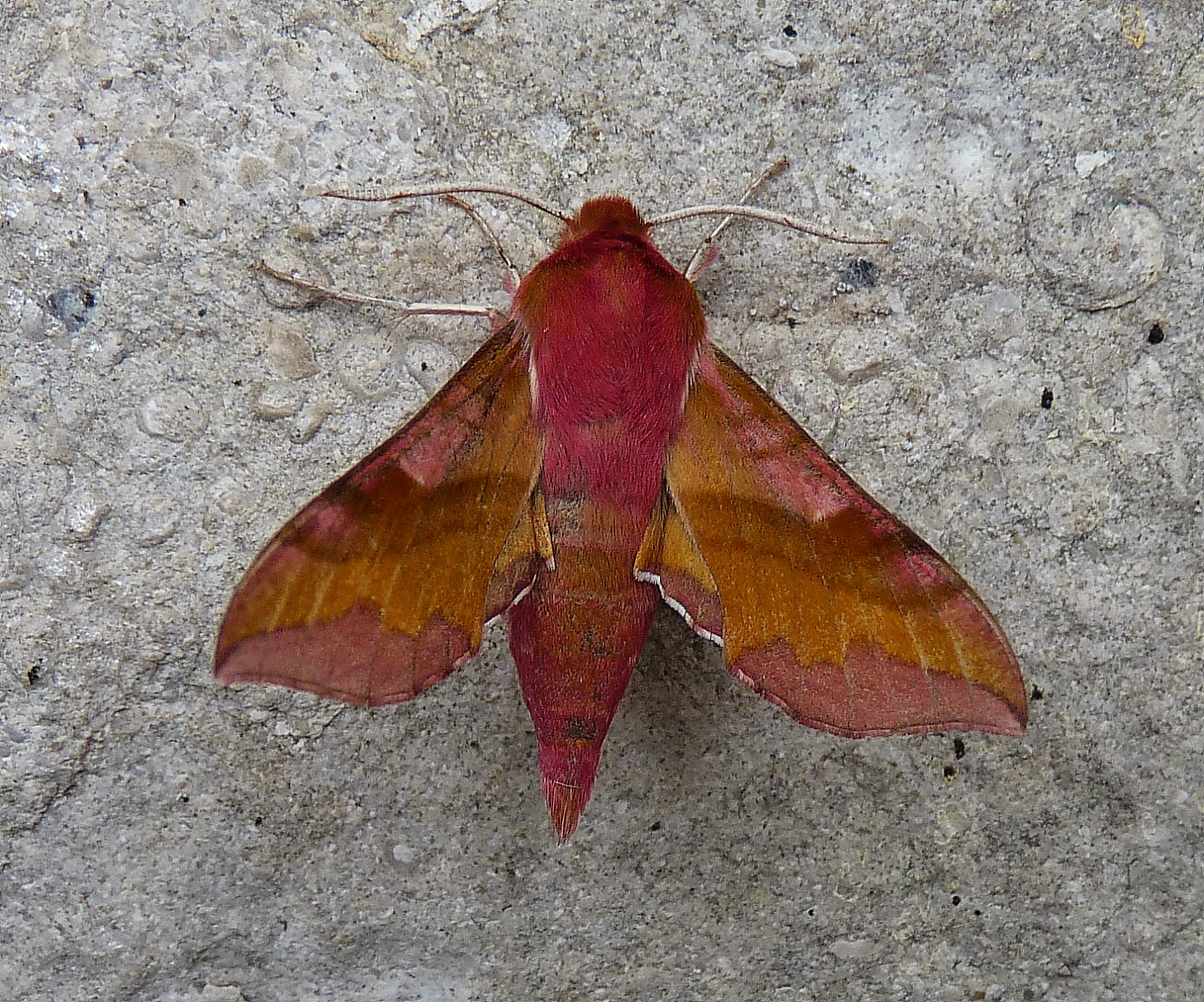
Small Elephant Hawk Moth: This is smaller & less commonly caught in my Moth trap. Swanage (26 July 10)
Silver-striped Hawk Moth: This is a species I haven't seen & the Dorset Moth group website lists this as a rare migrant with just 24 records. A photo of a Silver-striped Hawk Moth with a Striped Hawk Moth for comparison can be found on the Dorset Moth Group Website


