Showing posts with label Harbour Porpoise. Show all posts

24 Oct 2023

24 Oct 23 - Happy Tenth Birthday

It's ten years ago since I decided to buy a decent digital camera. My mate Pete Moore recommended I bought a Canon 7D & 400 mm lens. Pete also helped me get up to speed on the best settings for this combination. My first trip out was eventful as I was photographing a Kingfisher at Middlebere, when news broke about a Pallid Swift at Christchurch. I ended up getting thrown in at the deep end with trying to photograph a Pallid Swift in flight that afternoon. This was my first Blog Post.
Pallid Swift: This Pallid Swift on my first day out with the camera really pushed my comfort zone (24 Oct 13)
I've written another 885 Blog Posts since that first Blog Post. For this tenth birthday Blog Post, I will pick my favourite Blog Post from each Blog year. This is a particularly hard task as there are so many Blog Posts to choose from.

I'm not sure how I managed to get out Birding in the first year of having the camera, as I managed to create 229 Blog Posts during the first Blog year. I took a year off between contracts to travel to the Andamans & mainland India in Dec 13 to Jan 14, quickly followed by a short nine day trip to Morocco & Western Sahara in Feb 14, a week in Israel in Apr 14 and a three day trip to Croatia in May 14. With so many Blog Posts to chose from it is difficult to work out a favour Blog Post, so I've based it on this photo of four Wild Asses walking across a salt pan at Desert Coursers in Gujarat, India.
Four Wild Asses walking across a salt pan: Desert Coursers in Gujarat, India (17 Jan 14)
I was still taking a break between contracts at the start of the second Blog year, but that was because I was about to head off on the expedition ship, Braveheart, to Pitcairn Island, Henderson Island and remote French Polynesian islands. Pitcairn and Henderson Islands had been high on my list of places that I dreamt of visiting, with Pitcairn Island for its history of the Bounty mutineers and neighbouring Henderson Island for its endemic species. However, I never thought would be possible to visit this remote British dependence, until I saw Wildwings were offering a two week trip on the Braveheart to Pitcairn and Henderson Islands and some nearby French Polynesian islands with a few days on Tahiti. I booked up as soon as I saw that trip advertised. One of the other attractions was the opportunity to land on remote uninhabited islands in French Polynesia which were the home to several more island endemics: the highlight of which was obvious the enigmatic Tuamotu Sandpiper.
Tuamotu Sandpiper: The sweet-toothed Wader, Tenararo, French Polynesia (12 Nov 14)
It is a different subject for my favourite Blog Post of the third Blog year. I had spent a fair bit of this Blog year working on a long contract in Winchester & that limited my travelling. But there was an opportunity for a mini break to Ireland with Dave Gibbs & Paul Chapman that Autumn for a Royal Tern. After getting good views of the Royal Tern, we headed down to The Dingle for the evening where Dave & Paul planned to run a moth trap. There wasn't room in the accommodation for the three of us, so I headed off and found a B&B in the nearby village of Annascaul. By chance this is the village with the famous South Pole Inn which was owned & run by legendary Polar Explorer, Tom Crean. Crean travelled to the Antarctic three times with Scott & Shackleton and he was one of the three men, along with Shackleton & Worsley, to cross the South Georgia mountain range. He is one of the unsung heroes of the Golden Era of Polar Exploration and his story is as inspiration as Shackleton's story in my eyes.
Tom Crean's statue: This great statue sits in a small park to commemorate Tom & it is opposite his pub, the South Pole Inn (28 Aug 16)
The fourth Blog year was a quiet year where I was having to focus on the Winchester contract. There was no opportunity for foreign travel. I will stick to the historical theme of the last Blog Post. I drove past the Fovant Badges in Wiltshire in Apr 17 & this was a good opportunity to see the new Badge that had recently been carved into the down. The lost London Rifle Brigade Badge had been re-carved, one century after the Badges were originally carved. The others were created by the regiments who were training in the area before they were sent to the First World War trenches. Sadly, for many soldiers this area will have been the last part of England that they spent a lot of time in. It's great to see that volunteers are spending the time to not only look after the existing Badges, but to re-carve one of the lost ones.
The Fovant Badges: The lost London Rifle Brigade has been re-carved between the Post Office Rifles and the Devonshire Regiment (11 Apr 17)
Finally, the contract came to an end & I was free to travel again in the fifth Blog year. I planned a three month trip away, started in Colombia on a Birdquest tour with my late good mate Brian Field. I then squeezed in a couple of weeks on my own exploring Chile before flying to Ushuaia and boarding the Oceanwide Expeditions ship, Plancius, for a seven week trip from Ushuaia to Holland via South Georgia, Tristan da Cunha, St Helena, Ascension Island and Cape Verde. It is very hard to pick a standout day in such an amazing and varied three months. Ultimately, it would have to be a Blog Post from the time spent on the Plancius during the Atlantic Odyssey or West African Pelagic. On this trip, I saw about forty percent of the World's Seabirds, twenty-six of the ninety one Cetaceans and four of the seven species of Sea Turtles. I also got to visit another couple of remote British dependencies. I think the highlight Blog Post has to be the one where we saw a group of Flying Squid. I wasn't aware that Flying Squid existed, until we saw them & I'm glad to have got a photo of one group.
Flying Squid sp.: At Sea Tristan da Cunha to St Helena (15 Apr 18)
I spent most of the sixth Blog year working on another long term contract back in Winchester. Again, there was no time for foreign travel, so the Blog year was mainly local Birding and other Wildlife. But I couldn't resist the opportunity to spend a weekend on Shetland twitching the Tengmalm's Owl. For me, this was one of those mythical species on the British List which I never thought would occur again, let alone give Birders a chance of seeing it. It was one of the memorable twitches, but it was spoilt a bit by bad behaviour from two unknown twitchers that evening.
Tengmalm's Owl: Bixter with lighting thanks to Pratt-boy who insisted on turning on his torch against the instructions of the locals & houseowners (23 Feb 19)
The main event of the seventh Blog year was the C19 outbreak, especially losing the whole of the Spring to the lockdown. I was restricted to blogging about #BWKM0, Birdwatching at Kilometre zero which was a hashtag that was used a lot for Birders watching from home. However, the standout trip for me was my last carefree pre-C19 twitch to see a long staying Hermit Thrush on St Mary's. I spent a lot of time trying to figure out how to day trip to St Mary's to see it over a weekend. Eventually, I bit the bullet and took a day's unpaid leave on about the last nice weather day of the year. I saw it just in time as it departed a few days later.
Hermit Thrush: St Mary's (4 Dec 19)
Continuing to work from home was the one positive of the second year of C19. I was doing a lot of local Birding, but it took me some time to get back into the twitching and I ensured that the handful of twitches I went on were conducted in a safe way as far as C19 was concerned. So, masks in garages & shops and no lift sharing. The stand out twitch was to Tenby in Wales to see Wally, my first Walrus. However, I wasn't expecting Wally to be upstaged by a very showy Harbour Porpoise who put on a superb display that evening.
Wally the Walrus: Tenby (16 Apr 21)
Harbour Porpoise: Tenby (16 Apr 21)
The nineth Blog year saw me take early retirement from the IT world and look forward to more Birding opportunities. I managed two enjoyable and C19 safe mini-breaks to Ireland to see the Egyptian Vulture & a Northern Harrier, with the showy Baikal Teal on the Somerset Levels on the first trip & the Least Tern on the second trip. But the best day of the Blog year was another memorable twitch to the Scillies for the Blackburnian Warbler. This was upstaged on the way back by finding a Loggerhead Turtle on the return journey: there less than two hundred & fifty UK records.
Blackburnian Warbler: Bryher (17 Oct 22)
Loggerhead Turtle: At sea St Mary's to Penzance (17 Oct 22)
The tenth Blog year finally saw the return to overseas travel with a spate of C19 delayed foreign trips. It started with seven weeks returning to Indonesia with Bird Tour Asia trips to the Banda Sea & Remote Moluccas. I then had a few days Birding in Sulawesi, Bali & Java looking for Birds I had missed in the sixteen weeks I had spent over three long visits in 1991 & 1992. In Jan, I was travelled again with a week in Argentina before rejoining the Plancius & heading for the Falklands, South Georgia & Antarctica. In the late Winter, I was off again for my third trip to New Zealand looking for & seeing my last three Kiwis before joining what was to be a badly run and very disappointing West Pacific Odyssey from New Zealand to Japan, where the ship failed to put basic rules in place to manage a C19 outbreak onboard. The result is we were not allowed to land at Truk in Micronesia or on the planned Japanese islands. I will provide more detail of how badly Heritage Expeditions mismanaged the trip when I get around to sorting out the photos. For now I will not recommend anybody travels with Heritage Expeditions. Having completed all the C19 delayed trips, I managed to squeeze in a bonus trip to Angola with a couple of good mates, Phil Hansbro & Richard Carden in June. Again it's going to be hard to select a single Blog Post to adequately sum up the year. But in contrast to the disastrous Heritage Expeditions trip, the Oceanwide Expeditions cruise to Antarctica was a delight & another well-run trip with this excellent & professional expedition company. I've not had chance to sort out the photos, but I will leave this as my favourite photo of the trip & one of my favourite photos of the last ten years.
King Penguin: St Andrews Bay, South Georgia (22 Jan 23)
These are only a few of the 886 Blog Posts that I've written to date. There are many more Bird, Cetacean, Sea Turtle, Butterfly, Dragonfly or other Posts. I hope this has wetted your appetite to explore other Blog Posts which can be searched for on date or using the species lists on the right hand side of the Blog. Finally, thanks for helping to generate the over six hundred thousand Blog hits over the last decade. Hopefully, the next decade will be as varied and enjoyable as the last decade.

10 Oct 2021

10 Oct 21 - Goodbye To The Hobby

I was doing an Isle of Purbeck Year List in 2021, albeit I was hampered by the Covid lockdowns which helped to restrict my movements at various points in the year. I was back at St Aldhelms for the full morning as it was a weekend, rather than trying to cover the site in a quick dash before work. The Force 2 Northerly winds with initially cloudy skies and mild conditions seemed hopeful. But I hadn't seen that much on a fairly fast walk to the Coastguards. I tried a ninety minute seawatch from 08:30 from one of my favourite viewpoints known as the Delpinus Seat: this viewpoint is named after the pod of twenty-five Short-beaked Common Dolphins I found in Dec 20 from the stone seat. The seawatch had been uninspiring, except for two Harbour Porpoises about a quarter mile offshore.
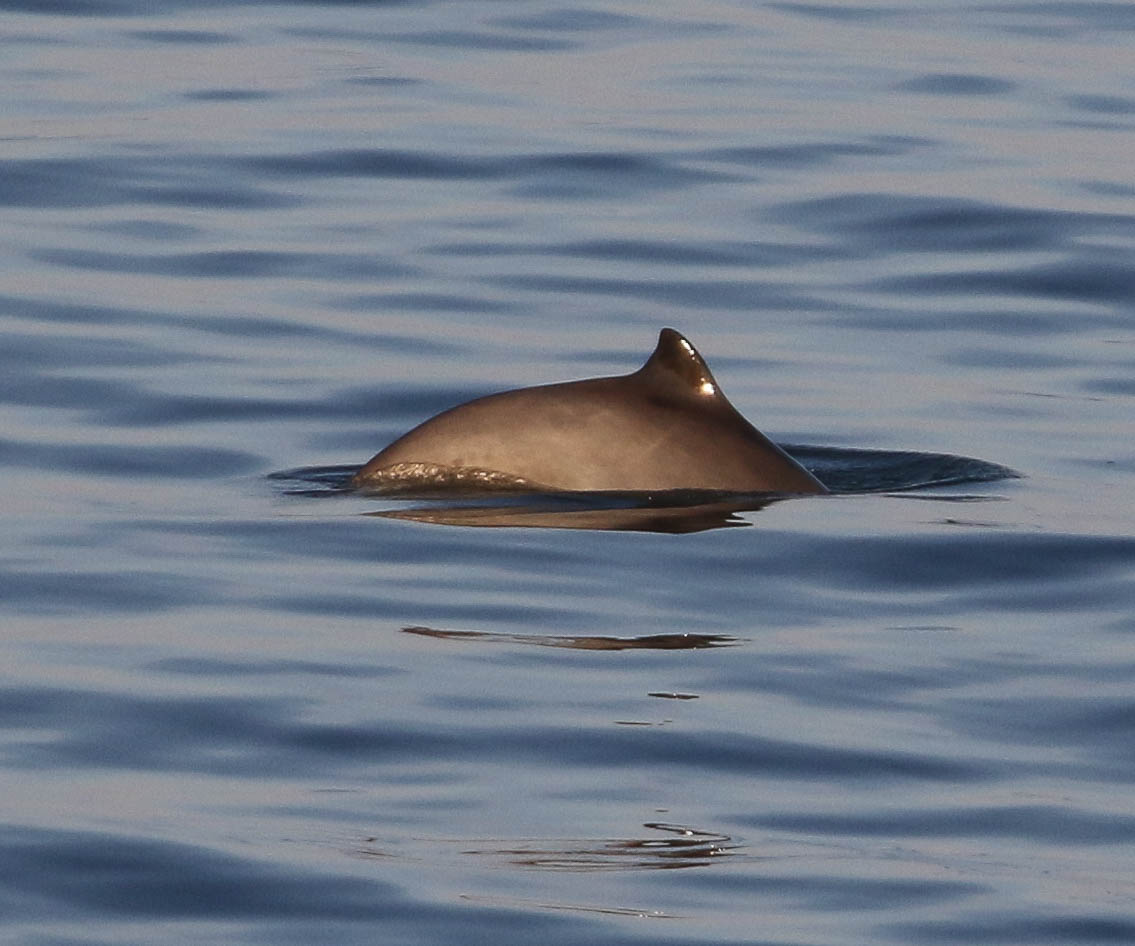
Harbour Porpoise: Note the rounded head with no beak and the broad triangular dorsal fin
My look around Quarry Ledge relocated a Dartford Warbler which had been around for a few weeks and had moved from Trev's Quarry to the back of Quarry Ledge.
Dartford Warbler: They are less than annual at St Aldhelms
I decided on a final look from my other more traditional seawatch site, above 'The Garden'. Fairly quickly I picked up a juvenile Hobby which appeared to come in off the sea. But I think it had probably headed out, before losing confidence and returning. It circled then went West. As I walked back to the coastguards lookout, I found it sitting on the big rock stack near the steps. It took off, flew around a few times and then slowly drifted out to sea. I lost it about a mile out when I was distracted by some House Sparrows flying over.
Hobby: Juv
Hobby: Juv. I only see one or two a year at St Aldhelms, so this was a nice record
Hobby: Juv
Hobby: Juv
Hobby: Juv
The walk back produced the first two Black Redstarts of the Autumn on the roof of Trev's Quarry workshop. The final highlight was when a Great Spotted Woodpecker flew West over the car park. This my 150th species for the St Aldhelms patch. Overall, it had been a good morning for St Aldhelms in the end.
Black Redstart

16 Apr 2021

16 Apr 21 - Harbour Porpoises Upstaging Wally

I didn't think that it would be possible to improve on seeing Wally the Walrus lazing around on the Tenby Lifeboat slipway. However, I was wrong as the local Harbour Porpoises decided to compete. I spent some time scanning the wide bay with the bins & scope in the hope of picking up some Dolphins. Surprisingly, I didn't see any, despite the perfect, calm seas. The best I could find was a handful of Guillemots.
The Harbour Porpoise came closer than this lone rock just off the fort
Then I picked up the first of three Harbour Porpoises. Initially, there was a distant pair, but then I picked up a third closer individual. This started to regularly appear as close as eighty metres from the shoreline. This is easily the best views I've ever seen of a Harbour Porpoise. Harbour Porpoises are shy and unlike their cousins the Dolphins, they proactively avoid boats. They surface and descend in an unobtrusive manner, which makes it hard to pick up their low profile on the water. On this occasion, looking down from the coastal path about thirty metres above the water level onto glass-like seas made for perfect conditions to see & photograph one.
Harbour Porpoise
Harbour Porpoise
Harbour Porpoise: A head shot from the last photo showing its small eye
Harbour Porpoise
Harbour Porpoise
Harbour Porpoise
Harbour Porpoise
Harbour Porpoise
Harbour Porpoise: Another surfacing almost completed
This is another surfacing sequence from the three quarters of an hour that this individual spent surfacing close to the shore.
Harbour Porpoise: It was so predictable that sometimes I managed to start taking photos just before it broke the surface to get the rare head photo
Harbour Porpoise
Harbour Porpoise
Harbour Porpoise
Harbour Porpoise
Harbour Porpoise
Harbour Porpoise
Harbour Porpoise
Harbour Porpoise: They drop below the surface without revealing the tail stock
While it was great to see Wally the Walrus, I did come away being more impressed by the performance from this Harbour Porpoise.

30 Dec 2018

30 Dec 18 - Index To My Porpoise Posts

This Blog Post is an Index to all the Blog Posts covering my Porpoise sightings. The following Blog Posts cover all my Rorqual Whale, Baleen Whale, Sperm Whale, Beaked Whale, Beluga Whale & Narwhal, Blackfish, Atlantic Dolphin, Pacific Dolphin and Porpoise Posts. The taxonomy follows the Marine Mammals of the World (Second Edition) book. There are links to the Posts against each entry below. Alternatively, you can click on a particular species in the Keywords section on the right side of the Blog to show all Posts for the selected species. Finally, selecting the Cetaceans Keyword to show all Cetacean Posts. I will continue to add to the photos and links as I write new Cetacean Blogs.
Harbour Porpoise: Slapton, UK (25 Feb 17)
Harbour Porpoise: English Channel (11 May 18)
Spectacled Porpoise: At the Estancia Harberton museum, Argentina (27 Mar 18)
Burmeister's Porpoise: At the Estancia Harberton museum, Argentina (27 Mar 18)

11 May 2018

11 May 18 - West African Pelagic - Day Eleven: Cruising In The English Channel (The Final Post)

This Blog Post covers the end of the West African Pelagic. We had enjoyed a successful day in the Southern Bay of Biscay with a Fin Whale, Short-beaked Common Dolphin & Seabirds, as well as, a great encounter with some Long-finned Pilot Whales. The day had started with flat calm seas & still conditions. As the day progressed, it had become steadily choppier as we ran into the front that was heading for the central part of the Bay of Biscay. The seas continued to increase during the evening, but for the passengers who had come up from Ushuaia it wasn't as bad as we had encountered in the Southern oceans. However, some of the passengers who joined at Cape Verde were less comfortable. By the following morning, we were in the Northern part of the Bay of Biscay. The seas were still lively & the bows were closed for most of the day. However, the rest of the decks were still open to passengers, so it still wasn't that bad. I've travelled through the Northern part of the Bay of Biscay on several occasions on ferries from Portsmouth to Bilboa & had an idea of what would be seen during the day. It is beyond the likely range of most interesting Seabirds i.e. the ones that breed around the Canaries & Madeira, especially in May. It is an excellent area for seeing Dolphins: but these would be Short-beaked Common Dolphins, Striped Dolphins & Bottlenose Dolphins (in that order). As we were now out of the deepest parts of the Bay of Biscay, we had a lower chance of seeing some of the more interesting Whales & Beaked Whales, which occur in the Southern part of the Bay of Biscay. Therefore, with the expectation of nothing new from the decks & the choppier seas making it unlikely to see many Cetaceans, then it was a day of mainly sorting photos from the trip. Bob Flood was interested in copies of my photos of the Zino's Petrels & a number of the Storm-petrel photos from the Atlantic Odyssey. I had only installed a copy of Adobe Lightroom a few days before joining the Plancius & so I was still trying to get used to it. Having edited all the photos from the Plancius, it would only take me a few hours to sort all these photos for Bob. However, it took me most of the day to sort the photos, plus the time I had spent off Northern Portugal. I wasn't missing anything, as reports from those on deck were confirming the only Seabirds that were being seen were species I could see off my local Dorset coastline. There was the occasional Short-beaked Common Dolphin sighting, but they were few & far between and not being seen well in the choppy seas & 20 knot winds. By the following morning, the photos had been sorted, the winds & sea had moderated & we were sailing steadily up the English Channel. By late afternoon, the seas were flat calm.
There was a large number of ships constantly passing in both directions: Boulogne-sur-mer is in the background
The seas were very busy: especially as we had been used to one or two fishing boats a week
A fair bit of the day was spent enjoying the cruise up the English Channel. There were few Seabirds to watch & the ones we did see were easy to identify.
Gannet: These are a common sight off the Dorset coast, although the nearest breeding colony is on Alderney
Fulmar: When the most exciting Seabird is a Fulmar which breeds on my local Studland & St Aldhelms patches, then you know you are close to home
Kittiwake: Another local breeding species in low numbers
Floating Seaweed: We saw a few small patches
Many people were on deck enjoying the views & just chatting. By now I had made a number of friends with the new Dutch passengers, as well as, the friends who had travelled all the way up from Ushuaia. Unfortunately, it was hazy which combined with the distance, reduced the quality of the coastal photos. We were several miles at least off the French coast & probably around fifteen miles or more off the English coast.
Dungeness: The power station & lighthouse were miles away in the distance, but easily visible for migrants on a good day
Boulogne-sur-mer: It was a hazy day
The Cap Gris-Nez Lighthouse: At 21 miles away, the Grey Nose headland is the closest point of France to the UK
The French equivalent of our Border Force off Cap Gris-Nez
The clear wildlife highlight of the day was a couple of Harbour Porpoises: my twenty sixth & final Cetacean on the Plancius (until I return for another trip). Unfortunately, both were short sightings. Despite the perfect flat seas & I only managed to get one worthwhile photo.
Harbour Porpoise: One day I will manage to get a good Harbour Porpoise photo
Earlier in the day, I had packed & sorted my bags for my departure the following morning as I needed to be off the Plancius as soon as possible. By early evening, we all headed down to the Observation lounge for a final wash up for the trip & to hear the plans for our arrival into the Dutch port of Vlissingen the following morning. This is the home port for Oceanwide Expeditions who own both the Plancius & Ortelius, which we had last seen in Ushuaia. Everybody was happy that evening as there were a few free drinks with the meal. I hadn't been ready to get off in Cape Verde, but now finally felt like the right time.
The final supper: (left to right) Roy, Lorraine, Hadie, Neil, Ian, Mike, me & Henrik
The following morning, I packed the last few items in the bags at first light & headed up on deck. Vlissengen is on the North bank of the River Scheldt river which continues to Antwerp.
Entering the channel leading to Vlissingen: We must be here will all these modern Dutch windmills
I had been told by Wildwings to expect we would be docking & able to disembark around 09:00. We were now being told by Inezia that while they were expecting us to be docking by 09:00, the likelihood was that passengers would not start disembarking until 10:00 or 10:30. The first passengers allowed off the Plancius would be passengers who were going to be dropped by coach at Vlissingen station. The coaches would then be returning to collect the remaining passengers who wanted to go to Schiphol airport. By the time, everybody had got off the ship, found their bags & got loaded onto the coaches, it was clear that it would be close to lunchtime before the coaches were finally leaving Vlissingen for Schiphol (about three hours away by road or rail). This was far too late for me, given I had taken the times I was given by Wildwings as accurate & had a mid-afternoon flight booked for Southampton. I had the tightest flight of any of the passengers. As a result, Pieter, the Inezia coordinator, had arranged with the Plancius, that my passport would be checked first by Dutch customs. Once checked, he would escort me to the dock gate where a taxi would be waiting to take me to the station. The taxi got me to the station with perfect timing: the twice hourly train to Schiphol & Amsterdam was just pulling in as I got on the platform. By the time the coaches were finally leaving Vlissingen for Schiphol, I was checking in for my flight, with enough time for some lunch. The taxi had cost me a bit more money, but it was much cheaper than the costs to rebook a missed flight (if that had been possible). Just over an hour after we took off, we were landing in Southampton airport. It was a short walk to the station & a short wait, before the train to Wareham arrived. A final taxi ride & I was home after six & a half weeks of travelling from Ushuaia. A number of my mates were still at Schiphol waiting for their flights when I was drinking for first English cuppa for three months. The end of one of the most amazing trips I've been on since my first foreign trip in 1983.