Showing posts with label Magpie. Show all posts

31 Jul 2026

3 Feb 26 - ORCA Canaries Cruise - Vigo: Another Unplanned Spanish Destination

We departed from Madeira, knowing we were having to divert to Vigo, Spain, rather than the planned destination of Lisbon. We spent the first day at sea in six to seven metre swells. The Captain explained the complications that stopped us getting to Lisbon. The port has a depth of not much over six metres at the shallowest point and the Spirit of Discovery had a similar draught. With the full six metre swell continuing close to the port, there was a risk that the ship could ground as we entered port. The only safe way to arrive was to enter overnight on the highest point of the high tide. While he thought we could arrive early for the overnight high tide, our departure would also be delayed to the following overnight high tide. This would have meant we would arrive several hours late in Pompey. The decision was taken we would head to Vigo instead.
Not surprising the seas were rough in the six to seven metre swell
The first day at sea was best forgot. In addition to the six to seven metre seas, the sea state was seven, which meant that we couldn't do any Cetacean surveying. However, we still stayed on deck looking, in the hope, we would at least see something. Twelve Kittiwakes were meagre pickings for my efforts from the back of deck 10. We continued to support the couple of one hour drop-in sessions each day, when passengers were able to meet one of the team on one of the lower decks for a chat about Cetaceans or Birds we had been seeing. Additionally, we were still producing the daily ORCA slides for the ship's TV system, so the passengers still would be aware of what we were seeing, even if we met few on deck.
Two of our regular passengers, Dorset-based Denise and Ian checking in with Fiona at the back of deck 10
The six to seven metre swell hadn't dropped at the start of the second day at sea, but at least the sea state had dropped to a six, which allowed us to resume surveying. We were twenty to thirty miles off the Portuguese coast. As we sailed North and came closer to the coast, the swell and sea state slowly moderated during the morning, but both still made surveying difficult. Additionally, there was still a thirty knot wind and the top decks remained closed, so we were again restricted to surveying from the back of deck 10. The highlight of the morning was I saw only the second Whale blow of the trip. There were only a couple of blows and like the first Whale, frustratingly I didn't see the body. Now we were closer to the coast, we were seeing more Kittiwakes, along with a few Gannets, Yellow-legged Gulls and distant unidentified Auks.
Gannet: One of two seen during the second morning at sea
We finished the morning's surveying with this lovely rainbow: A few minutes later it was chucking it down, but fortunately, that coincided with our lunch break
The seas calmed down a bit as we crossed into Spanish waters as we started to get closer to Vigo. But due to strong winds, we were still restricted to the back of deck 10. The highlight was when I saw a couple of Short-beaked Common Dolphins breach on the starboard side of the ship. Unfortunately, after a couple of breaches, they were too close to the side of the ship and I lost sight of them. I hoped they would come down the side of the ship, but if they did, we didn't see them. The numbers of Gannets, Razorbills, Kittiwakes and Yellow-legged Gulls picked up as we made our final approach into the Vigo estuary.
The Cies Islands lie at the entrance to the Vigo estuary: They have been a nature reserve since 1980
This large bridge spanned the estuary beyond Vigo
There were large Oyster farms in the estuary
Vigo has a large industrial port
We were finally tied up and able to go ashore
Vigo didn't look like it was going to be as attractive a city as Santander or La Coruna to walk around
The ship had laid on a couple of coach tours around Vigo and the neighbouring town of Baiona. I decided to skip these options and walk up to the Fortress of El Castro which dominated the high ground over the port. The Fortress had a park around it, so I was hoping to see a few Birds as well. Vigo is built on three surrounding hills and everywhere you go from the port seems to be a steep uphill walk. It was a good excuse to stretch the legs.
Yellow-legged Gull: This Yellow-legged Gull was hanging around tables outside a cafe hoping for some food. It is the nominate michahellis subspecies which breeds in breeds Portugal, Spain, Morocco and the coastal & inland Mediterranean from Belgium East to Poland & Turkey. The other subspecies breeds on the Azores, Canaries & Madeira
Looking back down one of the old streets
Vigo has a novel idea to help people get around the city on foot: There are currently twelve escalators in the city and more are planned. The plan is this will help encourage people to walk, rather than drive, in the city. The escalators only go uphill, so you still have to walk downhill. Some were very well designed and a lot more colourful than this one
I ran into a bird flock as I reached the woods in the park around the Fortress of El Castro. A quick bit of pishing produced a good response.
Coal Tit: This is the nominate ater subspecies which occurs from Europe to Siberia, Mongolia, Sakhalin & North East China
Firecrest: This is the nominate ignicapilla subspecies which occurs in West, central & South Europe to Asia Minor
Wren: This is the nominate troglodytes subspecies that breeds in Europe and Turkey
Robin: This is the nominate rubecula subspecies which breeds from Europe & West Turkey East to the Ural Mountains, South to North Morocco, the Azores, Western Canaries & Madeira
Chaffinch: This is most likely the nominate coelebs subspecies which breeds from Europe East to central Asia, South to West & North Turkey & North West Iran. However, it's possible it's a wintering gengleri subspecies that breeds in the UK & Ireland
The Fortress of El Castro was built in 1665 to defend the region from potential attacks by English forces. It is actually a combination of the Fortresses of El Castro and San Sebastian along with the city wall. It saw action in the Battle of Vigo Bay in 1702, when a combined English and Dutch fleet defeated a combined French and Spanish fleet. The Fortress, along with the city of Vigo itself, were captured by British forces as part of the capture of Vigo in 1719. In 1809, the Fortress was occupied by the French Imperial Army during Peninsular War, before being recaptured by Spanish forces.
The outer ramparts of the Fortress of El Castro
These three anchors commemorates the Battle of Vigo Bay in 1702: The battle was fought by the Anglo-Dutch navy and Spanish-French fleets and dozens of ships were sunk in the Vigo estuary
Old cannons within the Fortress
Black Redstart: This Black Redstart was feeding around the walls of the Fortress
Black Redstart: It is the same gibraltariensis subspecies that we see in the UK, which occurs throughout Europe, Turkey and Northern Africa
Chiffchaff: This Chiffchaff was feeding around the walls of the Fortress
Magpie: This is the melanotos subspecies which is restricted to the Iberian Peninsula
More of the outer walls
Looking at the inside of the Southern gate to the outer walls
Inside the walls
The gate on the inner Southern walls
Inside the inner Fortress
Inside the Fortress' Northern gate
The Fortress has a good view over the port
We spent the night moored in Vigo port and I booked on the coach tour to Baiona for the following morning. I will cover that in the next Blog Post.

19 Sept 2024

19 Sep 24 - My First Wildlife Guide Role On An ORCA Sea Safari To Santander: Heading North

In the last Blog Post, I covered the last ORCA Sea Safari to Santander where I was one of the Wildlife Guides. We had reached Santander and just disembarked. There were two options for entertainment. Ellie, our Team Leader and the only member of the ORCA staff, had said that there was an apparently better ice cream shop than the normal ORCA Heladeria: her plan was to visit both of them & compare options. My entertainment was to look for Hummingbird Hawk Moths in the park on the way there. Fortunately, there was time to accommodate both plans. What we didn't do, was agree on which of the Heladerias was the best.
Magpie: This is the melanotos subspecies which is restricted to the Iberian Peninsula
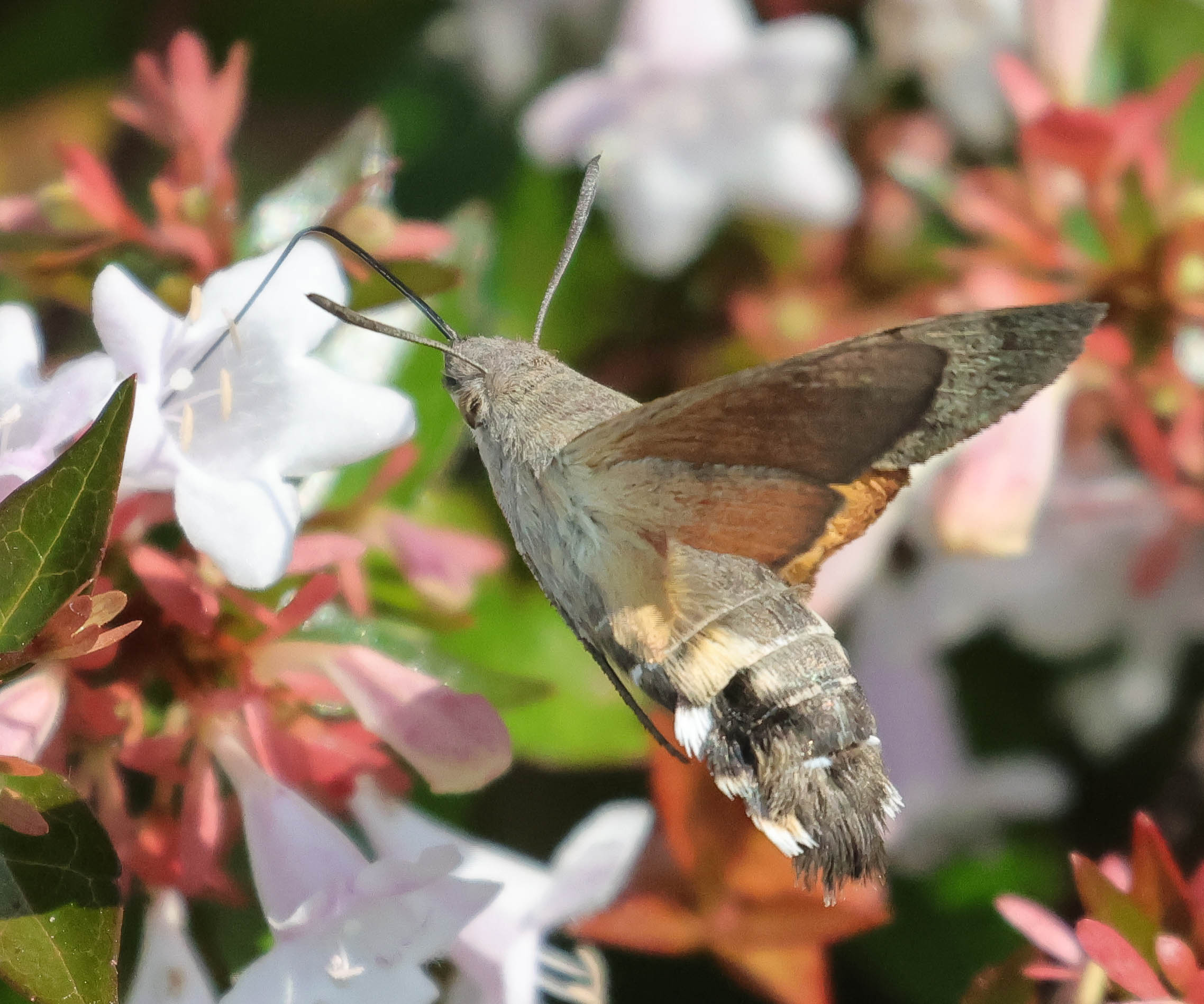
Hummingbird Hawk Moth: I saw at least six around these flower-packed bushes in the park on the way to the ice cream shops
Hummingbird Hawk Moth
Ivy Bee: This looks like an Ivy Bee to me. It photobombed one of the out of focus Hummingbird Hawk Moth photos
The normal ORCA Heladeria
The queue for an ice cream in the second Heladeria: It was great to see a good number of willing participants in this citizen science investigation
White-speck: This is a migrant species to the UK. I only saw my first White-speck on the Scillies in Oct 23
Ice cream taste testing over, we had to head back to the terminal. We didn't have too long to wait in the Brittany Ferry terminal before we were being called to clear customs. We were quickly on deck and ready for a few hours of watching as we headed back North. We were about an hour beyond the Northern end of the canyon that heads North out of Santander by sunset.
This sandy peninsula forms the other half of the narrow harbour's entrance
Fin Whale: This was my best photo of a couple of Fin Whales that I saw in Southern Biscay after we left Santander. Note, the long back and the smooth curve of the Dorsal Fin which confirms the identification as a Fin Whale
There was a cracking sunset at dusk
The alarm went off about 06:00 for the pre-dawn drinks and breakfast. I was on deck to find it was overcast & windy. With the earlier departure compared to the day when we normally survey on this route, we were well past the Brittany coast and about half way from the coast to the UK-French border. Unfortunately, due to the wind strength the top deck had been closed. I saw the ORCA team one deck lower on the starboard side. This deck is enclosed and I found it hard to look through the spray and rain-soaked glass. I relocated to the halfway up the steps to the top deck, where it was possible to stay out of the wind, whilst being able to look over the glass. This helped to some extent, and it was possible to see a few Gannets, Cory's Shearwaters and a Manx Shearwater. Bizarrely, a Red Admiral flew past: it was presumably the same individual I had briefly seen the previous day flying around the ship.
Ellie, Neil and Moira were deep in discussion, while a few of the passengers kept watch
David and Hannah
Ellie looks like she is still thinking about the ice cream shops
After a half-hour, Ellie decided we would relocate to deck 6 on the port side. Deck 6 is lower, but it is open-sided and it provides clearer views over the sea. Ellie asked me to stay put where I was, so that any late risers would know where the rest of the group were. Eventually, I headed down to deck 6 to join the others for the remainder of the crossing. It was a better deck to watch from. There was more Gannets, another Cory's Shearwater, a few Manx Shearwaters, three Kittiwakes and regular small groups of Swallows that had decided to abandon the Channel crossing and return to Cornwall. Unfortunately, I didn't see any Cetaceans.
The sea wasn't great: However, this would be classified as a reasonable day in the Southern Oceans. But at least by mid-Channel the light improved and the seas looked bluer compared to the very grey sea of the early morning. As we got closer to Plymouth, sea finally started to calm down
One final photo of Laura (far left) and Moira (at the back), with the passengers who stayed looking to the bitter end
This is the last ORCA Sea Safari to Santander of the season. If you are interested in an ORCA Sea Safari in 2025, then you can register your interest on the ORCA website. Further details of the dates will appear in due course. Hopefully I will be able to be one of the Wildlife Guides again in 2025.

15 Feb 2024

15 Feb 24 - ORCA Saga Caribbean Calypso Day 29 - La Coruna Is Spotless

The Atlantic crossing from the Caribbean to Spain on the Saga Caribbean Calypso was hectic and I hadn't had any time to look at options of things to do in La Coruna. Having said that, I knew there wouldn't be any potential Bird Ticks in the area. Charlotte had said that they didn't arrange any Cetacean trips out of La Coruna on her visit in the previous Autumn. Therefore, my time ashore was going to be focusing on a historical or museum visit. The Tower of Hercules and its surrounding park looking an interesting option. By the time I had looked at options after lunch, I was aware that I would be running out of light before I got back to the ship, now that we were back in the Europe mid-winter. I decided to sort some photos out and head out the following morning. The only problem was the forecast was for early morning rain, but clearing by mid-morning. I woke up to find it was dry first thing, but it was raining by the time I had finished breakfast.
The rain restarted as soon as I stepped ashore: It rained for the first two of the three hours I was ashore, before finally starting to clear up
There was an easy path along the waterfront to the Tower of Hercules and its surrounding park. The prospect of a decent six mile round walk after a week on the ship was appealing. The city had put a lot of effort into making this an interesting walk.
The Virgin of Carmel Statue
The waterfront
A closer view of the waterfront buildings
There is an interesting museum inside the Castelo de Santo Anton: That will have to wait for a future visit
Looking back on the Castelo de Santo Anton
The Abente y Lago Hospital: This old military hospital building was renovated and reopened as a cultural centre in 2012
The walk took me past these colourful murals
So much better than the mindless graffiti in many urban areas in the UK
After about an hour of walking I reach the Tower of Hercules. This is the oldest Roman lighthouse that is still in operation.
It was good to see the park around the Tower of Hercules is a protected area for biodiversity
A soggy skulking Sardinian Warbler: This is the nominate melanocephala subspecies which occurs in Southern Europe, the Canary & Mediterranean Islands, West Turkey & North Africa
Stonechat: Male. There were a pair of Stonechats around the Tower of Hercules. This is the hibernans subspecies which occurs in the UK, and along the coasts of West France & the Iberian Peninsula
The Tower of Hercules sits on a small hill to provide additional height as a lighthouse
The Tower of Hercules: I knew it was possible to climb the tower. What I didn't realise I needed to buy a ticket in advance, so I didn't get to go up it
It looks the La Coruna architects fell under the dreary concrete building spell
The next stop was La Coruna's Avebury and Stonehenge monuments.
Menhirs for Peace: Menhirs is Spanish for tall upright megaliths
Menhirs for Peace: These twelve granite stones were installed in 1994
Menhirs for Peace: You are supposed to contemplate their meaning
Menhirs for Peace: My thoughts it's a pity the holes weren't aligned to frame some interesting views of La Coruna when you look through them. This one could have been aligned so you could see the local Stonehenge as your next designation
The Monumento a Los Fusilados: The monument was erected in 1981 to remember all those killed in the Spanish Civil War especially, in the fierce fighting in La Coruna, when Franco's Nationalist forces tried to capture this key Republican stronghold
It's that Horn again
It was time to turn around and return to the Spirit of Discovery for a late lunch. I managed to see a few Birds on the return route.
Magpie: This is the melanotos subspecies which occurs throughout the Iberian Peninsula
Black Redstart: This is the gibraltariensis subspecies which occurs in the UK, West & central Europe to Crimea & North Africa
Black Redstart: It's always a good day when I see a Black Redstart
Spotless Starling: This monotypic species occurs from the Iberian Peninsula to Corsica, Sardinia, Sicily & North West Africa
Spotless Starling: I had forgotten how good-looking they are
Spotless Starling
The esplanade had these stylish lamp posts
I looked at this lamp post & saw a Sealife design
Every lamp post had a different Sealife design
Yellow-legged Gull: Adult. A few Yellow-legged Gulls for any Larid fans who read this Blog
Yellow-legged Gull: First Winter. This is the nominate michahellis subspecies that breeds on the Canaries, Madeira, North West Africa & throughout Mediterranean. This is the subspecies that visits the UK and has bred on Brownsea in the past
Yellow-legged Gull: First Winter
Almost back at the ship: Finally, the weather was starting to improve
We sailed late afternoon, which provided the chance to have another look for the Bryde's Whale. Unfortunately, both the Bryde's Whale and its Dolphin friends failed to put in another appearance.
Jan, Charlotte and I were on deck to survey as we departed: Terry was getting some peace to finalise his slides for his second talk that was scheduled for our last afternoon at sea
The ORCA team with some of our keenest Cetacean watchers: Chris, Jan, Terry, Penny, Charlotte, Sue & Les
Jan, Monica and Charlotte: Monica was another regular visitor to the top deck
We awoke for our final day on deck on the Saga Caribbean Calypso in North Biscay and getting ready to pass around the French Brittany coast. Unlike the Brittany Ferry's Pont-Aven, which passes between the French islands and mainland, we stayed about twenty or thirty miles offshore.
There was some cake on our last morning of surveying
It was a reasonable final day as we past Brittany & started to head up the Channel. The highlights were an extended pod of Risso's Dolphins which typically belted past us in the opposite direction to the one we were travelling. Risso's Dolphins do not seem to like interacting with ships. We also saw seven Short-beaked Common Dolphins. On the Avian front, there was a single Bonxie, an Arctic Skua and two Little Gulls. More surprising was a House Martin that hung around the ship for well over an hour in the late afternoon as we tracked up the Channel. A nice record for 16 Feb.
Short-beaked Common Dolphin
In the early afternoon, we all headed down to the lecture theatre for Terry's second and final lecture, which included photos of some of the lovely sightings we had seen during the Caribbean Calypso cruise.
A good message from Terry at the end of his lecture
A TV screen showing our route
My first ORCA Wildlife Guide role on a Saga cruise had been a fantastic trip. The ship's crew had looked after us really well, we had some excellent passenger engagement throughout the trip. We had managed to show the passengers a good selection of Cetaceans, Birds, Flying Fish and for a lucky few, a Sea Turtle or a brief Shark sighting. The weather had generally been OK, albeit some calmer seas would have been more helpful for Cetacean surveys. Terry, with a bit of help from the rest of the team, had provided a daily slide to the ship's IT team to display on the TV screens in the cabins. We had some good passenger feedback from these slides.
The restaurant team who had looked after us really well over the previous month
Finally, it wouldn't have been as much fun if I hadn't had such a lovely team to work with. Thanks Jan, Charlotte & Terry for making it a fantastic trip.
Charlotte, Jan & Terry were excellent company & great mentors as I was about to start my Team Leader training with ORCA: I'm pleased to say that I've now been signed off as an ORCA Team Leader