Showing posts with label Rock Eagle Owl. Show all posts

29 Mar 2014

29 March 14 - Indian Owl Fest

I've just completed writing the last post for the Indian trip which visited Calcutta, the Andamans, the Western Ghats, Gujarat & Rajasthan. Out of the 420 species of birds seen, I managed to photograph 342 species (over 81% of species seen). However, to spin these photos out a bit further, I've decided to pull together some posts on particular themes. So here is the first of them on the Owls seen on the trip. On the trip I managed to see 11 or 12 species of Owl depending on taxonomy & all species seen were photographed. On the Andamans, I saw Orintal (Walden's) Scops Owl which Clements currently lumps as a subspecies of Oriental Scops Owl, but Rasmussen splits. I can't tick it at the moment as I also saw Oriental Scops Owl in the Western Ghats & I keep to a Clements taxonomy for simplicity.
I can't tick this Owl at Periyar
India is a great country for seeing Owls & seeing them well. In most countries, Owls are something you look for at night & we did see several species after dark. However, due to the large game animals & the number of sites I visited which are Tiger reserves, then looking for Owls after dark is often not possible (the Andamans being the main exception on my trip). But the result is the local Indian guides have become good at finding Owls in daytime roosts, where with care, you can get some good photos & more importantly not disturb the Owls. I'll leave you to enjoy the Owls.
Andaman Scops Owl: Jirgatna, Andamans (23 Dec 13)
Indian Scops Owl: Nominate subspecies bakkamoena, Thattekad, Western Ghats (5 Jan 14)
Indian Scops Owl: Subspecies gangeticus, Bharatpur, Rajasthan (28 Jan 14)
Bruce's Scops Owl: Desert Coursers, Gujarat (14 Jan 14)
Oriental Scops Owl: Parambikulam, Western Ghats (2 Jan 14)
Oriental Scops Owl: Parambikulam, Western Ghats (2 Jan 14) 
Oriental (Walden's) Scops Owl: Chiriya Tapu, Andamans (24 Dec 13)
Rock Eagle Owl: Jungle Hut, Western Ghats (29 Dec 13) 
Rock Eagle Owl: CEDO, Gujarat (19 Jan 14)
Dusky Horned Owl: Bharatpur, Rajasthan (28 Jan 14)
Brown Fish Owl: Parambikulam, Western Ghats (2 Jan 14)
Jungle Owlet: Parambikulam, Western Ghats (1 Jan 14)
Jungle Owlet: Parambikulam, Western Ghats (2 Jan 14)
Spotted Owlet: Subspecies brama, Jungle Hut, Western Ghats (29 Dec 13)
Spotted Owlet: Subspecies indica, Desert Coursers, Gujarat Ghats (14 Jan 14)
Andaman Boobook: Chiriya Tapu, Andamans (22 Dec 13)
Hume's Boobook: Chiriya Tapu, Andamans (22 Dec 13)

20 Jan 2014

20 Jan 14 - An Enigmatic Family Year Tick

Having seen the main species (Sykes's Lark & White-naped Tit) quicker than expected, then a new plan for day 2 at CEDO was up for grabs. The options were either to head to the coast for Crab Plovers & other coastal species, look for Great Indian Bustard (very hard with low chance of success) or Grey Hypocolius. After some discussion, the revised plan was to look first thing for Grey Hypocolius, followed by some general birding around the lake area. This is a monotypic family which I've only seen in Bahrain in the mid 90s. They winter in low numbers from the Middle East to Gujarat & it was a species I was keen to have another look for, especially as it's still a family that many well travelled birders haven't seen. They are often seen near a local village & Jugal had arranged for a local villager to guide us to the spot. The bad thing was we had to meet him at first light, hence the alarm rang far too early before dawn.
Grey Hypocolius: Female. They are attracted here by these small berries
Barred Buttonquail: A pair appeared as we were leaving the Grey Hypocolius site & proceeded to spin in the dirt which is a characteristic of Buttonquails (apparently they spin on one leg, whilst scrapping away the dirt with the other leg) & they leave plate sized depressions in the ground
Barred Buttonquail: The female has a black throat, whereas the male is the browner, less contrasty, bird of the two
Black Redstart: Male phoenicuroides race
Black Redstart: Female
We left & heading back to the lake area for the rest of the morning. One of the stops was to look for Asian Desert Warblers. These were quickly found, but the family party of about 4 birds were moving around quite a bit. This wasn't helped by them moving between bushes on the ground on some occasions. However, just like the Dartford Warblers on my local Dorset heaths which follow the Stonechats around, these Asian Desert Warblers were following a Desert Wheatear. I assume the Warblers use the Stonechats/Wheatears as lookouts as they are usually up higher on the tops of the low bushes than the Warblers are.
Asian Desert Warbler: They often feed close to the ground
Asian Desert Warbler
Desert Wheatear: The lookout
Short-toed Eagle
Marsh Harrier: I hadn't expected to find one roosting in the daytime in the middle of the plain
Montagu's Harrier: Female. The central bar on the secondaries is darker than the trailing edge, the pale band between these 2 dark lines is fairly broad (narrower on Pallid) & the trailing edge is uniform along the length of the secondaries (broadened towards the base on Pallid). Also it's barred on the axilliaries & underwing coverts (mottled in Pallid)
Montagu's Harrier: Female. The dark bar on the middle of the secondaries is also visible on the upper surface. Photos of a female Pallid Harrier can be found in the post (The Best Of The Rest)
Montagu's Harrier: Female. Pallid would have a more obvious white collar & darker ear coverts
Rock Eagle Owl: Not going to pass up the chance for more Owl Photos
Rufous-tailed Desert Lark
Short-toed Lark: Thi is the greyer longipennis subspecies
Short-toed Lark: There is only a small amount of streaking on the breast
Eastern Pied Wheatear: Male transitioning into adult plumage
Indian Mongoose: Hunting in the Persian Red-tailed Wheatear 'kopje'
The final stop before lunch was the village with the wet pools. Again there were some very close Waders, but a few more passerines this time.
Marsh Sandpiper
Pied Wagtail
Yellow Wagtail: Think this is race thunbergi, but it's less clear cut than the birds seen in the Desert Coursers area
Clamorous Reed Warbler: Also know as Indian Reed Warbler

19 Jan 2014

19 Jan 14 - Close Waders & Rock Eagle Owls

By early afternoon we were heading out again to head off to a large lake near to CEDO & its surrounding bushes & dried grassland. The good thing I had seen both of the 2 likely ticks on the first morning: Sykes's Lark & White-naped Tit. Therefore, the pressure was off & I could just enjoy the birding & photography. On the way to the lake we stopped in a small basic village. I couldn't see why we were stopping at first, but when I looked on both sides of the road were small wet pools under the trees. Despite being in the village, there was a good selection of Waders present. Clearly, they are very tolerant of the villagers & the villagers aren't a threat to them.
The wet pools were right next to the road
Not surprisingly we attracted the attention of some of the local kids
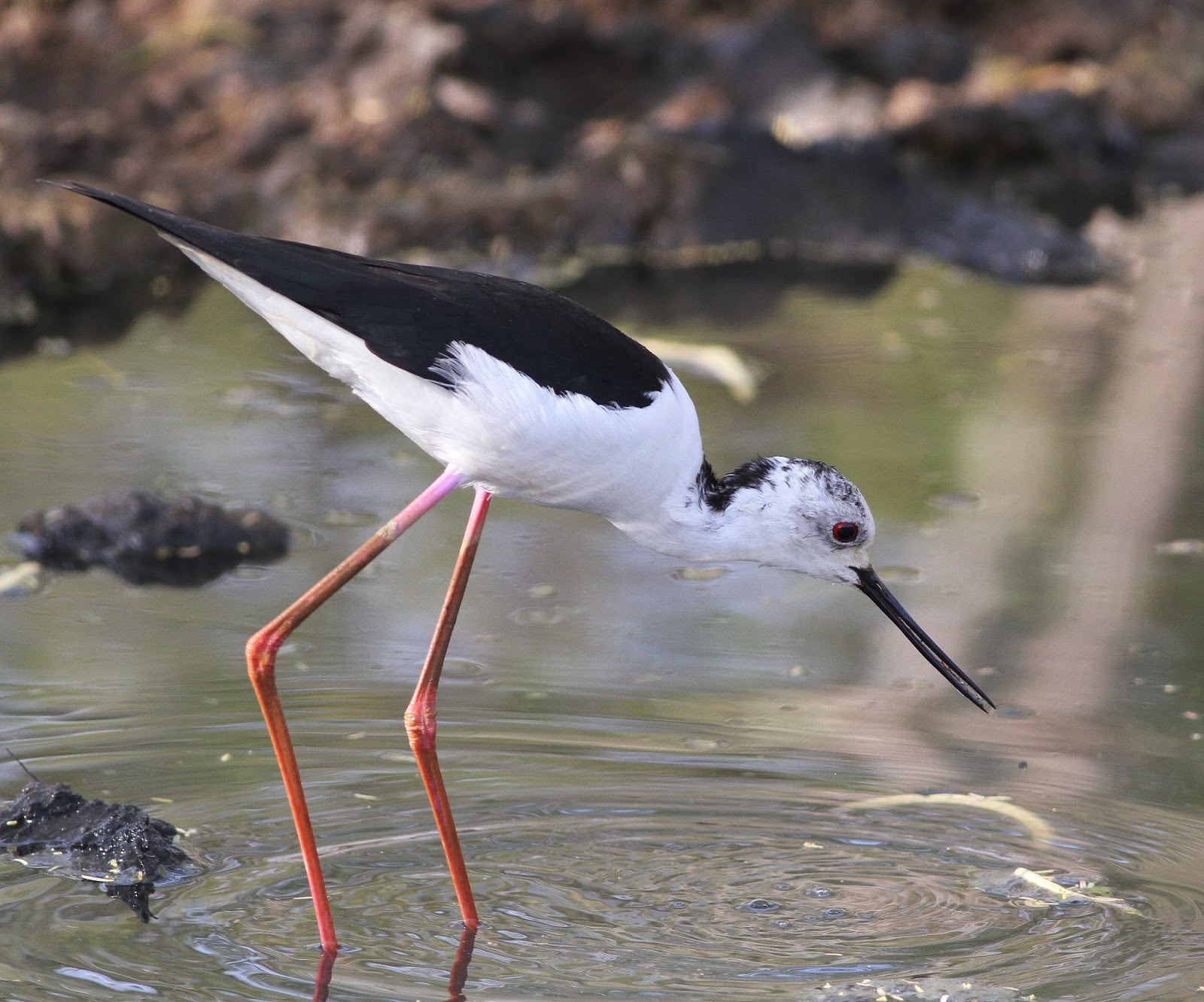
Black-winged Stilt
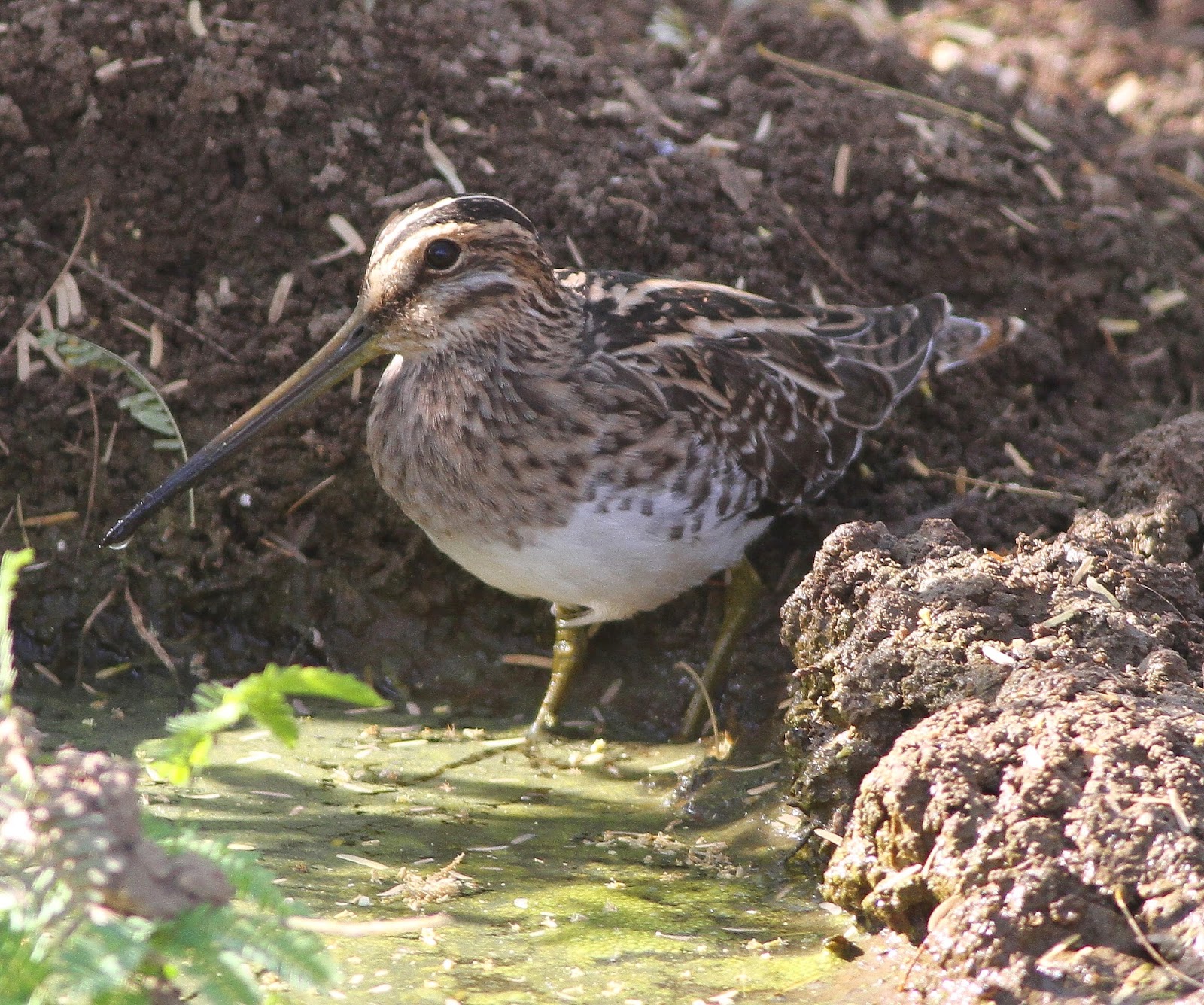
Snipe: The other similar Snipe species are out of range
Common Sandpiper
Green Sandpiper
Marsh Sandpiper
Citrine Wagtail
Finally, we were heading onto the lake, having had our fill of close Waders. The lake is surrounded by a large area of dry grassland & scattered bushes on a sandy soil, although the grass was largely dead. There were also scattered hills of varying sizes & one small hill was particularly good. It reminded me of the kopjes of Africa where small stoney hills project from the African plains & have their own distinct local wildlife.
The majority of the area was scattered bush country & dried grassland
With some quite large hills
This smaller hill had its own Persian Red-tailed Wheatear & Eastern Pied Wheatears
Persian Red-tailed Wheatear: This is the chrysopygia subspecies
Persian Red-tailed Wheatear: This is a winter visitor to Pakistan & NW India
As we were driving towards the lake, the driver spotted a Rock Eagle Owl trying to keep out of the sun by a low bush. Clearly, there is good feeding in this area, as we saw a second bird on the way out & 2 more on the following morning.
Rock Eagle Owl: Roosting by the bush
Rock Eagle Owl: As we got closer it tried to hide in the bush, but was clearly watching us
Rock Eagle Owl: The second bird was out hunting in the late afternoon
Rock Eagle Owl: It finally got bored of the attention
There were a good selection of other birds around the lake, although the Water birds were too far away to photograph.
The Tower hide
Pallid Harrier: I was struck how slim & buoyant this Harrier going to roost was when taking the photos. This is a female bird as it has a streaky breast & belly. The dark secondaries on the underwing separate it from a female Montagu's (which has pale secondaries)
Pallid Harrier: Really magnifying this I can see the trailing edge of the secondaries gets broader towards the base of the wing & there isn't much of a central pale band along the middle of the secondaries (a female Montagu's Harrier is photographed in the An Enigmatic Family Year Tick post)
Steppe Eagle: The long gape line, stout bill, grey coverts & white lines in the wing point to a subadult Steppe Eagle
Short-toed Lark: A fairly common lark in the more open areas
Crested Lark: Less common, but still a few around the more open areas
Crested Lark: That's an odd looking shadow
Sykes's Warbler
Lesser Whitethroat: The distinct mask separates it from Desert Lesser Whitethroat (or a migratory Hume's LWT). The most likely subspecies in Gujarat is blythi
On the way back to CEDO, we ran into this Jackal by the roadside as the light was starting to fade.
Jackal