Showing posts with label Striped Dolphin. Show all posts

8 Feb 2025

8 Feb 25 - ORCA Saga Eastern Med Cruise Days 19 - 20 - A Fine Cuvier's

After an uninspiring shore run at Palermo, Sicily and then a superb day around Carthage, Tunisia, we had two days at sea. We were on deck just before first light on the first morning and there was another reasonable sunrise. The weather and sea conditions were reasonable as we sailed East about thirty miles North of the Algerian coastline towards the Straits of Gibraltar.
Sunrise North of the Algerian coast
The nearest I'm going to get to Algerian Nuthatch: This Algerian endemic is restricted to a tiny area in the mountains of North East Algeria. Not only is it an expensive trip for one species, but the authorities are likely to confiscate binoculars and telescopes on arrival. Therefore, visiting Birders have been forced to use poor quality optics provided by local operators or their cameras instead of binoculars. Hardly fun Birding
Striped Dolphin: Despite the ORCA team recording thirty-two Striped Dolphins, this was the only one I managed to photograph during the day
Striped Dolphin: The same individual
Thanks to the calm seas, the end of day totals for Dolphins had been pretty successful
Golden Brown: This wasn't the North African Golden Brown that the Stranglers sang about in one of their best songs
This was perhaps the best sunset display of the trip (apart from the Green Flash night)
The sun changed to this vivid red
The hoped-for Green Flash didn't happen
Even after the sunset, the skies were still impressive
Almost an hour after the first Golden Brown photo: I reluctantly had to head back to the cabin as it was close to dinner time
We were looking forward to our second day at sea after leaving Tunis, as we would be approaching the Eastern end of the Alboran Sea. This is the part of the Mediterranean Sea which lies between Gibraltar and Almeria on the Iberian side and the Spanish enclave of Ceuta and Oran (Eastern Algeria) on the North African coast. The average depth of the Alboran Sea is about four hundred and fifty metres, with a maximum depth of fifteen hundred metres. It is an Important Marine Mammal Area (IMMA) and is a good area to see Cuvier's Beaked Whales and Dolphins. When we arrived on deck, we were disappointed to find that we had lost the calm seas and light winds of the previous day. The seas had lots of whitecaps and there was a stiff headwind. The observation conditions had clearly deteriorated overnight.
Snow-capped mountains in North West Algeria
We endured a stiff headwind all morning. By early afternoon, the headwind had strengthened to around thirty knots and we looked for another viewing location on the deck. One obvious location was on one of the higher aft decks. The top deck had an outside buffet and so, this wasn't realistic and the first deck below it was a smokers location. We could have tried the deck below that. The drawback was we weren't able to see forward from this deck and therefore, while we could watch from this location, we couldn't carry out a proper survey. Instead we tried the aft end of deck 13, where the passengers have a sheltered central position to play their popular game of Quoits. This allowed us to survey from both sides and to walk between the two sides, providing there was no Quoits being played. More importantly, it was a relatively sheltered location.
Sadly, the closest we got to seen an Orca on the trip: Karen brought this new purchase on the deck in the hope it would bring us luck with the infamous Orca pod in the Gibraltar area. It wasn't to be, but Terry had heard the pod were probably off the Portuguese coast during our visit
Within about an hour on being on the side of the ship, we had enjoyed some Dolphin sightings. The first was a small pod of Striped Dolphins. Next Terry had a lone Short-beaked Common Dolphin. A few minutes later, I picked up a couple more, as I looked up from recording the first sighting. Fortunately, this placed me on the correct side of the ship for the main event. One of our regular passengers, Andy, said 'What's that'. Terry had also seen it about the same time and knew what it was. I looked up from the ORCA tablet and about sixty metres off the side of the ship was a lovely Cuvier's Beaked Whale. Somehow, I managed to say Cuvier's Beaked Whale before Terry, but I think he was just focusing on getting his camera onto it as soon as possible. Lifting my camera was slowed, by having to log the sighting's position on the tablet first. As a result, Terry managed to get the best angled photo of the two of us. Fortunately, it resurfaced twice more to allow me to get some photos. We were also calling Lexie over from the port side, but unfortunately, she didn't appear quick enough to see her first Cuvier's Beaked Whale. All too quickly it was gone. It was easily my Cetacean highlight of the cruise.
Cuvier's Beaked Whale: With the size and shape, the whitish head and lots of scarring, the identification could only be a Cuvier's Beaked Whale
Cuvier's Beaked Whale: Even underwater, the identification is straight-forward
Cuvier's Beaked Whale: Fortunately it resurfaced again
Cuvier's Beaked Whale: That's a lot of hieroglyphics on its body
Cuvier's Beaked Whale: In less than a minute from my first photo, it was going under and we would have been well past it, on the next time it resurfaced
While the sea conditions during the day hadn't been favourable compared to the first day at sea after Tunis, it had been one of our better days thanks to the Cuvier's Beaked Whale. When we packed up for the day, I didn't stay up for the sunset as it was my time to prepare the slide for the day. One of the duties of the day for the ORCA team was to prepare a daily slide to be displayed on the TV screens. Fortunately, there was no problem thinking of a subject for the slide.
My Cuvier's Beaked Whale slide: Karen, Lexie and I all produced three or four slides, so that Terry wouldn't have to be working on a slide each day. Albeit Terry still had to upload it for the ship's IT officer to add to the TV screen
We passed through the Straits of Gibraltar during the evening and the next morning, we were entering the port of Cadiz for our final shore run.

4 Feb 2025

4 Feb 25 - ORCA Saga Eastern Med Cruise Day 16 - Back At Sea In The Eastern Med

We had enjoyed five consecutive days ashore, on the Saga Eastern Mediterranean Cruise, with two landings in Cyprus, followed by landings in Turkey, Rhodes and Crete. However, the ORCA team were onboard to survey for Cetaceans. Consequently, we were looking forward to a day at sea when we could enjoy some surveying.
We had a pre-dawn breakfast and were still on deck, just before eight, for the sunrise
The ORCA sightings board was exciting, but frustrating. A passenger had seen a Seal swimming around in the Crete's Heraklion harbour on the previous afternoon. Unfortunately, we didn't hear about it, until we were sailing away from Heraklion. The only Seal that occurs regularly this far into the Mediterranean is Mediterranean Monk Seal. With a population of only six to seven hundred individuals and only three hundred and fifty to four hundred and fifty mature adults, this is one of the rarest Seals in the world. Their main range is limited to the Eastern Mediterranean and the coast of Mauritania, with a small population on Madeira's Desertas islands. The latest IUCN assessment was reassessed in June 23 to Vulnerable (from Endangered), as the population is slowly increasing.
Mediterranean Monk Seal: This was the sighting of the cruise and sadly none of the ORCA team saw it to confirm the identification beyond doubt. There is always a small chance of a vagrant Grey Seal or Common Seal: albeit either species would be a good record for the Straits of Gibraltar, let alone the Eastern Mediterranean
We had enjoyed good weather throughout our time in the Mediterranean, despite it was still very early in the year. However, the weather was changing as we sailed West and we had a strong headwind on the starboard side throughout the day. There was even a short burst of rain during the morning.
The rain brought this double rainbow: We were all hoping for a Cetacean under the rainbow, but it didn't happen
Karen surveying and nattering with Andy, who was our most frequent visitor
Despite four and a half hours of surveying in the morning, I hadn't seen anything other than a lone Mediterranean Gull. Fortunately, mid-afternoon, I picked up a pod of Striped Dolphins on the starboard side. They weren't close, but it was good to see them.
Striped Dolphins: The lead individuals in the pod. Unlike Short-beaked Common Dolphins and Bottlenose Dolphins, Striped Dolphins generally don't approach ships to play in the bow-wave. These were no exception
Striped Dolphins: The main group in the pod
Striped Dolphin: This large youngster was tagging along behind the pod
Striped Dolphin: Two final individuals. They are the commonest Dolphin species in the Mediterranean, with an estimated half a million individuals. Their numbers are increasing, whereas the other Dolphin species in the Mediterranean, Short-beaked Common Dolphins, Bottlenose Dolphins and Risso's Dolphins are declining.
An atmospheric sunset is a good way to end a day of surveying
The end of the day's statistics were, we had covered around one hundred and seventy nautical miles during the eight and a half hours of surveying. In that time, we had recorded seventeen Striped Dolphins. It hadn't been a bad day, albeit the strong wind had made us all appreciate the warm clothing we had brought.

25 Mar 2024

25 Mar 24 - To Santander For An Ice Cream With ORCA

The 2024 season of ORCA ferry survey has just started. I am now training as a team leader for ORCA and part of the training is to gain additional experience of each of the routes I could be team leading on in the future. My first team leader training was on the Plymouth to Santander route. I met the others, Karen Griffin (team leader), Terry Carne & Magda Debiec, in late afternoon of 24 Mar at the Brittany Ferries terminal at Plymouth.
Magda Debiec, Karen Griffin & Terry Carne in Santander
We quickly boarded and we were pleased to see that we were going to get the best part of an hour before it got dark. However, by the time we had cleared Plymouth Sound and been allowed onto the bridge, there would only have been the time for a thirty minute survey. Therefore, the decision was we would pop up to the top deck and run a deck survey from there for that thirty minutes.
The outer breakwater & fort: Work on the breakwater was started in 1811 & completed in 1814. Work on the fort was started in 1860 and completed in 1865 (24 Aug 24)
None of us had brought enough clothes for a deck watch and so it was a chilly early evening. But it was worth getting cold for our first Short-beaked Common Dolphins of the trip, as well as, a Great Northern Diver & good numbers of Manx Shearwaters.
Eddystone Lighthouse: The Eddystone Lighthouse lies eleven miles outside of the breakwater. To the right is the base of the third lighthouse which was completed in 1759. It was superseded in 1882, when the current lighthouse was finished (24 Aug 24)
The top of the third Eddystone Lighthouse on Plymouth Hoe: The stone from the upper part of the third lighthouse was dismantled and rebuilt to acknowledge the revolutionary design of that lighthouse (16 Aug 18)
It was an early start on 25 Mar and we were on the bridge in the half-light about 05:50. With it being an early spring trip, we had already crossed the continental shelf in the dark and we were over the deep abyssal plain. We were all pleased to find the sea was relatively calm for the Bay of Biscay: there was a large swell, but not too many white-caps, with overcast conditions which minimised the glare during the crossing. As soon as there was enough light to survey we started the bridge survey at 06:00. Within the first twenty minutes of the survey, I picked up the first of several pods of Short-beaked Common Dolphins on the starboard side.
Striped Dolphin: In the books, their range extends up to the top of the Scottish mainland. But in reality, they are hard to see in UK or Irish waters
After I completed my first thirty minute survey on the starboard side, I was officially off survey and able to rest or more generally switch to Birding. This was followed by a thirty minute port survey. My final thirty minutes was spent recording the following: the start time for each rotation; the ship's position; the sea state; swell; glare and visibility. Subsequent changes to any of these conditions are also recorded, along with any sightings. This two hour cycle was then repeated until we reached Santander. As we were over the abyssal plain I didn't see many Seabirds, apart from the occasional Lesser Black-backed Gull moving North for the breeding season and a few feeding Gannets.
Striped Dolphin: The same individual
At one point we saw two distant Whale blows. Terry saw one of these Whales breach and confirmed it was a Humpback Whale. A few minutes later, we picked up one of these Whales a few hundred metres ahead and on the port side. It was good to see the crew manoeuvre the ship away from the Whale to reduce the risk of a collision. I also saw a couple of Long-beaked Pilot Whales: which unusually for Pilot Whales didn't give good views. But the clear highlight was a pod of six Striped Dolphins which came in to bow-wave the ship for several minutes. I've seen a lot of Striped Dolphins over the years, but I think this is the first time I've seen them bow-waving: although I have seen them approach the ship before.
Striped Dolphin: A close up of the same individual. I was surprised how good these pictures were considering they were photographed through the thick bridge windows
Striped Dolphin: Another close up of the same individual
Striped Dolphin: A different individual with a thinner black stripe and not showing a diffuse pale band on the top of the body in front of the dorsal fin
Striped Dolphin: One final leap before they were off
After eight hours surveying, we were about twenty minutes away from the Spanish coast and we stopped the survey and left the Pont Aven bridge before she entering the port of Santander. There was time for a late lunch in the restaurant, before we were heading off the ship. On paper the ship is in port for three hours, but with check-in closing about one hour before the ship departs, the reality is there was only enough time to have a quick stretch of the legs ashore. The custom seems to head to a small ice cream cafe which is just across the quayside park. We were all pleased to find the cafe was open, despite it being a chilly day in late March.
Magda Debiec, Karen Griffin & myself outside the ice cream shop in Santander
There was a good selection of ice cream to choose from
Lemon & Lime on Mint Chocolate: A good combination
After that there was time for a short walk around the nearby streets, to have a look at the cathedral from the outside and discover a good-looking pizza restaurant, where we only had time for a coffee. Perhaps a future venue to check out.
Santander Cathedral
The Santander Cathedral entrance
There wasn't time for more than a few minutes of watching from the top deck before it got dark. But it was pelting it down and so we skipped that option.
Leaving Santander in the rain: It was a lot worse than this photo suggests
The day before we left Plymouth, the forecast was for a low in the Bay of Biscay with a four metre swell on the return journey. I woke in the early hours of the morning to find that the swell had got up & it was choppy. Fortunately, the sea had quietened down by 05:50, when we reached the bridge in the half-light. We were all relieved to find we were ahead of the front. Again, we had crossed the continental shelf in the dark and we could see a lighthouse off the South West corner of the Brittany coastline on our starboard side. A couple of hours after dawn we were cutting between Ile de Sein and the coast. This was followed by cutting between Ushant Island and the coast, which is another spectacular journey.
The Phare de la Vieille Lighthouse on the Brittany coast (26 Mar 24)
The Tevennec Lighthouse: This is actually a small lighthouse, albeit it looks more like a small chapel on this rock near to the Phare de la Vieille Lighthouse (26 Mar 24)
Overall, it was a quieter than the previous day for Cetaceans, but we saw a few pods of Short-beaked Common Dolphins and three Bottlenose Dolphins. It was also great to see fifteen Bonxies in the Western Approaches, albeit some of the sightings could have been duplicates by the Bonxies flying on ahead and then dropped back onto the water. Again there were good numbers of Manx Shearwaters off both coastlines.

20 Jan 2024

20 Jan 24 - ORCA Saga Caribbean Calypso Day 3 - Sweet & Sower By The Ship

We were back on the top deck for first light on our second day at sea on the ORCA Saga Caribbean Calypso. The Spirit of Discovery was about two hundred & fifty miles West of La Coruna on the North West corner of Spain. We were getting into the swing of the surveying and life at sea. It was good to find the ship was comfortable and stable at sea. We managed to get two or three half hour survey rotations in before heading down for breakfast. The only problem so far had been the absence of any Cetaceans on the first day at sea as we passed well to the West of the Bay of Biscay. But the deep oceans have a smaller number of Cetacean species compared to the continental shelf and unless you are on a Whale migration route, there can be long spells when you don't encounter any Cetaceans. After breakfast, we returned to the deck again. Being further South, it wasn't as cold as it had been on deck for the first day.

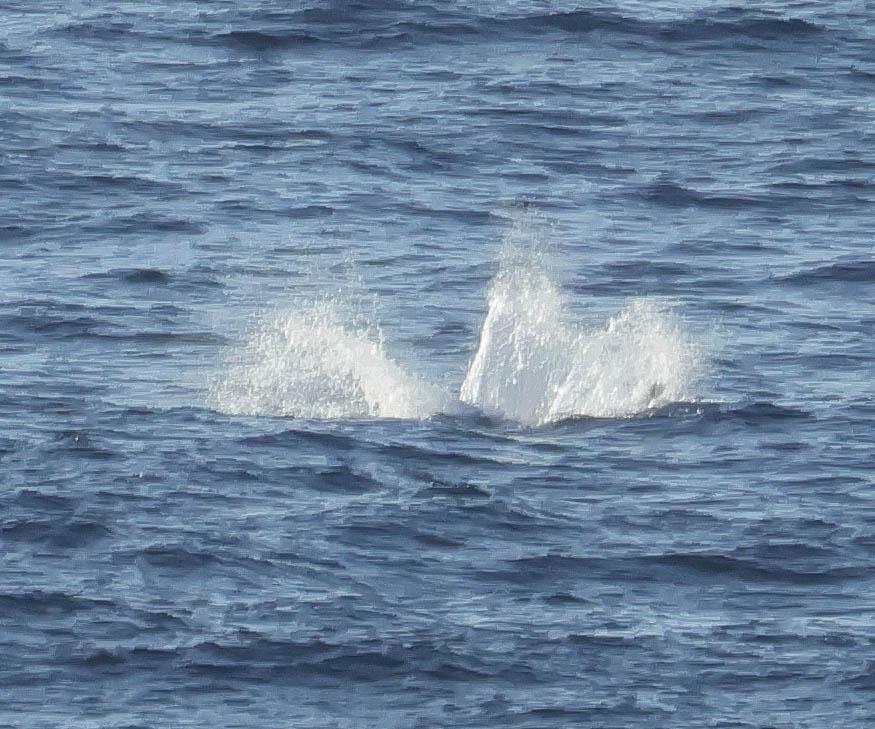
Around late-morning, I was surveying from the starboard side & chatting to Chris, who was another of our regular top deck passengers. Chris & I saw a distant splash several miles ahead of us & to the starboard side. We scanned the area for the next five minutes, but we didn't see it again or any blows. There wasn't anything we could do with the sighting and being a lone splash, I couldn't be sure if we had seen the splash of a Whale or a lone Tuna: I wrote it off as probably the latter option.

When I had lost all hope on the splash reoccurring, there was a shout from one of our regular passengers, Penny, of a Cetacean breaching on the port side about half a mile in front of the ship. I got onto it quickly. It looked too big to be a Dolphin and looked like a slim Beaked Whale. Beaked Whales are some of the most trickly Cetaceans to identify and good photos are often required to both identify the species and to convince others you have made the correct identification. I quickly lifted the camera and started to take photographs as it repeated breached, before it splashed down into the water. In total, I saw it beach five times, before it stopped. I lowered the camera to have another look with the bins, but I couldn't find it again.
Sowerby's Beaked Whale: Beaked Whales are often tricky to identify, however, the slim body and the long thin beak is unique & diagnostic among the North Atlantic Beaked Whales
Sowerby's Beaked Whale: Was this the cause of the splash that Chris & I had seen several minutes earlier. We will never know, but I like to think it was, given we hadn't seen any other Cetaceans or Tuna up to this individual
Sowerby's Beaked Whale: They can grow to about 5.5 metres long for males, with females being slightly smaller at 5 metres
Sowerby's Beaked Whale: The big splash
I joined the others who were on the port side having had a quick look at the photos. These confirmed my suspicions that it was my first Sowerby's Beaked Whale. I've seen similar photos of Sowerby's Beaked Whales breaching like that in the Bay of Biscay. But as they are an uncommon species in the Bay of Biscay, it was a species I never expected to see.
Sowerby's Beaked Whale: The start of the second set of breaches for the camera
Sowerby's Beaked Whale: Sowerby's Beaked Whale is the forty-fifth Cetacean species that I've seen. I have now seen over half of the extant eighty-nine Cetaceans: following the taxonomy in the excellent Marine Mammals of the World Edition II handbook
Sowerby's Beaked Whale: Another & a better splash
This was the third & final set of breaches, I managed to photograph.
Sowerby's Beaked Whale: Showing the flipper
Sowerby's Beaked Whale: The dorsal fin appears as well
Sowerby's Beaked Whale: It is thought these breaches might help to knock off parasites from their bodies
Sowerby's Beaked Whale: The final splash
A couple of hours later, we were on our final thirty minute survey, before heading off to lunch, when we saw a pod of Dolphins. They were quickly identified as eight Striped Dolphins. It had been a good morning for sightings.
Striped Dolphin: Showing the thin black line through the eye & onto the body which gives the Striped Dolphins their name
Striped Dolphin: The rear of the body of the same individual. The pale stripe going up towards the dorsal fin is another useful identification feature, along with the tall, narrow & falcate dorsal fin
Striped Dolphin: Then there was three individuals
Striped Dolphin: A fourth individual has just popped up
Striped Dolphin
Striped Dolphin: It's been over five years since I last saw these gorgeous Dolphins and it was great to see some more
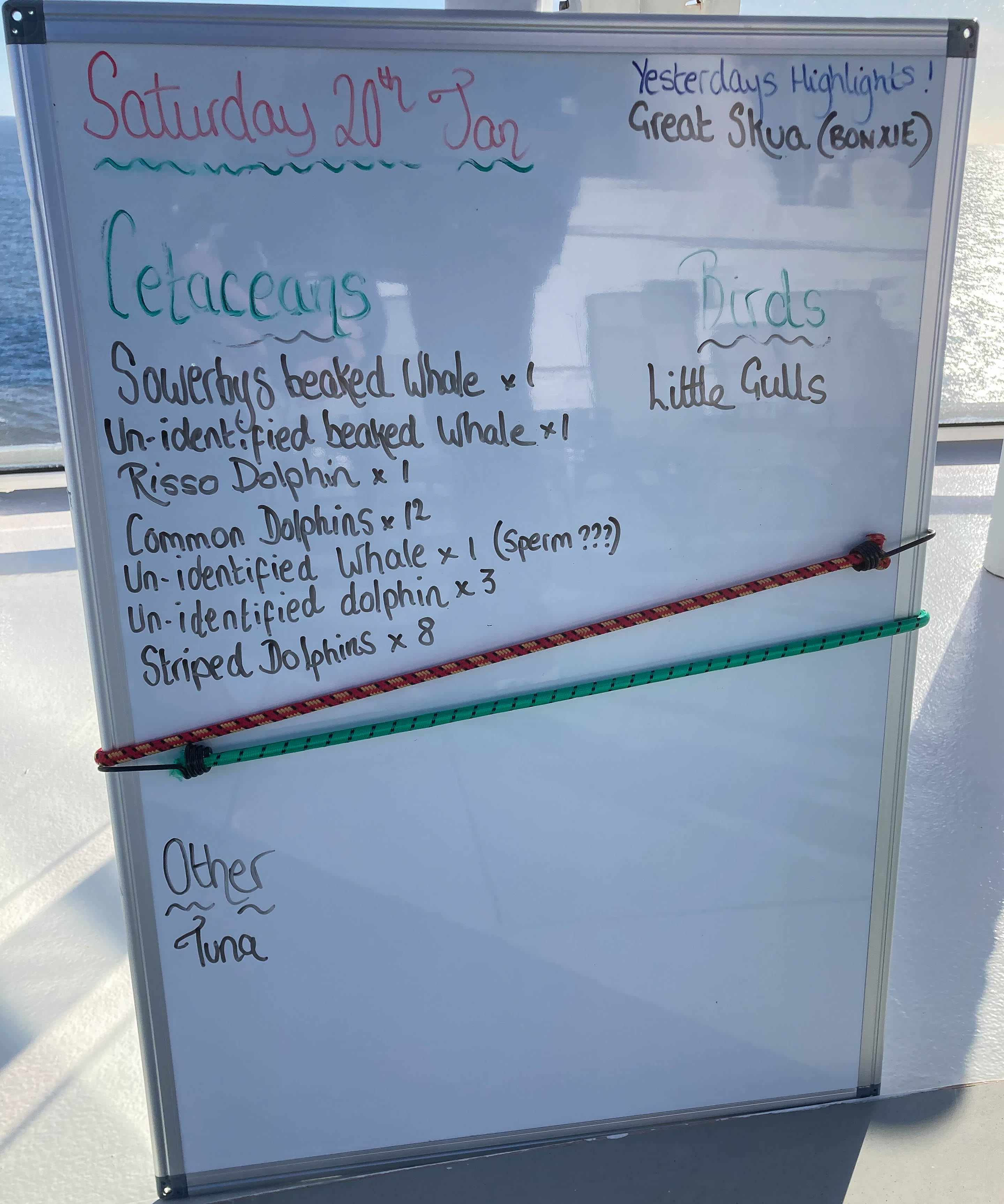
After a superb morning, the afternoon was quieter. However, by the end of the day, we had also seen brief views of another unidentified Beaked Whale, a pod of eleven Short-beaked Common Dolphins, another pod of six unidentified Dolphins and a lone Risso's Dolphin. The only Birds I saw during the day were two Kittiwakes & six Little Gulls.
Little Gull: Adult
The end of day noticeboard: Charlotte did an excellent job keeping the noticeboard up to date with sightings & it was always a popular spot for passengers to stop and read