Showing posts with label Spotted Sandpiper. Show all posts

31 Jan 2024

31 Jan 24 - ORCA Saga Caribbean Calypso Day 14 - Barbados: An Unusual Taxi Destination

We were on deck for dawn in the hope of a Cetacean sighting as we approached Barbados. But given it was one of the larger and more populated islands that we were visiting, I wasn't hopeful of any sightings. Sadly, I was correct. All I saw at sea was a couple of Magnificent Frigatebirds and a Red-footed Booby. Soon we were entering the port of Bridgetown.
The first view of the Bridgetown port: Clearly, it was a much bigger port and city compared to the small scale port and St George's in Grenada
I had only looked into the Birding options on the different new islands I was visited. Therefore, I hadn't looked into the size or populations on the islands. I had imagined Barbados to be a nice Caribbean island, but it was clearly a very different from the laid back look of Grenada that I had liked. Barbados is nearly one hundred and seventy square miles with a population of around two hundred and eighty thousand people. So, over twice the population on an island that is only twenty-five percent larger.
We clearly weren't the only tourists in town
These local boats weren't going back out to sea: Maybe the damage from a previous hurricane
As we came into the port, we saw our only Peregrine in the Caribbean section of the trip. We later went on to see a Peregrine in Spain in the final few days. It was time for a late breakfast & to prepare to go ashore.
There was a distant Peregrine on this tower by the port: No doubt, helping to control the island's Feral Pigeons numbers
Peregrine: This is the anatum subspecies which occurs from North America, excluding the tundra to the West Indies and North Mexico
Charlotte researching Barbados: Whilst waiting for husband Terry to come back from giving the Ship's Information Officer the daily ORCA slide
To be fair, there was quite a bit of information on the TV in the rooms about the destinations and various tours that the ship was running: Not that this was of much use to me. But I had sites off eBird for the potential Ticks
When I was looking at potential Ticks on the Lesser Antilles section of the trip, there were a handful of Caribbean endemic species that I hadn't seen. Additionally, there was one other potential Tick that I could see when we were ashore: Masked Duck. This has a widespread range in the Caribbean and Latin America, but, it is sparsely distributed throughout its range. I had looked unsuccessfully for it on previous trips. Looking at eBird, Masked Ducks have been recorded on most of the islands we were visiting, but it was described as uncommon on St Lucia, rare on Barbados & Martinique and a vagrant on the remaining islands. Interestingly, there were a few recent records at Bayfield Pond on Barbados within the last couple of weeks. This was clearly a site that was worth visiting, especially as it was only about fifteen miles from Bridgetown. There were taxis in the port, but they were overpriced and wouldn't barter on price. One of the port staff told me to try outside the port gate. I quickly found a taxi at a more sensible price. Being an ex-British colony, meant that there were no language problems.
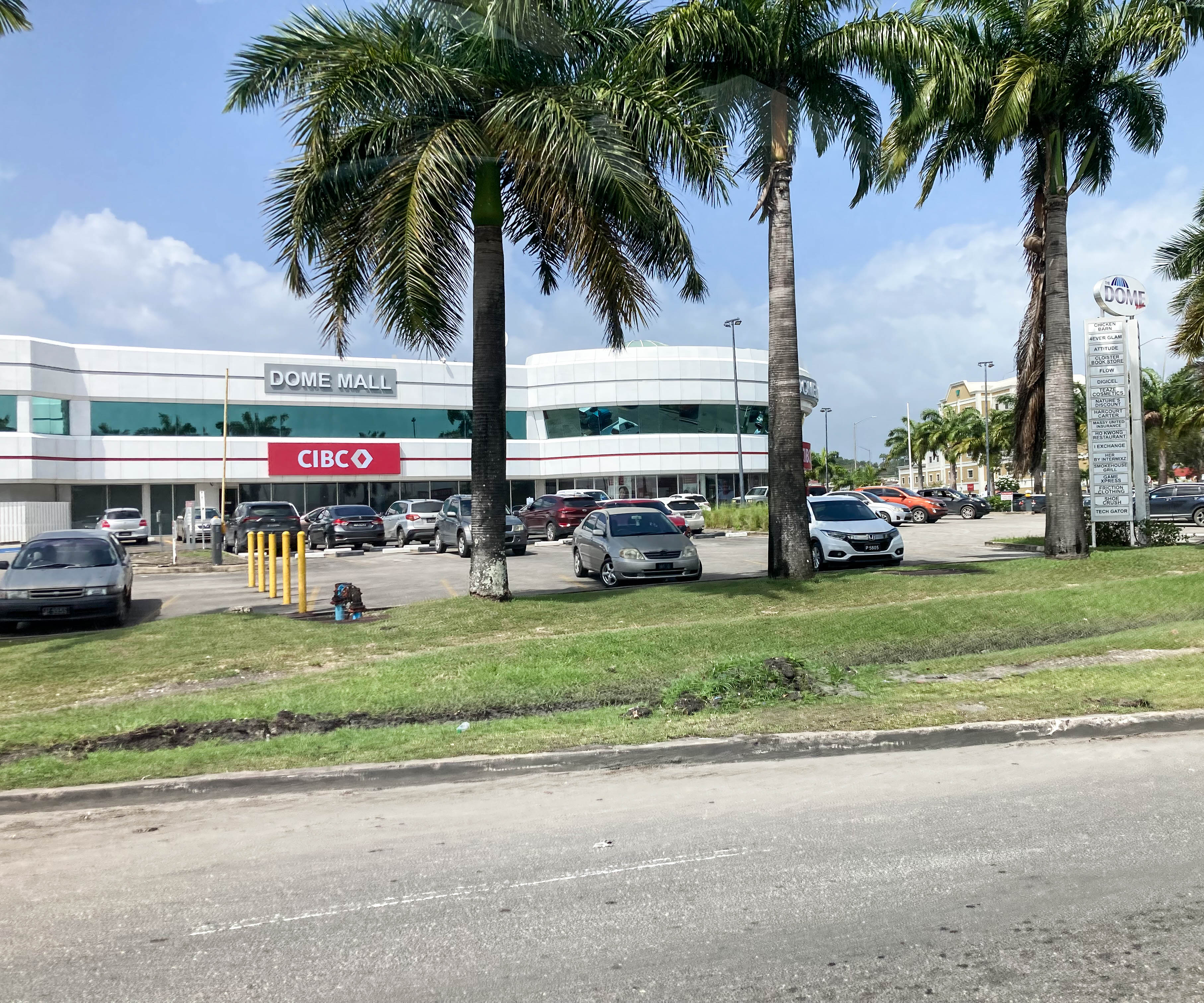
Some parts of Barbados looked very American
Barbados drives on the left being an ex-British colony
The further we got from Bridgetown, the housing and roads were looking more run down
Barbados sugar cane fields: When Barbados gained independence in 1966, its economy was dependent upon sugar production. There are still plenty of sugar cane fields. However, tourism & the offshore sector have helped the economy become a lot richer
A disused sugar cane estate windmill
Another local village
I figured that the five hours I had hired the taxi for should allow me more than enough time at Bayfield Pond and it would give me time to have stop somewhere to look for the widespread Barbados Bullfinch. As it turned out, I had brief views of my first Barbados Bullfinch in the port, but I quickly lost it. After about forty-five minutes of driving we arrived at Bayfield Pool.
Bayfield Pond: It's a small pond only thirty or forty metres across and surrounded by houses
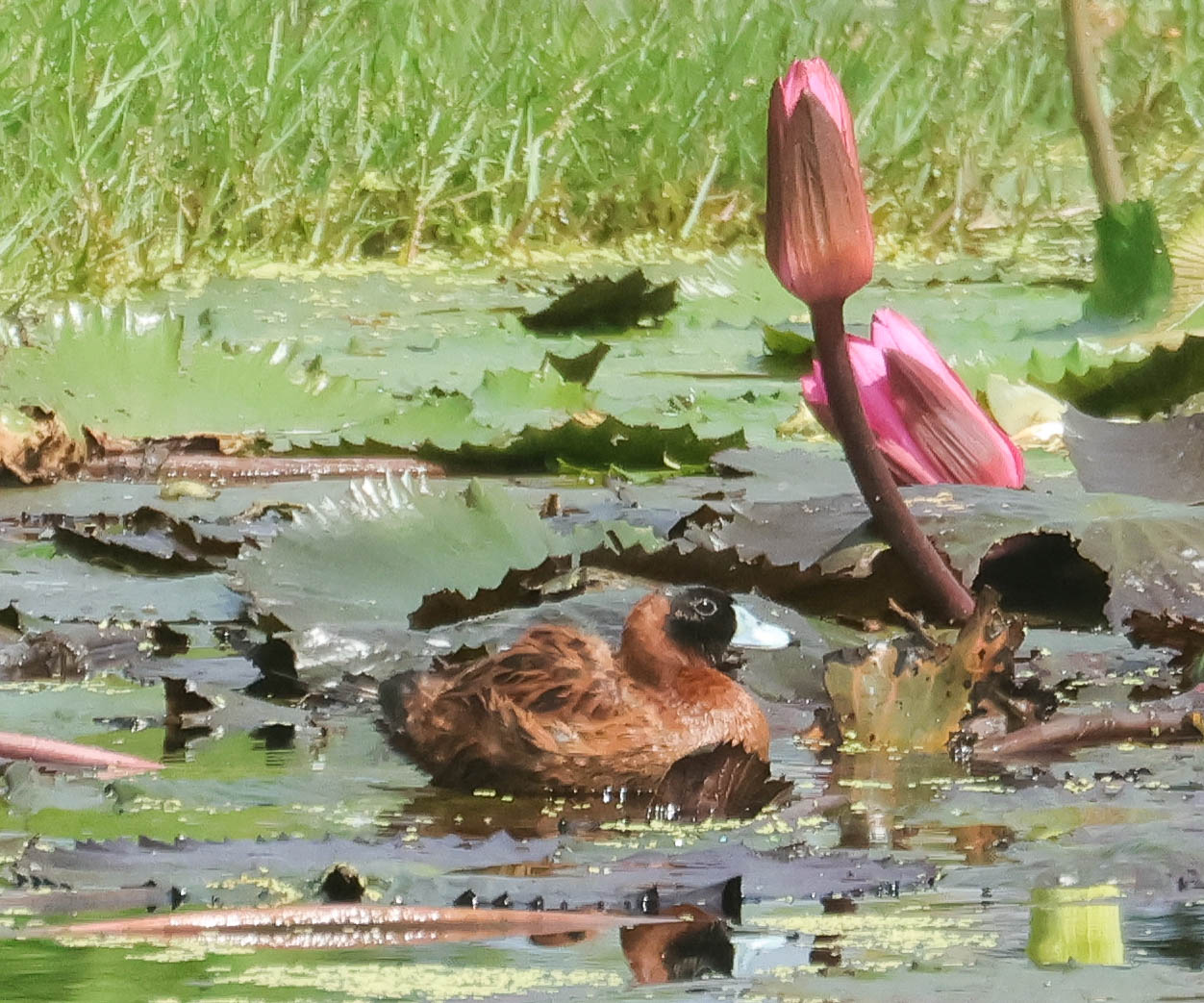
Masked Duck: Male. When I arrived there was no sign of the Masked Duck for the first thirty minutes. Then it just appeared. It must have been sleeping in the pool's vegetation up to that point
Masked Duck: Male. I had finally seen my last of the World's Stiff-tail Ducks
Masked Duck: Male. This monotypic species has a wide range from Texas, the West Indies, North Eastern Mexico South to West Ecuador and on the Eastern side of the Andes to Brazil & North Argentina
Masked Duck: Male. I moved around to the road side of the pond where I was a bit closer to the Masked Duck
There was an American Moorhen and a Spotted Sandpiper on the pool. With the pressure off, I spent a few minutes getting photos of both species, albeit neither were close.
American Moorhen: This species is generally called Common Gallinule, but American Moorhen seems a better name
American Moorhen: This is the barbadensis subspecies which is restricted to Barbados. There is another subspecies which occurs across the rest of the Lesser and Greater Antilles. Other subspecies occur throughout the New World from Canada to Argentina & Chile, as well as, on Hawaii
Spotted Sandpiper: This monotypic species breeds in North America and winters throughout Latin America, except for Argentina. A few turn up in the UK every year including the first Poole Harbour record which was seen for a few hours on 5 Nov 23 by the Studland Houseboats
I had seen a Scaly-naped Pigeon flying over, a few Eared Doves & a few Grey Kingbirds. There wasn't a lot else in the area, which was surrounded by wooden houses. Maybe there were a few additional species around the houses including some Barbados Bullfinches. However, the driver had suggested there it wasn't a great area to wander around, albeit the few people I saw were all very friendly. It was time to move on to a site where there had been a few recent Barbados Bullfinch sightings. I will cover that in the next Blog Post.

5 Nov 2023

5 Nov 23 - A Poole Harbour First - Schrodinger's Sandpiper: Spotted, But Not Spotted

It was promising to be a reasonable day at Studland & I headed for South Haven, in the hope of some arriving Wildfowl through the Poole Harbour mouth. There have been the occasional records of Whooper Swans or Grey Geese in and there are still only two records of Glossy Ibis for Studland. With only three or four flyby records of Egyptian Geese at Studland, a flock of pale buff Geese would still be a result. But there was little on the move.

Time for Plan B to have a look around the back of the South Haven Pool, walk the beach to Pilots Point in the hope of a Snow Bunting and have a look along the Heather Walk in the hope of a lingering rare Phylloscopus Warbler. Being an optimist is an essential quality for a Birder, albeit I'm generally more realistic than optimistic, in general life. I was checking the South Haven Pool, when Paul Morton rang to say there was a likely Spotted Sandpiper that had just been found by Mark Wright by the Tank Traps. The Tank Traps are on the other side of South Haven and just to the South of the Houseboats, which was on my list of places to check later in the morning.

About ten minutes later, I was carefully approached the Tank Traps through the trees so I could look over them from where I expected Mark to be looking from. But there was no sign of either the Spotted Sandpiper or Mark and his partner Debbie. There is a very limited view from the trees at the Tank Traps. I rang Paul back for more directions. He confirmed that Mark was still watching the Spotted Sandpiper, but he didn't have any directions. I guessed it was probably on the small beach at the base of Jerry's Point. I carefully walked in that direction, to ensure I didn't flush it if my hunch was correct. A couple of minutes later, I could see Mark, Debbie & the first of the local Birders on the beach at the base of the Jerry's Point track, but I still couldn't see the Spotted Sandpiper. I backtracked out to the road and walked to the beach, via the Jerry's Point track.
Spotted Sandpiper: It looks superficially like a Common Sandpiper, but the bright yellow-orange legs stand out compared to the greenish-brown-yellow of Common Sandpipers. Other features are 1st Winter Spotted Sandpipers have plain edged tertials compared to pale spots on the tertial edges on Common Sandpipers. Spotted Sandpipers have pale pink bills with a dark tip, whereas, Common Sandpipers usually have all dark bills. Also, Spotted Sandpipers have a more rounded body with a short tail, compared to a more attenuated shape and a long tail in Common Sandpipers. In flight, Spotted Sandpipers have a thinner and shorter central white wing stripe especially on the inner wing
Finally, I could see the Spotted Sandpiper which had been just out of view, from my previous viewpoint. It stayed till 12:30 with a party of Turnstones, four Dunlin & a Knot. It stayed in the area even when the other Waders flushed, until it was flushed by two selfish dog walkers who insisted on their right to boot it so they could wade past it, as the beach was still covered in water. They were asked not to, but then that would have needed the missing considerate genes in their DNA. The Spotted Sandpiper flew to Jerry's Point, where they flushed it again. We couldn't relocate it around Jerry's Point, Sandy Point or the Redhorn Quay area for the next hour and a half. But it finally returned to its preferred beach with the Turnstones, where it spent the rest of the afternoon.
Spotted Sandpiper: Adult Spotted Sandpipers are spotted in the breeding season. All ages are unspotted in the Winter and yet it was cleared spotted by all Birders who saw it on its one day visit to Studland. Clearly, a birding variation on Schrodinger's famous cat hypothesis which was also in two states at once
I hoped there would be the chance for some better photographs on the following day, as these photos were disappointing. But it disappeared overnight and hasn't been relocated locally since. This is the first Poole Harbour record and the tenth Dorset record.
Common Sandpiper: A Brownsea Common Sandpiper for comparison (2 Sep 17)